Human Population Decline and why birth rates are dropping with Jim Penman
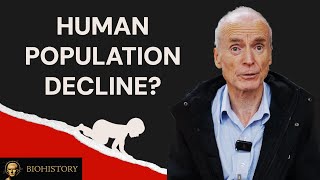
Jim Penman on why birth rates are collapsing in wealthy countries and what might reverse it. He argues that wealth, urbanization, and the loss of religion have killed parental motivation, and proposes using pheromones or drugs inspired by animal studies to make people want more children.
Questions this video answers
July 23, 2024
Approximately 2.1 children per woman
Israel
About 0.8 births per minute (speaker also references "0.7.8" phrasing)
Ten children
Chapters
Well, they're going down all over the world. All the OECD countries are well below replacement level, except for Israel, which is just slightly above. And that's largely because of the Muslims there and also because of the ultra orthodox. But it's a problem generally. Eastern Europe is particularly bad and the worst cases of all are in East Asia, Japan, China, now South Korea. South Korea is about 0.8 births per minute. It's about a third of what's necessary to replace population. So these countries are dying? Well, there's problems. I mean, overpopulation is one thing, but the problem, if you stop having children, eventually your society will die. Now, if that's something that you want to have happen, then I can't argue with that. But I think our societies, our civilizations are worth preserving. The other problem too is when you have a rapidly shrinking birth rate, you have more and more old people attempting to be supported by less and less working age people. And that's bad for. Well, it's bad for the economy, but it's also bad people who can't get care. For example, who's going to look after all the elderly when there's no more children, there's no more young people around. I think it's mainly a personality issue. It's a matter of behaviour. People have children because they want to have children, because they like children, because they enjoy children, and they don't have children because they'd rather do other things with their lives, which is understandable. You know, you can spend more, you can travel, you can buy better cars, better houses. The trouble you get is when you get so many people thinking that having children is a bad idea or you don't want too many or too late or whatever. It does create a sort of a social pressure. I know one of my daughters probably wouldn't mind getting married and having children. She's quite young, early twenties. But the social pressure, oh, you can't do that. It's just other people would look at you and think you were strange. So it does have an effect. But yet back in the 1950s and early 60s, for example, it was normal to have children. People just thought it was the right thing to do. And actually, if you read accounts of people at the time they did surveys of women, they said women who had children and were largely at home in those days felt sorry for women who didn't. They just thought they were missing out on something. Loss of religion. It's a cause, but it's really part of the same process. People are going away from, you know, Belief in family, belief in your nation, belief in principles to one where we just believe in pleasure and having fun and enjoying ourselves. And what makes me feel good now, no, it's not good for society, it's not good for individuals, it's not good for anything. We need to get back to a stage where we live for people other than ourselves and it's a lot more satisfaction than that. People say it's the reason, but I think it's a rationalization. It's like somebody says, oh look, I'm such a noble citizen of the world, I'm so concerned about it that I'll spend my money on flying overseas trips and buying an ultra expensive car and a giant house and all the existing rules in the world because I'm saving the planet by not having kids. Well, you're not saving the planet, you're just spending money in a different way, in a very selfish way, in my point of view. And enjoying yourself and thinking that you're virtuous. Well, technology creates wealth and what causes birth rates to drop is money is wealth and urbanization. And that's just not the case of the modern world. This was the case, say in the late Roman Republic when the birth rate was dropping. It's the case of, if you look at leaps throughout history of the Chinese college entry, you find very fertile. Peasant families become wealthy, become merchants, they succeed in the imperial exam, they move to the towns, the cities and the birth rates would just plummet and they just basically die out within a few generations. That was a typical thing. So it's not just the modern world, it's wealth urbanization as far as technology is concerned. Obviously what makes it possible these days is the pill and all the different things. But the fact is people don't want children. They'll work out how to get rid of them. In the ancient world, they used to used to abandon babies. They had too many. Obviously people can use abortion and so forth. If you really don't want children, you're not going to have them. I can remember back in the day we're talking about zero population growth, zpg, it was a big thing. Hey, we're threatened by overriding mass population growth. Like in China, the crazy policies, like the one child policy and in India they used to forcibly sterilize you had young men camping out in the field to fear of being grabbed and given false vasectomies. You did these draconian things which were never necessary because wealth and urbanisation always solves the problem. Well, governments are starting to try and do all kinds of things. But governments, basically what they do is they make subsidies, say for childcare. The problem with that is that people don't have children for economic reasons. Now I've got 10 children and I started having children when I was a lawn mowing contractor. My wife was a student, not working. I was deeply in debt, didn't have a house. Okay. I just wanted kids. And then with time, because I had a family, I suppose I just had to work hard enough to support it. And that was the attitude in the past. People these days know that they need to have savings, they need to have houses which are ridiculously expensive. And then children come maybe when they're in their 30s, which is often too late because they just can't have the children they want. Look, some people are happy with it. Some people want to see the end of a society. They think it's better if we all die out. I mean, I can't argue with that. That's their emotional point of view. I think more and more people are starting to panic. People are starting to worry now, I think just over the past few years, the collapse in birth rate in so many countries. And it's not just getting the Z population growth, it's going down way below it. In a lot of countries. It's basically about half the level. You need 2.1 children per woman to maintain population. Approximately that. Some people not have children. We're now down to a lot of countries, down to 1.2, 1.1. South Korea, like 0.7.8. So there is starting to be a sense of panic about this thing in certain quarters. And I believe with time this is not going to reverse, this is going to get worse, it's not going to improve. You're going to have birth rates splitting more and more and people will start to worry more and more. Yeah. Elon Musk is a spokesman for Natality and he's obviously given a good example there. If my research could get the funding from one billionaire or one national government, you probably solved the problem within five years. We're spending in the region probably two to three million dollars a year. Coming from my business, that's all into scientific baseline, scientific research into the beneficial effects of food restriction and how to bring them about. We just need one funding source and this problem is solved. I think it's part of the decline and general collapse of civilization. I think that's what's going on. As to preparing, what can you do? I don't think it's irreversible. And this is the point, I think we can do something about it because there's, there are, we've done a lot of studies on rats, for example. And one of the interesting things is we're looking at the effects of mild food restriction, which is the opposite to what's happening in society. So instead of having over plentiful food, you mildly restrict food. And what you find when you do that is the mothers become a lot better at mothering, they actually spend more time with their infants, they build their nests better, they gather them back into the nest, they behave very, very differently. And in social environments you actually find that, in multi male environments, you actually find that the infants have a higher survival rate because they're so much better looked after. Now what we want to do is to make available to people the treatments that can have the same effect on people, which will not only help people to want to have more children and enjoy having children, but will also help with things like drug addiction, alcoholism, obesity, a lot of other similar issues which are all based on short term thinking versus long term value. What actually is happening is we're trying to reverse engineer the effects of food restriction. We know if we food restrict animals, they behave in ways that are good for the species. I suppose you might say they look after their young better, they're more interested in their young, they're more exploratory. They actually, in a sense, in human terms, they're more hard working, they're more innovative, they're better at problem solving. There's many beneficial aspects. So we can't get people to restrict their eating. That's not possible. So what we're trying to do is have some effect. Now there's various ways of doing it. One of the effects we're looking at is pheromones. Food restricted animals actually give out a smell. And if you expose rats to the smell, to the bedding, food restricted rats, they tend to act as if they're food restricted to some extent. So we're looking at pheromones that can influence behavior and that's known to be an effect. We're looking at potential drugs that can do it. We're about to launch a project where we're actually mass screening 100,000 different drugs looking for epigenetic effects associated with food restriction. So we just got masses and masses of different treatments. Some of these new weight loss treatments like WeGovy could actually potentially have this effect. And down the track a bit, we are looking at CRISPR as a possibility. Now CRISPR is a way these changes the effects of food Restrictions are basically epigenetic. They don't change the genes, but they change the way the genes function. In effect, if you consider DNA as a sort of a series of little taps spitting out proteins, what epigenetic does is turns the taps on or turns them off. So we have a fairly good idea now of what the epigenetics of food restriction looks like. And so down the track a bit, it should be possible to get a target to go into that particular gene and say, turn it off, turn this one on and actually change behavior in a fundamental way. And I stress this is something that people would choose to do because there will be multiple benefits in terms of well being, treatment of even things like mental illness. There's lots and lots of benefits to this kind of food restriction idea. It's good for mind, it's good for body. The message I give is that children are fun. They're really joyful. They're one of the most meaningful joy giving experiences you will ever have in life. The sense of purpose in what you do with yourself. I think one problem is people have the wrong idea of what being a parent is about. They think to be a parent you've got to actually spend all your time and money and effort and costing them and ferrying them to place after place and watching them. The helicopter parenting thing. There's a lot of studies now that suggest that's actually very bad parenting. But one of the best things you can do for your kids is to let them go out and play with each other in groups. They actually learn more than they do from endless classes. In other words, children need some care and discipline from you, but they don't need you to be there every second of their lives. They're actually better off if you can just back off, let children play. There's wonderful books like the Anxious Generation by Jonathan Haidt, which has just come out, which talks about the problems with modern parenting. Parents are trying so hard to do so much that they're making their children weak. At the same time, they're putting a huge burden, they're taking the joy out of being a parent. There's a wonderful book called Selfish Reasons to have More Kids Too, which I really enjoy. And the thing about it too is that children need space, they need time, they need to be able to play freely, but they also need limits from parents. And if we act in a way that children are basically, you know, they more or less do what they're told and you have certain firm limits, it's a lot more enjoyable than if you live your life as a slave to these spoiled brats, which is what people are reading these days. So it's good to have children, but bring them up in the right way. Best for them, best for you. People can go to my website, jimpennman.com au and I have a newsletter that I'm very happy to share.
More from Jim


Rising mental illness and falling birth rates have the same cause, it is this.....








