Jay Westbury interviews Jim Penman, CEO and founder of Jim's Group
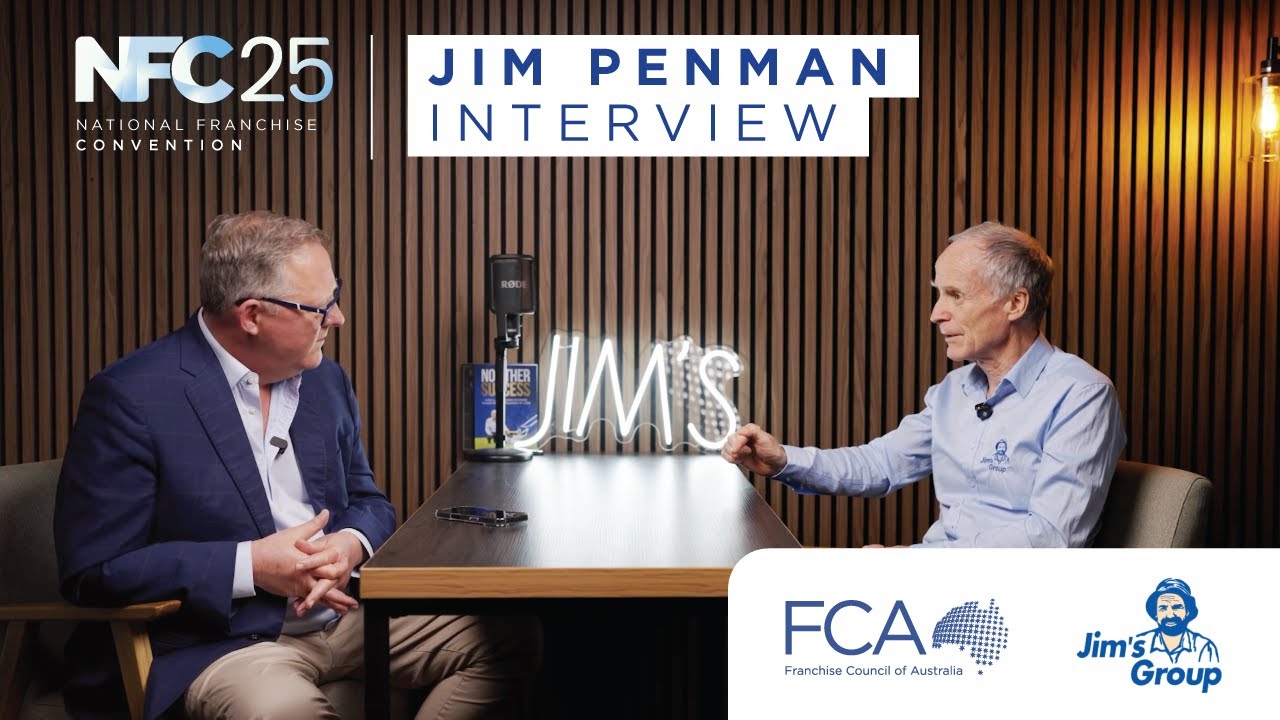
In this interview at the National Franchising Convention in Melbourne, Jay Westbury talks with Jim Penman, founder and CEO of Jim's Group, about the origins, principles, and future of his franchising empire. Penman explains that the decision to franchise was driven by fear of competition, not a grand strategic plan. He emphasizes that franchisee welfare is the core of Jim's Group’s model, detailing contractual rights such as first‑refusal on jobs, freedom to work across territories, automatic renewal, and the ability to move between divisions or vote out a franchisor. Penman critiques the broader franchising industry, calling many systems “appalling” and describing the current franchising code and disclosure documents as ineffective, legal‑heavy, and a tool for bad actors. He advocates for industry self‑regulation through independent, confidential franchisee polling, which Jim’s already does via its Diamond Awards and a proprietary rating system. Penman argues that government and the Franchising Code of Conduct (FCA) have failed to protect franchisees and should instead support accreditation based on franchisee feedback rather than contract checks. He discusses the heavy regulatory burden in Australia, its impact on entrepreneurship, and the need to lower barriers to entry. Expansion at Jim’s Group is largely franchisee‑led: ideas are sourced from high‑performing franchisees, evaluated on profitability (e.g., $70 hour average), volume potential, and non‑conflict with existing divisions. The group uses a centralized lead‑distribution system that prioritises territory holders, then regional, then division‑wide franchisees. Penman also mentions multi‑unit franchisee growth (MUMBO), the Pay‑for‑Work Guarantee that helps franchisees generate cash flow, and his broader concerns about industrial‑relations policies that make hiring older workers costly. Throughout, Penman’s tone is candid, passionate, and often critical of regulatory bodies, while remaining optimistic about the potential of a franchisee‑centric model.
Chapters
So welcome to the National Franchising Convention here in Melbourne, and I'm delighted to be sitting down and having a conversation with Jim Penman, the founder of the Jim's Group. I've got a few questions here, Jim, but I thought we might just have a bit of a conversation if that's okay.
Yeah, sure.
I guess, I mean, I look at the audience that's sitting here with us today at this convention, and I'm sure there's 400-odd people here. If they all got to ask you a question, there'd be a range of things people would want to know. You've written a few books, so as long as they're So you hold things close to your chest. What prompted you to take a successful lawn mowing business and franchise?
Fear, basically.
Fear?
Because what happened is I had a business that was building up and selling lawn mowing rounds and then VIP came from Adelaide as a franchise and I thought they'd crush me if I didn't franchise, basically in self-defence.
Is that right?
Nothing glorified about it.
And so no massive big strategic plan, that was just— Fear.
Yeah, I had a good little business and I thought they would eat my lunch if I if I didn't do something. So I set out to learn what I could from what they were doing and said, "Okay, let me devise my own system," and took it from there.
And here you are. Wow! And and so you know what do you think? What do you think really has been the most biggest factor in the success of the Jim's Group? I mean, you've gone into so many different lines and different areas. What do you think's been the sort of secret?
We we have a number one principle: is our first priority is the welfare of franchisees. So everything we we do looks at it in terms of what will make a franchisee successful. So in the original contract, we put a whole lot of clauses in. For example, we gave franchisees rights to first refusal to any job coming from their territory, but allow them to work wherever they wish. They can build their business to any extent they wish. They own their clients. They can sell the rights to them. They can't have it taken off them. They've got an automatic right of renewal. And later on, we put clauses in like you can move to a different franchisor or even a different division if you wish. You can vote out your franchisor. You can veto You can't make changes to your own manual. We put all these systems in place to see what can we do to make the franchise maximally attractive to franchisees. That is the one key principle.
That's the secret sauce.
Yeah. And you keep on trying to do better.
Right. And so do you think, I mean, you've obviously been in franchising for a very long time. Do you see others copying you in that formula or do you have particular views on the way some of the franchise systems are operating?
I think there's some appalling systems around. It makes me quite angry the way franchisees are ripped off by some franchisors. I don't want to name names in particular, but you'd know about them.
Sure, sure. No, no, they're well publicized, some of those stories.
I'm sure there are many decent franchise— one I know is McDonald's, for example. They're a great franchisor. I'm very proud to say my 16-year-old son's working for McDonald's. Great training as well. So I have enormous respect for them, not for the food, But for the assistance of business and as franchisors, they are great. So there's some very good franchisors around who genuinely care about their franchisees. And there are some that don't.
Right. And do you think, do you think that's something that the industry should lean in on a bit more?
Yes, I think the industry should self-regulate. Look, what we do every year is we poll our franchisees confidentially and we ask them questions about the support they're getting. How often does their franchisor ring them? How helpful are they? How quickly did they get back to them? And that's put into a score, a rating.
Right.
And we then put that amassed with the by each franchisor, and we publish that. Right. And we give them awards based on how well they do. So if you came in today, you'd have seen a sign on the wall. It's called the Diamond Wall.
Right.
And that's franchisors who, according to their own franchisees, say ring me weekly, get back to me straight away. I take the call and are very helpful. You have to have virtually all of them say that. To be a diamond, that's the top award in Jim's group. Now, what I think we should be doing—the franchising industry should be doing—and I said this to the government too—the we should do the same thing across the entire industry. We should have an independent pollster contact every franchisee in every franchise group, group, yep, anonymously, confidentially poll them and publish the results online. And if we did that. That would do more for ethics of franchising than 100 disclosure documents, which is basically garbage.
Yeah. And do you think that your colleagues in the franchising sector would be up for that? I mean, have you had conversations about that with many?
No. I've approached a few people without much success. It's really something the government ought to do if the FCA would get behind it. Look, the problem I've had with the FCA is I haven't had much of an involvement And my issue is that the FCA has no standards. Now, if the FCA got together and said, okay, we are going to do something like this, public polling, revelation, what do franchisees think about their franchisors? If the FCA was gonna do that, I would be 100% in favour and I'd get involved. Right. At the moment, I don't like when you accept everybody simply because they pay fees.
Right. And of course, as you know, we've talked about this before, we've proposed to the government a co-regulatory model.
Yes.
And some of the things you're talking about are forming part of the thinking that's going on. And you'd said to me before that that's something you'd be in favor of.
Yes.
Mainly to get the government out of the way or to put things that are fit for purpose in place?
Well, because I want to see franchisees protected. The problem with the disclosure document is this. I have asked my franchisees, I have never yet anybody who's ever read the disclosure document. In fact, you need a fairly experienced franchising lawyer to understand it. So if you were a crooked, Mercenary rip-off franchisor, you're going to love it because what you do is you hide the crucial stuff in there, knowing they'll never read it and say, "Yes, we told you. We've got an excuse to do what we like." Right. That is the garbage. The disclosure document is completely useless. The only useful thing about the whole thing is the requirement to give a list of all current franchisees with their contact number, which we at Jim's has done for 36 years.
Right.
That is a good system. The rest is absolute rubbish. It doesn't help ethical franchising at all. What the FCA should do is get behind a system of asking franchisees directly. Because whenever I talk to prospective franchisees, I say one thing: you want to buy a franchise, do one thing— get hold of that list, ring as many franchisees as you can and ask them what it's like. Don't listen to what you're told by the franchisor. Ask the franchisees.
Right.
And if they come back to you and say, yes, ethical, look after me, do what they say, keep their promises, right on. Now, whether it's Jim's or somebody else, that's what you do. If they come back and say, no, broke promises, ripped me off, made me buy stuff twice as expensive if I can get them from Coles, that kind of stuff, then don't go near it. But the government should get behind it. The government should protect people against people making very rash and foolish decisions.
I guess the, I mean, one of the challenges with the way that whole thing's structured around this code of conduct is it's all very red tape orientated and theoretical. It's no practical notion to it. I mean, the ACCC is casting fines of $16,500 to franchisors 'cause they haven't filled out a website that no one uses.
Yes.
I mean, you've obviously seen this code go from, you were obviously around when it was first introduced. Do you think it's served its time? Do you think it's done its job, or do you think it's a shocker?
I don't think it's achieved anything. It's a feeding frenzy for lawyers. I've yet to meet any prospective franchisee, and we take on about 1,000 a year, who's ever been helped by anything in the code except that list of franchisees. There's nothing in it. It's so arbitrary and bureaucratic and impossible to understand. If you were going to get franchisees to have their contracts checked out, why get the franchisees to pay for it by going to a lawyer who doesn't know anything about franchising anyway for the most part?
Right.
And doesn't even read the contracts most of the time. Why don't you, if you want to protect it, why don't you get the franchisors to put their franchise documents into an experienced, qualified franchising lawyer who then gives an opinion to every franchisee which they don't have to pay for?
Right. And what approach— I mean, with that many coming on, how are you approaching that and still complying with the requirements?
Oh, we do. Look, one of the things I suppose you'd say is that it's actually a benefit to establish systems like ours because we have internal documents. I've got an in-house lawyer. We've got all kinds of resources to do this. So when we do a disclosure document, it's all part of a template.
Right.
Now, which is why we only charge $700 for a contract, whereas other people would have to charge several thousand dollars simply because the requirements are so extreme, because we do so many of them. So in a sense, it is one way of protecting the big players in the industry against upstarts, but that's not a healthy thing in itself. I mean, you shouldn't be, you shouldn't be trying to squelch competition and keep the new people out. You should be encouraging new forces to arise. So I think anything that protects the incumbents and hurts the newcomers is a bad thing. It's anti-competitive. The government in so many ways is acting against the interests of franchisees and against the interests of the industry.
Yeah, right. And I think, well, I think that's very relevant in terms of the way people come to these expos that are on. And I've been talking to many talking about, oh, I've got this great idea and I want to franchise it. And by the time they leave the expo, they've changed their mind because they've decided that the barriers to entry Are too heavy. Yes. Do you think? Do you think there'd be more entrepreneurship if we got that out of the way? Yes. Yeah.
We're becoming an increasingly bureaucratic country. We've got more and more regulations at every stage. Franchising is really, really bad. Other areas like building, like like like suppliers, like all kinds of things. There's more and more rules and regulations, and the more rules and regulations you have, look, there are sensible things governments have to do. Like for example, guard public health and sanitation and so forth, and food safety. I mean, there's great. stuff government do. But the immense weight of, ever-growing weight of rules that come on. And the people who make these rules are convinced there's no cost to them. But there is a cost. And guess who pays? It's the end consumer.
Of course.
Or the franchisee or the public who has to pay more than they should for the service. They're the ones that actually end up paying for it. It's crippling our standard of living. And franchising is just one area where it's gone completely wild. There is no sense of the cost. There's no sense of the efficacy of anything that's been done.
It's just say, we think it's a good idea.
idea, let's put another regulation and another and another and another and another.
That's true. I mean, the code's been through 11 reviews. It's layer upon layer. You know, I called it the other day, I called it the croissant of franchising because it is layer upon layer. So if a young entrepreneur came up to you and said, I've got this really great idea and I'm thinking of franchising it, I'd say do it through Jim's. Great answer.
Which is what happens.
Yeah, right.
We have a very good We have a very good track record of exactly that. You've got a great idea or you're running a great business, come to us and we'll help you franchise it. And some people do come to us.
Is that how you've expanded into all these very— I looked at your Diamond Awards and I mean, there's pretty much nothing in the services space you don't have now, it seems like.
Well, we could do with more. There's a lot of things we'd love to do that we don't currently have. We'd love to do personal training, for example. That's a wonderful one we'd love to have. It's a great niche.
Everybody in the room has just shuddered at you saying that because obviously that's a space that is really expanding.
Yeah.
But good on you. But, and so that, is that how some of these various lines or what divisions that you might call them have come about? Someone's approached you?
Yeah.
And said, I, I'm good on this bit. And you've said—
In virtually every case, like last year, for example, one of our mowing franchisees in South Australia, Lance Azzopardi, came up with that. He said, I'd like to do Jim's driving school. Now Lance is a great franchisee. He's got a 5.0 perfect customer service record. He's making a very good income, which is important. And he's also somebody who's training and helping local people. So he's got a good attitude towards it. Right on. Right. So now he's booming with driving school.
Is that right? And is that just— did you say in South Australia?
No, no, it's all over the country.
Is that right? Wow. Jim's Driving School. Right. And obviously there'd be company secretaries to talk about what's next. But, but people— you're open to people approaching you about ideas?
Yeah, they do all the time. I probably get a new inquiry once a week. Just yesterday, somebody inquired me about Jim's Shipping. I did some inquiries about it and I said, no, it probably wouldn't suit us because this kind of market it is, it's too big.
Right.
It's more suited to established companies. We do Jim's Couriers, for example. That's more like our level. It's more, we're more on the domestic brand.
Yeah. Right, right, right. And, and, and has there been, you know, a strategy to that or, or it's, it really a good idea comes your way and you think, I'll get on it?
Okay. We look at a number of things. First of all, we have to look at a franchisee being able to make at least $70 an hour. I'm talking about an average franchisee, $70 an hour. We need to see something doesn't conflict with a current division. Like we couldn't do Jim's Gardening 'cause that's included in mowing. We, and we have to look at a volume business.
Right.
There's no good having 5 franchisees 'cause it doesn't pay. Our fees are only about 6% of turnover. So we need to make it something viable. You need to have at least 20, 25 franchisees.
Right.
So we look at volume. You go, actually go into Google and you see how many, how many sponsored ads are there. That's a good sign.
Right.
If there's a lot of sponsored ads, that's a good business, good size. Now, given all that's right, then we look at the person running it. What's their business background? Do they know this industry? What other businesses have they run? What are they like? If they're a successful franchisee from Jim's, that's already an advantage. Like, for example, one of our cleaning franchisors, Bill Komenoglu, came up to me with the idea of Jim's Laundry. Now, Bill's a great guy. He's a franchisor within cleaning already, very successful. Started Jim's Laundry. In 3 years, we had 120 franchisees and still growing.
In laundry?
In laundry, yeah. Very successful.
But, and he's, so he's actually diversified himself?
Yes. He's now a franchisor in more than one division, which is not that uncommon. A lot of franchisees who get successful in one division, like mowing for example, they might have, you know, half a dozen workers in mowing, then they buy the cleaning franchise and they put people in cleaning as well, and then they have handymen, so they have multiple franchises.
Right.
We've worked with at least 20 franchisees that I know of are turning over more than $1 million a year, and it's growing all the time.
Across different silos or?
Yeah, mostly it's in divisions like mowing and cleaning and those kinds of ones where it's easy to put regular workers on.
Right, right, right. And they obviously can get up amongst it. I mean, one of the terms that was introduced to me in the US last year is this term of MUMBO, multi-unit, multi-business owner. So you obviously would encourage that within the Jim's Group though.
We do. They're not normally, you don't normally have more than one within the division. Because there's no limit to the size. You can have a single franchise in, say, mowing and turn over $2 million a year. That's quite possible and allowable. You don't normally need multiple franchises unless you wanna go different states, for example.
Right, right, right.
But so you're more likely to go mowing and have a lot of people there and then different divisions. So then you get different ranges of clients. In most of our divisions, we've got surplus work. We had more than 200,000 unserviced leads in the last year. So it's easy to look at it and somebody could say, hey, there's all these unserviced handyman jobs in my area, so I'm gonna, buy a handyman franchise and put people onto work on that one.
And are you, is that something that you are doing? You, you are fishing out the leads, you, you, the leads come in through the website or wherever and then you dish 'em out, or is there a system for that?
Yeah, that's right. There's a system actually. It's a, it's a matter of priority. When a lead comes in, you look, is there a territory holder? They get it. If not them, any from the same region, then anybody from the same division, then anybody from any other division.
Right. Wow. Okay. And I guess that's an important part for the franchisee to know that those leads, 'cause you're, you are not in competition with them. Obviously. And that's the big difference here. And often that's the case with some franchise groups. There's company-owned and operated stores or whatever it might be, and then there's franchise. And it happens a lot in the travel space, which is the space I'm from, where there used to be these competing interests. But that's clearly something you've—
We don't own any franchises ourselves. It's not part of our way of doing things. We want franchisees.
Yeah, right. What do you think the number one thing that you'd like to see? I mean, we talked about industry regulation, but is there something else that you think we could we do in franchising to really get franchising back from where it is now?
I just think you need a better standard of franchisors. There's some really bad eggs in the industry and they should be outed and they should be destroyed.
You think they should be vetted more? The franchisor should be vetted more?
Yes. And I think we should ask the franchisees. Look, you see things, what's the best franchise system, but they don't do anything. They don't ask the people that really count, is the franchisees. The real test of any franchise system is what do the franchisees think about it? It's not the bottom line, it's not the profit, it's not the public perception, it's not the lawyers, it's not the government, it's the franchisees. They're the ones that really matter. If you ask what they want and how they're being looked after and you publicize that, that's the one thing that we should do. The government should do it, the FCA should do it.
Right.
And if you guys want to get onto that, I will support you 100% and we'll be the first in line to put all of our information through. And I'll tell you something, If we don't get a good response from that, well, that's our responsibility and our fault.
Right.
And I'm quite prepared to wear that. And then we have to work harder as we do to make sure people are looked after.
Right, right. No, I hear you loud and clear on it. And in fact, it forms a big part of the suggestion that we've made to government about bringing in the word accreditation. It's not licensing, it's accreditation, which runs to the concept that you are talking about.
But as long as you do it in the right way, accreditation can't be about checking contracts. Like our contracts are spectacularly fair and balanced. There's no doubt about it. But what matters far more is how we operate those contracts. Do we do what we say? Are they effective in helping people to work? If you give somebody a guarantee of some kind, how meaningful is it?
Right.
We have a system called Pay for Work Guarantee where they can go out and do free services. Now, we show them how to do it, we teach them how to do it, we encourage them to do it. You can have it in the contract, but if you don't actually make it work, it's meaningless. But it does work actually most of the time. Some franchisees won't do it or they can't do it very well. But the great majority of time, if they don't have enough work, They go do freebies, we pay them, we encourage them, we train them, and then they build their cash business that way. So it's not just what you say, it's how you operate that matters.
Yes. And I think again, going back to that expo that I was at recently, you know, a lot of people were shopping around for a franchise as an alternative to finding a job.
Yes.
Because for that reason, you know, they, they want to get into their own business.
It's harder and harder. And people who are, say, a bit older, for example, often have trouble getting employment these days. And it's going to get worse because as the government becomes more and more restrictive, look, you can have as much unemployment as you want. All you've got to do is to make it impossible to fire people and then they won't hire. That is, that's what they do in Italy, for example. They've got sky-high unemployment because the government says once you've employed them effectively, you can't get rid of them ever.
Right.
And that's just an invitation to say don't hire anybody. You know, there's actually a government penalty against employing older workers. They actually penalise you. You know that?
Go on.
The penalty is this. If you let a person go, if they're over the age of, I think, 50, You've gotta give them 2 weeks' notice instead of 1.
That's true.
So they say, okay, we want you to only employ young people. We're gonna penalise you, make it more difficult and expensive to employ older ones. Why does the government have a policy against employing older people? They don't understand the incentives on business are such that if you make it expensive and difficult to deal with people, with employees, you're not gonna employ as many.
True. I mean, we are in a sort of a new golden age industrial relations reform with this Labor government that we have. And it's very evident by the fact that they've now put into law the right for penalty rates. There's obviously a big discussion going on down here in Victoria around this work from home. I'm not quite sure how a person who runs a lawnmower can work from home.
I know we have the same issue here though. I mean, look, we find that it depends on the division actually. When you're talking about people in the call centre, for example, working from home, very, very well. Some of them prefer to come to the office, some like to work from home, some of them want to do a mix. So we're fine with that. Other kinds of jobs, apart from home, apart from the office, some jobs really require you to be here. Now, the thing that annoys me about this particular thing is that it should be up to the employer to decide.
Right.
And what I find really appalling is you get some government minister, particularly Labor Party, who has never in their life ever run a business of any kind, Right. All they've ever done is work for the government. And they say, listen, we are so much more superior than you that we can tell you, business owner, how to operate your business most effectively. We know better than you. You're the one sitting there running the business, but we are so incredibly more intelligent than you that we can tell you how to run your business better and more effectively. And they say this is good for you when it's garbage. They have no idea what they're doing.
Yeah. No, and I love the passion and I feel it and breathe it every day that I'm down in Canberra. There's a lot of aggro going on at the moment around the way in which industrial relations are being dealt with. But it is what it is. The Australian people voted them in and they've got their policies and I suppose we'll just have to roll with it. Look, I really want to thank you for your time today. It's been really great to have a little chat with you here. I'm sure everyone that's at the conference is going to really relish the moment. And we just want to say a big thank you to Jim for giving us the time. and for all that you've done and you're doing for franchising. So thank you very much.
Good to talk to you.
Good on you. Thanks.
More from Jim


Rising mental illness and falling birth rates have the same cause, it is this.....








