Jim Penman: Business, Politics, and the Future of Small Enterprise in Australia
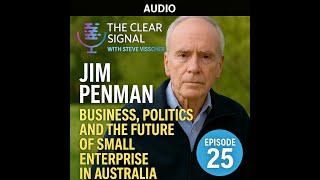
In this interview on The Clear Signal, Jim Penman, founder of the Jim’s franchise group, discusses the origins and evolution of his franchising model, emphasizing his deliberately franchise‑friendly contracts and rigorous franchisee selection to protect franchisee welfare. He explains how his focus on service quality, mental‑health support, and ongoing mentorship has driven growth, even during economic downturns and the COVID‑19 pandemic. Penman critiques Australian regulatory and political environments, condemning restrictive franchising codes, excessive zoning and housing policies, and the Victorian lockdowns, while advocating for YIMBY housing reforms and a more market‑friendly approach. He also shares his leadership philosophy, the role of honesty and personal connection with franchisees, and his views on social media, political parties, and the potential for entrepreneurs to become millionaires through low‑cost franchise entry. The conversation blends practical franchise insights, personal anecdotes, and broader commentary on Australian business policy.
Chapters
The Clear Signal with Steve Vischer.
Well, hi there. Welcome back to The Clear Signal. Great to have you back with us this week as we have what I hope will be another really engaging and interesting chat with this week, actually a leader of Australian business and probably someone who I guess I'll probably ask him this one. I'll have to see what he thinks about it, but he probably is humble enough that he probably doesn't like to be seen that way. I'm not really sure. We'll certainly see. If you live here in Australia, of course, you know, you might be familiar with the Jim's brand. I don't see how you couldn't be. We see Jim's Mowing, Jim's Dog Wash, Jim's everything else. There's so many different parts of that franchise business that's around, and it really is an Australian business success story. So I really have for a long time wanted to speak to Jim Penman and just see what it is that makes him tick and really see what he thinks about the business environment these days. He's been very outspoken on politics and many other issues as well. He's certainly a man who's very passionate about what he does, and it certainly has paid dividends. There's been a lot of success, and as I say, there's been so many Jim's franchises around the place over all these years. He must be doing something right, so perhaps we can all learn from that. It's a really great privilege to have him with us. He joins us on the line now. Jim Penman, welcome to the show. It's great to meet you.
Yeah, good to be here.
Now, Jim, Jim's group, it started in 1989 and it's really been a success story, I think primarily in franchising, if nothing else. I wonder when you started into the franchising model here, I would've thought, probably thinking back to that time, that it was probably mostly the domain of fast food restaurants and the like, but going into something like mowing franchises and home services seemed to me to be a really departure from the norm at that time. That must've been a big decision to take.
Well, I wasn't the pioneer. A company called VIP was already doing it. Um, but they had 250 franchisees when I signed my first one. They started in Adelaide. They come across to Melbourne and to a large extent, they inspired me. Um, I said, if they can do it, maybe I can do it. But also, I mean, slightly in self-defense, I, I had a little business that was building up and selling lawn mowing rounds. And I thought these franchising would kill me. So I, I, yeah, I just, I raided their, their, their stand at the expo in 1988 and found out what they were doing and decided to try and, and see if I could, see if I could compete with them.
That's interesting. I remember interviewing Dick Smith many years ago and he, he was quite open about the fact that he, when he set up his very successful business, then he was quite open about the idea that he didn't really try anything new. He just looked at what was working for other businesses and decided he'd go down the same path and it certainly paid dividends for him too.
Yeah, I didn't like what they did actually. I could see the point to it, but there were certain aspects of their system that I didn't approve of. I had a look at their contract. I got a copy and I thought, this is too unfair. I don't think this is a fair thing for a franchisee to sign. So I actually had my contract written completely from scratch, much more favorable to franchisees. I gave them all kinds of rights, like they could walk away in the beginning without paying anything if they wanted to go independent. They had an absolute right of refusal from any jobs to their territory. We were actually forbidden by contract for taking any leads off them without their consent. They had the automatic right of renewal. There's a whole stack of stuff in there. They could grow to whatever extent they liked and still pay the same base fee. So their fees wouldn't increase. I put in, I put in all the stuff that I would like to have had if I was the prospective franchisee. So I had a different vision for it. And the other thing I was determined to, I didn't want franchisees to fail. So VIP had no selection system at all. They still don't actually. But I, and I said, I'm not gonna take anybody on that I think is gonna fail. So I would interview them and I would troll 'em on the road. I'd go out with prospective, with good people. If they didn't do well, I wouldn't take them. So I did want it differently.
You know, it's interesting. I've actually been at points in my life and where I've considered actually perhaps looking at your franchise system and going into it. That was an interesting point. I just speak from personal experience here. I was looking at buying a franchise for my son who's in the turf industry and was looking for new opportunities at the time. One of the things I really appreciated about your representative that came to my house that day was he was really honest about the prospects of how that would work the way my son had his finances set up at that time. He was honest enough to say, "I don't think this is the right time for you." I found that honesty really refreshing in business. Just as easily as said, yeah, take our money and go, but that's not what happened. And I think that's something that really makes your business model stand out. Yeah.
Yeah. Quite proper. We had a case a few years back where a, um, a lady approached me about a problem with the contract that was being prepared. And I found out that she was buying a franchise on behalf of her son who was in his early 20s. And she said, because he can't find a job. And I said, we're not going to sell you a franchise. That's outrageous. Because I didn't say it to her. I said, no, because that's a recipe for failure. You're providing the money. He can't find a job. That is a guaranteed failure. And she said, I wish I'd never called you. And I said, it's a jolly good thing that you did. She said, what do I do? He's got no work. And I said, why don't I get him to go out on the road with a couple of my guys in the area who need workers, which is pretty common in our industry, and see how he goes. He went out a couple of days. He was hopeless, absolutely hopeless. Now that was a really bad thing for the franchisor to do. In fact, when his contract came up for renewal the following year, I said, we're not renewing, sell. That was the final straw. That was an outrageous thing to do, to actually take somebody that he must have known would fail.
Yeah, it's really interesting. I suppose if we look back at the time when you looked to set this up and we look at the economic times that were sort of around at the end of the 1980s, I have a theory, Jim, that this sort of economic phenomenon is cyclical. We sort of saw it towards the end of the 2000s. Now we're seeing it in the 2020s where times are tough. How do you see the times now in the business environment compared to back at the time of Paul Keating's rather infamous recession we had to have?
Well, we loved the recession you had to have because our problem is not finding clients, it's finding franchisees. We grew from 1,000 to 1,400 in a single year. We have never grown that fast before or since. And that was because times were bad. Like, we do a lot better in New Zealand than Australia because the Australian, New Zealand economy is terrible. So even though I personally want my fellow Australians to be prosperous and I vote for the party I think will achieve that, which by hint is not the Labor Party, um, from our point of view, it's probably best the Greens came to power because then the economy would be so bad that everybody would have to join a farm co-op.
That certainly is pragmatism. That certainly is pragmatism. They were tough times at the end of the 1980s. We'd come through a boom time. Things were very prosperous. I think back to those times, I was in my late teens back then, and I remember my father was in the earth moving game at the time and business sort of dried up. And I remember anytime Paul Keating, the Prime Minister at the time, would come on the television, my father would get very agitated because times were very tough. What that forced him to do, and I guess what it forced you to do, was look for new opportunities. And I suppose tough times is when that sort of drive in a lot of people comes out.
Yeah. Well, we actually find it a lot easier in recent years in terms of clients, even though the economy lately isn't that great, because our complaint rate has dropped so dramatically over the years, over the decade, for various innovations like our surveys system as measurable complaints have gone down to a fraction of their former level. So the leads have risen. So we, um, we've given back well over a million dollars to franchisees in, um, unspendable advertising because the, because the franchise is just so flat out that just, there's no, just no reason to, um, to spend the money. They're flat out year out. Um, we've actually, I've actually gone through just recently and slashed the fees for two of my franchisees. Divisions of fencing and dog wash because we just simply don't need the money.
That is amazing. Why do you think it is? We hear so much negativity from media and media commentators, and certainly it's a lived experience for people in these tough times where things are tight, where money is tight, interest rates are high. The amount of money people have to borrow these days compounds that exponentially. Yet, as you say, there are still people that are wanting to pay to have so many different home services done for them. Why do you think that is?
Yeah, there's a tremendous demand, but what clients want in particular is good service. The amount of difference in pricing isn't the real issue. It's whether a person turns up, whether they're reliable, whether they're trustworthy, whether they do a good job, those kinds of things. It's not a few dollars here or there that we find is the difference. The big difference is the better your service becomes, the easier it is to find clients. My, my daughter and her partner have just gone into, just started the last 6 months, um, 6 months ago, Jim's Removals, and they are absolutely flying. And they've got, uh, in our internal system, they've got 70 reviews. They're 5.0 stars. And they're getting so many repeats and referrals. They're about to pick up their second truck this week. And they'll have 3 or 4 by Christmas. Um, they just—
wow.
They're just good at what they do and they're getting so much repeat business. People are hungry for good service.
And people will pay for convenience. I know that's a principle that a lot of people work on. You know, there's value in convenience and people's lives are very busy these days. I suppose that's a really significant factor too. Yeah.
Well, if you want something done, you want it done well. It's no good having a service that's no good. They never turn up or the service is shoddy or your place looks bad or the cleaning isn't done correctly or, you know, whatever your problem is. Decent service. They don't want to pay outrageous money, but we actually target ourselves. We tell our franchisees to charge above the going rate. Don't compete on price. In fact, with very rare exceptions, you'll never see gyms advertising on price. The only exception would be car detailing where they do have a price schedule. But in general, we don't advertise price. We never certainly say cheap price. Just don't do it.
Jim, you talk there a lot about the way you like to support your franchisees. And one of the aspects of business that always I'm quite passionate about is leadership and the way the way people lead businesses. What you are really talking about there was seeing people as people, as human beings, rather than just seeing people as a franchisee or a number. How important is that ethos in your business? Obviously it's a very significant factor. Is that something that you've studied or is it something that's just comes naturally to you? It's always been the case.
It's a core part of my belief system. I started from the idea I wanted my franchisees to be successful. That's why I wasn't gonna take anybody I thought might fail. Basically what we say is, um, we only take people we're convinced will succeed. We've got a three-part thing. I had right from the beginning, our first project is welfare of franchisees. We're also passionate about customer service. We sign only franchisees and franchisors we are convinced will succeed. That's, that's the idea behind it. I stay very close to my franchisees. I personally attend training. I give two talks. I try and greet everybody at least once during that training. I write to them after 1 month and ask them how they're going and really, and I also give my direct email and phone number to every franchisee, everyone, and repeatedly invite them to contact me. And they do actually, generally several a day will contact me about something.
Do you find that a lot of people, one of the things I find as a leader in my sort of line of work outside of what I do here in the media is that people have a lot of things going on in their lives that, you things you might not see. And all of that affects the way they perform in their work life and their business. I would imagine people come to you not only with, you know, business problems, but also problems that might have an impact on their business, which I suppose in a way could potentially have an impact on, you know, your brand as a whole. So that's something that you would have to certainly manage and certainly help people walk through.
We are very concerned about mental health. It's probably our number one charity. All the money fundraising we do, like we support Men's Sheds, for example, that's, that's for men's mental health, those kinds of things, or Beyond Blue. We do a lot for our franchisees. First of all, a lot of what we do as a franchisor is designed to maintain relationships. For example, we have meetings which are supposed to be held 8 times a year. That means they get together, ideally have a meal, and they get to talk to each other and build relationship. Your franchisor is not only there to take calls, but should ring the franchisee at least monthly, ideally weekly, especially in the beginning, and contact with them and see how they're going. So not just accept it, but actively go out and do it. We also have franchisee mentors who are not paid, who are available to talk to franchisees. All of our franchisors are trained, including myself, I might say, in dealing with mental health issues. We have a free on-the-phone psychologist available to give psychological help and counseling. We give, we send out fridge magnets with all the contact details. We just do everything we can to try and help them with mental health.
It's a really wonderful thing. And I think a lot of businesses could really learn from that and really learn from that where You know, sometimes people just feel like they're a number or whatever. I can speak to— I've spoken to a number of my local gyms around my area that I've bumped into over the years. They all speak praises of the way of your leadership style. So I think that really speaks volumes. And I suppose there was a time that was quite challenging recently, of course, here in Victoria particularly, where that sort of leadership style of yours really came to the fore. And I think in a more public forum, when you took the decision to really speak out over the lockdowns around the pandemic and all that sort of stuff. That must have been a big decision to make for you, or really was it, given your ethos?
It wasn't a decision, no. It was so outrageous what the state government of Victoria did. It was just terrible. And there was so obviously no reason. Their own guidelines set out a few days previously at the weekend, it was like 4 days of very careful and sensible regulations about public health, including You know, shutting down restaurants and this kind of thing too, fair enough, but individual contractors working by themselves were allowed to. And then the Premier gets up at a conference the following Wednesday and says, you can't have your lawns mowed or your houses cleaned, which is really interesting wording because he wasn't thinking about 100,000+ Victorians out being out of work because they're peasants, they're not important, they're just mere workers. I'm considering my affluent inner suburb people that I identify with. Well, frankly, I don't identify with you, your affluence, but I identify with my people. And it was absolutely outrageous. And he had no health advice whatsoever because we took him to court to challenge it. He said, what was your health advice? And the answer was, we don't have to tell you. In other words, he had none. So there wasn't really any decision. I was absolutely outraged. I got to say it was difficult. Two of my daughters wouldn't speak to me for months. They really got furious. Because I was supporting, you know, dear angel Dan, who's such a perfect person, and they were outraged. Afterwards, I had a little slightly different attitude, but at the time it was very difficult, but I never considered not speaking out. It was terrible.
It was really a case of psychological warfare, I almost thought. You talk about leadership style. There was the Victorian Premier, Dan Andrews, and I should mention, there's a lot of people that watch my podcast that live outside of Australia, I mean, have a look back, look at a documentary, for example, called Battleground Melbourne if you want to know what it was really like living here in Melbourne at that time. It was something akin to living in 1970s East Berlin, I kind of always thought. But Andrew's had a push or push through mentality. It was always about politics to him. It's certainly coming out now, of course, that there was really none of his decisions were based on health advice. But looking at your business and your decision to advocate for your franchisees and the people that matter to you. That really stood out to me as something that a business leader would do that not a lot of them were doing at the time.
Well, it was, it's very cynical politics. It really was. There was nothing behind it. We actually had the worst lockdown by far of any state in the Commonwealth. We also had the highest death rate per capita. We've also got the highest debt of any, and we've got the worst business state for doing business. I mean, I mean, it's an appalling government. They really were. I cannot believe that people reelected them.
But it's an indictment on their opposition. I often think, I mean, their opposition is so weak here in Victoria that I think it just creates an opportunity. I spoke in my last podcast with my guest Damian Currie. We were discussing the way the left side of politics in particular are so effective at managing media and managing messaging, whereas I don't know what you think about this, Jim, but their opposition is just Hartwell is at it.
Very good on the social media. They are extremely skilled at the political social media. The Liberal Party in general is pathetic at social media. I don't know what there is about them. They just can't handle it. I reckon we're better at social media than the Liberal Party is. I mean, it's not that difficult, honestly. I've got one guy, Joel, that you probably had contact with, and he's got an off-sider, and they do tremendous social media. I have yet to see the Liberal Party do anything approaching as good as that. This is a company, look, I go down, you, during the, before the last federal election, you drive down the road and there's Liberal Party all over the place. They must have spent millions on these things. What about putting some money into the stuff that matters? Social media is so powerful in this day and age. It really is. It's the way to get your message across.
Did you cop a lot of flak? Did you cop any flak from the business community? I'm sure that you had political operatives that were pushing back at you a bit. How was that, how was your advocacy at that time viewed within the business community more widely?
Actually, I don't have much to do with the business community except for my own franchisees, and they were pretty grateful.
So yeah, I, I, they, they certainly were.
I don't know any, I hardly know anybody in business outside of Jim's, honestly. I speak to my franchisees and franchisors all the time. Other people hardly ever. I don't go to business meetings. I don't go into town. I'm just not. In that world. My, my, my, my, my franchisees, my business, my family, my church, that's my world.
I'm surprised in one factor about, in one factor of that, Jim, I would have thought that perhaps businesses might come to you looking for leadership advice. Do you ever find that that happens?
No, no, they don't.
They don't.
They might watch the podcasts. There's enough around, but.
Well, I tell you what, there's, there's a phenomenon that I've experienced it in different times in my career. Where you'll sit around a corporate table and there's a certain language that corporate people speak. In fact, there's actually some really good social media channels that sort of send that phenomenon up these days. But I always find there's much greater value when you're talking to, in my case, employees, or in your case, franchisees, business owners, and just talking like a real person. That actually, I think, is a key factor in really good leadership. Just talk to them on the level.
Yeah, well, I don't know how good a leader I am. I make some appalling mistakes. Honestly, I've done such stupid things.
And, and, but that's, but that's important to admit too. That's important to admit too, Jim.
Yeah, that's right. I just discovered something. I've made terrible mistakes over the past couple of years and cost me a huge amount of money. And so much went wrong because I made some bad decisions. It happens all the time. So whether I'm a, I don't know, I don't know whether business leaders can learn much from me because I'm so eccentric. I don't really care about money that much. I have my research foundation, which I want to fund, and 90% of my income goes into that anyway. So it's not, I don't have any desire for personal wealth at all. And my business is not really, it's not really aimed to make them to maximize income. It's just not. Um, I have 5,000 and a half franchisees and people assume I'm sort of a rich, you know, in the bitch list and stuff. I'm not even close. We don't make— I make about $9 million a year, to give you an idea, which for a business this size turning over close to $1 billion a year, if not much.
Those are big figures. I wonder though, Jim, just thinking back, one of the central themes I wanted to explore with you today is just comparing the way things were back in the late '80s compared to now. How is the business environment? What are people saying to you on the ground about the way things are? I know you're saying that people are really busy. But there are other factors. There are very high taxes, there are high interest rates and all that sort of stuff. Is that having an impact on your franchisees?
Not really. There are more complaints about lack of work than there were, say, 12 months ago. So the post-COVID era, even during COVID when we were allowed to work, and the post-COVID era has been pretty good for us. It's gone off the boil a bit, but most of my franchises are fairly busy still. I don't think taxes is such a problem though when you're a franchisee because there's so many Being self-employed, you can do all kinds of things like you declare your motor vehicle expenses, part of your housing, your electricity, your phone costs. Obviously you can split income with your wife. And that's not to talk about people collecting cash, which we'd never, never, never approve of or encourage in any way. But we know quite well that some people do it. So I don't think changes in government. What I find government is a problem is not so much at the franchisee level as at our level. The franchising code's becoming a strangling octopus. The disclosure documents are outrageously complicated and restricting, and it's brutal in what you have to do. So just as an example, all right, let me tell you, we've got a franchisee who, given a contract, has to wait 2 weeks. And then you have that to sign the contract and start. So they've got no income. You have that contract, they realize they need a new, um, they need a different entity. Okay. Now, what we'd like to do is to start them, but you can't do that. What you've got to do is to get them to sign a new contract and wait another 2 weeks. This is a family being without work for 4 weeks. Now that's just one of a maze of problems and issues that arise because of what the code causes us to do. We have this extraordinary disclosure document, which is hugely thick. Now, I asked a group of more than 100 trainees recently who's read it. Not one of them has actually read this thing. In fact, most lawyers can't understand it. The only gift that it does, it's a wonderful gift for lawyers. It's a feeding frenzy for them. And also, if you are a brutal unscrupulous franchisor, it's fantastic because all you gotta do is to bury it somewhere in this mass of words that nobody ever reads, anything that you wanna put in knowing that it's hidden from plain sight. That's the, that's the only thing it's good for. And there's, there's so much other garbage that goes on. There's very simple ways of making franchising ethical, which I've talked about years. Get every franchisee to answer a survey every year. Of how good their franchisor is, are they looked after, and have that publicly posted and make every franchisor pay for it by an independent agency and display it to every potential franchisee. Now that gesture would do more good than all the disclosure documents and garbage, but that's not the way the government, the government says, no, the more lawyers make money, the happier we are. Give us, and they don't give a stuff about franchisees in practice. Unless they—
that's the thing I want—
every franchisee is a trained lawyer with 20 years of commercial law experience, which is about what they seem to assume.
It really seems to me, and you hear this complaint a lot in businesses, that the politicians that make these rules, that make these laws, they don't seem to really live in the real world, do they? They don't really seem to understand that bringing in more regulation, just in the end, it can stifle business.
Right?
They might be genuinely looking to fix a perceived problem. But they don't often look at the flow-on effects or the ramifications of some of these laws.
This applies to everything. This applies to occupational licensing. It applies to housing. For example, let's compare Melbourne with Houston, Texas, which is very similar kinds of cities, similar kind of economic situation, but Houston has very, very relaxed zoning laws. We have quite strict. Now, our average Australian dollars, the average Houston, the median Houston home price is just over $500,000 Australian. Melbourne and Sydney double that. Why? Zoning laws, zoning laws and ridiculous things. My wife's a developer. You want to develop a building, it takes months and months and months and months to get the permissions through and all the permits and everything you have to do. It's so difficult, so complicated. And everybody says, well, that's okay. What if it costs the builder $50,000? That just takes that, eats away from their fat profit margin. No, it doesn't. It just comes onto the price of the property. And that's why housing is unaffordable. It's government that makes housing unaffordable. It's forced up the price of housing. So people who are rich, people who got money, see their property, and including myself, I might say, their property goes up and up and up and up in value all the time. And the poor sods. Young people who can't afford to buy, people who are trying desperately to get a rental, they cannot find anything. It's an extraordinary thing. Government is impoverishing us. Our public service is grossly inefficient and overmanned. There are far too many public servants. They are so inefficient that they're enforcing laws that have no sense. If we cut the public service by two-thirds, which I estimate you could easily do, and do all the things you do to have clean air, you could actually give every Australian family tens of thousands of dollars a year. That's how much it costs us.
It's interesting you mentioned Houston, Jim. I'll actually be there in about 3 weeks from now. And I have lived in the United States and one of the things you find over there is there is much more of a can-do attitude when it comes to business. I find that really goes in line with what you're saying there. It always seems to get closed up in a lot of regulation and bureaucracy. Over there, generally speaking, I know it's a broad sweeping statement and maybe some of my American views, my viewers might dispute this, but I find it's a much more business-friendly environment there, generally speaking.
Well, it depends on the state though. If you're talking about Texas, yes. If you're talking about California or San Francisco, absolutely not. They're worse than us.
Oh, true. Yeah.
The Greens are in control in there. I mean, the actual price in, in, in is in San Francisco. The average price of a median house price is way over what there is even in Sydney or Melbourne. It's obscene. Ordinary people can't afford to live in there. Ordinary people are leaving California in droves despite the buoyant economy, moving to places like Texas where houses are affordable. It's outrageous. Government is such an enemy, the way it's run, it's such an enemy of ordinary people. It impoverishes everybody.
Yeah. And Texas, I'm a bit biased towards Texas, Jim. I've gotta tell you, I used to live not far from there and I reckon it's an awesome place. I love it there. But I suppose that leads onto a question about politics. We talk about all the problems that politicians create for us. I suppose when we look at opportunities, you know, people might say, well, why don't you step up into politics? And people have said that to me over the time too. I did see on your website a reference to Jim's party. Have you advanced that at all?
Have you?
Would you really want to step into that arena, do you think?
Yeah, I have had vague thoughts of setting up a Yimby party to fight the next Victorian state election. I don't particularly want to be in politics myself, but the housing crisis seems such an appalling issue. It causes so much suffering amongst the poor in society. And as a Christian, as a human being, I have to recognize that. You know, my children are okay in a sense. What happens is when they reach get to the stage, um, they want to have children, I give them a million bucks to buy a house. Um, but who, who, how many people have got fathers who are multimillionaires? Great if you have, but what about the rest? But even then, you know, they were looking, a couple of my, um, kids were looking to rent a place and they turned up and there's like 40 people trying to rent one apartment. I even offered to give the, the landlord a year's rent in advance and they still couldn't get it. Just terrible.
The rental situation here in Victoria, just as an aside, is, and a lot of this is actually directly due to the tax regime that's come out. I have owned investment properties in this state. Now I'm kind of glad I don't. And it's actually affecting my son at the moment. His rent is going up because of supply and demand. But landlords are being forced out of the Victorian market at the moment by the high tax regime primarily. And this is not helping supply and demand, which is forcing rent up and The problem just rolls on. It makes it very difficult for young people to save for a house of their own.
It's not just tax. It's also the way that the law has become more and more biased towards— and it's easy to understand politically, a lot more tenants than landlords. So, you know, making it harder and harder for landlords to make a living sounds fantastic from the point of view of a tenant. But what they don't understand is the more you punish and penalise landlords, The fewer rental properties you have and the higher the prices. Now what they haven't done yet, but the moment will be coming, is they'll start freezing rents, which has been done in some of the lefty cities in the US. And that's disastrous because that means that it becomes virtually impossible for anybody below who's not wealthy to rent a place. It's a terrible move. And all you need to do is to make housing affordable. Expensive housing is terrible. It impoverishes everybody because it means that people can't move to the places where the jobs are, where the best-paying jobs are. It stops people rising in social mobility. It stops people moving. It causes an increase in homelessness. That's why there's so many homeless places like Melbourne, but even worse in San Francisco. The more you use government rigid government controls, to force up the price of housing, the more people you have living and dying in the streets. That's a terribly dangerous place to be. Why do we accept this? And then they say, "Oh no, that's textable further. Let's have government-funded housing." That's not a solution. Why not let the market do the job? The market's eager to do the job. All you got to do is stop restricting us and cramp—
Create the right environment.
Yeah. I live on a 5-acre property, let me tell you. And this is 5 minutes from a station, from shops, from employment. You could basically walk there almost, 5 minutes drive away. You cannot divide below 5 acres. Why? There's nothing wrong with it. Why can't you have 20 families living or 30 families living in this land? Why should it be left just to me? And then what you do is you put up the land tax, you relax the zoning, you put up the land tax, and all these properties are subdivided and developed and people can afford houses and young families can afford to buy instead of being stuck with these fantastic mortgages for years and years and years and they're impoverished so they can't afford to have children. It's such a terrible idea. Yimby is, I'm passionate about Yimby. I really am. We've got to be able to say, yes, we want affordable housing. Let's have the government stop getting in the way. And you can look at the other areas too. You think about taxis. Okay. For years, the government said, we're going to restrict the number of taxis. Why? Better service. Okay. Garbage. As soon as Uber and Lyft come in and get past the monopoly, what do you have? Better service, lower prices. So the government spent years, they spent decades, all these regulations about medallions, and they did two things. Gave us worse service and higher prices. Is that really what we pay taxes to the government for? Here's all my tax money, government. Now make sure I have to pay more to get poorer services.
I'm reminded of that really famous grilling that was given to Kerry Packer back in the day when he was testifying to, I think, a Senate Estimates Committee where he basically said it's every Australian's moral duty, if you like, to not avoid tax but to minimise their tax because the money we're giving you, we've got to tell you, don't spend it too well.
Yeah.
Always to that effect anyway.
Yeah. Well, he said, as far as I remember, he said, they don't spend it so well. You want to give them any extra? That's exactly right. He's a funny guy. You know, one, he was talking with a, supposedly a Texan millionaire one time and he was boasting about how much money he had his ranch was worth. And Kerry said, posture for it.
Jim, there's so many things that we could be concerned about, but there are also many things that we, you know, in life that we can also be very grateful for. And there's always hope for the future. Would you have a message for people that perhaps are struggling or looking for new opportunities about changing their mindset? Or what would you say to someone who's really looking for a change in this environment? It's doable, isn't it, given the right circumstances?
Yes. Yeah, there is. Look, there is money to be made. There are people, we reckon, we call ourselves the millionaire factory. We reckon Jim's group has created more millionaires and multimillionaires than any company in the history of this country because you don't have to have money to start. I mean, like to get even a lawn mowing franchise, which is a good way in, that's a royal road in. It's going to cost you what, $25,000, $30,000? Most people can borrow that, get a mortgage, anything. It's not hard to find. The average franchisee turns over well over the, the, their profit is well over the median Australian income. So they're already starting off well, but not only that, but they've then got the opportunity to do better. There's nothing in our contract that stops people from having as many workers as they wish. The fees don't go up. We've got franchisees turning over millions of dollars a year with employees all over the place. Just starting off from nothing. Like Dan Cahill is a good example. He's started, he was a high school dropout, worked for McDonald's for a while, bought a lawn mowing franchise from us in his early 20s. He's now a multimillionaire and he's still in his early 30s and looking at going after starting up the United States. I mean, high school dropout, the whole society would look at someone like Dan and say, hey, you're obviously useless. We reject you. You couldn't even finish high school. All right. He's a brilliant guy. Absolutely. But he actually speaks to our trainees as well to inspire them with his story. And he's done lots of videos and there's so many stories like that. Great stories.
Interesting. You say he came out of the McDonald's system. I'm actually a big advocate for that system too, the way it trains their people. So maybe there's a—
My youngest son has just got a job at McDonald's. So I said, yeah, right on. Just don't eat the food. It's terrible. Disgusting, unhealthy garbage. But as franchisors, McDonald's are great. They really are the best one amongst the best practice. I really admire them in that way. And in terms of training kids to take responsibility and move into leadership, fantastic. I said that's my number one preference is he goes to work there.
Jim Penman, it's been a joy to talk to you and I'm really humbled to meet you and I really, I could sit here and I could talk to you all day, but I know you're a busy man. Thanks so much for joining us. People can find your business and check out any of the home services, of course, at jims.net. And thanks once again for spending some time with us.
All right, good to talk to you. Get in touch, join the conversation. Find us online at clearsignal.com.au.
More from Jim


Rising mental illness and falling birth rates have the same cause, it is this.....








