Jim Penman's $500 Million Faith-Driven Success
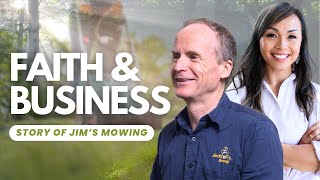
YouTube interview with Jim Penman covering his journey from atheism to becoming a Christian at age 28, his move from university/PhD into full-time lawn-mowing to raise funds for research, and the subsequent growth of Jim’s Mowing into a large franchise. The conversation links Penman’s Christian faith to business choices (screening and supporting franchisees, ethical priorities), his personal habits (simple lifestyle, tithing, informal prayer, church and life-group participation), and motivations for giving (funding a research project). The host frames the business scale as over 5,000 franchisees and roughly $500M turnover.
Chapters
Very important as Christians that we are part of the body of Christ, that we stay connected. I have a wonderful church, actually. It's a very big church where it has amazingly great sermons. That's as much as anything, actually. You go to church and I very rarely miss out on church. It was very hard during lockdown. I missed out a lot and as soon as possible came back. I love to go to church. I love to hear a great message. I like to be uplifted. And then after church, we usually go out and have lunch with some friends who are part of our group. We also have a life group that I coordinate where we meet together every second. We had one last night. It was actually on Monday night. It was wonderful. We just meet together and we discuss things from the sermon. That's part of the system we use. And then we pray together, pray for each other and talk about difficulties and stuff. We talk about anger on Monday. So those kinds of things.
Hi and welcome to my channel. And today we have a special guest who's about to take us on a journey exploring the intriguing blend of work and fun faith. Joining us is Jim Penman, the brilliant mind behind the renowned Jim's Mowing group. Now, Jim's Group has over 5,000 franchisees and a turnover of approximately $500 million. It is more than just a lawn care business. It's a testament to Jim's unparalleled success in the business world. But there's more to Jim than just his thriving franchises. He's a thinker, a visionary, and someone who deeply understands the connection between. Between work and faith. So in today's episode, we'll uncover how Jim's personal beliefs have influenced his approach to entrepreneurship, to leadership, and to the pursuit of excellence. Stay tuned as we dive into Jim's insights, exploring the profound ways in which faith can shape not only our careers, but our entire outlook on life. Let's welcome Jim Penman to the show. Welcome to the show, Jim. Thank you for spending time with me today.
Good to be here.
Yeah. So I was fortunate to see you speak at EO Sydney. And one thing that really stood out was you mentioning Jesus. And also I could just see through you as a servant leader, someone that was, you know, really taking care of their staff. And it is, you know, relatable. I'm a Christian and actually a newly Christian, probably only about two, three years. And I was an atheist. And while I was on the call, I literally quickly Google you up and I realized that you once upon a time was an atheist and then became a Christian. And so I reach out to you and that's why we're here. And so, you know, I guess my first question for you, Jim, and this podcast is a little bit different. It's not all purely about business. It's really about, you know, your journey through faith. And I believe that we're here to serve God and I just want to love to hear your input in it. So, yeah. Jim, would you like to share a little bit about, I guess, life before you found Christ and what were you like as a, as a business person or leader back then?
Well, I wasn't in business at all really, apart from a part time gardening waterline business. I wasn't just non Christian, I was sort of anti Christian in a way. I used to argue with Christians when I was in school. I went to a sort of a typical Anglican school, which is a feminine capital and stuff. I used to go and got in trouble because I would, I would take people up on it and I would argue about why there was no God and fight people and they actually, yeah, I was going to have a very big attitude. My best friend was suspended briefly in her final year of school and told to stay away from him. He's a bad influence. So when we had speakers who were Christian speakers, we would, he and I would go and challenge them and even went to a Billy Graham concert and just make fun of people, which I mean, sounds terrible, but that's what he did. He just sounded crazy. But it must have had some sort of internal spiritual hunger because I was always interested, you know, anybody come to the door, any Mormons, anybody else, we'd all invite them in, talk to them and stuff. It just didn't make any sense. And then how can I explain it? When I was 28 years old, after many years at university, I was walking through the like we had an O week there in the central building and there was these kids at the Christian Union table and I just stopped to tap to them. It was quite random actually. I'd actually been to a coffee shop beforehand that was invited to go there. I thought I'd go on and talk to these people and I went down and sat down. I'm pretty introverted. Nobody spoke to me, so I just walked away. But this time I got chatting to them and got to like them and they invited me on this retreat and the first morning of this retreat you were supposed to sit down. It was quiet time, you know, this kind of thing. Well, I wasn't going to pray because I didn't know how to believe. In God or anything. So I just sat down with a book, a textbook, and I had a red pen and I just wrote down the thoughts that were inside me. And I had this very vivid sense one was calling me. So I sat down atheist and grab a Christian.
So like you just got converted like that. Like in that moment you just found a calling. And when you say you found that like what was that feeling like? Was it a feeling, a voice?
Yeah, it came through writing. I'm very writing sort of oriented person. So I just came, I just started to write down what through my mind and I just thought God was calling me. And in a sense you could say I wanted to because it was attractive. It was. Most amazing thing happened. I. Everything changed actually. I surprised a lot of people. That one guy heard that I would become a Christian. He just looked at them and said Jim Penman, the Christian, Jim Penman, that guy, he's a Christian. I was very vocal, very spoken. And then when I changed like Paul on the road to Damascus or saw it those days, I just, I went whole hog and I joined the Christian unit, became on their committee and I went on evangelistic coffee shop and you know, did the kids thing at the evangelical convention. We used to entertain the kids with a sort of improv which is really, really fun. So I did that a couple of years and I just, I just really adopted. It was just wonderful. It was most amazing, joyful, happy thing. So I guess added to that I don't know where, where all the really nice girls were. They were Christians.
Yeah, they're very.
I felt like got up in the. As the promised land. It was just most amazing period of my life. A couple of years I got married to a guy, met a church and you know, went from there.
Yeah. So were you brought up with any faith at all or were your parents quite atheist type people and then you just went on your own journey?
Well, we were sort of set aside school as kids but sent not, not taken. My mother was sort of nominally I suppose my father in the early days I heard he was, he was a strong church go but he was an atheist. He wasn't allowed to say so my mother wouldn't let, wouldn't let him say that he was an atheist until. Or he comes up with an agnostic until I actually said that I was too. I abandoned any, any beliefs at the age of 14. Just made. Made no sense. I didn't believe in it, that's all.
Yeah. And so you know, when I found Christianity, I think it also came at a point Where I had certain values in life, you know, whether it's love, kindness and all these things. And when I delve into learning more about it, I just felt like it was so aligned and it was aligned to the way I run my business, is the way I like to, to running my life. And so was it something like that for you? That made sense because, I mean, why did it at that time, Christianity made sense to you?
I had a spiritual hunger. Obviously there was something inside me that was lacking. I just didn't have the actual belief in life. Just had to make that leap of faith to say, yeah, I mean, I guess obviously the values appeal to me and my self. Critic. Yeah, he's a lot better about emotion. It's not as about your head. You can, you can believe in, in your head that there's a God and everything else, but it doesn't mean anything unless you have that relationship, that sense of, of Jesus is your. As the mentor. It's like I feel like it's a loyalty thing. It's like I sometimes think about it. My image of Christianity is like, I'm a big history buff, as you may know. So, yeah, I was a, a farmer or yeoman farmer or something in the old days. And the land is oppressed by darkness and there was tyranny and everything else. And this, this army comes to fight against his evil. And there's a man on a white horse leading the army, and he says, will you join me in this battle? And that to me, is my image of Jesus. It's like a, like a loyalty thing. He's my person I go to, which is why I speak to old Christians and they ask me what my. And I don't push by faith a lot when I talk to such people. But if they ask what was my. Who's my mentor? That's the way I look at it. Jesus is my mentor. He's the person, he's the man I follow. And I relate to him very much as a human being, perhaps even more than as the risen Savior. In some ways, that's just my own psychology. I love the gospels, particularly the synoptic gospels, without getting close to the real Jesus the way he was. That's my example. That's my person I follow.
Yeah. Yeah. And, you know, it's interesting, like, I am nearly 40, and it wasn't only a few years ago that I realized that we are spiritual beings in a, in a physical body. And I think a lot of people don't realize that. And there's that sense, especially when you're an entrepreneur, you know, you, you're succeeding, you making money and yet you're feeling something's missing. What would you say that comes from, you know, is it like, yeah, there's a, is there a gap between them acknowledging that we are spiritual or, or. Yeah, what is really happening when we're feeling unfulfilled? As an entrepreneur, well, as a human.
Being, I would say, I don't know, I only can say is that to me there was a hole in my heart, there's something missing. This fits in a way that's, you know, like the story they tell about the, when they, about in the days of communism when they tried to get this, this fish to not like the water. And so they indoctrinated and they teach it and they do everything they can just to show this fish that water is no good. And then, but then when you actually let the fish into the water, it just swims away because it loves it. And it's just, it's just natural to us to be one with God. The world around pushes us away and gives all these reasons. It's just part of our nature that there's a God shaped hole in our life if it's not filled. I love a life of faith. It makes, it makes sense to me. I walk in, I don't, I don't do a lot of long formal pray except in, in my micro life groups and so forth. But I often pray just God give me some guidance or, or comfort me or if I think of someone, I say pray for them briefly. I often do it when I'm outside, actually. I love. It seems closer when in the open air. I love being outside.
Yeah, yeah, I totally agree with you because ever since I discovered God, I feel like I'm not alone. I'm not always in control and I don't have to be in control. I could almost just let it go. And I think, you know, a lot of times we learn from personal development about surrendering how to leave it to the universe. But it's all part of the Bible. It's always been there. Can you share between the time that you were 28 and when did you officially start dunes mowing and. Yeah. How A little bit of your background when you started so people get to know you a bit.
Okay. I would have started, I would have become a Christian when I was 28. I think it was just. So I probably was about 18 months later actually that I finished my PhD effectively. So I've been studying at university since 1971. This was like 1982. So I was 10 years doing this study, this research work on understanding human society, which incidentally, as a matter of fact, one of the things that my studies told me is that Christianity was the driving force behind civilization. This was as an atheist, the potion of Christian values were actually particularly things like chastity and fasting and Sabbath keeping in those kinds of areas, rationally had enormous amount to do with the rise of Western civilization, the development of character that made it possible. So that was kind of a, in a way more positive. But I did this, this very radical rethinking of how society works. And I submitted my PhD and I have always thought I'd be an academic, but I just met complete rejection. Nobody accepted my ideas. They were just very, very radical. Now the interesting thing about it was that I was. Even though my theory was developed in terms of history and economics and quad quadrant topology, the implications were all in terms of physiology, in terms of what we now call epigenetics, we have a word in those days. So it was all. So what I needed to do was to have a research institute of some kind of. And that would cost a lot of money, and I had no money. I was $35,000 in debt and I had no potential to do it, to do a science degree. So what I decided at that stage when my PhD was basically not going to go anywhere, was that I had to have enough money to fund my own research institute. So then, flat broke, age of 30, very newly a Christian, I decided I had to become rich somehow. Rich enough to, I want to do this. Which must have seemed completely lunatic to anybody, I'm sure my mother, nobody else did. So I just started full time mowing lawns. That's basically what it is. With not necessarily thinking that that would be the avenue, but somehow I needed to make enough money to be able to fund my research, which I now extend of several million dollars a year.
Yeah, I saw that on Wikipedia about this research that you're funding. And it's so interesting, it's so unique that you started this business to fund this research. It's such, it shows such a passionate person you are. And so would you say that then you didn't you, you weren't someone that kind of knew, okay, this is the type of business I want, this is what I'm going to do. You were kind of just following one day at a time. Like, how did you all of a sudden now build a business to $500 million?
It was, it was, all of, it was anything I knew it was. The lawnmower was all I knew how to do. I had no other knowledge of any business, of any anything. I had skills. I mean, a PhD in history does not, does not really fit you for anything in particular, apart from being an academic, which was completely impossible for me. So I just did what I needed to do and I said, I'll just do this, keep on doing this until something better comes along. Oh, look, I tried a whole lot different things. I tried email leaders, I tried Amway, bring some. I've got no people skills. So that was a very stupid thing to try. At one time I had a mower shop, I had a computer shop, I tried to get a tourist resort going. I tried all kinds of different things. And while I was doing all these things, this little mowing business just kept on huddling along, just gradually improving it. Because I always go back and look at what am I doing, how can I improve it? I have this obsessive need to improve everything I do, including the most efficient way to mow a lawn and what to do with clients and how to look after them and getting subbies and stuff. I just, I just kept on working on this, on this little business and it kept on growing and the other things just didn't work out. Most of the things I've done in my whole life have failed, I must say, an academic career and all these other businesses. And I just kept on doing that. And then 1988 or thereabouts, a company called VIP came to Melbourne and they were a franchise company which I never even considered, and they just hit the pants off me. So I basically franchised in self defense. When somebody asked me on how many franchisees I might have one day, I said maybe have a hundred one day if it works out well. So it's in the bit more successful than that.
Yeah. And so when you said you were mowing lawns, will you literally do it yourself for a while? How long was that before you start to actually have a business where people were running it for you?
Well, it's sort of gradually. I was mowing lawns as a student for several years part time. And then I started optimum. And I think after a couple of years I started putting on subbies and so forth in a small way. I basically went from mining laws myself to try to build up and sell a lawnmower. That was kind of the thing I was doing, which was sort of a heart house. And then I learned a lot about that, how to approach people and how to look after them and how it Helped be successful and stuff. So I was kind of already doing these kind of things in a very small way. I maybe had about a dozen subbies at one stage. That was. That was a lot of even terrible to my service, I must say. It was really not a good business. If Jims had been around. No. So they couldn't have competed because I wasn't very good at what I was doing. But then I franchised and I had this concept and a lot of it. I wanted to post franchising in a very different way. One of the crucial things, and this was very much driven by Christian faith. I didn't want my franchisees to fail. That was a big emotional thing in those days in this. In the service industry. And I think it's generally so outside of gyms today, you basically take anybody who paid that's coming to franchising is done. They like as one. Somebody said to me, how do you. How do you choose a potential franchisee? $50,000 on a pulse. I'm not sure people said that to me. This is what they say. And I said that was wrong because I didn't want to take somebody's money and have them fail. So I determined that I was going to screen people. So I used to put them out on the road with people that I trusted and say, are these people good? Are they going to succeed? They're good. Cut customer service attitude. I knew that would actually hurt my growth because I would be rejecting people and therefore growing slower. It was done actually for moral reasons, but it turned out to be a very good business decision because what happened is because I knocked back people that I wasn't. Wasn't confident would succeed, and because I put enormous effort into helping my people to succeed as individuals. And I was always talking to them and helping them and trying to advise them and doing everything else. What I used to do was to put a list of all my franchisees together with their phone numbers and if anybody's interested in the franchise, and they'd say, well, why would I buy from you? You're running it basically from your basement and here's this Pip Interstate, much bigger than you. You've got a fancy office, got all these advantages, then why would I do with you? And I said, well, look, there's some differences, but here's a list of my franchisees. I want you to call them as many as possible. Ask Vip to give you a list. Because I knew they wouldn't give them a list. They had to. And that list that people who were happy with me was what drove gyms. And we still do this today. And now it's part of the law. You have to give them a list. But I always say that the list current franchisees urge somebody to ring your current people and ask them and you can to make them successful, including choosing the right people in the first place. They'll sell the business for you. That's how it works.
Yeah. So how do you know they're really good? Like what are you looking for when it comes to. You're looking basically for potential business owners, entrepreneurs.
Most people have the now put money into a business will be okay. It's more a case of looking for the ones that don't look. There's certain kinds of red flags. For example, young man in his particular early 20s, mother or father is paying for the business. Absolute no abs. No, they will not succeed. Never had a case that I know of. Somebody else told me to watch one who did, but I've never seen it. So that point of view. So then you interview them. You see whether they speak well with you. They've got sense. So they ask more questions. So they ask questions, good questions. Not just how much do I get paid, but how does it work? And you know, what happens if things go wrong. Just sensible things. The bigger the list of questions they have when they came to me, the happier I was. But most of all, I would send them out on the road, people I trusted and I would say take them around with you for a day. If they don't do the day, then they get knocked back. So you can just go half a day. I've seen that. That's it. That's a failure. If they turn up late, they don't that kind of thing. If they. If they don't show initiative and they don't start after the first two or three jobs, they should jump out and start unloading equipment and stuff without being asked. If they don't follow instructions like you tell them to, okay, mow around the side of the lawn, then move straight lines. Or when you. When there's a hose in the corner or even if there's just a few blades of grass there on the leaves, put the hose onto the garden and then mow underneath it. So you teach them to do these things. If they didn't listen after being advised once or twice, they'd fail. The trader would ask me, I'm not sure about this guy. And I said, well, okay, posing. You were looking for someone to run a second trader, which a lot of them had. Would you put this guy in charge. And they'd say, no, I'm saying that case, if you're not going to put him in charge of your business, I'm not going to put him on either. So it's just those kinds of things.
But a lot of people, that's really interesting. You know, I read in Wikipedia as well, it said that you used to be an angry person at work or something. Is that true? And what were you like as a leader back then versus now?
Lynn, I'd like to say I'm not angry, but I would say if I do discussion with people. Roth is probably my defining sin. My age last and stuff isn't such a problem anymore. But I'm still getting, I don't know. I had a conversation just before I talked to you with a email with a franchisee complaining bitterly about the system. This is, this is a guy. I won't even go into what it's about. But the element system, which has to do with leave fees, it's just very clear what's supposed to be. He just keeps on going on about it and insulting me and telling me I'm a hypocrite because I don't care about franchisees. And this kind of stuff too makes me annoyed now. I, I didn't respond in any very harsh sense. I didn't show anger. Because when you said an email, you always looked, it's okay, is this going to help? Is this going to be any better? And this guy is a franchisee. But I get angry. I still get angry. Yeah, I haven't slowed down much. Totally agree.
I was angry at my, my husband the other day. Yesterday was my daughter. I'm always angry and I think it's. I guess that's the challenge being a Christian is, you know, ideally how you could be as a person. You know, the godly characters that God wants you to be. And you'll struggle with the human being flaws, the sin that you just naturally do. Yeah, I guess. How do you. What's your daily practice or yearly practice to help you to align yourself to faith? You know, you mentioned about praying. Like how often do you pray? What do you do to. To really center yourself and continue to be a good person, a good child of God?
Just go back to anger a bit. Right. Our pastor preached a wonderful sermon last Sunday and it says from Paul, one of Paul's letters, he said, be angry, but do not sin. So he's talking about anger itself isn't a bad thing, but what you do about is bad. And you know, you don't hold on to anger and rage and so forth, and you act in a proper way. So I don't think being angry at itself is sometimes if you see injustice or something going wrong in the world. When my franchisees were cut off from work for two months for no reason at all in Victoria, I was very, very angry at the premier for doing it and made my. Because it hurt them very badly and there was no reason for it. So anger at self isn't bad, but how do you align yourself? I think it's very, very important as Christians that we are part of the body of Christ, that we stay connected. I have a wonderful church, actually. It's a very big church, but it has amazingly great sermons. That's as much as anything, actually. You can go to church. And I very rarely miss out on church. It was very hard during lockdown. I missed out a lot. As soon as possible came back. I love to go to church. I love to hear a great message. I like to be uplifted. And then after church, we usually go out and have lunch with some friends who are part of our group. We also have the life group that I coordinated where we meet together every second. We had one last night, it was actually on Monday night. It was wonderful. We just meet together and we discuss things from the sermon. That's part of the system we use. And then we pray together. Pray for each other and talk about difficulties and stuff. We talk about anger on Monday. So those kinds of things. I don't read the Bible as much as I should, but pray often more informally, actually, as I said, it's just a part of life.
Yeah.
Quite frequently, you know, God just helped me with this or, you know, I think about somebody, please bless them in this kind of thing.
Yeah.
I'm not a wonderful Christian then. I don't do the whole quiet time stuff, but. But God's in my mind and. And I love that. You know, our pastor said one of the things that senior pastor said, Guy in the sermon, he said, I don't know any Christians who flourish in isolation. Be part of the body of Christ. You've got to meet with your people. That's why I said going to church singing, you get very uplifted. So forth. And then a great sermon and then go out to lunch with people and with the Christian people and you, you talk to them. Not always Christian stuff about everything, personal everything, and just they enmesh with people. I love doing that kind of stuff.
Yeah, yeah, yeah, definitely. This year I really have started going to church very regularly. I used to have a goal just once a month But I found a really good church that I like down in, in my area, 45 minutes from my house actually. But it's so good that I want to come all the time now just talking about business wise I've always kind of sometimes struggled with like wanting to be more successful, make more money. I know in deep down I want to help more people but at the same time there's that kind of sense. It's like I should spend more time just focusing on, I don't know, doing godly things, volunteer. I don't know, I'm, it's like I want. How do you continue to really stay hungry in business and you know, and making more money without feeling any guilt of worldly possession?
It's going to sound strange for me to say this but one of my great advantages in business is I'm particularly terrible at doing almost everything. I'm not a good manager, I'm not good at finance, I'm not very good at personal patience. I'm not good at social media. I'm not good at lots of things, documents, legal, lots of things. So what I, what I do is I get good people focus on those things and I, and I try and work with them. I have very limited skills. PR is one I'm not too bad expressing what we believe in and teaching like to new franchises and franchise or very creative. I'm always thinking of new ideas, new ways. I just have that. So what it means is I'm not actually particularly overburdened by my business because there's not that much I can do that well. So I so and I didn't even know what you, how you define as work. You know, you go down, have a chat to people in the office am I working or not? I don't know how you define it. Or reading a book. I'm reading a book about business. Am I working or not? I don't know exactly. Everything gets mixed up. My life is very mixed. I hate taking holidays actually. I just, I just love work. I guess that's time. That's one thing. I always think if you run your business properly you've got time to do what you need to do. There's a wonderful statement that says no other success can compensate for failure. The home. Now I drive my son, my 20 year old son to work to school and pick him up almost every day of the week. So that's just part of what I do. It's part of my life and it's worthwhile. I don't really define things in terms of what's work and what's not. It's what's worthwhile and what's not excess worthwhile. Work is worthwhile to some extent. Church work is worthwhile. And a lot of things can be not worthwhile. Sometimes things you do for business are just not particularly worthwhile because they're not productive or somebody else can do it better because it's only an ego thing. It's not. But the big thing when it comes to where I have the strongest idea is when it comes to money. And I like to read a lot. I probably read or listen to a couple of books a week on average. So I'm always reading. One of the things I'm very interested in is psychology. Psychology, evolutionary psychology, the science of the mind, economics, politics, lots of different things. Very interested in the subject to health and happiness. And it's very striking that, that people think the way to become happy is you. You, you work hard, you become more successful, you have more money, you can buy more stuff, you can buy a bigger house and a better car and more expensive holidays and so forth. What the science finds is that when you actually I'm not talking about Christians, I'm talking about just scientists investigating this. Those kind of things do not really relate to happiness. There's a statement that says that social comparison is the thief of joy, which is Theodore Brisbane. So if you're just simply out there to make more money so you can look prestigious, it doesn't make you happy. In fact, in terms of spending money, spending on experiences is better like going out with so with your family, something like that or basic those kinds of things. But the number one thing that you discovered this is not Christian thinking. This is psychologists and studies surveys. The one thing you can best do with money to make yourself happy is to give it away to a cause that you're involved in. Like. Like my research project or this kind of thing. They've also found too that if you want to make yourself happy, doing something for somebody else is actually more beneficial to your happiness than even receiving help. Human psychology. The amazing thing is they get all these atheist scientists. I know probably not all atheists, they come to these conclusions frighteningly. Looks very much like the Christian gospel in terms of behavior. But I'd say I don't. I one thing I firmly believe in is that God gives us money as a. As a trust. We are not to use it for ourselves. I try and live simply. It's a little difficult. My wife has more expensive taste. She's not bad to me. To me, if you want to go out, I like eating out with friends and so forth and family. To me, pizza is fine. I don't like expensive meals. It just is worth it. It costs too much. You know, this is work clothes. I buy my handsome boots from Kmart. Until, until last, late last year. I've never owned a new car in my life. My car was worth about $10,000. Then I bought electric car, which, which is for various reasons. But I don't like spending money. The money I have goes into something that I think is worthwhile, which is obviously tithing. I think tithing is really important and to my research project and that's been made.
And when you say you don't like sp spending money, it's more like it doesn't give you joy to spend on things that you don't think is necessary. But when you spend it on the things that you like, like tithing, which is a way of spending but you're giving away, it gives you true joy. And that's why you do it. Not because you're like, I don't want to waste money. And you know, yeah, when they call someone being rich and tight ass or something like that, but like from what I'm hearing is that you, you know truly what is happiness. And hence you spend it on where it actually brings you you happiness.
Look, to be honest, I'm not even tempted to spend on such things. I just don't even like them. To me, a meal tastes worse if it costs much. Clothes like lifestyles buys me things that are too expensive. I don't really like them very much. So it's not, it's not difficult in that sense to restrict spending to things that are worthwhile. But I'd also feel, I feel a bit guilty if I, if I. And bad if I'm. If I'm spending on something that's indulgent. Like I'm always going around the house turning up lights and turning the heater down and people are using the room and this kind of stuff too. Which conflict was. Yeah, I just, I just don't like waste. I don't like wasting food. There's only 32 things that I spend without limit and one of them is books and the other is fruit. Okay, Any level of fruit is fine because it's healthy and it tastes good and I think it's good. And insert books, anything, I'll buy any. I want to read and I read a lot. So it's quite an expensive hobby. But apart from that I'm very, very stingy on the original Scrooge. I mean, here's my hero Scrooge. I mean, people just. I love Scrooge. I'm a big fan of villains, actually. I think, I think they're underestimated. When I was doing the improv in the Belgrave Heights, you know, when you can make up your own story, I always make myself into the villain because that's the most fun thing.
Oh, wow. I just love your honesty. And so you don't feel like it's a waste if you, you know, there's only a few years left to life. You know, we all die eventually and you didn't get to fly on a private jet and, and drive the Maseratis. Like it doesn't interest you at all.
Oh, I've got so much to do. I mean, I'm 71 now. Like Google tells me because of my health is really, really good. I'll probably live to my early 90s. Early to mid-90s. That's my most. I've got 20 years left and I think got a lot for me to do in that period of time. I think I've got so much to get done. I don't have time for wasting and that's for sure. I don't want to. I knew I don't like that kind of stuff. I don't want to. I hate travel, actually. I really think to me, right, if I'm, you know, I want to work, I like to buy recreation. I want to go out to my farm and dig potatoes. That's my idea of fun.
So when you mention experiences is something that we can be more happy with. And so how do you have experiences if you don't like traveling or. What are some experiences that you do?
Oh, just social experiences too. I mean, it's important to have contacts. Like tonight I'm going off to see one of my sons and his wife and his little boy, Joshua. He's cutest little kid in the world. Nine months old now. I'll see another one of my sons and he's coming over with his wife. So we'll just have dinner together. I'll go over there and I'll order. Will order many lot because I find that looks, looks better, better than a restaurant because you rent a home, little kid can crawl around. We always play with him and we chunk and stuff so that we do that kind of thing regularly. And then I have my life group and then I have another friends that I meet with occasionally and. And so just. Just social engagement. You don't have to spend a lot of money. I mean, I'm not, you know, I'm not living in poverty. I'm not here. Sure. Or anything. It's just you. It doesn't take much to. To have a good life. You want to be with friends. You don't need an expensive restaurant, you know, like having a barbecue or a pizza or something like that. That's ample. Most people in this country can live very, very well just by spending all the things that are useful and valuable. You don't need the expensive stuff. It doesn't help once you start comparing yourself with a lot of people. That's, that's just. That's misery from the point of view of possessions. And it's bad from the point of view of social media, which is why things like Facebook is so bad. I don't, strangely enough. I'm big on social media, but I don't do any of it. I don't. I don't look at social media. I had no idea. People tell me and I respond to things, but I don't do it because you're always going for the likes and things. And whether you say it's going to get engagement and stuff, I really don't do that kind of stuff.
Yeah, yeah. I just love your philosophy alive. It's really simple and it is true. You know, when we were all locked down, the only thing we could think about is spending quality time with our family. We don't really care about all the luxury things and sometimes we get caught up in society and it actually does create more misery. And so would you say that when you were broke at 30, up till you now, you know, build a really big business, things haven't really changed too much, like you yourself has always felt fulfilled or like you've only needed simple things to make yourself happy?
Yeah. Yeah. I doubt as a happier person on the face of the earth than me. I have very wonderful life. I have everything I have. I have a wonderful wife. I love my kids. I mean, always get on well with everybody that I like to as little as I'd like to, but.
More from Jim


Rising mental illness and falling birth rates have the same cause, it is this.....








