Jim's Group CEO, Jim Penman interviewed about the lockdowns, franchisee surveys plus a lot more!
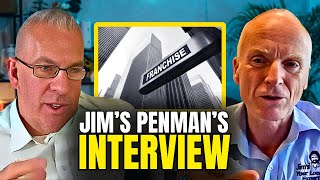
Jim Penman, founder and CEO of Jim's Group, discusses the franchisor's anonymous franchisee survey (claims it's the first published by a franchisor), the company's legal challenge to COVID lockdowns, and growth from 3,842 franchisees in 2018 to 5,500 in 2024 across 50 divisions. He addresses over 200,000 unserviced leads and operational pressures across the business.
Chapters
Let's talk about the franchisee survey. If I'm correct in my assumption, you're the first franchisor to publicly release the anonymous results of your entire group, is that correct?
Yes.
I couldn't find any other research about this.
We actually. Our own surveys are internal. Yeah, we really try to get about 90% and we ring them and ring them, but they're all internal. One we had done was commissioned by an external body.
Yeah, that's right.
They only got about 30%. So they were slightly more negative. I think they showed about 15% with poor income versus our 9, because the people who responded were more like those who were negative. Yeah, we're the only company in the world that's ever done that, as far as I know. But this is a thing I've said to governments for years when they go on about the franchising code. Their idea is, let's have a more and more detailed and legalistic disclosure document. Now, the problem with that is that nobody reads the disclosure document. And I've asked franchisees at training, I said, has anybody read the entire disclosure document? Not one person puts up their hand. So it's basically legalistic garbage. It means nothing. What I said, in every inquiry, always, what you need to do is to have a visual independent body poll every franchisee every year and public display the results. And that would do so much for franchising. Not just the fact that the contract is spare, but is the support good? Are they nice to you? Would you do it again? Simple questions like that. I got so frustrated. Eventually I said, we'll do it ourselves. We'll be an example. We'll put our own stuff out there. Because I know perfectly well that if we were compared against any other franchise system, especially in the service area, we would kill them because our franchisee satisfaction is so much better.
Ladies and gentlemen, great to have Jim Penman, founder and CEO of Jim's Group, of on the podcast today. Jim's Group, as we all know, is the largest franchise group in the Southern hemisphere. Jim, welcome.
Yeah, good to be here.
It's great. Now, look, I've got to ask you. First question, Has Daniel Andrews given you a call asking for any of Jim's Group services?
Not that I know of.
Look, you banned him a few days ago and I saw in the news it said backlash. I think they had quotes from two or three people. Have you actually seen any dip in demand as a result of banning Daniel Andrews?
Well, he's not exactly a big client of it. I don't think he'd probably want to use anyway. I didn't actually ban him. I just recommended to any franchisee or any. Any independent contractor, considering how badly he's treated you, you know, I'd be. I encourage you not to provide service. I think it's wonderful. These restaurant owners, I mean, they're sort of hitting back.
I mean, they certainly are threatened to people like dirt.
He threw a hundred thousand plus Victorians out of work for no reason at all. No hold to device, nothing. He said 100,000 Victorians plus lose their jobs or I might look a bit weak or politically not so good. Easy decision. Oh.
So look, you know, let's assume he's sitting in his stately home or, you know, the Imperial palace in Beijing. Wherever he's domiciled at the moment, he phones up and says, take my money. You wouldn't take his money.
Well, I don't. I don't work for People Direct. Probably wouldn't even know. And I just go to the system. All I can say is, if any franchisee of mine were to say no, Dudley Andrews, I'd say, good on you. It's about time he got told. It's good to know that the damage he's done to the state and to so many people that some people are actually fighting back.
Did. Did anything ever come of the legal case that you brought against the or? You were considering bringing against the or?
You.
I think you had a couple of appeals knocked back, if I remember correctly, and then you considering going again. Did anything ever come of that?
We. We lost.
We appealed.
We lost that, basically. So in that sense, we lost another sense, Barry. We won big because the whole point that we were making was there was no health reason for shutting down independent contractors. And when the only defence they've got is we say, tell us your reason for doing it. And they say, we don't have to tell you. Now, that is an admission they had no health cases. Of course, if they had the, why wouldn't they give it? Yeah. Here's a report from Chief Medical Officer. Risk of infection is higher, as per overseas. Give us the evidence. No evidence. What it does, it was actually very successful and it proofed positive. He had no health reason for doing it. It was pure mercenary politics.
Well, I think globally we're seeing a little bit of a backlash against the decisions that were made at the time. And at the time, I recall, I was in Victoria. I managed to escape when the first lockdown finished, but the Victorian government offered, I think it was $3,000 or something like that to sole Operators. I'm not sure about the chronology, but was your media release, your open letter, was that before they offered the money to sole operators or did the money come first?
This was federal money, not state. The state didn't offer anything. Okay, federal money, but it didn't replace their income. Not the sense of purpose you get from, you know, doing your job. We independent operators, we get something out of what we do. We provide a service to the public, we keep their houses clean and their gard mode. It's a sense of purpose and meaning in life. Sitting at home waiting for federal government checks, not much of a substitute for that.
Yeah, I'm going to come back to that meaning in life because you spoke about that at the franchising Expo. But let's just continue that sort of COVID pandemic vein. I was having a look at the numbers for Jim's group. On May 10, 2018 you had 3842 franchisees in 50 divisions. In August 2021 you had 4350 in 50 divisions. And now in 2024 your LinkedIn says that you have 5500 franchisees still in 50 divisions. So the numbers online. So you've remained static in terms of divisions, but franchisees, you've had a 43% increase during that period. Pre pandemic, post pandemic and you know, in fact during the so called economic downturn, the mini recession we've had. What do you attribute that to? Because if the pandemic was so bad, you as a group have grown exponentially. How do you reconcile that?
Well, the pandemic wasn't particularly bad for us, apart from that two month lockdown in Victoria because, well, it didn't really, didn't really slow us down at all. Recession isn't particularly bad for a company like mine because we tend to have surplus work. We've knocked back more than 200,000 leads in the past year and we've actually got so much, so many leads in some divisions. We've been giving that money to the franchisees because we can't spend their advertising budgets. So lack of work isn't the problem. So if the economy goes down, we're actually well off.
Now.
We did have a very strong demand. People couldn't go on holidays, they couldn't go to restaurants, but they could still generally get services done. So we had very strong demand in that time. At one stage, close to a third of our leads were unserviced. The demand was so high we just dropped off. But as to why we've continued to grow. I do think, strangely enough, the whole controversy over the lockdown did help to raise the profile of the company. And I became known as a spokesperson, and particularly if you look at it, a spokesperson for the people who've been forgotten, the independent contractors, even a lot of the independents actually thanked me for what I did because we spoke up for them, which nobody else did. The kind of person who's thinking of looking for a business might look at that and say, wow, you know, this is a guy that really stood up for his people when times were tough and even when it wasn't popular. So maybe I'll think about a franchise. I think it has a. It has a big impact. A lot of people actually came to franchise training because they. Because they heard this story and they read the publicity and they thought, this guy really stands up for us, which we do. The other thing too is that we have a fantastic social media section run by a guy called Joel Klebert, who is just brilliant and he's very, very good on social media. We've got stuff going out all over the place all the time. I just do things like do answers to TikTok inquiries and get, you know, 20,000 people read them. It's just astonishing. So we had this very strong social media outlet now, which we didn't in the past.
Joel. Joel is phenomenal in the industry. I've got a lot of time and respect for Joel and what he's done over that period, you know, the 2018-2024 period, your marketing has actually changed quite dramatically in the sort of six and a half years. And I think that's certainly thanks to Joel Kleber and also you giving the permission to Joel to do that, but also your transparency in the way you talk and in fact, how you've become a spokesperson for those who are seeking a bit of justice. How does that make you feel, Jim? Like people are calling you a bit of a legend online and you've got your haters as well.
Of course, online, there's Dan lovers out there still. Somehow, I don't know how or why, but they do.
What does that make you feel? I know you're a man of deep faith and you have a sense of purpose and justice, but when you see people flocking to the brand, maybe, and I would say because of your stance during COVID how does that make you feel as a person? It's good.
I mean. I mean, it's. It's kind of embarrassing sometimes. People often come up and thank me and stuff, which Is nice. But, you know, in a sense, I liked the old days when I. People didn't know who I was. So, you know, people had asked me what my profession was, and I'd say, well, I. I. What my job was. And I'd say, well, I have a business that, you know, organizes cleaning and gardenings or something like that. So I would never admit it. And if I wasn't wearing my uniform, they wouldn't know. Or even if I was, they wouldn't know it was me. So I kind of missed that anonymity in a way. But look, it's part of my job, to be honest. I'm not particularly good at doing a lot of things. I'm not a very good manager or not a very good with figures or a whole heap of stuff. Not very good at it. So speaking out is one of the very few things I can do.
Yeah, I remember, you know, six years ago, people online were saying, is there really a gym? But I think everyone fundamentally knows who Jim is now.
Yeah, well, actually, I went to a wedding the other day, and somebody's the father. The bride spoke to me and said, oh, what's your job?
Are you.
You a lawyer? So he didn't know. So I just told him, oh, yeah, I have this cleaning gardening company.
It's funny, I was just reading a book by Eric Idle from Monty Python, and he said, the only good thing about Fane is you can get a table in restaurants. Do you find that?
Well, Barry, the kind of restaurants I go to, there's not normally a wasting this.
Yeah, you are.
A very local. Local pizza joint's good for me. And they have a good fish and vegetables. Something healthy. And it's not too quite. I'm not really an aficionado of the. Of the upscale places. 25 bucks a meal is a really good, really good feed. That's. That's what I want.
Let's go back to those unserviced leads. So 200,000 unserviced leads. I remember back when Goblit started right at the start, and it's had a few names, but there were 104,000. The leads have actually doubled. The unserviced leads have doubled. Tell me, where are they geographically and in which divisions do you have the predominance of those unserviced leads?
Well, they're all over less in New Zealand because the economy is pretty pathetically weak over there. It depends more on the division. So there's some divisions that tend to be very overlead. Like one is fencing, probably the extreme, at one stage we were knocking back 60% of fencing leads to the extent that we're even starting up our own fencing franchise these days to try and employ people direct to just to train them and get them going. There's so much work. Dogwash is another one. Most of our dogwash franchises are booked out months ahead. They get busy very quickly. Mowing is pretty strong. And then you go to cleaning, which is not too bad. And then you go to divisions like test and tag it bookkeeping, which really have to go out and push a lot to get work. So it's sort of an extreme from fencing dogwash at one end down to it bookkeeping at the other.
Okay, and so are you actively chasing franchisees? And of course you are, but I mean what, what are you doing to actively attract new franchisees to service those leads? Because the customer dissatisfaction, even though they aren't a client of Jim's because they're not getting their lead service. That may be a genuine problem. What are you doing to get people to service those leads? Are you still pushing the independent contractors angle?
We do actually convert. We have a system where we with thing called, you mentioned Gobits, we call it Bizzer now, where we actually sell leads to independent contractors. Quite a few of those actually when they get the quality of the leads. Because our leads are like high pages where you get five people going for a lead cheapest price. We're going to give it to one person so they like the quality of the lead. When that becomes competitive, we have quite a few come across to gyms and join us. So that's, that's one of the things that we do. But honest and often if they're good operators and they're well established, we just grant them a franchise because there is so much work. But we just simply try to find more franchisees. That's biggest struggle. We on the whole, no division is really determined by the level of leads. Every division is determined by the ability to attract capable people. So we advertise wherever we can. We have a lot of social media, we do a lot of Facebook, Facebook boosts, that kind of thing. Obviously just the normal seek and everything else. We just every method possible to try and attract people to the system. And then we have a big social media campaign in general that's very, very effective. Bring people to us.
How many franchisee applicants do you actually reject? Because I remember at training, you know, I saw one person out of an auditorium full of potential applicants. One person decided not to join, but everyone else was Just gung ho for the, for the system. You're still not getting enough in. But how many do you actually reject at the moment? Do you reject any?
Oh, yes, yes. But not at the stage of training. We occasionally knock back a person for training. For example, we had one of the things, I'll always ask the staff at the conference center, is anybody being rude or difficult, that's a really bad sign. Or we had one particular person who made improper advances towards female staff. I mean, just so you look for that sort of thing, but generally the screening is done earlier. But for example, if you've got somebody who comes up and it's clear that the mother or the father is buying a job for their early 20s son who can't find a job, that's a sort of a complete red flag. But franchisors do that quite early in the process. We also put them out on the road, too. We get an opinion of them from the franchisees who are there, who are trainers and say, are they good? Do they have a good attitude? Do they listen? Do they learn?
Okay, so it's done in advance of, of training. So let's just go back to some of those divisions that you mentioned. You've been in the media a little bit recently with some disgruntled divisions or some challenges with Dogwash and Handyman. How's that going? I mean, you know, I know you've come to an arrangement with the franchisees in Dogwash, but what's happening with that? Can you talk about those two divisions?
First of all, yes, there's a genuine issue in that the person who was selling the franchises for Dogwash, we have a system in Dogwash where we own the trailers and we basically assign them as part of the deal and then they can sell, including the right to it, but they don't own the trailers. Now, what we discovered is that the person who was selling the franchises for Dog Wash was telling people they would come to own the trailer, which is an obvious lie. And it's completely not so in any of our documentation. It's in the contract, disclosure, everything. It's all clear that we own them. But she told them that. So we said, look, we have to accept that she was saying that. There was no written evidence, but we had to accept it. I was told legally speaking, they had no case, but morally speaking, we hadn't. We had. They had a case. So what I said to them is, okay, here's your two options. First of all, if you truly believe the trailer should be yours, what be yours? We'll give it to you. Okay. We'll pass it across to you. All you've got to do is to pay $5,000 for us to waive the trailer trade, because it's normally because they want to go independent to do it. And if we'd been paying for the trailer's upkeep on the basis that it was ours, you have to pay us back that. So once they paid that back, then we just assigned the trial to them. And the other option was people who wanted to keep on. We just say, look, as an apology, we'll give you six months free. Yeah, she's worth about, you know, $5,000, no fees. And if you ever wanted to sell, we won't take any resale commission, which is about 20%, so that will save another 10, $15,000.
More from Jim


Rising mental illness and falling birth rates have the same cause, it is this.....








