Jim's Group CEO, Jim Penman's Candid Opinion on Franchising Code Reform
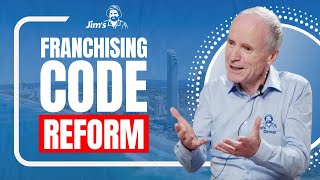
Transcript of an interview with Jim Penman (Jim's Group CEO) giving a candid critique of Australia’s franchising code. Penman argues the current code is ineffective, highlights flaws in lawyer/ disclosure practices, proposes practical reforms (expert contract reviews paid by franchisors, public annual franchisee surveys), and gives advice for prospective franchisees and calls for better government protection of small businesses.
Chapters
So Jim, what we want to do today, before people might see this in the media, with your various media rounds that are going to come off, this was your submission to the review about the franchising code. So maybe you want to just fill a bit of people in about why you take the time to do the submission and just your thoughts around the whole process.
Look, what I see in the industry is people who are ripped off one definite center. I see it again and again, again horrifying stories. So I think the franchising code idea is very good. I think the government should step in to help people to make better decisions and to, you know, come down on the bad operators. However, the franchising code as it is now is completely and utterly pathetic. It's almost completely useless for that purpose.
Now what were your, some of your recommendations, what some things that they should be doing or looking at?
First of all, they get people to go to a lawyer to do a, you should look at the contract to see whether the contract's good or not. Now problem with this, most lawyers do not have a clue about franchising contracts at all. They just don't know anything about them. They've got no experience. They don't even, from my experience, even read the contracts. Mostly they just say it's a Jim's contract, that's okay. Or one particular case. We had one franchisee whose lawyer told them not to sign the contract. And I said why doesn't he know it's actually one of the fairest contracts around? He said yes, it was a very fair franchise contract but on principle I tell people never to sign franchise contracts. In other words, this lawyer charged 4, 500 bucks, whatever when you could actually see from the title franchising. No, I mean why is that reasonable? What should be done is that franchisors should pay for somebody who is an expert and I mean somebody who knows franchising contracts and there's some good people around in the industry and get some to look at it. Do a thorough analysis, comparison with other franchise contracts. Do a brief one page summary of how good the contract is. Weakness of strength that anybody can read plain English. Now that would cost a tiny fraction of what it costs to go to all these lawyers and give far, far better advice.
Maybe you'll talk about from our experience as well through training in regards to how people, how many people actually read the agreement before coming to training just to let people know about this sort of stuff.
Very, very few contractors, very few prospects ever read the franchise contract. If they do, it's a very good sign. Most of them are just not that sophisticated. But the interesting thing is I have never, in all the years I've been asking, ever met anybody who's read the disclosure document. It is dense legalistic twaddle. It's incomprehensible to me that the vast majority of franchisees could get anything out of that. In fact, it's a blessing for the most scumbag franchisors around because what you can is you can bury things in the fine print. Hey, for example, you know that you must buy from the company, even if you've got to pay twice what you're paying from Coles. Bury it way down in the fine print. Nobody ever read it. Now what then happens is the franchisee finds out these outrageous things later down the track of it, then they say, oh, it's in the disclosure document. So they've covered themselves legally. So for the rip off franchisors, it's a wonderful deal. The franchisees, it's useless now do you.
Think, because obviously there's representations made by councils and stuff to the government about this stuff and this is how this stuff comes about. Because in the end what we know is that franchising, if you ask the general puncher on the street, is it positive or negative, I would say due to a lot of stories that get run, it'd be a negative thing. So do you think the people within the industry are hurting how franchising is perceived?
I don't know how these scenes get made. We have had multiple reviews in the past about the franchising code and every one of them I've said the same thing. This is useless. There's better ways to do it. How they come to the decision they do. All I can say is that somehow they're very representative of the financial services industry and the legal industry. For them, the lawyers for financial advisors, it's a gravy train. They produce nothing, they provide nothing and they make a huge amount of money.
So out of the code, what are some things that you'd like to see sustain it?
Well, first of all, I don't think the code is entirely bad. There are some elements which are actually very good. One of them is a requirement to put every current and I believe past franchisees in the disclosure document. I thoroughly approve of that. I do know that some franchisors completely mess it up. I've seen one of those things with all the office number, that's every franchisee. But, but it's a good idea. I also think it's a good idea. The requirement to go to mediation. Most issues can be settled at mediation. We don't get many disputes, but virtually all of them get settled at mediation. I think in the whole history of unscript, we've been to court twice. So there are some very good things in the code, but that's the end of it, fundamentally. The other thing is there is a much more effective way of protecting people and it's something that we've been doing for the past decade. It works really, really well. It's very, very powerful in pushing down bad behavior, in reinforcing good behavior. And that is that what we do every year is we survey each franchisee. Now we survey them anonymously so no franchisor notice will know what each individual person is doing. We ask very simple questions like how often does your franchisor call you, see how you're going, and then the options are weekly, at least monthly, less quickly, back to you straight away, take the call within 24 hours later. How helpful are they? Very helpful, somewhat helpful. We ask about meetings, we ask about the PIN income, which basically when asked how much they're making, we ask things like is your income good, satisfactory, poor? Now that becomes a rating on every franchisor. And now if we find franchisors that are not doing their job well, then we can immediately clamp down. We also reward and recognize franchiseors who do the job because we have about 200 franchises within the Jim's group and like 40 something divisions. So we actually use this very powerful tool and instead of me doing that, the level of service has risen dramatically compared to what it used to be. That's a very powerful system. Now if you were going to do it for the franchising industry as a whole, you might not use the same questions, but they should be very, very simple and quick and easy to understand and what you should be. What we should do then is have them all on a publicly listed website so you could see all the different franchise systems, including ours, including our different divisions, and make judgment. And fundamentally, if we can't get a good result on a survey like that, then we don't deserve to be in business.
Now let's talk about, because most people might be listening to this who are in franchising and going, well, Jim's is, you know, your home services, they're not your half a million, you're not your, you know, 300 grand type of, you know, your retail site ones as well. What extra stuff or what would you say to those people looking at maybe those sorts of levels of franchising or is it a similar sort of thing?
Very similar issues. I don't necessarily think a person who pays a half million dollars for a cafe or something like that, the Gloria Jeans franchise is necessarily that much more sophisticated. They're very similar. We had one recently who bought Gloria Jeans, had very bad experiences and then came bought a Jim's franchise. They're not necessarily people who've got years of legal expertise or county expertise. So I think they need protection just as much now. Maybe a person who buys a McDonald's franchise, puts them at million dollars, is slightly more sophisticated. But let's have, let's have a system that works for everybody and not just that 5% hyper educated elite.
What do you think is them stopping them from looking at trying things that are new? Because as I said like short poll of the general public, I'd say you get more negative about positive if someone just said franchising. That's because of the multiple media stories that get run with, you know, the bad situations. I don't hear about the good stuff unfortunately. So why do you think that they're still going down this path?
I frankly it beats me. I just cannot see how a system that is so grossly unfair to potential franchisees which allows and even encourages bad behaviour. Look, a person filing a franchise is horrifying. It really is. You see somebody puts up. I mean our people put up like maybe typically 25, $30,000. But even that and most of them do succeed. But even putting out that much money and failing is a very bad trauma. People now you've got a half million dollars to buy another kind of franchise and you fell in that, that's really, really bad. And the cases that were laid out some years back with the retail food group, some of those franchises like brumbies and so forth, the stories are just horrifying the amount of damage and hurt that it caused. Now I don't know what people are thinking when they do this kind of stuff, when they do these codes, but they are not thinking of people like that because nothing of what they've ever done has any relevance to stop people from doing bad things. You know, why should a franchisee be forced to sell a pizza at less than the cost of manufacture simply because the franchisor rips off money? Why should you be forced to pay double supplies that you can get from coleslaw? I mean this kind of garbage goes on all the time. Where is the franchising code? How does it protect anybody?
Well, do you think these type of Then things they put into it are driven more by, let's say private equity and let's say these type of people as opposed to.
I have no idea. I don't understand why we're a democracy. People vote. How on earth can a system that is so obviously aiding a few greedy, incompetent. Because they're incompetent, because they wreck the brands that they destroy with these things. Greedy capitalists, often multinationals, big companies. How can you possibly, possibly put the interests of that against tens of thousands of small businesses?
And let's talk about real quickly about the misconception. People think that if you spend more money on a franchise, you're going to get a more of a return or more of a net profit in the end. But we know from people who come through training mentioned the Gloria Jeans person who went to scratch and dent. I know people who are another larger franchise come to us and they file, they tell us in terms of the profit. What about that sort of misconception as well?
People can buy what they want. Not everybody wants to buy a cleaning franchise. And you can make very good money. But I'm not. Want to be a cleaner, don't want to be a guy, that's fine. You want to be in. You want to run a cafe. Personally, I'm not sure it's the greatest financial investor, but some people do well at it. I'm not arguing with that. But what I am really concerned about is that people be treated fairly. Now, Whether you've got $20,000 to spend or $2 million to spend, people should be treated fairly. They should be given proper protection and it's up to the government to do it. And I cannot, I cannot comprehend why every time I go up before these, these inquiries and say why they should do these things, why they should do simple things that protect ordinary Australian investors, why they just ignore it completely and say let's put more and more paperwork, more and more bureaucracy, more and more legalese and somehow in the end people get looked after. They have no understanding of how people think. And I know that I know people think because I speak to my phone number. 5,000 plus franchisees have my phone number, email address. They contact me every day. I know how they think, I know what they're going through. I know how easy it is to make mistakes. Even when we explain things really carefully again and again and again, people will still make mistakes. People who buy businesses aren't necessarily all that sophisticated. A lot of them need the franchise support to succeed. I just think they should be Protected.
Well, it's a shame because Australia's. We're very favourable to franchises. There's lots of franchises around. Percentage wise we're really large. Small businesses as well dominate. Obviously most businesses are small businesses. So do you think it's just. They just got a general, let's say, disdain for small businesses, they're not enough of a voting bloc or why do you think it's not something that's been more serious?
I think governments in general are pretty indifferent to small business. Liberal Party, to be fair, is better but even Liberals are more attuned to the top end of town. You know, the big companies.
Look at the big. Look what's happened, the big four. Look at all that sort of rorting that's been going on.
Yeah, I think generally speaking, look, you've got it, you've got a kind of a limit. You've got the Liberal Party which tends to be really, really entrenched in, you know, big business. They love big business. They want, you know, hundreds of thousands of employees. That's kind of. They understand that. They talk regularly to such people. They all come to business conferences and stuff and they go to fundraisers and they raise money. So they're very attuned to top end of town. Labor Party basically. They understand that the unions, they understand the inner urban elites, the lawyers and the public servants. That's their kind of constituency. And example of that is the contemptuous way that our premier Daniel Andrews treated small businesses by sending independent businesses off the road for two months without any sort of health justification back during COVID That's a typical example. They don't think about small business, they don't understand small business. But there's hundreds of thousands of small businesses in Australia. It's about time that one or either of the parties actually set up and said let's do something to help small business and protect them against these blood sucking parasites. These big companies. I have contact with the Australian Franchise association, they're good people actually and they try and do good things but they don't have much of a voice, they don't have much money. It's about time the government stepped in to protect people. And if I'm saying this, and I'm the biggest franchisor in the country and this is fair, this is reasonable. Franchisors should pay for a legal opinion. It's not that much. Franchisors should pay to have their franchisees surveyed. It's not that much. It really isn't. We do it every year and we've got 5,000 plus. Why can't they do it? Why can't you ring up people who've got other kinds of. Why can't you talk to them? Why can't you get their opinion and let everybody know?
With someone who's watching this going like the sound of it, and they want to actually get into franchising still, what's your best couple of bits of advice for them?
Well, I'd say first of all, do your research. The one decent thing about this code fundamentally, is from the point of view of buying a franchise, is they will give you a list of current franchisees. I would suggest if you don't get that list very quickly and you shouldn't need to pay anything, no deposits, nothing. It should just be handed to you like that. And I know some franchises ask for it, they shouldn't. It's outrageous that they do. You get that and you ring as many people as possible. It's incomprehensible to me how somebody can spend even 25, $30,000 on a business without spending two hours on doing research. If you ring up a nice franchisee, what's the real story? They will tell you. That's the first thing they should do. And the other thing they should do is write to their MP and tell them, let's have some protection for franchisees and let's not worry completely and only about the lawyers in the top end of town.
Well, that's the thing. Like, there's no real franchising lobby group that you know of, is there? You've never heard of a franchise lobbyist in Canberra or anything, have you?
There's plenty of lobbyists, but they'd be the big companies. They're the ones that have got the money. We don't do any lobbying. Probably if I did, they might have got some success out of it. But.
How would you go about it than doing it? How would you go about it? Would you just be knocking on the doors or getting in there? What would you do?
I don't know. I don't know how to do that kind of stuff. I know it's a big business, they spend billions of dollars on, you know, like, you see these fundraisers, for example. And I actually, I have run some fundraisers for the Liberal Party in the way in the past. I get excited about certain issues and so forth, which is quite fun. You get to sit down with top people and ministers and so forth. But I never really tried to persuade him of anything. I probably should have, but that's what. That's what you do fundraising. Political parties need money. So they go along and you have this, you know, thousand dollars a plate dinner, and you get to hobnob with the minister. And then that gives people influence. That kind of money should not interfere with democratic process. In fact, there's too much money in politics.
Absolutely. So we'll leave it there, guys. If you want to check out more from Jim, head to JimPeman.com and sign up for his newsletter as well. We do a monthly newsletter. It's got a lot of great insights in there as well. Jim's email is obviously on that website address as well. And make sure you subscribe and download.
More from Jim


Rising mental illness and falling birth rates have the same cause, it is this.....








