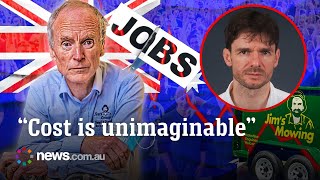
Millionaire businessman Jim Penman argues Australia's public service should be cut by two-thirds, claiming government bloat drives up housing costs through restrictive zoning. Australia's public sector employs 2.6 million people, 18% of the workforce, and created over 80% of new jobs in 2023-24 while private-sector job creation collapsed.
Chapters
We are really killing ourselves as a nation. The cost is unimaginable. Buddhists have no idea how much we're impoverished by this garbage that goes on. I cannot comprehend how the public service works. It is so, so bloated. People are unsackable. It doesn't matter how badly they do. There is no concern about efficiency whatsoever. So my best estimate is you could probably cut bureaucracy by two thirds and you'd have a much better functioning government.
This is millionaire businessman Jim Penman, and he's slamming the size of Australia's government bureaucracy, calling for it to be cut down by 2/3. Mr. Penman built the Jim's mowing franchise that turns over a billion dollars a year and has expanded into more than 50 services, including cleaning and dog washing. He was a vocal critic of the COVID lockdowns in Victoria, and hundreds of his franchisees joined an unsuccessful class action against the state government. The businessman announced his support for the Libertarian Party in October and told us he was considering running as a candidate in Victoria's state election later this year. He believes public sector bloat is weighing down the country's productivity and adding to a strict regulatory atmosphere in business and construction.
Building is a perfect example. Zoning system. This is one of the things I'm most passionate about. We have governments spending billions of dollars a year. Their only job that they're doing effectively is to say, how can we make rents as high as possible and housing as expensive as possible? How can we make it impossible for anybody to buy a house? That's our goal. Let's put all this massive bureaucracy in place. It's all completely. It's terrible.
So does Mr. Penman have a point? Well, the data shows that There were about 2.6 million public sector jobs in June last year. Total employment was 14.2 million, which means 18%, or roughly one in six Aussie workers were public servants. That would place Australia slightly below the OECD average, which is 18.6%. Nordic countries like Norway, Sweden and Denmark have very high levels of public sector employment, close to 30%. In China, nearly 50% of workers were somehow in the government sector, including state owned enterprises, which form a large chunk of the Chinese economy. So Australia's public sector isn't particularly large by global standards, but in the years since COVID it created far more jobs than the private sector did. In other words, we've started relying on it to shore up employment figures. According to an analysis from the Australian Industry group, more than 80% of all jobs created in 2023 and 2024 were were in the non market sector. Usually, the private sector accounts for about two thirds of job creation in Australia. But since 2023 its job creation rates collapsed, adding just 53,000 new jobs. In 2024, the government picked up the slack with new jobs in the public sector, where workers are directly employed by the government and the non market sector, which includes jobs in the National Disability Insurance Scheme or or ndis. While public sector jobs are essential for delivering services like health and education, they're less productive than market sector jobs. Having too many creates a drag on overall productivity and poaches labour from the private sector. The Australian industry group told us there had been a welcome decline in public sector job creation in 2025. Only 90,000 jobs were created, less than a third of the peak. But the private sector had yet to fully take the reins. It created 100,000 jobs, not enough to compensate for the fall in government funded roles. The group said if the private sector remains relatively weak, there is a risk. The labour market deteriorates markedly in 2026.
Why do you have government doing things that actually make people worse off and steadily worse off? Productivity is going down, flat is going down in Australia. We're getting worse, we're coming poorer. And the people who are affected are not the multimillionaires, quite bluntly, not people like myself. It's the battlers. It's the ordinary citizens who are really being crippled by this stuff. I don't know, it's a striped man.