The Dopamine Trap: Jim Penman on Faith, Family & the Birth Rate Crisis
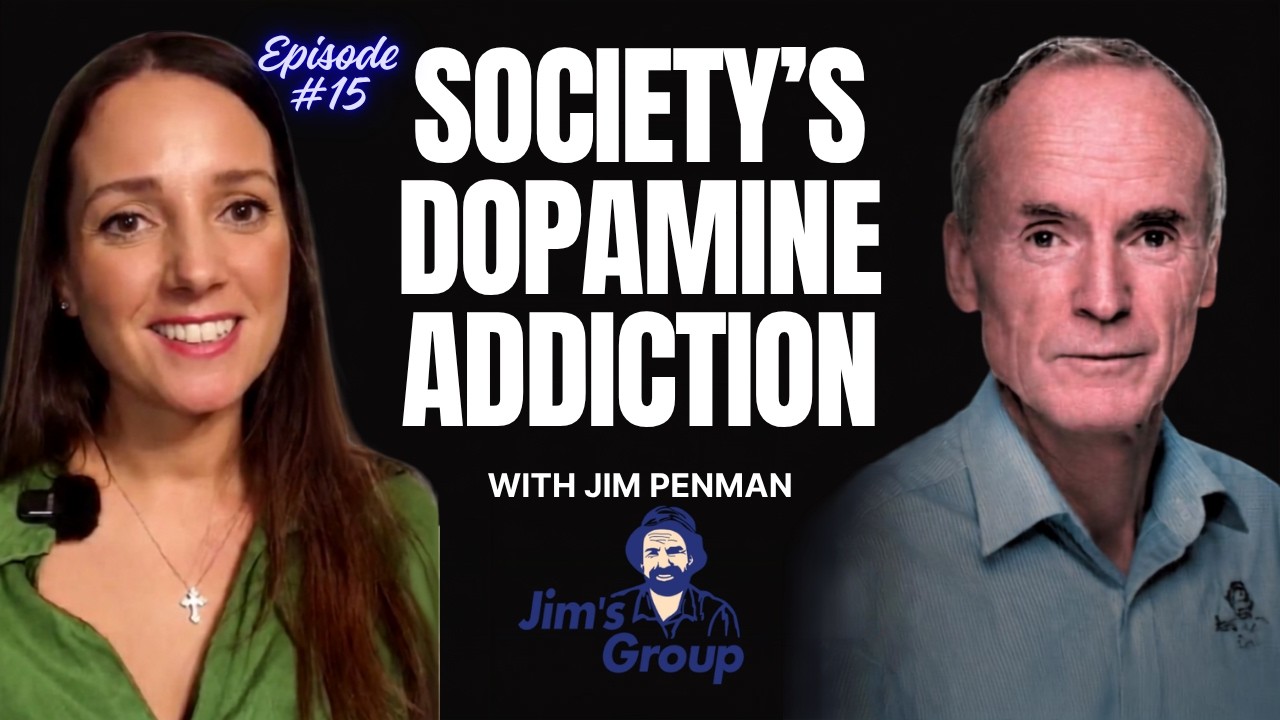
Jim Penman, founder of Jim's Group and a historian, argues that dopamine desensitization from modern life is driving declining birth rates globally. He discusses how fasting, lifestyle changes, and treatments like GLP agonists might reverse the trend, alongside the roles of faith and parenting in cultural renewal.
Chapters
In a sense, the whole of society has gone into kind of a cocaine habit, but it's not cocaine, it's just the modern world that's doing it. It's actually an entire collapse of the civilization. It's the same thing that happened to ancient Rome, but much, much, much quicker.
Jim Penman founded Jim's Group with 5,000+ franchises across Australia. He's also a PhD historian researching epigenetics and birth rates. Why are the global birth rates declining now?
If we continue as we are now, if we don't do anything, Drastic. Birth rates will continue to decline. If you look at the projections, they all show it leveling off. It's been declining, now it's gonna level. No, it's not. It's gonna get worse.
Jim explains how dopamine, modern life, and our choices are changing family, happiness, and society.
A little surge of dopamine. Oh, new car. I feel so good. I feel so powerful and important. I'm so rich. But it doesn't last. But your children, what you do with them, that lasts forever.
What does it look like in the future right now? Are these declining birth rates?
Not just the birth rate decline that's the problem. Things like mental health is going down, loneliness is rising, community is failing, and rates of deaths of despair.
But what if modern prosperity is actually making us unhappy and threatening civilization? Explain why people increasingly see that having children is boring or building a family is of low reward for them.
Brains become desensitized to dopamine, so they need more and more of a dopamine surge to feel happy.
What do you think are some of the most promising approaches What are some of the challenges that your team is looking at right now to reverse these behaviours and mindsets?
Okay, the first thing is to—
An Aussie icon. How could one man's friendly face become a household name? If you've ever seen a green trailer with a yellow face logo parked outside a house, you already know the man we're about to speak to. Jim Penman is the founder of Jim's Group, Australia's largest franchise network and genuine household name. What began as one man with a lawnmower has grown into over 5,000 franchises across dozens of services, touching millions of Australian homes every year. But Jim is far more than a face of the country's best-known franchise. He's also a historian with a PhD, a researcher deeply immersed in epigenetics, And the author of the forthcoming book Birthrate Crisis. In it, he argues the global collapse in birth rates is not just about money or lifestyle. It's riddled in how modern prosperity has changed our brains and our behavior. So Jim, welcome. It's so great to have you here.
Yeah, good to be here. That was a good introduction.
Thank you. Such an incredible honor and privilege to have you here to talk about such a fascinating subject. I've always had a great interest in the theory of nature versus nurture and how that kind of depicts human behaviours and people's decisions that they make. And can you briefly explain how epigenetics is linked to that theory?
Basically, people tend to see what happens in society as based on sort of impersonal, like, culture and institutions and government decisions. I think basically what matters is human character. The people have certain attitudes which reflect a lot of things, including the economy, including the government. And when you look at a thing like birth rate problems, with birth rate collapse, people say, oh, well, because you've got to have the right government rules and the government principles and the government payments and the government incentives and the economy and this and this and this. But actually, in fact, the simple— what it comes down to is how much do you like children? If you really, really like children and you want to be married and have children, you'll tend to have a large family almost regardless of your economic situation. And if you don't, and if you're more interested in other things like, you know, career and socializing and so forth, then no matter how wealthy you are, you won't tend to have children. That's the simple idea. And people find it hard to grasp, which is why country after country does the same thing. Let's give them more money, more money, more money, more money, more money. And none of it works.
Well, how does the idea of a dopamine desensitisation explain why people increasingly say that having children is, you know, boring, or building a family is of low reward for them?
Okay, let me give you an analogy to the way cocaine works, and it's more than an analogy. You take— somebody takes cocaine or heroin or something like that, they get an immediate rush of pleasure. And that's because it releases a big surge of dopamine into their brain. And they think, whacker, I've found the secret of eternal happiness. But then they have it again, and it's not so effective. And the more they have it, the less effective it is. What actually happens is their brains become desensitized to dopamine. So they need more and more of the dopamine surge to feel happy. And then ordinary things like friendships and work and family become less and less interesting because they don't They produce a little trickle of dopamine, but it's not enough to be satisfied. Well, in a sense, that's what's happening with the whole society. The modern world with all of its stimulation, with the junk food, with the excitement, with the stimulation, with the travel, with the portrayal of people with greater wealth and that level of competition and social media, all these things, what they do is they constantly buffet the brain with dopamine. dopamine. And the more that happens, even though it feels good to do that, it makes people more and more insensitive to dopamine. So dopamine has less of an effect. So if your brain is very sensitive to dopamine, which is more so in the past, then the little trickle of dopamine that you got from family, from children, from work was very appealing. Churchgoing, faith, those kinds of things, it really was enough to make you feel very happy and very confident and fulfilled. But if your brain is insensitive, as it so much is in today's world, then that little trickle is just not enough. It's boring. No, I want more. I want more excitement. So in a sense, the whole of society has gone into kind of a cocaine habit, but it's not cocaine. It's just the modern world that's doing it.
Yeah, that, that's wild how you can really, you know, put that comparison with a drug that you're, you're essentially saying society has become a drug to fulfill that dopamine fix that we do need. It's incredible. Wow. You did mention there briefly about religion and faith, and I know that, um, Jim, you, you were an atheist back in your early years, and, and, you know, over time you became a Christian, to the Christian faith. How do you think, um, that faith has influenced how you think about family purpose and, and the long-term future for societies?
I think it's more the other way around. When I was doing my studies as an atheist, I call myself an agnostic, but effectively an atheist. Yes, I turned my back on all the Christian values. That's all superstitious, the old age. You know, we're in the modern age. We don't need that sort of stuff. And the more I studied, the more I realized that there was very good sense to the kinds of Christian values, particularly in terms of restraint, in terms of not sleeping around, not doing those kinds of things that are you know, faith tells you not to do.
Yeah.
And, and I recognized eventually that was, that was point. And in a way, that, that helped me to come to God. It was quite sudden. It was like at the age of 28, it was like an overnight experience. So it was— it wasn't gradual at all in that sense, having a sense of God's presence. But I was, I was open to the, the potential and the possibility of it. In a sense, what religion is, is a kind of a what I call a cultural technology. And it actually helps you to do things that stops the rush of dopamine. And it says, you know, focus on family, focus on church, focus on fellowship, avoid these, you know, the drink and the drugs and the sleeping around, all that kind of stuff to avoid the dopamine surge things. And what that does, what faith does when it's properly occupied is to, to resensitize the brain. It makes people happier. And it's interesting, even though people think that doing all these things like the gambling and the sex and all the rest of it's going to make you happy, all studies showed that in fact it doesn't, that happy people tend to be those who have got good families, that the churchgoers, regular churchgoers, people who live a life of relative unselfishness, that they serve the community rather than just themselves, even though— In the short term, it always seems, hey, if I do the selfish thing, I'm going to be happier. It doesn't work out that way in practice. So what religion does is give you a blueprint for a better way of life, rebalances the brain.
Yeah, I mean, I believe faith and God is an interesting social concept to watch where, you know, there's been real true shifts in that pushback and pushback of religion and then families or individuals then returning back to faith. throughout my lifetime. And I honestly believe there are a lot of misconceptions around the perception of faith and the church. And so with your research, what do you find is a common link between society, religion, and their community connection?
Well, it's the same process, actually. The reason why, why a church, for example, or family or children seem less attractive is because of this insensitiveness of the brain. because our brains have been overloaded by these dopamine surges, they've become less and less attractive. And that's a sort of a spiral because, of course, if you, if church becomes, if faith becomes less attractive, then you avoid that behavior. You start doing things that bring on more dopamine surges. So it's because our brains are less sensitive to dopamine, therefore faith is less attractive, therefore we stop behaving in a way that limits the brain Dopamine, so just therefore we get more dopamine, so just so our brains become less sensitive in turn. It's a, this, it's a, it's a descending spiral.
Yeah, right. And I think there are a lot of misconceptions that people have on the church and have on faith, and, and it's exactly that— they, they feel restricted. Um, and that's what I'm hearing from, you know, a lot of people that have turned away from faith and, and God. Um, how would you combat that type of scenario with people and their mindset shift?
I think people have got to— first stage is to understand what's going on. That when you do things that produce that dopamine surge in the short term, you think, I'm going for happiness. Yeah, I'll do that because I'm happier. You know, the old saying, if it feels good, do it. That's actually a very, very bad guide to life. Because the things that make us feel good in the short term don't in the long term. So what part of this role is to try and help people to understand that doing things that you don't necessarily want to do right now, but doing the things that you think are right, actually, even though you think you're going to be less happy, in fact, you're more happy. It's like one of my daughters was talking about alcohol. When she was young, she used to get, you know, overimbibe a bit. But what she noticed is that even though in the short term it made her feel, you know, pretty good, she noticed that her mood overall was less. And that when she stopped drinking, her overall mood improved and she was happier. So it's a short-term, do what's right thing now for the long-term benefit. Look, it's the same as exercise, okay? You get up in the morning, like I get up in the morning, This morning, and I had a run. I did a half-hour run, did some weightlifting, stretching, then I had a cold shower. Now, probably if you looked at my absolute short-term enjoyment, I might have been better lying around in bed a bit longer. But I know that by doing that, even though it might be a little bit comfortable and challenging, I actually have a much, much happier life. And exercise does that. It's the same thing with diet. People think, I'll have this food now because it feels good. I'll have this chocolate, I'll have this cream cake, or whatever it is. Right now, I feel better. But in actual fact, in the long term, you're going to feel worse. So it's getting a unit of happiness now, but losing a lot, lot more down the track of it. So people can understand that process and say, yes, limit myself now. Stay off the social media. Stay off the alcohol. Stay off the junk food. Stay off the social media round robin. You make a little bit of a hit now, but you'll benefit across the whole of your life. And I want people to understand that. And of course, going to church, especially a strong church, one that challenges you, like you've got a sermon that really challenges you to live a better life, is a very big help in that. You might not even feel like going to church. I don't always feel like getting up and going to church, but I know that if I do, my life will be better. And that sounds very selfish, I know, but there's, there's altruistic reason for all these things. You know, I think God wants me to go to church, but still, the point of it is, from sheer happiness point of view, doing the thing that's right, that has the long-term benefit, is really, really much better for you.
Yeah, agreed, agreed. Definitely, I can relate to that. I, I have a church that I go to, and the, the sermons really touch my husband and I hard. And I think when it really resonates with you and you've got someone that you can connect with, it really helps with that. You talked a little bit about consumerism a little bit there, and I think over-consumerism, organizations, corporate has given us access to so much. We have so much available now, and all you need to do is walk into a shopping center and see every single store has the same products. the same colors. That overstimulation hits our dopamine too. What do you think corporates' and organizations' responsibility is in helping society lower our dopamine levels?
I don't think they will. It's not their interest, is it? It's just like Mark Zuckerberg and, you know, be more responsible and stop getting people to scroll through Facebook. But of course, that's how he makes money. And all these people are doing things like people who want us to gamble, people who want us to buy more stuff. They're all doing things to help their own profit. I don't think you can actually expect the corporates to do anything.
Yeah.
Where the corporates can help, of course, is if you can develop a treatment that'll help people to rebalance their brains and become more sensitive to dopamine. That would be a business enterprise which would probably make billions and billions of dollars. So in that sense, that's the kind of enterprise that could help people. But not the people who would— who are pushing this stuff on us. They're on the other side. Sorry.
They benefit financially from all of it. Can you explain how things like mild food restrictions can actually change the brain's dopamine system and how that might affect, you know, people's behaviour to— and drive to have children?
Yes, well, that does the opposite. If you restrict your food— I practice 16:8 fasting and also try and eat in a fairly moderate fashion too and avoid things like sweet drinks. If you do that kind of stuff, you're resensitizing your brain. It's one of the most effective ways to do it. So fasting is part of every religious tradition. It doesn't matter whether it's Buddhism, Christianity, Islam, anything. We all fast. That's part of it. So it's, it's the same technology. It's like an anti-drug. It's doing the opposite. See, one of the interesting things about is this too. People wonder about the baby boom, and this is a really classic example of this. Why did the baby boom happen? Why did the birth rates soar after the Second World War? Now, people say it's because of the Second World War, but it isn't, because actually mostly what happens after major wars is the birth rate drops. It dropped after the First World War, dropped after the American Civil War, dropped after the Napoleonic War. Mostly it drops. What causes birth rates to rise is depressions. And what seems to matter most of all is the late childhood, between the ages of 6 and 12. So the people who went through the Depression in that late juvenile period, in that 6 to 12 period, they were the parents of the baby boom. And they were, they loved family, they married early, they loved children, they had lots and lots of kids, they were very strongly into community. And so what happens is, because our brains are more sensitive at an early age, there's a certain age which is that 6 to 12 age group especially, where this dopamine system is set, this dopamine reaction is set. And if you go through a little bit of hunger, a little bit of hardship in that period, you are permanently in a better situation. Now you can change it as an adult, but it's harder.
Interesting, interesting. And yeah, wow, that's so incredibly fascinating. I think we have it too easy. We have a society, we have it really easy. Everything is so accessible. We're more disconnected than ever with each other, partners included, husbands and wives included. Like what you say, we're on these social medias and looking at other people's lifestyles, comparing ourselves with everyone else.
Yes.
What do you think are some of the most promising approaches that your team is looking at right now to kind of reverse these behaviors and mindsets?
The first thing is to explain to people how the brain works. Though, mind you, you could read 100 books on happiness, and the good ones will all say the same thing. Go for the long term, go for community, go for friendship. Don't be greedy, don't be selfish. Don't spend money on display, give it away. These are— this is fairly commonplace. Go to church. I mean, these are all things that are associated with long-term happiness. So we can Reinforce that and we can help people to understand the scientific basis. It's not just— it's not just being foolish, it's being sensible to do things, to take a long-term view of these things. But the problem is that the pressures in our society, in our extremely wealthy society, are such that behavior alone is not going to be able to turn things around. So what we're doing is working to develop treatments that'll do the same thing. So in actual fact, medications of some kind or epigenetic treatments that go directly into the mind, into the brain, and reset our brains in a more healthy way to try and reproduce the effects of what depression does without having to go through a Great Depression, which was very painful for a lot of people.
Hmm.
So it's treatments. And some of these weight loss drugs like these GLP agonists, have some of these effects. They do tend to make people less, um, less interested in, in food, obviously, um, less interested in drugs, in smoking, and those kinds of things. Um, even make them a little bit less, um, gregarious.
Mm-hmm.
You know, less interested in lively parties and so forth. I, I had a little bit of a try myself, just, just weight loss. I don't need weight loss, but I just did it. And one thing I did is I stopped biting my nails. which has been a lifelong habit. So that's another kind of effect that you see. Yeah. So what we— these drugs already seem to have some of these effects. What we need to do is to tweak them. And we're actually testing some of these on animals to actually see whether we can see improved maternal behaviour.
That's incredible. So is there a link there between the peptides that are available for muscle repair and weight loss? Is that the link?
Well, it just seems to be they have all kinds of effects, these peptides. There's so many different peptides that do all kinds of interesting things. They have to do with sleep, to do with exercise, to do with everything. But, um, yes, you've got to just try and focus on them. You don't particularly want drastic weight loss. I actually— I had to stop it after I had one small dose. That was it, because I lost 3 kilos.
Oh, wow.
It was too much. It took me months to get my weight back to where it should have been. But So you don't want the weight loss stuff, but you've got to try and work out how to get the more psychological beneficial, which would actually help you to lose weight. Because if you have— if your brain's more sensitive to dopamine, you don't feel so tempted by junk food and so forth.
Wow.
But the main benefit would make people happier, more connected, more— less anxiety, more close to people, better friendships, better families, those kinds of things. And I'm able to work harder too.
Yeah. And look, how does that in turn then— because I talk a lot about this in my show, about that connection, building your family back, having modeling great parental behaviors, and which flows then on to, you know, our children and how they want to become adults and parents in the future. With a treatment such as this, How would you see the future look for our children then to develop those same principles and models that our parents have shown us?
Well, yes, one of the best ways to achieve a more sensitive dopamine reaction is to have parents who are fairly consistent in their discipline. I don't mean harsh, not punishing, that's quite different, but just control in a loving, careful way, guiding children to behave in a certain way. And everybody knows that. widespread literature, that kind of parenting has the best success for adults, no question. They're more likely to be occupationally successful, more likely to have happy families, better, good parents, all the rest of it. They all go together. So what would happen actually, the treatment, people wouldn't take such a treatment because of the effect on birth rate. They'd do it because it makes them feel better. I mean, I have a life which is a very happy life. And a large part of that is because my life is very directed by purpose. So if you could have a substance that would help you to find a really strong purpose in life and build stronger social bonds with people, it would actually make you a better parent. And it'd also make you want to have children and enjoy spending time with your children. So it's a kind of indirect effect. And there's conditions like ADHD, for example, Which is something that should be very, very effective because what it does is help people to concentrate and to focus and to think long-term. And it's very good for work. So you notice that ascetic kind of groups like, you know, Mormons and Amish and so forth tend to be very hardworking. It's the same kind of attitude, the same kind of change. We want to produce that.
And so right now, how did you realize there was such a problem? What is the problem with the global birth rate decline? And what does the future look like from here?
If we continue as we are now and we don't do anything drastic, the birth rates will continue to decline. If you look at the projections, they all show it levelling off. It's been declining and now it's going to level. No, it's not. It's going to get worse because if you look at the attitudes of young people, the ones who aren't parents yet, they have less interest in children, less interest in families than their elders. So currently, the birth rate is going to decline further continuously. Like Australia, we're at 1.4 children per woman. You need 2.1 to— it'll be 1.1. It'll be 0.9. It'll be like South Korea. That's where we're going. But it's actually a lot worse than that because it's not just the birth rate decline that's the problem. It's things like mental health is going down. Loneliness is rising. Community is failing. Rates of deaths of despair from things like drug addiction and suicide, they're going to continue rising. Not only that, but you're going to have an effect on the economy. You're going to find economic situations, economy stagnating and going backwards because people start getting poorer because it's all part of the same process. So it's actually, it's actually an entire collapse of the civilization. It's the same thing that happened to ancient Rome, but much, much, much quicker. Because in ancient Rome, it was mainly the elites that were mainly affected. Most people were hungry at times, whereas now poor people are more likely to be obese. So we're in the same process of civilization decline, but it's going to happen very, very fast within, within your lifetime because you're a lot younger than me. You will see society going down a long, long way. You'll see negative economic growth.
Wow, that's, that's quite scary. Over the years, the government in Australia and globally, they've rewarded people with bonuses, financial incentives. Why do you think that has failed almost everywhere?
Because people aren't driven by money. They say they're not having children because they're concerned about the environment or because they haven't got enough money, but it's just a rationalisation. Look, I have a kind of mind that is very much in this mindset. I must have a very strong dopamine system because of my early experience in life and so forth. I started having children. I was a mowing contractor. I didn't have a house. I was actually in debt. My wife wasn't working. Now, you think about that. Here's a guy, failed PhD, no money, no house, nothing. Started having children as much, as quickly as I could. Now, I actually got more affluent with time, But it's because I love children. And before I was a father, I just loved being around children. I used to go back to the Belgrave Heights Convention where we put on a show for the kids, and it was just the greatest fun. I love— we did improv theater. I just loved doing that. And I used to teach Sunday school, and the kids from across the road were always across at my place. I just loved being around kids. Children just— And when I had my own, that was incredibly Amazingly joyful. I just love my children so much. So it was— it's easy to have a big family when you love kids like that. And because nothing else matters. I mean, really, obviously you've got to be able to make a living. But seriously, if you don't mind having holidays in a tent and, you know, buying secondhand clothes and stuff, well, you'll do what's most important to you. And that's what we've got to change. People have just got to want to have kids because ultimately they're the greatest joy in life and the greatest meaning in life. I got 10 kids and I love them to pieces and I miss them being little, I must say. That's great to have grandchildren coming along. I got number 6 on the way. So.
Lovely, lovely, Jim. I, you know, I'm the same. I can resonate. I've got 4 actually, which is quite a lot for someone my age. And a lot of people say, wow, how do you do it? How do you run your business? How do you You do everything. And, you know, I often hear people say, look, I'm just going to wait. I'm just going to wait till I build that house. I'm just going to wait till I get that job. And my husband and I didn't really have that mindset. We were like, all right, let's do it and make our children adapt to our lifestyle rather than us adapt to the baby. And I think having 4 at this day and age is quite a shock to some people.
It is, but it's joyful, isn't it? It's because that's what you want to do with your life. And if you look at the alternative, yes, I didn't have these overseas trips and I didn't have this fancy car and stuff, but what gives me the greatest meaning and satisfaction in my life? And it's not the stuff that produces very little surge of dopamine. Oh, new car. I feel so good. I feel so powerful and important. I'm so rich, but it doesn't last.
No.
But your children, what you do with them, that lasts forever. Yeah.
And so what practical cultural or policy shifts do you think that could be recommended in the short term while the science catches up?
Policy is very, very difficult because governments can do stuff all. That's really— they are almost helpless. I mean, you consider the case in China, okay? Chinese government, most powerful on earth, controls its citizens minutely. Now, they decided to have this one-child policy, okay, because they said it's becoming overpopulated. Now, they were foolish. They didn't recognize the fact that when you become wealthy, the birth rates drop naturally. But then people stopped having children, and they said, oh, this is going a bit too far, okay, so let's allow you to have a second child.
Oh wow.
And they waited for the birth rate to come pouring back. But you know what? The birth rate went down. And then they said, oh, this is really a worry. Now, no limits at all. We'd like you to have more than 2 children. And you know what happened? The birth rate went down. So really, in reality, the Chinese government is far more powerful than we are. They can influence all kinds of things. And they can't stop the birth rate declining. Vladimir Putin in Russia is doing everything he can to try and restore traditional values. The Hungarians are spending 5% of GDP. The government can do stuff all. The one thing the governments could do, which I hope they will do, is to fund research into basic neuroscience, because then we can understand the problem. The great thing about our current age— the worst thing about our current age is the affluence is what's making us sick psychologically. It's having a terrible, terrible effect. But the great thing about the modern age is that our science is now developed in a way that's completely beyond anything possible in history. We actually can reverse this. So governments do. I mean, I say the government, if you really want to have a concern about it, forget about baby boomers, just take, take 1% or a tenth of a percent of what you're currently spending on research and put it into this field. We're not talking about a lot of money, maybe $100 or $200 billion to develop the first stage of these drugs. And by that time, the drug company will take them up in droves because there'll be so much money in it. So yes, do some research. Find out. Help us to develop it. I'm currently spending a few million dollars a year developing these. I could do with a bit of help. My business makes good money, but it's not infinite. I'm a lot more famous than I'm rich. So yeah, put money into basic research. That's my request across the road. I think we'll do it. I really do. I'm very confident because people are panicking about it. You know, there's probably 10,000 people in the world that could afford to fund a research program like this. I only have to convince one of them and they say, yes, let's have a go at it. And then the problem would be solved. I actually think, strangely enough, it's more solvable than a lot of other problems. Like, I think problems like greenhouse gases and like threat of biological warfare and runaway AI, they are very, very difficult So this problem, even though at the present time it threatens our entire civilization and way of life, actually shouldn't be too difficult. It just needs a little bit of research.
And Jim, what's your views on the opinion that our urban and city areas are overpopulated, you know, where infrastructure and our properties are in short supply? Do we even have enough room in Australia, in the big cities, for more population growth?
Well, Australia is one of the least unpopulated— it's the least unpopulated country on Earth apart from Antarctica. I mean, really, we haven't got a lot of people. The problem with us is we cram into these big cities. But that's also part of this mentality. If you have a brain that's highly insensitive to dopamine, you need stimulation. So going into a big city with all the bright lights and the gambling and the socializing and the drugs and alcohol, all the rest of that stuff goes on, is very attractive. If you're like me, actually, and I don't like that kind of stuff, I actually live in a 5-acre lot on the outer suburbs. And if I want recreation, I don't go to the city, I go to my farm, which is half an hour, and I spend, you know, chopping wood and gardening. So in a sense, the overcrowding is a result of the mentality problems rather than the other way around.
Yeah, that's interesting because I do live in a city which is quite busy and we find that, yeah, it's crazy life. It's— you've got cars everywhere in the suburbia and in the city. It feels like overpopulation. But when, like you say, you can understand why people are attracted to that kind of lifestyle because it's that dopamine hit. What you're saying is people should just have a simpler life, live out on the farm, live out on open lands, and then you find that it's, yeah, more of a beautiful lifestyle change. Is that what you're saying?
Yeah, that's right. But I mean, deliberately choosing a quieter lifestyle is part of this whole process. But it's not just that. You have to do a lot of things. You have to control your diet, your exercise, your social life, your social media. Just get rid of a lot of the poisonous influences. Even things like soft drink, actually, it's deadly stuff. Having a can of soft drink is a really bad thing to do. It's bad for your health, but it's bad psychologically too. And also things like coffee too. And that's less obvious. That's not obviously harmful to physical health, but it's a potent dopamine booster. So I don't drink tea and coffee, for example, because you don't have that stuff. Caffeine is not good for you. It's not good for your soul. It's not good for your psychology. Because it both don't mean you've got to calm it down. This simpler food, you can still enjoy your food. I love my food. My wife last night cooked a very nice meal of vegetables and bean curd and stuff, and I finished it off with fruit, and it was a really nice meal. But no soft drinks, no desserts, this kind of stuff. I had some occasionally, but not very much. But that's what you've got to do. It's the whole of lifestyle. It's not just one thing. It's everything together. Even things like how you do it. Like, you know, we're fairly well off as you can probably imagine, but I still, tomorrow morning, I'll change the beds and do the laundry and hang it out on the line and, you know, clean up the kitchen and stuff. And it's just, it's not necessarily chop my own wood. It's just deliberately taking a lifestyle that's simpler than you could afford to have.
I really love that concept. I think it's beautiful. Looking ahead over the next 20 to 30 years, what does a successful reversal of a birthright crisis look like to you?
It'd be like it'd be like the hysteria over weight loss drugs, but more so because once people start to see the effects, they'll want this stuff because it'll be so good for them. They'll feel so much happier, so much better, and those who don't take them will be. lost in the dust of history. It'll become— and the birth rate will actually just rise of their own accord. Once this stuff becomes available, that's what's likely to happen. It'll be incredibly popular because it feels so good. You know yourself, if you've got a sense of purpose in your life and meaning and you enjoy friendships and so forth and you have this calm, quiet, contented satisfaction, you don't feel the anxiety, you don't feel the envy. It's a much better way to live. A certain level of personal humility, of recognizing your own faults and weaknesses, is part of that kind of mentality. It's also good for people financially. I mean, I have this extreme mentality, and I'm the most financially successful person in my family for many generations, because that helps me to focus on the things that are important, even though money has never been my main goal. It's more my research. Having that kind of mentality helps you to succeed in life in a way that makes you very satisfied. So I think so. I think the biggest problem we're likely to come up with is that we'll have too many children. The birth rate will start to soar. I think ironic as it may seem, we may have to consider what the Chinese government did in reverse with the one-child policy, not the one-child policy, but say limit people to, you know, 1.5 children each or something like that, because otherwise you get overpopulated very fast. I mean, what you don't want is population to double every generation. That would be disastrous. It's just the Earth can't comfortably cope with so many. So we should control population if it gets to be out of hand. I know it sounds very weird right now, but the implications of the research is that people would really, really want children. And people will want to have 3 or 4 children, and they'll start getting married much younger because that's what they'll want. So that can easily happen to the stage where you have to say, hey, we've got to— this is getting out of control. We can't afford to have population doubling all the time.
Do you think that would happen in our lifetime, that something like that where there would be overpopulation based on what the synopsis looks like?
Oh, I think it'll take a few decades to come through. You've got to develop the treatments first. You've got to have them tested. That takes a while. then people are going to start using them. And then the feed-through to the birth rate will depend on the younger generation. I mean, what people my age take doesn't make much difference. But if you're in your teens, for example— so it'll take a few decades to actually come through. But even if you just see the decline leveling off and then you see it start to rise, you say, hey, we're moving in the right direction. And you'll also see things like mental health issues improving, and you'll see the economy starting to pick up. Those effects will happen a lot more quickly. So I think there'll be a general improvement and there'll be less cynicism about government too, which is part of the problem about present age. People are more and more cynical about government and quite rightly because the government isn't able to do very much.
Yeah.
But it's a problem in society when people lose faith in government. I think you'll see changes even in my lifetime. I'm 74, probably another 20 years because I'm in very good health. Even in my lifetime, I would expect to see some improvement. In yours, I would expect to see a significant improvement. But as far as reforming a society is concerned, I think it's actually quite doable. It's one of the easiest things to solve because it's basically individual psychology. And because if we developed a treatment like this, people would want it. They'd be storming the pharmacies to get hold of this stuff. Yeah.
Yeah, I think you're right. Mental illness and depression is one of the most rising issues that we're facing, particularly here in Australia. And yeah, it definitely does have a lot to do with that lack of purpose, lack of identity. If there was something out there that people could hold on to to make them feel better, I'm sure, you know, it could go really, really far.
Yeah.
But it also comes down to family dynamic and, and what we're teaching our children. I, I truly believe that out there, what we have in society, particularly around social media and that influence that we have on television, for example, it's projecting that lifestyle of oversexualization, toxic behavior.
Yes.
And it's really interesting to see how that impacts You know, people's mindset and psychology and how they want to live their daily lives, it's quite a negative impact really.
Yes, yeah, we can do a lot already. This is the point too. Just a simple thing like if you've got kids, don't give them free access to smartphones at a young age. I mean, that's well recognized about how damaging that is. You know, a 13-year-old boy can get hold of the most vile porn on a smartphone. It's just It's freely available. It's absolutely disgusting, this stuff. I mean, that should not be possible. And then young girls especially have got caught up in social media, and there's all this cyberbullying and always envying other people and pictures of people, you know, happy and laughing and having a great life, and I don't have such a good life. I mean, it just creates misery. And all this business about likes— social media is toxic. It really is really bad. And I love my smartphone. It's fantastic. I listen to I use great talking books all the time. And, you know, it's great for my appointments so I don't miss things. But my goodness, it's so, so damaging. But so individuals can do so much to live a better life. And I think if you understand how the brain works and you understand the dopamine system and you see how all this other stuff fits together, it's not just one thing. It's everything. It's junk food. It's soft drinks. It's drugs. It's gambling. get-rich-quick mentality. It's the social media, it's the craving for likes, it's watching the lives of the rich and famous and feeling envious. It's spending on things we can't afford, which we think will make us happy when they won't. It's avoiding the kind of things. If we can understand how damaging that is, and then go for the things that really bring satisfaction, like faith communities. I'm a Christian, obviously, but it doesn't matter. It doesn't have to be Christianity. It can be Buddhism, it can be Hinduism, Islam. Some of the best people I know are practicing Muslims. Anything that gives your life purpose, family, children, faith, community, purpose, meaning. These are the things we've got to go for. And routine work, helping. You know, too many young men these days don't help with housework. That's really quite a bad idea. It's very bad. It's very bad for children to see that kind of pattern. Men should help, not just for the sake of their wives, but for their own sake and for the sake of the children seeing an example. My kids always know that, you know, when the meal finishes, we get up and do the washing up. That's always been the way of it. They've seen that from their earliest ages, so they understand that.
Yeah. What are your views on— I don't know if you've seen the manosphere influence for young boys. What do you think about that?
I find that totally toxic. The whole thing is subordinating women. That's a distorted idea of the past. A real man doesn't push down on a woman. He respects her as the love of his life. I adore my wife. I had a nightmare last night. I dreamt I was single and I was dating again. I woke up and my wife's next to me. I could just touch her. Oh, I was so happy. I think that the manosphere stuff is vile. It really is. It's just a terrible, terrible way to life. We don't become better and more meaningful lives by oppressing somebody else. We do it by stepping up to the best inside ourselves, which is to be the best husband, the best father, the best member of the community, helping, nurturing others. And these are largely female things, but still, that's very much— if you look back to the '50s, people did act that way. Now, admittedly, a man would go and work and a wife would look after the home, but that's a fair division of labor, for heaven's sake, because women, most of them weren't working. But if you're both working, a man should help. That is the— it is the absolute opposite to what the manosphere does. And women aren't putting up with it. They're not going to accept that. Why would they accept such a terrible burden where they've got to do half the work and all the housework and be subordinate and everything else?
Yeah.
It's not Christianity. And if you read what the Bible says, or any— it's not what that's about either. That's our tradition. It's the Judeo-Christian tradition. It's what Jesus taught. It's what we've been taught for 2,000 years. That, that's, that's the best way to live a good life, not this manosphere garbage.
Yeah, and, and it's interesting because you have the flip side of that as well, the feminist movement, which is pushing a little bit too far as well. And I talk about this quite often, about, you know, having that women's rights, which is absolutely fair, but that feminism movement that just really demasculinates men as well, where they feel less of a man, that has a large place in mental health as well for men. It's, you know, in my opinion, and let me know your thoughts as well. And I think having a beautiful balance of connection in both sides and sharing those responsibilities, having that beautiful balance at home where we're working together.
I do think that there's an element of— and I'm extraordinarily blessed. My wife is an amazing woman. She's Incredibly smart. She's also great at business. She helps me with the business and everything else. And she's no patsy. She's a very strong, real woman. Quite, quite, very excitable at times, to put it mildly. But at the same time, there is a sense in which she respects me as the head of the household. Now, in most ways, I'll do what she wants. Like, if you look at the furnishings in the house, that's her taste, not mine, I can assure you. But in really crucial things like You know, she wasn't a Christian. She comes to church with me. She follows her husband in that sense. Also, I have to say, we've got 4 children between us, and that's not something she would have necessarily decided, but it's something that I wanted. So in really crucial things, she does respect that. And I think that if you've got that kind of relationship where you love and respect your wife, but she also respects your leadership in some crucial ways, that's a A pretty healthy relationship. And look, I really adore my wife. Like, I'll go through the house, I'll pick up stuff from the floor because the dog's always making a mess, and pick up scraps, and I clean up the kitchen. And I'm always thinking, I'll do this for Lee because I love her and I want to do something nice for her. So, and I tell her I love her many times a day. So it's kind of, it's absolutely wonderful. But there is, there is in a sense where she does like the fact that I have very strong principles. She says like I'm a force of nature. I have these very strong goals in my life that I just can't be diverted from. And I think she— that's one of the things she likes about me. So that's a great relationship of a strong woman, capable, intelligent, principled, a husband who adores her, looks after her, serves her, does everything he can to make her life happy. But at the same time, The husband having some sort of leading role within the family is psychologically very good. And I think that's fundamentally what most men would like, but they've got to be worthy of it. You can't be a leader in the house by simply bearing down and ordering your wife around. That's toxic. That's bad. If you're the kind of person, if we follow the biblical injunction to love, as Paul says, love your wife as Christ loved the church, who gave his life for it, If you follow that kind of injunction, then you're somebody worthy of being a leader.
Incredible take. I love that. My husband often says, well, we talk about it at home, he's the head of the house, I'm the neck, and the children are the body. And we move all together to, yeah, really function and live. I love that. That's beautiful. It's really nice to hear.
One of the great things about Birthrate Crisis, actually, it's a co-work. The ideas are mine, but Andrea, my editor, has written it. She's actually put her own voice into it. And she's that kind of woman. She's a traditional woman. She loves children, would love to have even more than she has. She reveres her husband. She's just a great lady, a perfect example. And she's a regular churchgoer too. So we have very much the same values. She's coming out to see us. We've never actually met. She's coming out to see us next month to view the research.
Oh, wow.
She lives in Utah, actually. The whole family's coming out. It'll be so fun. Yeah.
Great, great. Look, the Australian way of life, I think moving forward for my show, what I really want to project here is just, you know, that beautiful sense of family again, that connection, building our old-school values, you know, old school, bring the village back. And I'm so grateful that you've, you know, shared your experience with me here on this show and your expert insight. It's been lovely to have you here. I really appreciate it. Thank you so much, Jim.
Yeah, well, that's great. Um, when, when the book comes out, we'll get you a copy. Birthright Crisis, in October it's coming out, so love to hear what you think about it.
Definitely would love to, to, to read it. Thank you so, so much. So, Jim, um, one last question. My brother, he's 45 now, but when he was 13, he did have a lawn mowing business And it was one of the things that really pushed him to be so motivated. And he's a very successful financial planner now. But yeah, in his younger years, he wanted me to ask you one question. In your gardening franchises, can you tell us what is the most reliable brand of equipment? And also, will you be sticking with power tools in the future with petrol, or are you moving towards battery-operated ones?
Ah, there's so many brands around these days. We used to use Honda motors. They were particularly powerful, but we're moving more and more towards battery. There's EGO, there's Palink, there's others. One of the problems with them is they don't have enough battery at the moment. So often what our guys do is use them for the battery-powered, for the, like the brush cutter and the blower, but they still use petrol. But as it goes along, I love battery stuff. I've got an electric car and I use everything electric if I possibly can because it's actually a bit more expensive, but it's easier, it's quieter. It's, you know, you're mowing a lawn and you can just go over a gravel pathway and you just take your hands off the grip and the blade stops spinning. I think That's where the future is more and more. It's great that he has that experience. I started gardening when I was 8 years old. How do you do it? How do you mow your field? You'll never guess what I use though. I do it on my farm, just the area around the house. I use an actual push mower, you know, the ones with no power at all. It's just one that turns the wheels by hand. I use that. Oh, you're joking.
No, you don't. No, you don't.
Isn't that ironic? I run the biggest lawn mowing company in the country and I actually use a push mower.
On your 5-acre property? Goodness me, Jim.
Oh no, not on 5 acres.
You've got to be kidding me.
No, somebody does that with a rider on. I just talk— it's just the area around the house, the small area around the house. I use that push mower sometimes.
Brilliant, brilliant. Oh, thank you so, so much. I appreciate your time today.
Yeah, I love talking to you too. Great interview. Thank you. Okay, God bless you.
All the very best. God bless you too, Jim.
More from Jim


Rising mental illness and falling birth rates have the same cause, it is this.....








