3-Part Arm Workout You Can Do At Home in Just 15 mins 💪
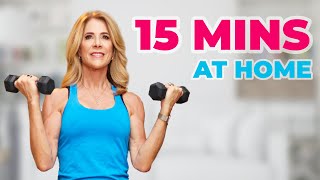
JJ Virgin shows a 15-minute arm workout using compound moves like push-ups, rows, and overhead presses instead of isolation exercises. She recommends 8-12 reps per set, three hard sets per exercise, and training arms three times a week. Hit 80-90% of failure, rest 1-2 minutes between sets, eat 30g protein per meal, and take creatine for best results.
Questions this video answers
As little as 6 reps up to 30 repetitions (multiple sets), with a common preference for 8–12 reps.
About 80–90% of failure (feels like you couldn't do another one or two).
At least three hard sets.
Three times per week is preferred; if only twice weekly, increase total sets (volume trumps frequency).
One to two minutes (not full recovery).
Chapters
When you think about strong tone, defined arms, you probably think you need to focus on bicep curls and tricep extensions. So it may surprise you to discover that these are exercises that I rarely include in my upper body workout. I'm going to share my 3 part arm workout that will make you want to go sleeveless even in the winter. And the strategies beyond the training that are mission critical for great arms. Now, first of all, I know I kind of threw a curveball there saying I don't do bicep curls and triceps, but I'll tell you why do big compound movements rather than what I call those little vanity movements. First of all, remember, when you're doing anything that's an upper body pushing or an upper body pulling exercise, you are working your arms right? Every time you are pushing, what works, your triceps have to extend your elbow. Every time you're pulling, what works, your biceps have to pull in. So when you do compound movements, let's say a pull up, yes, you can do it, or a pushup, you're pulling in more muscles and you're creating a much bigger metabolic effect. You're going to want to get to near failure if you are looking to build muscle or what's called hypertrophy. So let me explain what that means because I think most people have no idea what it really feels like to go near failure in a workout. If you're going to test how much you could really do, there's something called a 1 RM, a 1 repetition max. That's how much you could do one time. And everything's based on that. So if someone was spotting you on a chest press, it's how much you could get up one time and if you tried to do it again, nothing would happen. That's what failure means. Now, when you're trying to build muscle, the rep range kind of, it's very variable. Used to be when I was in school, a gazillion years ago, we were taught it, it was 8 to 15 reps. Now we know that you can do as little six reps, you could go all the way up to 30 repetitions, multiple sets. With the key thing being you want to make sure as you get towards the end of your rep range that you get to a point where you're about 80 to 90% of failure, where you feel like you couldn't do another one or two. So if you're like me, I don't want to spend all day at the gym, I'm going to work more in the 8 to 12 repetitions. And because I can get through it faster and I don't really like lifting something 30 times. Not so fun, right? But if you want to go lighter, you're just going to have to go longer. But you still have to get to that point where you feel like you barely are able to do another one. That is a super mission critical thing. You're going to want to be able to do at least three hard sets. So that means if I'm doing push ups, I'm doing at least three, three sets of hard push ups. I'm also going to do a warmup. So that's why I'm saying three hard sets. And for hypertrophy, it's really going to be better if you can do it three times a week. Now, if you could only do it twice a week, then up the amount of sets because volume actually trumps frequency. But frequency still matters too. But three times a week would be better. And here's what's cool to move things around, to shake things up, you can always adjust how much you weigh. If you lift, you can adjust how many times you lift it, right? The reps, you can adjust how fast you do it. So there's a variety of ways you can switch things up. Along with switching up the exercises, what you'll also want to do is in between your sets. Let's say I am doing three sets of pull ups or three sets of bent over rows. I'm going to want to rest for one to two minutes. I don't want to fully recover. I don't want to rest for 30 minutes. Because you are only going to build the muscle fibers you recruit. And if you let yourself fully rest, then you are going to just start to recruit the same old ones again. The more you don't let yourself fully recover, you pull in new fibers. So when you're going to start a workout routine, you want to make sure that your body is warmed up. So I call that the global warmup. What could that be? That could actually even be taking a hot shower. I kind of call that the cheating warmup. But it might be doing a little bit of cardio for three to five minutes. It could be doing jumping jacks, something to get your blood flow going and your core body temperature up after that as you're starting, especially if you're doing just here, I'm only showing you three exercises. You're going to want to do a targeted warmup. What is that? That means the easy version of the move you're going to do. So with Each of these ones, I'm going to show you how to adjust it to make it easier. And again, remember, exercise is progressive. It should never really get easier. So once you've done that warm up, you're going into those three hard sets. It should feel hard. That's how you get stronger and that's how you build muscle. So let's start first with a tricep. And I'm going to teach you how to do a pushup. And here's the thing, the great thing about a pushup is that you can adjust your pushup a variety of different ways to make it harder or easier. I'm going to show you the easiest way to start a pushup. And here's the thing, you could also just do this against a wall. So that's the easiest, easiest way. But the easy way to start a pushup is called a tabletop push up. Now, the more body weight that goes over your hands, the harder the pushup gets, the less the easier it gets. That's why a push up against a wall is going to be easier. And that's why in a tabletop push up, it's way easy because I don't have my body weight over me. So just to warm up, this could be an easy way to warm up. Right? It's just here. As you get ready to progress, I'm coming out here. Now, what you'll notice if you want to really focus on triceps, I bring my arms in closer, but I'm also doing more of a compound movement of my chest and my triceps. So this is an easier version, but I still have my body weight forward. What's important, however you're doing push ups is this is not happening. That's not a push up. That is a trunk something. I don't even know what it is. So what you want to do is come down and you really want to come all the way down. Tap that nose. Right. Coming all the way down. Beat. Oh, look what I have here. Thank you. Now that is the easier way to do it. Obviously, coming up onto your toes is going to be the harder way to do it. But again, important here is to watch this form as this does not sag. Right? So that is a push up. Why do I love a push up? Because I can do it anywhere. I can modify it and progress it. And I am now doing a push that works the front of my shoulders, my pecs and my triceps. Okay. So for your biceps, I'm going to show you a bent over row and I love bent over rows because it's going to use your biceps, your lats, your shoulders and your rear shoulders. But it also uses your quads and your glutes and your back. Now I'm going to also show you how to do this one arm at a time. If you have any back injuries and you're not able to do a full bent over row yet, obviously one of the things I'm doing is not using the weight that I would use to failure. So I just want you to bear that in mind when you're doing a bent over row. First thing I teach you to do is get into what I call well, I'm going to drop the weights to show this. Get into shortstop position. You want to be in a position where if someone came around and knocked my arm, I'd fall. So I'm right here. I've got my back extended so that I can use my back muscles, my quad muscles to hold me in this position. Then I'm going to start hands right by my knees and hands, my palms facing my knees. Again, my belly button is pulled up, my back is extended and I'm going to reach up and cup my ribs and come back down. So I do this rotation. And the reason that I'm doing this rotation or supination with my hands is because it involves more bicep when I do this. If this was problematic for you, maybe you're recovering from some kind of a back injury long term. This is fantastic because it's. We train to get better at life, not to get better training. And this is very good for you if you have to ever pick anything up off the floor, which who doesn't? However, to start another thing that you can do and I want to show you this because I see this done wrong at the gym and it makes me crazy. You can do a one arm row, but notice I'm not putting my knee up on anything. Instead I'm just like I was in the other position. I'm in a little bit of a tabletop. I'm going to scoop one hand in so I'm more like a tripod. Back is extended and I'm going to do the same movement. Now I've got my palm facing towards my leg and then I reach up and palm cups my ribs. And the other important thing here is I'm not sagging, I'm not rounding right. I've got an extended back so that I'm working the back of my shoulders, I'm working my lats and I'm working my biceps. So that is how you can modify it. If currently you're not able to do a freestanding bent over row, the next exercise is going to hit your triceps as well, but it's also going to focus on your shoulders. When we did a chest press, we got the front of your shoulders. When we did a bent over row, we did the back of your shoulders. Now we're going to work on, you've got three parts of your shoulders, anterior, medial and posterior deltoid. So now we are going to get all of them and we are also going to get your triceps because we're pushing. This is really important when you do an overhead press. And I'm doing it seated right now. And then I'm going to show you standing, and I prefer standing because when you're standing and doing an overhead pressure loading your spine, which is awesome, right, because that helps with bone mineral density. But I'm going to show you this first so you can really see the direction I go with my hands. And this is important because the way you see, most people traditionally do an overhead press, they go like this. And this can impinge something in your AC joint called there's a little bursa there and it can actually impinge that. So what I do instead is I pull my hands forward and as if I'm cupping my face and my thumbs are pointing in, my hands are in front of my body and I'm going to push straight up. This is where I'm starting. But again, my goal would be for you to do this standing. And you see how I'm doing this. Knees are slightly bent. I've got my spine supported, belly button pulled in and I'm not going back like this. That's important. Okay, so that's the halfway mark because that's the resistance training. But remember, resistance training alone is not going to get you there because there's the other side and that is the nutrition side. Right? You got to build them and you got to feed them. And how do you feed them? Well, you need protein because you need the essential amino acids from that protein. And then also you're going to want to have creatine and fish oil. So first off, protein. I have a protein cheat sheet that is going to help you figure out how to get the protein you need in at each meal and overall, and that is@jjvirgin.com protein cheat sheet. So that's the first part. And remember, you're going to get 7 to 1 gram per pound of target body weight of protein in 30 grams at least. Especially your bumper meals. That's super duper important. The other thing I want you to focus on is creatine. Three to five grams of creatine. If you're 120 pounds or less, then you're going to want to do three grams more than that. Five grams creatine is going to help you work out harder. It's going to help with muscle hypertrophy and bone mineral density. And fish oil has been shown to be anabolic as well. You need some carbs. And what are the best sources of that? I think we should be having two servings of fruit a day. I love berries. Fresh or frozen is best, right? Not dried. That's candy, not juice, that's a soda. And then lots of non starchy vegetables and a little bit of slow low carbs like I talk about in the sugar impact diet. The other thing that can help you is caffeine. And so a little caffeine before a workout can be a great ergogenic aid. Just like creatine, it can help you work out harder, have a lower, you know, feeling of perceived exertion. So, so that's really good. And the other one that I love to do, of course is I do electrolytes every day. I've got my electro replenish drink. You're lifting heavy, you're eating protein first. But that's not where you build the muscle. You build the muscle in recovery. And so what do you need to do to recover? Biggest, most important thing is to sleep. If you're not sleeping well, you're not going to have great arms. That's just the way it is. So good sleep, super important. I've done videos on this. I'll link to it in the show notes. Some other things that you can do to help red light therapy. One of the things that I have in my now biohacking lab at home is a joovv j o o v red light therapy. And what red light therapy can do is help you recover, help reduce inflammation and help improve your mitochondria. So that's one the next thing that can help cold. Now I have a cold plunge. This took a while for me to decide I wanted to do because I hate being cold. But also, you know, hey, it's an investment. You can always use a cold shower too or you can just dunk your face into cold. But here's the issue with cold. You want to be six to eight hours away from your training session before you do this cold exposure. Because when you work out you create some inflammation, you create some micro damage your body is now going to recover from. If you go into cold, you stop that process. So don't do it right after you work out. In fact, what I'll do is get up in the morning, meditate, have my coffee and then go cold plunge and then I'll eat, wait an hour or so, get my body warmed back up. I always wait an hour because I want to shiver for an hour and then I will go to the gym. Stay tuned because the next one up is my how to drop your body fat. My strategies for fast lasting fat loss. Check them out.








