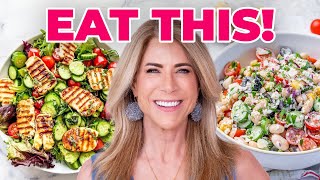
In this video JJ Virgin shares her daily nutrition framework, emphasizing a "protein‑first" philosophy and a curated list of five food groups she eats consistently. She explains why she chooses clean, lean animal proteins (wild seafood, pastured chicken, grass‑fed beef) and how she combines them with protein shakes that include whey, pea, bone‑broth collagen, and added supplements (creatinine, Mitopure). After protein, she fills her plate with non‑starchy vegetables—especially deep‑green leafy greens that support methylation—and mushrooms for their beta‑glucans and ergothioneine. She limits fruit to two servings of antioxidant‑rich berries (blueberries, blackberries, raspberries) for phytochemicals and fiber. Healthy fats come from whole‑food sources like avocado and extra‑virgin olive oil, providing monounsaturated fats and antioxidants. Fiber is further boosted with beets, lentils, chickpeas, and black beans, which also supply nitrates, folate, and low‑glycemic protein. JJ stresses tracking intake with a food app and scale, calculating protein needs (0.7‑1 g per lb of target weight), and structuring meals around the circadian clock (eating 90 min–2 h after waking, stopping 2‑4 h before bed). She walks through a typical day—from thyroid medication, meditation, coffee, a protein‑rich breakfast smoothie or yogurt parfait (with added creatine, Mitopure, fiber), gym green‑tea, a vegetable‑protein lunch salad, to a dinner of steak, mushrooms, cauliflower rice, and lentils—highlighting habit‑building over cheat meals. The video blends practical food prep tips, supplement rationale, and lifestyle habits aimed at satiety, blood‑sugar stability, gut health, and overall metabolic optimization.
Chapters
5 foods that I eat every day as a nutrition expert. I'll talk about my personal food rules, the foods I make sure to eat consistently, and my favorite ways to prepare them fast. Now let's talk what to eat, and I'm going to share my favorites that I regularly incorporate into my diet. And then after that, I'm going to walk you through what a typical day of eating looks like for me. First up, of course, is protein, and I go for clean, lean protein sources. I'm looking for where I can get the right balance of the 9 essential amino acids. I eat protein first, and here's I'm doing when I'm eating protein. I'm getting great satiety. I'm not as hungry, right? I'm getting great satisfaction. It helps with cravings. And of course, you need protein to detoxify. I try to about 3 times a week or more eat wild seafood. I do this for a couple different reasons. Number 1, cuz it's rich in omega-3s and seafood is really good for gut healing. And also I really love to get wild salmon because of the astaxanthin. It's a great antioxidant. So I try to get that in at least 3 times a week. The next one up is pastured chicken. The other thing I like to have for lunch is grass-fed and finished beef burger. And the reason I love grass-fed beef is it's a great source of B12 and B6, of iron and zinc, things that are critical for brain health, for your energy levels, for a great immune system. Plus, it's such an easy thing to cook up for lunch. In the morning, I'm generally either starting with a protein shake or I'm starting with Greek-style yogurt. And I rotate in now some dairy into my life, but I keep it to whey or Greek-style yogurt. If I'm doing Greek-style yogurt though, here's what I do. I get the fat-free and I stir in some of my All-in-One Paleo Protein Shake that's bone broth. So I'm gonna get some additional protein and collagen into it as well. The other thing that I'll do, and I actually had this for lunch today, was I did an egg and egg white scramble. Why do I do it? Because I'm not gonna get enough protein by the eggs alone. I'll push too much into fat. I love eggs because they're sulfur-rich, which is great for detox. They're rich in choline. What I did today is what I love to do. I got some deep green leafies. Threw in some mushrooms, scrambled it up. You can also take some of that ground beef that we were talking about and throw it in there too. That thing's called a Joe's Scramble. For protein shakes, I have a couple different that I like. I will use a little whey protein. If you are not dairy intolerant, try whey protein. It doesn't have the casein if you're doing the isolate, so it might be okay if you're doing that. I would highly recommend doing whey protein and stirring in some bone broth protein and getting the collagen as well. Or try a pea protein shake. Again, add the collagen in there. Now the other cool thing is it helps with skin regeneration because it's giving you these specific essential amino acids that you need for skin health, for rebuilding cartilage and restoring elasticity of the joints, for reducing pain and stiffness, and also good for your bones and might help reduce the risk of things like osteoporosis. So collagen for the win. After I put protein on my plate, the next thing I add in are non-starchy vegetables. So I eat protein first, non-starchy vegetables come second. Those are the ones like cauliflower or broccoli or Brussels sprouts. Now, I'm always looking for ways to get more fiber in. One, because we know that fiber is great for satiety. Number two, because it's so good for your gut microbiome. And number three, because helps you poop. So good for all of these things. The other thing, of course, that these do is support detox. And especially when we talk about deep green leafies, because they support something called methylation. And this is a super important biochemical process that involves the transfer of single carbon units to support DNA repair and then the creation of vital compounds and detoxification. And in fact, when you methylate well, it decreases the risk of genetic mutations and cancer development. So this is things like arugula, spinach, kale, chard. The other thing that I love to stir into my pilafs are mushrooms. Ever since I talked to Dr. Sarah Ballantyne about our Nutri-Score, I've been obsessed with mushrooms. Mushrooms are packed with nutrients like vitamins, minerals, antioxidants. What really sets them apart are their unique compounds, these beta glucans that support the immune system and heart health and can help support cancer treatments. And then something called ergothioneine, that's a potent antioxidant that protects cells from oxidative stress. And then there's these polysaccharides like chitin and chitosan that are known for their anti-inflammatory and cholesterol-lowering properties. Next up is fruit. I focus on getting 2 servings of fruit a day. Pretty much I stick with berries and I rotate between blackberries, blueberries, and raspberries. I love berries because they've got great antioxidants, loads of fiber, and a lot of vitamin C. Now blueberries I'm— I eat blueberries every day, and they are like just packed with phytochemicals, especially something called anthocyanins. Those are the natural pigments in the plant that's responsible for that blue color that have antioxidant and anti-inflammatory properties and can help protect your heart, your brain, and overall health. In fact, studies show blueberries have antioxidant and anti-inflammatory powers that support your healthy blood vessels and help control blood sugar. So, all right, now let's talk fat. When you're eating clean animal and seafood protein, it comes with fat. Now, I like to choose lean sources first, grass-fed beef, lean chicken, but salmon I'm not. Salmon, I'm actually really working on getting the fatty fish because it's high in omega-3s. And omega-3s are critical for your heart health. They reduce inflammation. They're big for your brain health. They help maintain the elasticity of your arteries. They help prevent excessive blood clotting, and they can also help lower cholesterol. Now, one of the ways you can tell if you have the right amount of omega-3s, cuz it's all about balance, is doing a test called an OmegaQuant. And you're really gonna wanna look at your omega-6 to 3 ratio of somewhere in the 4 to 1 ratio. Now, it turns out that you can also get omega-3s from grass-fed beef. And this is one of the big differences between grass-fed and finished beef versus corn-fed beef is that it will be higher in omega-3s. First off, what I do is, and this is where I use a food app, I see how much fat I got just from eating those clean animal proteins sources, then I try to add with whole fat sources first. What would that be? That's something like an avocado. When I look at an avocado, it's like a two for one because it's rich in fiber, which of course promotes great digestive health, regular bowel movements, helps with blood sugar levels, but also it's a great source of monounsaturated fats, specifically something called oleic acid, which is good for your heart and can help with normalizing cholesterol levels. Plus avocados are rich in antioxidants, vitamin C, E carotenoids like lutein and zeaxanthin. These can help protect the cells from free radical damage, might reduce the risk of chronic disease. And also there's a bunch of great nutrients packed into avocados: potassium, magnesium, vitamins K and B6, folate, and riboflavin. So you're just getting a lot of goodness. The other fat that I like to use when I'm looking at oils, I would pretty much stick with 3. I stick with extra virgin olive oil because it has so many amazing health benefits. It's predominantly made up of monounsaturated fats. Again, oleic acid like avocado, which of course can support heart health, can help reduce blood pressure and cholesterol levels. And it's got powerful antioxidants like vitamin E and polyphenols. And these compounds can protect your body, just like avocados, from that free radical damage, which is such a big deal in aging. Now let's go back to fiber. And the ones that I'll try to put into my diet are beets, lentils, and other legumes. Specifically, I'll do chickpeas and black beans. Now, I gotta tell you, I don't eat a whole lot of starchy carbs. I just don't really like them, but I really look for how to incorporate in these legumes and beets. Well, fiber, of course, we know can help prevent constipation, can help you feel fuller longer, can help your gut microbiome. And for beets, you're not only getting that, you're also getting these nitrates that can help lower blood pressure and improve your heart function. And then lentils, like lentils, when you look at anything for a plant-based protein source, lentils are the definite winner in the legume family. They're high in folate, manganese, iron, phosphorus. So they are really rich. And just like the other legumes are low on the glycemic index, super high fiber, and really good for balancing out your blood sugar. Here's the thing. If you feel like you're kind of outta touch, the first place I always start is with a food audit and committing to tracking. This is super important while you're getting new habits in place. Or if you feel like you kind of lost your way a bit. I gotta tell you, I still track what I eat and I literally travel with a food scale. It just makes it so much easier to stay on track. So I have a mantra, eat protein first. This is because I wanna make sure that you get your protein in. And I hear too often, oh, I didn't get all my protein and I got too full. First thing you do is identify how much protein you need, 0.7 to 1 gram per pound of target body weight. If you're not sure, go to jjvirgin.com/proteinfirst. I got the calculator there. Next one is upgrade your plate. I like to think of adding before you take away. My plate has protein, fiber from loads of non-starchy vegetables, maybe a little slow, low carbs, and healthy fat. And that really is a trifecta for satiety and blood sugar balance. So that's what you're going to see on the plate. Then make sure that you're staying well hydrated because quite often you've heard you're not hungry, you're thirsty, but even mild dehydration can actually make you store fat. And then of course, not only you're eating by the plate, you're also eating by the clock. And this is really important because when you align your meal timing with your body's internal clock to optimize your health— this is all Dr. Satchin Panda's work— it's eating with that normal circadian rhythm. This means that you're going to eat 90 minutes to about 2 hours after waking up, and you'll stop eating 2 to 4 hours before bed. This is going to be so much better for blood sugar control and insulin sensitivity, and it really ensures that you're eating food when you're most likely to use it. So now I'm going to walk you through what a typical day looks like for me. I wake up, go to the bathroom, take my thyroid medication, and do my Oxaline Pro scale and record it on my phone. Then I sit down and I meditate. Then I have a lot of black coffee. And about 90 minutes to 2 hours later, I will have either a smoothie or a yogurt parfait. My smoothie is made and I like to combine my different protein shakes. I have a pea-based and a collagen-inspired bone broth one. I like I like to mix them together, or I will do a yogurt parfait of Greek-style yogurt, and I put in my Paleo All-in-One Shake into that. I also add into that creatine, Mitopure, and fiber. And Mitopure is something called urolithin A that helps your mitochondria basically stay young and regenerate. Then I'll go to the gym a little bit later. My gym drink, I make a big green tea. Then I have lunch, and generally what I like to do at lunch is have salad. That's where I'll throw the arugula in, or I'll have leftover cauliflower rice and left— and my protein. And that's where I do some berries, and then I have a treat. Now, I'm a fast caffeine metabolizer. What I like to do as a treat is I use something called Living Ratio Cacao Calm, and it is this mushroom adaptogenic, no-sugar-added chocolate powder that I put into coffee. Then dinner. Dinner is always vegetables and protein, and a very common one would be a grass-fed, grass-finished New York steak with those sautéed mushrooms and onions with a little extra virgin olive oil, like I talked about, with some cauliflower peel-off, with any leftover veggies thrown into that, little lentils. And then if I want a little something-something after that, it's the berries, the dark chocolate, and maybe a little of the whip and RX Sugar. And here's the challenge. When they talk about the cheat meal or the cheat day, it just sets you up to fail. The bottom line is it's all about habit building. Start with what's at the end of your fork, skip the cheat days, and then watch this next video where I share the 5 daily habits to incorporate into your routine for easier fat loss and better muscle building at any age.