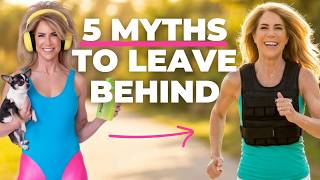
In this YouTube presentation, veteran fitness expert JJ Virgin addresses five pervasive myths that keep women over 40 from building strength, muscle, and metabolic health. She begins by challenging the notion that midlife women are fragile, then systematically debunks each myth: (1) fasted workouts are unsafe – citing a 2020 study showing no adverse effects for post‑menopausal women and emphasizing consistency over pre‑workout fueling; (2) a mandatory 15 g pre‑workout protein – explaining that total daily protein (0.7‑1 g per pound of target body weight) matters more, with 30‑40 g of high‑leucine protein around the workout window being optimal; (3) zone‑2 cardio spikes cortisol – clarifying that zone‑2 is low‑intensity, stress‑reducing, and beneficial for heart health, while recommending two HIIT sessions and one longer zone‑2 session per week; (4) only heavy‑weight lifting builds muscle – outlining the need for a spectrum of loads to develop strength, power, hypertrophy, stability, and mobility, and encouraging training close to technical failure across 5‑30 rep ranges; (5) under‑eating calories is the main problem – revealing that most women under‑consume protein rather than calories, and urging food tracking, macro auditing, and prioritizing 30‑40 g protein per meal. She then synthesizes actionable habits: increase NEAT (≈8,000 steps/day), perform full‑body resistance training 2‑3 times/week, incorporate HIIT, schedule one longer cardio walk, prioritize sleep and stress‑management, and shift the mindset from “exercise to burn calories” to “exercise for metabolic, hormonal, and muscular health.” The talk is framed with personal anecdotes, practical hacks (e.g., essential amino acid drinks, walking vest), and a motivational call for consistency as the queen of progress.
Chapters
Newsflash: midlife women are not fragile. They might be under-muscled, overstressed, and drowning in crazy fitness advice that doesn't apply to them. That's true. And today I'm going to be breaking down some of the biggest myths that are holding women over 40 back from getting strong, building muscle, and feeling powerful again. I'm frustrated about these because these myths create fear and confusion and decision fatigue, and they push women away from the very habits that would save their metabolism. Now, I've been in the fitness space for over 4 decades, really when it was all just starting. Yes, I was one of those aerobics instructors complete with the leg warmers back in the day. Now I have heard some crazy myths over the years, and sadly enough, I admit back in the day I may have even spread a few. I still remember the days when we were afraid of high-intensity interval training and you had to do cardio for at least 30 minutes at your target heart rate in order to burn fat, or you shouldn't even bother. And it feels like round 2 is happening, though this time I'm busting the myths rather than participating in sharing them. And the latest ones are really going after this 40-plus crowd. So let's talk about what actually matters and what you can stop stressing about. Okay, so myth number 1, you shouldn't work out fasted. Here's the reality. Fasted workouts are totally fine for most midlife women. There was a 2020 study that was published in the Aeneas de Academia Brasileira de Ciências. I know I killed that, but it looks specifically at postmenopausal women doing a 12-week multi-component training program. Things like strength and balance and cardio. Half the women exercise fasted, half exercise fed, and guess what? No negative effects from fasted training. Fasted workouts didn't worsen body comp, blood pressure, blood markers, or fitness outcomes. Here's the thing. Strength training, walking, low-intensity sessions, they don't need pre-fueling. If you're an elite athlete, different. But for a busy woman doing 3 to 4 workouts a week, this is not something you need to worry about. What you need to worry about is getting your workouts in, being consistent. Consistency is going to matter way more than the perfect pre-workout nutrition. If fasted trainings make your workouts easier to fit in, do it that way. Now, I will tell you what I did. So I tried fasted workouts for a month plus. I think it was actually more like 3 months. My workouts suffered. So I don't really like to work out fasted, but sometimes it's the only way it's going to happen. Now, if I am doing it that way, I kind of do a fake fast. I'll do in my water bottle my chiatine, my essential amino acids, and my Electro Replenish, and then kind of throw some collagen in my coffee and I'll do a yolked packet. Okay, so that's not fasting, but that's what I do. And then I just found for me it works better. So you do you, find out what works best for you. Myth number 2, you need 15 grams of protein before your workout. There's actually no scientific requirement for pre-workout protein. What they've seen over and over again is it's really daily protein intake that truly matters, that you get in at least that 100 grams. You want to dose it per your body weight, 0.7 to 1 gram per pound of target body weight. Now, having said that, doing some protein around your workout, like an hour or so before or an hour or so afterwards, that will help support muscle protein synthesis. What research shows is that for women, especially midlife women, the biggest driver of muscle and metabolism isn't when you eat the protein, it's getting enough protein throughout the day. But again, I would really emphasize, let's get some around your workout, because exercise makes your muscles more sensitive to amino acids for several hours. So get the 30 to 40 grams of high-quality protein. So it's rich in leucine around your workout window, and then get it throughout the day in your meals. So breakfast, lunch, dinner, right? And that's what's going to really move the needle for your strength and your recovery and your overall metabolic health. So that pre-workout, that's optional, not a rule. And if you find you feel better with it, like I just talked about, you can hack it. That's where I use my Amino Acid Power. I hack it with some essential amino acids. So There's always ways to break the rules. All right, myth number 3: Avoid zone 2, it spikes cortisol. All right, newsflash. Zone 2 cardio doesn't meaningfully raise cortisol. It's one of the lower forms of cardio because it's, it should be easy conversational aerobic, right? If it's, if you're raising your cortisol, you're probably actually into zone 3 or you're hungry. Zone 2 is kind of this metabolic sweet spot that that helps you burn fat and improve endurance without overstimulating your stress response. And what you'll find is that a lot of light cycling, walking, hiking, again, that zone 2, can actually lower stress. Now here's the thing though, you gotta know, if cortisol comes up during more intense exercise, which is what it should be doing, by the way, it's actually gonna help your body get even better at handling. It's gonna improve your overall stress response and resilience, and probably you'll have a little lower cortisol after. It's called hormesis or hormetic stress, right? It's why we lift weights. We do something stressful so your body responds by getting stronger. If you've got high-performing athletes with large training loads, hey, we gotta worry about this. But for most of us, that's not us, right? Now, what about zone 2? For the average midlife woman, I think zone 2 is a great thing for heart health. Now, if I had to choose, I'm gonna put high-intensity interval training as a priority over zone 2 because of what it does for, you know, lactate and your brain and your heart. But I think do 2 HIIT trainings a week and do 1 longer zone 2 cardio sessions a week. That's when I get on the StairMaster and I read Chick Lit. Full disclosure, I admit it, but it makes me wanna do it. I just get frustrated with these myths because I feel like they create fear and then you don't work out. And what I see with most women is they're not doing too much, they're not doing enough. Last thing I need to do is get you scared out of doing enough. All right, let's now go into the myths around lifting and under eating. Even more confusion. All right, so these are some places that you're really being misled. Okay, next one. Only lift heavy weights. Now I like you lifting heavy, but here's the reality. There's some people out there saying that you should only lift heavy weights. I think that's an oversimplification. It doesn't match the research or our physiology. Lifting heavy is important because it's great for strength and bone density, but we need more things than that. We also need muscle endurance. We need power. We need stability. We need mobility, we need aerobic capacity. So I worry about heavy because I worry that it scares people away. You have a higher injury risk and you're gonna have some gaps in your training. Remember, we're gonna need strength, we're gonna need power, we're gonna need mobility, right? We're gonna need hypertrophy. There's not just one tool here, but here's what happens. Remember, as we age, we lose muscle, that's size. We lose muscle strength and we lose muscle power. Now those heavy short sets, those are best for strength, but actually moving fast with more moderate weights is better for best for power. And moving with good volume to a point that you almost can't do the next one is best for hypertrophy. So you want all three of those, right? What's cool is we can build muscle with moderate loads as long as we take them close to failure. And what I call that is that place where you feel like your form's going to go if you do another one, right? That's to me what failure is. Don't blow your form. Technical failure is failure. And you can do that with tempo work, you can do that with bands, you can do that with body weight. Whatever it is, it's the heaviest weight you can handle in good form to anywhere from 5 to 30 reps. So let's not get all scared with the heavy. In fact, I've stopped using that. I used to say it all the time. I thought I'm freaking people out. What I'm going to tell, say instead is challenge your muscles, challenge your muscles. And again, you could build muscle doing 30 reps. You can build muscle doing 6 reps. You build more strength in the lower rep range, like 1 to 5 reps. And again, power is speed, but All of these things matter. You want to work across the spectrum. So you're building size, strength, power, mobility, stability, balance, all of that. Now let's talk about food and undereating. And this is another one. I mean, there's something in sports called RED-S and it's Relative Energy Deficiency Syndrome. And with athletes. Now, what I see with most women my age is they're not undereating. They're not undereating calories rather, they're undereating protein. They're snacking a lot. They're doing a lot of carbs, but not the carbs I want you to eat, more ultra-processed food carbs or like sugar in your coffee, skipping meals, right? Snacking instead of eating full meals. But the biggest thing I see across the board is not getting in enough protein. This is why I am absolutely vehement with my clients that you must track. Do a food tracking app. I love Cronometer. And get yourself a food scale because labels lie, and really do a little macro audit. Be curious, not judgmental. Just for a week or two, just really pay attention to everything you're eating. Are you getting that 0.7 to 1 gram per pound of target body weight of protein? That means that you should be getting like 30 to 40 grams at least at each meal, 100 grams or more overall. What types of carbs are you getting? Are you getting high fiber carbs? You want to make sure you're getting those. That's going to help you have the energy you need to work out. Remember, when you're doing a lot of resistance training and you're building muscle, carbohydrates get stored in the muscles' energy for the next time around. If you are tracking what you're eating, you will see if you are undereating or if the reality is you're undereating protein. I gotta tell you, I feel like these myths just paralyze women. They keep you from going, okay, I'm not going to lift, you know, I'm not going to walk, I'm not going to get enough protein. Like, all the stuff— like, like, let's get going. Let's talk about what actually matters for women over 40 and these simple, consistent habits that can build muscle and can build Brilliance. Because here's the biggest thing: consistency is the most important thing. Here's the real truth about what women over 40 really need. Number 1, NEAT— non-exercise activity thermogenesis. So we have 2 things in activity that impact our metabolism, and actually NEAT's the most modifiable. That just means you're moving more throughout the day. Get your 8,000 steps in, move more all throughout the day. Do resistance training to hit your major body parts— your upper body pushing, your upper body pulling, your hips and thighs, and your power core— 2 to 3 times a week. Make sure you're eating enough protein to give your body what it needs to stimulate muscle repair. When you're doing your resistance training, train close to failure. Get to that point where you might be able to eke out one more rep before your form goes, right? And do that volume so you build muscle. Throw in some high-intensity interval training. This is going to help burn off that visceral adipose tissue. It's great for producing lactate. That's good for your heart and your brain. It's great for improving your VO2 max. There's lots of good stuff there. And then, you know, throw in one longer workout session a week. Maybe you go for a long walk with a friend. That's one of the ways I like to make sure I see my friends. If it's someone— most of my friends are a lot shorter than me. I'm 6 feet tall. Like, most people are a lot shorter than me, so I have bigger strides. So I throw on a walking vest to make it harder for me. So that's one way you can do it if you've got friends that don't walk quite as fast as you do. Or use it as your time to read the guilty pleasure novels like I do. And yes, I do. I read the like most ridiculous chick-lit rom-com books. Full disclosure. Now you know. You won't be able to unknow that one. Sleep is where you build muscle. If you are not sleeping well, you will not be able to build muscle well and you won't be able to lose fat well either. And right along with sleep is stress. Now we wanna have exercise stress, that hormetic effect. It actually improves your body's ability to handle stress. But watch the life stress. And sometimes there's not much we can do about it, but change our body's ability to respond to it. Exercise is one way. I will tell you, when my son was in the hospital, nearly died in a car accident, I was using the stairs. I was doing HIIT. I was like, exercise saved me because I was— I felt like I could blow off the steam of the ridiculous stress that I was under. So find your bliss for how you can burn off the stress. Maybe it's Dr. Joe Dispenza with some meditation. Maybe it's some breathwork. Maybe it's a hot bath. I don't care. Find the thing that works for you. And then Do that and don't feel guilty about it either. I find that we women, like, we take care of everybody else and then forget about ourselves. Like, that's, that's like, we stop that now, right? I think, I know when you hit about 50, you go, yeah, I'm done with that. But if you're 40 listening, let's get done with that now. Okay, now here's the other thing I want you to do. This is like this big message I want to get out there. Stop exercising to burn calories. By the way, what they say you're burning on the treadmill or StairMaster, it's, it's BS anyway. It's not accurate, but stop it. You know, you exercise build muscle. You exercise to support hormones, longevity, insulin sensitivity, for all those metabolic effects, not for burning calories, okay? For the metabolic effect. And by the way, like, I hear about this, you know, overtraining, undereating. What I see out there, I do not see. And I think of 40-plus years of being in the business, working with clients, I've had very few clients overtraining. It's just, you know, not that common. Most of us are undertraining. I'm undertraining. I would love to work out more. By the way, poor recovery comes from not having enough muscle and being inconsistent, being stressed out, not sleeping well, not getting enough protein. It's usually not because you're overexercising. It's because you're underdoing all the rest of that stuff. So hopefully this gave you some clarity so you're not freaked out by all the stuff going on out there so that you can get to work consistently. Because here's the truth. We women, we don't need more warnings. We need more wins. Our problem isn't that we're doing too much exercise. We're doing too much of everything else. And then we're hearing too many conflicting things and we're like, okay, I just won't do anything. I freeze. Everything counts. Consistency is queen. And muscle is that magic that you've been missing. And I hope this has cleared up the confusion. If so, hit subscribe, share it with another woman who needs some clarity, and let me know which myth you are letting go of today.