Biohacking Mistakes - What You NEED to Focus on First!
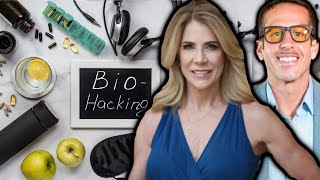
JJ Virgin and a biohacking expert argue that walking, ketosis, and resistance training are the real foundations of mitochondrial health, not fancy tech. Cold plunges should start at 50-52°F for women, building to 11 minutes weekly. Skip the saunas and red-light therapy until you nail the basics first.
Chapters
You know, people always want to know how to get your kids to eat healthy. I'm like, just eat healthy.
Exactly, be the example.
If you do it, guess what they'll do? That's what they know. Okay, over to mitochondria. So what is your approach? What are you doing to keep your mitochondria healthy?
I love talking about the mitochondria and learning about it too. In the book I have some interesting facts about the mitochondria when I started to dig into it.
Let's talk a couple of facts.
Yeah, let's talk about a couple of facts. Here, here's one fact: we get all of our mitochondria from our mother. So depending on your mother's health could depend on the health of your current mitochondrial state. Um, the cells in the body that are most required for survival are the cells that have the most mitochondria. For example, the brain— there are regions in the brain that could have over 2 million mitochondria in a single cell. The brain is required for thinking, you know, being able to survive, find your, your food. The eyes are also loaded in mitochondria to be able to see your predator. Uh, The ovaries are also loaded in mitochondria, the testicles, the heart. These are all very important for survival. There are hundreds of thousands of mitochondria. So that's how important they are. God put them in the cells that are most needed for survival and reproduction. They're bacteria, these little organelles that are really important for not just energy production. I know we learned that in high school biology class, the powerhouse of the cell, but they're also— there's an intelligence to the mitochondria where they act like surveillance systems for stressors and threats, right? So we know about long COVID, for example, people who got exposed to COVID, now they have symptoms even months or years later. That's a cellular danger response where they already had a high stress bucket. They got the stress of a virus coming in. The mitochondria saw that threat, lowered its energy production. This is why we feel tired when we're sick. The virus went away, but now the mitochondria got stuck in this cell danger response. Dr. Robert Naviaux calls it wartime metabolism. So we needed to switch that mitochondria back to peacetime metabolism. And one of the best ways to do that is moving your body, moving your body, walking. I know you're a big fan of walking. Walking is a great way to mildly stress the mitochondria, forcing it to adapt, right? Stress is how you improve mitochondrial health, but it needs to be stress that you adapt to, not just throwing in a cold plunge and a sauna if you've never done it before, you're going to feel worse and actually do more harm, right? So mild stress, ketosis is a mild stress, walking, and then you start adding in some resistance training. The more you could add some stressors to the mitochondria, the more it adapts, gets out of this wartime metabolism, starts producing energy, which raises your basal metabolic rate, which by default helps you burn more fat.
Nice. And I think the important thing there is too much stress, you'll die. It's the right amount of stress and then you adapt and then more stress and then you adapt. So it's a process to get there.
That's right. Hormesis, the process of hormesis. You stay in that hormetic curve, which drives me crazy in the biohacking space that we're in, right? Because we hear—
I'm not in the biohacking space.
Well, I am in the biohacking space. I'll identify.
There's a couple of things I love in the biohacking space, but I'm always fighting with them going, could we major in the majors before we major in the minors, please?
Right, and you spoke about that on my podcast and I agree with you. I agree with you. But what drives me crazy— I am in the biohacking space— what drives me crazy is we talk about cold plunging and sauna and PEMF. First of all, you're correct. Those are not the majors. Those are the minors. They're add-ons to actually after you do all the work. But you ask the average cold plunge coach, whatever they're called—
Is there such a thing?
I know there are some facilities that have cold plunge coaches. I don't know what their name is, but there is a thing. They're all over Miami.
Wow.
But you go to this cold plunge clinic, right? And you've never cold plunged and you ask the coach, "How long should I go for?" You know what they're going to say? 3 minutes. Every time it's 3 minutes. If you've never cold plunged before, should you do it for 3 minutes?
And what temperature are we talking?
Usually 39 degrees.
No, not for a woman.
Or even a man who's never done it.
You know what I tell a woman? First of all, it's 50, 52. I go, "Get in, get out." That's right. Get in, get out. That's all you're supposed to do.
You're smarter than all of the cold plunge coaches.
And I go, you may, like, you know, the whole point is to get in there, shiver and get out. Yeah.
Right, yeah, then if you do too much, you don't adapt, you feel wiped out.
Yeah, or you totally adapt and then you get no benefits from it.
Or that too.
That's what I was like when we first got our cold plunge. I just started distracting myself in there and I got myself to the point where I was doing like 12 minutes and we had it down at like 46. And then I was talking to— you must know Mark Sisson.
Of course. Okay, so Mark, he's down by me.
What are you doing?
Yeah.
Because that's not the point of it. He's correct. It's not, you know, but I mean, all the information I was hearing out there, I was like, more is better. No, more is not better. And it was so relieving, honestly, because now I'm like—
You don't have to do it.
No, I do 2 minutes.
Well, some of the research, and I put this in the book, shows that 11 minutes per week is the ideal range to hit for the mitochondrial uncoupling benefits.
Explain what that is.
That means you're helping your mitochondria produce more energy, at the same time lower its free radical production, which is key. Also the beiging of fat to browning of fat, so helping you burn more fat. Activating cold shock proteins, which again help the mitochondria. A lot of studies show when you accumulate 11 minutes per week at 59°F or less, so it doesn't have to be as cold as 39°F, it could be 58°F, 11 minutes per week, but you don't start there, you work your way there, and I wouldn't do it in one setting.
I would— I would think you're better off to do small settings than one 11-minute one anyway.
I agree, and that's how I do it personally. And I, I actually like my sauna more than I do the cold plunge.
Who doesn't like their sauna more than their cold plunge? We actually now have two saunas.
Which one do you have?
So we have the big Sunlighten. Yeah, we had one and we had to— we got a bigger one.
Yeah, so the Impulse is the Impulse. Yeah, that's the one I have too.
So we have that one for like 6 or 8 people. Wow, we're tall, right? So, you know, we took up a lot of space in that sauna. So they have that, and then we got one of those Relax, the fast heat ones.
I haven't seen those.
You'll see it tonight, I'll show it to you. So the sunlight, and I like to use that one at night, and so we'll watch Netflix in there. So that's kind of my rule, if we're watching Netflix, we'll get in the sauna.
I love it.
And plus you can do the sauna at any point, it's not going to interfere with your anabolic response to exercise, right? It's true. But in the morning what I like to do is 10 minutes to 15 minutes in the quick one, because the quick one, You know how you have to warm up? So the quick one goes immediately up to 180 degrees. And so, and it goes up to your neck. My husband puts a hat on and he puts this thing around his neck. I'm like, "I got to blow out. That's not happening." But I do it for 10 to 15 minutes, then I go get in the cold plunge. The cold plunge is right next to it. And sometimes I'll go over and do the red lights because I have the Joovv red lights. I just cannot tell if the red lights are really like— I can't figure out if these red lights are really doing anything or not. A mystery to me. Do you have any opinion on this?
Well, the research is pretty solid. I do them every day as well.
I know, it's a big challenge. You're like, yeah, I mean, you take creatine, you know you took it. You take like, you know, Mitopure or Qualia NAD+, you're like, I took it, I know, I can feel it. Red lights, I'm like, I don't know.
I think it's more of the cumulative effects, consistent use of it, that you might notice the effects, especially with like skin health. But I put a whole bunch of additional red light in my Sunlight Impulse. So I have the red light that comes with it, and added a couple.
I didn't know we could do that.
Yeah, well, Sunlight didn't tell me to do it. I did it on my own.
Yeah. Okay, well, we needed some coaching on that. Yeah, yeah. And then we have a hyperbaric in there too.
Oh, that's awesome. So you got quite the setup.
You see the setup? And then I built a gym upstairs.
So I love it.
It's basically— I created a retreat








