How to Take Creatine the Right Way (Especially for Women Over 40)
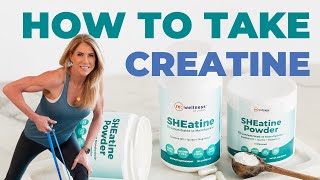
JJ Virgin explains creatine for women over 40, focusing on creatine HCl, which absorbs seven times better than monohydrate at a 750 mg dose. It acts as cellular energy, boosts brain function, and doesn't cause fat gain or hair loss. Track energy, focus, and body composition on a BIA scale to measure results.
Chapters
Congratulations on taking the big step, one of the most important steps you can actually take to start taking creatine. So I'm going to talk to you about how to take it, when to take it, why you're taking it, what are some of the best use cases, what to expect from taking it, and some of the questions that have come up. Before I do that, I want to give you a little refresher course just to remind you why you're taking it and what it is actually. So creatine is an amino acid-like dipeptide. The kidneys, the liver, the pancreas make about a gram of it a day from the essential amino acids methionine, arginine, and glycine. And we need another gram a day from food. And so you're going to get this from if you eat a pound of rare or raw red meat, that's the best one, or fish, or 2 pounds of cooked. The challenge is you're not going to get as much when you cook it because creatine gets denatured with heat and it moves from creatine to creatinine. We really want to have creatine. We have about 120 grams on our body, in our body anyway. We want to keep those tissue stores full because creatine is literally like your cellular, cellular battery booster. Now, where is it? So 95% of your creatine is in your skeletal muscle. This is where it teams up with a phosphate to form phosphocreatine. I want you to think of this as a turbocharged battery pack that can donate phosphate to spent ATP and instantly reload your energy, regenerate that ATP during hard contractions, sprints, or heavy lifts. This is why we know that when you take creatine You're gonna be able to work out harder. Now, the next thing that it does is it's an osmotic cell volumizer. When muscle cells stockpile creatine, they pull water and nutrients— that's super important— in with it, turning on genes for muscle protein synthesis, for muscle repair and growth. And this is why when you take it, you'll find that you recover faster from a workout. Creatine is also an amazing brain fuel. Neurons use that same— and about 5% of it, by the way, is in the brain— and neurons use that phosphocreatine shuttle I just talked about. So extra creatine can sharpen cognitive performance when you're under stress, when you're sleep deprived, deprived, or aging. And it's being studied now for dementia, for depression, for TBIs. And it also is a great antioxidant and mitochondrial support molecule. Creatine indirectly buffers acid, mops up reactive oxygen species, and helps stabilize the mitochondrial membranes, which is super important for endurance and the aging. But here's what it doesn't do, just to manage expectations. It doesn't just build muscle. You don't just take creatine, sit on the couch, and go, "Wow, look at me!" It's not gonna happen. But another thing it doesn't do is cause fat gain. We're gonna talk about weight gain, but know that it does not cause fat gain. It also doesn't cause hair loss, and it's also not a steroid or a hormone. Here's what you should notice when you're taking it. You should notice more energy overall. You should feel like you can work out harder, recover better. You should also feel— notice that you have more focus. And in your muscles, likely you'll also notice more definition because remember, creatine's osmotic, so you'll get a little bit of increased water in the muscle, especially if you're lucky. We'll talk about that in a sec. And that is why it's really important when you're taking creatine to make sure that you are using a bioimpedance scale to measure what's going on with your body composition when you start it. If you— when you are using a bioimpedance scale, remember you're looking at total body water, okay? And you're looking at total body water, which will predict your fat-free mass. If you are lucky, you may see your total body water go up and you may see your weight go up a half pound to a pound, and it will show up as more fat-free mass and a decrease in body fat. This is what physique models are hoping for. This is what people want to have because it makes your muscles look fuller. Now, this is not gaining fat, okay? Now here's the deal. There's a big difference between HCL, the form that I use, and creatine monohydrate. And I want to talk about that because it comes down to dosing. And so creatine monohydrate is absorbed at about 15% and the rest is excreted. But along with it getting excreted along the way, it cause some issues like GI distress, some overall bloating. So that good muscle fluid I talked about, you might just get overall fluid retention. Versus HCL, which is 7 times absorbed, so you only need a little bit—750 milligrams—as compared to the 5-milligram dose you'll hear that you need with creatine monohydrate. Now I want you just to think about that for a minute, because you're going to hear out there that creatine monohydrate is 100% absorbed. Well, the part that's actually in the bloodstream, about 15%, is absorbed, but the rest is excreted. That's why you need to take 5 5 grams a day. I just said earlier we need to get about a gram a day. So if you are absorbing— if you need to take 5 grams, why would you need to take it if it was 100% absorbed? You can do the math and figure out that's not— doesn't make any sense. So that's why we're using HCl. We're not going to have that excretion. You won't have that extracellular bloating, that fluid retention you don't want to have. You'll just get it where you need it. So this is another important thing here. Is you are going to want to take a foundational dose, probably around 750 milligrams of creatine HCL. If you're around, if you're 150 pounds or less, that's my foundational dose. You can do it in pills, you can do it in the caps, it doesn't matter, whatever your preference is. And as you're taking it, I want you to monitor 3 things, really important. I want you to monitor your energy levels. I want you to monitor your focus and your mood and monitor your your BIA on the body composition scale. That's super important. Again, you may see that your weight goes up a little bit. Most people, you're not going to see that, especially if we start to just titrate dose— the dose up. But the reality is, if it does go up, I'm jealous. This is what you want. If it goes up a little bit, it is because you have more intracellular fluid in your muscles And that's fantastic. It will actually make your muscles look more defined. It will actually help with muscle protein synthesis. It'll help bring nutrients into the muscles. This is what you actually want. But I like you to start with that foundational dose. Now, when would you crank the dose up? So 750 is going to be your foundational dose. When I take it up from there, and, and We wanna get your tissue stores up, so you're gonna use that every single day. If you are working out super hard, generally what I do is I go to the gym, I bring my big water bottle, I put in some Peak Green Tea in there, I put in my Electro Replenish, I put in my Essential Aminos, and I put in my Chia Tea powder. That's what I take to the gym. It's a big old thing. So I will do an extra serving on my hard workout days then, and I'll also do that when I'm doing my high-intensity interval training. If my sleep has not gone well the night before, or I'm switching time zones, if I had a poor night's sleep— it happens, especially because I have a new puppy— I will do another dose in the day. So I will do 2 to 3 doses if I'm doing a heavy workout and I'm sleep deprived. I might kick it to 3 doses. If I'm time zone adjusting and I know I'm going to be time zone adjusting, which obviously you, you likely know ahead of a trip, the day before I take an extra dose and then I start taking an extra dose for a couple days till I feel time zone adjusted. What's great about creatine is because 5% goes to the brain, you will hear, um, you'll hear about the research coming out with sleep deprivation, with with mood, with focus, with TBI. And it hasn't been studied yet, but it was obvious to me that jet lag would be a great thing for it. And so I've tested it personally. Oh my gosh, what a difference! Like, serious game changer for me, who used to really struggle with jet lag. So those are the different places. If I was under a lot of stress, I'd probably kick it too. But those are the different places that I would use it. Hold on. —start back here. Now it's being studied, the creatine monohydrate. Remember, monohydrate is just the carrier. What they're studying is how much is getting into the cells. So basically, whatever they're talking about getting into the cells with creatine monohydrate, take a seventh of that, and that's what you can use for the HCL. So they're studying it for neurodegenerative disease, for depression, at 20 grams. And so that would be 4 doses of ours. Now here's the thing. If you're taking that much, you might be worried about the taurine and the magnesium. I actually developed this product so you could take 4 doses a day totally fine. So do not worry about that. Now another one I get asked is, can my husband take it? It's called She-ateen. And you know, my husband actually named this product. All you have to do is put your finger over the S and guess what it becomes? Heatine. So yeah, it's totally fine for men too. If you do not want to share with your husband, then just say it's, it's chiotine honey, right? Um, the other big question is, can you take it if you have kidney issues? I have to have you talk to your doctor about that because again, you are going to be excreting some of this. So this is one you would want to talk to your doctor about. Remember, you might have a little transient increase in your creatinine. Creatine, um, gets denatured into creatinine, so you may see your creatinine go up a little bit. If nothing else changes, That's totally normal and totally fine. Now, I also have a creatine guide to go along with this that gives you a bunch of information and the research showing from a f-pharmak kinetics study the difference between creatine monohydrate and creatine HCL. So you can totally see that monohydrate is not 100% absorbed, it's about 15% absorbed. There is also a new study coming out. I I'm waiting with bated breath for that, where they looked at postmenopausal women and found that about 76— it was over 3/4 of them complained about GI issues and getting bloated from this. But again, I really want to stress, just in life, ditch the scale. Only use body composition. Use a bioimpedance scale and monitor that total body water. You want that total body water to go up a little bit because it will show that you've got more fat-free mass. That's what we're tracking. You'll see more fat-free mass when it gives you the printout You'll see less body fat. That's a big win. Super duper important. And again, any questions you have, what you can do is you can either DM me on Instagram @jj.virgin or you can reach out to customer service info@jjvirgin.com or you can ask my clone on the Reignite Wellness store. And the other thing is I would love to hear your chiatine story. So I'd love your feedback. If you bought it on Amazon, leaving a review there or leaving a review on our store, Boy, would I love, love, love to hear your success stories. I've already heard some amazing stories from people whose trainers at the gym were like, what the heck have you been doing? So I'd love to hear from you as well. And again, I think this is like, this is the thing that if I could go back and tell my younger self, do this thing, it would have been get on creatine already. But I'm glad I'm doing it now. And it's my mission to get as many of us on it and on the HCL so we don't have to suffer with those side effects. So happy creatining. I don't know if that's actually a word, but I look forward to hearing your results as well.








