I Walked 10,000+ Steps Per Day for 30 Days and It Worked!
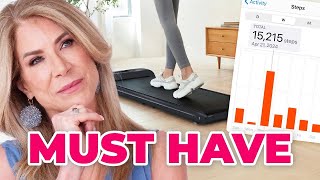
JJ Virgin explains why walking, though not exercise, is crucial for metabolism and fat loss. A 2020 study found 8,000 steps daily cuts death risk by 50%, and 12,000 steps by 65%. Adding intensity like faster pace three times weekly boosts visceral fat loss and improves cholesterol and glucose more than steps alone.
Chapters
If you've been following me for a while, then you probably heard me rant about how walking isn't exercise, and maybe you thought that because of that, I felt like it was a waste of time, but that is definitely not the case. While for most of us, walking doesn't fall into the definition of exercise, meaning that you're doing more than what your body's used to, so it has to adapt and get stronger, that doesn't mean it's not vital for your metabolism and It can play a strategic role in supporting fat loss while holding on to muscle. That's known as recomping. Walking is also hugely important in lowering your risk of death. Yes, walking is a big thing in reducing all-cause mortality. So I'm going to deep dive into walking in this video, and I'm going to share my favorite walking pad, how I use it, and what else you can do to get those steps in daily and increase your overall daily calorie burn, which is also known as your total daily energy expenditure. Now, there are 3 things that impact your metabolism. Your basal metabolic rate, or the amount of calories you burn at rest, and that's determined by your age, your sex, your genetics, and your muscle mass, which is really the only thing that you can change there is by adding more muscle mass or overall weight. And this accounts for about 50 to 60% of your total daily energy expenditure. Next is the thermic amount of food, which accounts for maybe 10% of your total daily energy expenditure, and the 3 macronutrients, protein, carbs, and fat. And of the 3 macronutrients, protein, carbs, and fat, protein has by far the highest thermic effect of food. It's 20 to 30% of its calories are expended in the digestion and assimilation of protein. Plus, as you know, protein supports your basal metabolic rate by helping you hold on to lean tissue when you're losing fat. The third thing that impacts your metabolism is activity, which includes both exercise and non-exercise activity thermogenesis. Now, exercise accounts for anywhere from zero— if you're not doing anything, doesn't count, right?— to 10% of your daily energy expenditure. So that means that activity is the most modifiable in this plan. This can be anywhere from 15 to 30% of your overall expenditure. So when you're looking to lose weight, bumping up your activity may be just the difference your metabolism needs to break through that plateau. Now when I think of NEAT, and there's some controversy about NEAT as to whether non-exercise activity thermogenesis is just stuff like fidgeting, things we don't really think about, but for the sake of this, I'm going to call NEAT everything from fidgeting to taking the stairs to parking farther away. Now we can't change the unconscious things like the fidgeting, so let's focus on what we can change, and that is our total steps per day and the intensity of them. So it turns out that the average person gets in about 3,000 to 4,000 steps per day, and your goal should be at least 8,000, and really in the range of 8,000 to 12,000. There was a research team with investigators from the NIH's National Cancer Institute, the National Institute on Aging, and the Centers for Disease Control and Prevention, and they looked at the association between step count intensity and risk of death in a broader range of the United States population. They used data on the physical activity collected by the National Health Survey. This was the NHANES study, the National Health and Nutrition Examination Survey, between 2003 and 2006. This study was published in JAMA, March 24, 2020, and what they found was that compared with people who took 4,000 steps a day, that was the average, Those who took 8,000 steps a day at the start of the study had a 50% lower risk of dying from any cause during the follow-up. And people who took 12,000 steps a day had a 65% lower risk of dying than those who only took 4,000 steps. Higher step counts were also associated with lower rates of death from heart disease and cancer. And these benefits, by the way, were consistent across age, across sex, and across racial groups. Now, step intensity didn't seem to impact the risk of mortality once the total number of steps were considered. Only an increase in the number of steps was associated with a reduced risk of death. But intensity can have some pretty cool impacts too. There was a study aimed at looking at intensity where they looked at two approaches to increasing daily steps. And they wanted to see how it would affect both body composition and metabolic health. And they did it with college students with obesity. So they divided these students into, into 3 groups. There were 32 people. First, they had the walking step goal group, and they were supposed to have 12,000 steps a day. Then they had the walking exercise group. They were given do 12,000 steps a day, but 3 days a week, go at a faster pace.. And then there was the control group. They were told to just do what they normally did. So they tracked the number of steps each participant took daily for 8 weeks. And here's what they found. There were no real difference between the walking step group and the walking exercise group in terms of how many steps they took. But there was a big difference in health improvements. The walking exercise group had improvements in their hip circumference, in their visceral fat, in their HDLC, in their fasting glucose, and their triglycerides. Whereas the walking step group only improved their HDL-C. And of course, the control group, nothing happened, which is what we would expect. So not only is having a walk and step goal helpful for overall health, right, but you add in a little bit of intensity to it, and I'm going to show you how to do that. It's more effective when you do that in improving body composition and metabolic health, and it may also reduce your risk for cardiovascular diseases. So what's the takeaway? Walking helps you not die, which is most important of all because the rest of this is meaningless if that happens. But adding in some intensity, it can also help with body composition. And I'm going to show you how to do that with my favorite piece of equipment. But first, let's look at how we can get those 8,000 to 12,000 steps in daily. And what I do first is I start with an activity audit. That is very simple. You know what you need? You need a fitness tracker like an Oura Ring or an Apple Watch, and you need a phone. And so what I have someone do to start is just track how many steps you're getting in each day. That's it. First thing you do is you get curious and you just track. Now, what you measure and monitor, you can improve. I find just tracking makes you start to become more aware and start to want more, and you can make this kind of fun and challenge yourself. My goal is wherever you're starting is to increase it 10% every couple days until you get into that range of 8,000 to 12,000, and then that's just your non-negotiable. You get that in every single day. So how do you get that in every single day? Well, here's some different ways to do it. Park farther away. So I go to a gym a couple days a week, and what I do at the gym is I don't park down at the lower level and walk into the gym. No, I park in one of the upper levels in the parking garage and I take the stairs. So I park farther away. Next one is, is to get a very needy dog, right? So that you have to walk the dog. Granted, that's walk, walk, sniff, walk, walk, sniff, but still gets you out. The next one is take the stairs wherever you can. So I have a two-level house, and when we were putting everything together, my office is on the second story, and I thought, oh, I should get an espresso machine in my office and a refrigerator for drinks. And then I thought, no, I should not. I should have to go downstairs every time I want to get something so that I'm getting up all the time. Plus, my office is right next to my gym, so I can go jump in there and get a couple steps on my walking treadmill, um, or on my Exciser. So make it so that you actually have to get the movement in. Now, the other day I was going to meet my girlfriend for coffee, and I thought about— and I thought, why am I meeting her for coffee? Then we're going to sit for an hour. Instead, I pinged her and I said, let's go for a walk instead. And what I did was when I met her for a walk, I also threw on a rucking vest, which I'll talk about in a little bit what that is. So here's how I do this at home too. I get more in, and again, because I'm measuring mantra, I'm making sure that I'm getting in more steps throughout the day. Now you've probably heard about these walking pads. A walking pad is basically a compact treadmill. Where the railing part can fold down. So last year I got this stand-up desk, and then I got a walking treadmill so that when I'm on conference calls, I can jump on the treadmill and I can work and walk at the same time. These things are pretty cheap. They're like around— a really good one, and I'll put the link to the one I have on Amazon, is about $350. Mine is a Eurivo 2-in-1. It goes up to 3.8 miles per hour without the guardrails up, which you're probably going, that's not much, but it is much when you're doing it for an hour or two on a conference call, because I'm going about 3 miles an hour because I'm literally still working while I'm doing this at my stand-up desk. Now, another way you can do this, because I just shared that study about how intensity improved a bunch of metabolic markers and improved body comp— obviously walking is going to help. Adding the speed, and that's what they did in that study, they had them increase the speed. So one of the ways you could do that is just walk faster, or you could do hills, but I live in Florida, so unless I'm going over to a bridge, there are no hills here. So what I've done instead is I got a rucking vest, and this rucking vest is super cool. So rucking vest is simply a weighted vest, and you might have heard some of them because they came from the military, military training where people are like 40 pounds. That is not what I'm talking about. I'm talking about doing— starting with it being 5 to 10 pounds. And what's cool about these vests and I'll, I'll put in the show notes which ones I got, is that I got one that goes from 11 to 20 pounds, and I can just add in weight. So I start at 11, if I want to up it, I have 1-pound weights that I can put in. You can get the one that starts at 4 pounds and goes to 10 pounds. It's probably a good place to start, depends how conditioned you are. My husband got the one that goes from 20 pounds up to 30 pounds. But these things are fantastic because it's a great way to add intensity. Right? And you're going to burn more calories, plus you're going to improve your cardiovascular fitness. And there's one other thing that it does for you— it also improves your bone density, which is fantastic. The one I got is called Aduro Sport, and again, it has weights, so you can keep putting in more weights as you go. And I would start, start slow and just add it in. So I'll put the link on that in show notes. But I just love this one, and this is also one that you could just wear around the house. It's just going to increase increase the amount of calories that you spend throughout the day. I have literally made it my mission to get in at least 8,000 steps a day. I'm actually now trying to do at least 12,000 steps a day, and I try to get in at least half of those before noon so that I'm not trying to play catch-up all day long. But I also love to get in a walk after dinner because that's going to help with lowering blood sugar, it's going to improve digestion, and it helps with sleep. Okay, so that's an easy one to do. And if you find that you can't go out after dinner because of where you live or maybe the weather, just walk around the house, right? Or jump on your walking pad, but do something. And especially if you can start to make the habit of getting in a little walk after dinner, that can make a profound impact. So now that you know the power of walking and how it can impact your overall health and metabolism, let's figure out— let's talk about how to keep your metabolic Fire Burning, which is the next video where I'm going to share the best foods to support a healthy metabolism. I'm sharing exactly what to eat to fuel your body and feel energized all day long, so you'll always be primed and ready to get those steps in.








