JJ Virgin FULL BODY STRENGTH Workout. 15 Minutes ONLY - Follow Along
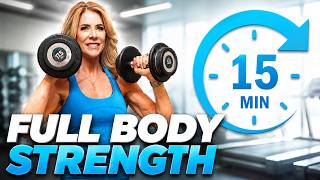
In this 15‑minute follow‑along video, JJ Virgin guides viewers through a full‑body strength routine built around five compound movements: a dumbbell goblet squat, bent‑over row, Romanian (stiff‑legged) deadlift, bridging chest press, and standing overhead press. She emphasizes proper biomechanics—hip‑hinge, glute activation, shoulder‑blade retraction, spinal loading—and pairs each exercise with breathing cues (inhale on the eccentric, exhale on the concentric). Throughout, she frames the workout as functional training for "better life" rather than just gym performance, stressing progressive overload (more sets, reps, or weight) and consistent twice‑weekly frequency. JJ also highlights broader health benefits (cardiovascular fitness, VO₂ max, bone density, metabolic and mental health) and encourages community engagement via her Facebook group and channel subscription.
Chapters
If you're looking for a workout to keep you fit, lean, and energized, you are in the right place. Today I'm gonna break down one of my favorite full body workouts. This is an exercise that's based on compound movements that are very similar to the things we do in life. Because again, we are training not to get better at training, we are training to get better at life. We are going to start out with a dumbbell goblet squat. But before we grab the dumbbell, the first thing we gotta do is make sure that we're squatting correctly. And I'm gonna I'm gonna have you do the squat maybe a little differently today. I always like to do it over a bench so you can tap down to see where you're at. And I'm gonna have you just stand a little bit wider than hip width and just rotate out slightly from the hips. As you do this, you're going to focus on two things. You're gonna focus on your heels and your glutes. And you wanna keep your chest upright. So always focus on something above me. So I keep looking up. Mm-hmm. And then I'm gonna sit back as if I'm sitting down into a chair, right? And then come back up. So that's why I like to have that bench behind me so I can make sure that I'm hitting my mark. So you're sitting down as if you're sitting into a chair and coming back up, sitting down as if sitting into a chair and sitting back up. So as you're doing that, you should be able to feel that you can pull your toes up off the ground. You're sitting into your heels, you're keeping your chest upright. Mm-hmm. And you're sitting back and really hip hinging. The movement's happening through the hips. It's not happening from the knees. It's happening from the hips. So that's the first part of it. Before you ever grab a dumbbell, make sure you have that piece together because when you add weight, you're just going to unveil any issues that you would have with form. And we never sacrifice form to go heavier weight. That's what the gym bros do. We don't do that here. Yeah. So here's how we do a goblet squat with a dumbbell. You're going to start by holding it up here. Now, what's great here is we are putting a little bit of load on our hips with this, but we're also having to focus on keeping our chest upright. This is going to try to pull you down. You're going to work against that to keep your chest upright. So we're keeping our chest upright as we're coming down and back up. And again, I should be able to lift my toes up as I'm doing this. And I'm driving through my hips. So I'm hinging back with my hips and pulling them forward, hinging back with my hips, pulling them forward. As you get more comfortable, you can pull the bench away and you can even come down lower. But this is the starting point to make sure we nail it. And again, start first with nothing, then add a small dumbbell and then build from that. I always like to go low and slow and then build up from there. And by low and slow, I mean with how much resistance you do. You wanna progress and build, but if you go too fast and you get injured, then you're sidelined and no one wants that. So where should I be feeling this? The biggest place you wanna be feeling that is in your glutes. You're really working on driving your glutes right now. This is a full-body exercise. You will get a little bit happening in your quads, your calves, your trunk, but really the prime mover here are those glutes. So that's what you want to be focusing on. So if tomorrow your glutes are a little sore, good on you. The next exercise is a bent-over row. So this is an upper body pulling exercise. That means we're going to use your lats, those are that V-shaped muscle behind you that pulls you back. We're going to use your biceps. Anytime you pull, your biceps have to work, and we're going to use the back of your shoulders. Now, let me give you a little bit of instruction before we go. When you're doing this exercise, the first thing I want you to do before you grab the dumbbells is just slide down, stick, just like we did with the squat, stick your glutes back. So we are hinging at the hips coming down. Mm-hmm. And from here, we are using your back extensors and your abdominals to hold you in place. Take your hands, drop them, keep them close to your body. You're going to have your palms facing your legs. Then you're going to pull your palms up, frame your chest, squeeze your shoulder blades together, and bring it back down. I am not moving my trunk. I am pulling my shoulder blades back together and opening up my shoulder blades, just up and down in this movement. So that's the first thing. You're going to have an isometric contraction holding you, back extension, deep abdominals, quads, glutes, all have to work to hold you steady. And then you're doing the work through your lats, your biceps, and the back of your shoulders. Okay. Why do I like this so much? Because we have to pick stuff up off the floor. Right? So it's very much like life. So see how I'm rotating when I do this and not moving through my trunk. I'm moving through my shoulder blades. And when you do this, focus on the exhale, on the exertion. I've always put the two together. So I'm inhaling on the way down. Exhale up. Inhaling on the way down, exhale up. All right, bent over row. Next exercise is really going to put the emphasis on your glutes and your hamstrings. There are a variety of different ways to do the exercise called a deadlift. The way we're going to do it is something called a Romanian or stiff-legged deadlift. We're doing it this way because of the emphasis that it places on your glutes and your hamstrings. And your hamstrings specifically, because those are hard to get at home. So what you're going to do with this one is your legs are bent, but stiff. That's the way to think of them. So don't lock them out, keep them slightly bent, and you're going to come down. as low as you can without bending your back, without rounding your back or straightening your legs. So your legs stay just a little stiff. And to start with, all you do is slide your hands down to where you have that natural stopping point. You'll feel a big stretch in your hamstrings. Squeeze your glutes, squeeze your hamstrings to lift you up. So down, squeeze your glutes, squeeze your hamstrings to lift you up. Now, I like to do this with a slight rotate out at the hips, just a slight, because I find that it helps me pull in my glute medius too. Important thing here is we're not swinging the weights out. We're keeping the weights close to the body as we do this so we don't put any stress on the low back doing that. But I want you to think of the biggest thing happening here is a hip hinge. And again, when you're coming back up, you should feel your glutes and your hamstrings. On this one, you're inhaling on the way down, you're exhaling on the way up. When you're coming up, you're really thinking of squeezing those glutes. Hinge, squeeze. Hinge, squeeze. Hinge, squeeze. Hinge, squeeze. Okay, now that your glutes are warmed up, I'm going to show you a way to do a chest press that's fun because it also works your glutes. And it's got to have your spinal stabilizers kicked in too. And so one of the things I like about free weights is number one, we're not bolted to the floor, right? So this is more like real life, but also your nervous system and your muscles have to really communicate here to keep you solid, especially with what we're about to do. What we're about to do is a bridging chest press. Now you can do a bridging chest press off a bench, or you can do it off of one of the big stability balls. So whichever way you wanna do it is fine, whatever you have access to. Is fine. I'm going to show you with the bench because it happens to be behind me. All right. So the hardest part of this exercise probably is getting in position. If you have a partner, way better because they can hand you the weights. You don't have to do what I'm going to do now, which is kind of walk out. Because where you want to hit is right so that you have to use your glutes to keep you upright. So right now I've got my glutes up. So my glutes have to work isometrically to hold me in place and to keep me balanced, right? And then I'm doing a triangle over my chest. And the important thing here is do not let your butt drop. So you're squeezing your glutes the whole time. And you're doing a triangle over your chest. So again, the exhales on the hard part on the way up. Inhale down. Exhale up. Inhale down, exhale up. Inhale down. And you can see that I'm doing a nice full range of motion, but no bouncing. Once you've done that, easy enough to drop the weights. And drop down. The final thing is a standing overhead press. I'm going to show you a way to do them that's different than probably what you've seen. Now, why do I love a standing overhead press? Because when you push up overhead, you load your spine and hips, which is really good for bone quality, for bone mineral density. So I'm going to start with a little flex in my knees and I'm lifting my spine. So I've got my chest lifted up. Then the thing I'm going to do is I'm going to bring my thumbs to my shoulders. This is different than probably how you've seen an overhead press, and I'm pushing up overhead. They stay in my peripheral vision as I do this. And the reason I do this and not that is this is hard on your AC joint in your shoulder. It actually can compress a little pillow bursa you have there and cause some shoulder pain. So I always do it in front. And if you do it correctly, look at my range of motion here. It's slightly in front of the body. Mm-hmm. Right? It's not back here. That's wrong. You should be able to see it the whole time. Now you'll never have as much power here as you do in your chest. Much smaller muscles. This is upper body pushing, but it's focused on the upper traps, the shoulders, and the triceps. And then of course we're loading the spine and the hips with the weight. The reason I like this exercise is because in life we put things overhead, like in the airplane. So it's very useful. All right. So we just rolled through a goblet squat, then we did a dumbbell bent-over row, then we did a deadlift, stiff-legged or Romanian, then we did a bridging chest press, and then we did an overhead press. Ideally, you do this 2 times a week and you do multiple sets of each exercise. There's a couple different ways that you can do this. You could just roll through the whole thing 2, 3, 4 times, or you can do one exercise at a time and roll through it a couple times, or you can superset. You could do a goblet squat alternated with an overhead press, and you could go back and forth. Whatever you want to do, mix it up. The most important thing is that you progress. So as you're doing this, you're continuing to make it harder. You're either doing more sets, more reps, or lifting heavier weight. Because the way that your muscles get stronger is you do more than what you're used to, so they have to adapt and get stronger. And that you're giving yourself at least a day of rest in between. So maybe you do this Tuesday, Thursday, or Tuesday, Friday, but this will hit all of the major muscles. And it also is going to be good for your cardiovascular fitness, your VO2 max, your bone mineral density. So lots of good things in a very small workout. Come over to my Facebook group. It's the JJ Virgin Lifestyle Community. We're all in there. My coach is in there. My clone is in there. So it's a great place for camaraderie because Who wants to do this alone? It's no fun. And you get much farther when you go with friends. And if you love this video, stick around because I have everything built around optimizing your body composition for better metabolic health, better mental health, and living healthier longer. So be sure to subscribe, like, and hang out for the next video.








