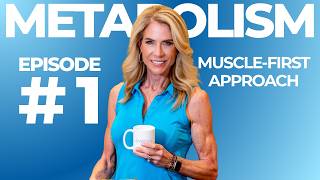
In this launch episode of a new YouTube series, JJ Virgin addresses women over 40 who struggle with weight loss resistance. She announces a Metabolism Makeover Bundle giveaway and outlines a paradigm shift from scale‑centric dieting to a muscle‑first, health‑first approach. Virgin explains how traditional calorie‑restriction and excessive cardio strip muscle, leading to metabolic adaptation, slower resting metabolic rate, and fat‑overshoot after diets. She cites research (Obesity Reviews, American Journal of Medicine, Frontiers in Physiology, NEJM) showing that muscle loss during dieting can be 25‑40%, that higher muscle mass correlates with longevity, and that resistance training improves insulin sensitivity and releases anti‑inflammatory myokines. She emphasizes that muscle can be built at any age, counters the myth that metabolism crashes after 40, and encourages viewers to focus on body recomposition rather than weight loss. Practical calls to action include subscribing, commenting, and preparing for the next episode on nutrition for a muscle‑first metabolism. The tone is enthusiastic, instructional, and promotional, aiming to empower midlife women to rebuild muscle, improve metabolic health, and age stronger.
Chapters
Hey, it's JJ Virgin here. I am beyond excited to kick off a brand new series. It's designed specifically for you, the 40+ year old woman ready to take back her metabolism and age powerfully. Now, to celebrate this launch, I'm doing a super special giveaway. I'm gonna be giving away an exclusive Metabolism Makeover Bundle. Here's what's got in it. First of all, it's got my new Take Me to the Gym Kit, which of course has the most important chiateen, powder, my Amino Acid Power powder and Electro Replenish, and also my plant-based protein powder that has the essential amino acid profile that mimics whey protein. Super cool. I'm even including some helpful tools that are going to be revealed after we choose the winner, and they are big. All you have to do is subscribe to my channel, hit the like button, and drop a comment below about your biggest metabolism question or goal. Now make sure you've got notifications turned on because you don't want to miss a thing. This series is all about empowering you with the latest science-backed strategies to build muscle, balance your hormones, heal your gut, and finally break free from weight loss resistance. Remember, you gotta get healthy to lose weight, not lose weight to get healthy. So let's get you healthy. Let's get you strong. And let's get you feeling unstoppable. And good luck on the giveaway. I cannot wait to read your comments and hear what you would love to achieve. Welcome to episode 1. Now, if you've been stuck on the weight loss roller coaster, constantly dieting and watching the scale go up and down, it's time for a total paradigm shift. The truth is, the scale has been lying to you, and focusing on that one number may be the very thing holding holding you back. In today's video, I'm going to explain why muscle is not just weight, it's the real secret sauce for a revved up midlife metabolism. And by the end, you're going to understand why getting healthy to lose weight instead of starving to lose weight is the game-changing mindset for every woman over 40. If you are ready to redefine your relationship with weight loss, let's dive in. We're gonna talk about the weight loss trap, why eating less and moving more has failed us. And literally, the reality is we have been chasing the wrong goal. Losing pounds at any cost is not success. It actually sets you up for failure. What those pounds are made of, fat versus muscle, matters far, far more. And where that fat is, even more so. Those crash diets, that endless cardio, What that can do is strip away the muscle, and what that does is grind your metabolism down. Fast weight loss pretty much ensures that you're losing muscle as well as fat. In fact, poorly designed diets have been shown to cause anywhere from a 25 to 40% muscle loss, and that will devastate your metabolism. This is really that yo-yo effect. You get on the diet, that dieting off the muscle sets you up for then fat regain. So you lose the muscle and fat, but then when you gain back the weight, guess what you gain back? Mainly fat. So you actually end up worse off than you were before, meaning now you have higher body fat than you started with. And even worse than that, you have a slower metabolism too because you have less muscle. That's what's called metabolic adaptation, when your resting metabolic rate is lower than it should be. Here's the reality with the scale. There could be two women, they may weigh 150 pounds, but the one with more muscle is gonna look leaner, feel stronger, and burn more calories at rest. They'll probably be a couple sizes, clothing sizes smaller too. Progress is about your body composition, not the number on the scale. I will tell you, I saw this in practice years ago. I had a client who was actually the same weight and around the same height as me, but her body fat was basically double mine and literally, She wore 2 sizes bigger than me and she had to eat less than me just to maintain that weight. And of course, we turned that one around. It was easy for me to show her the difference and then to get her there by adding muscle on. And remember, you gotta get healthy to lose weight. If you're struggling to lose fat or if you're like 95% of the people who out there who will gain it back after they lose it, it's more due to weight loss resistance than willpower. Weight loss resistance is often driven by inflammation, insulin resistance, or hormone imbalances. Fix your health, and guess what? The weight loss will follow. There was a study in Obesity Reviews that found regaining lost weight is actually the norm. Between one-third and two-thirds of lost weight is typically regained within just one year. And guess what? 5 years in, 95% of people have regained their weight. The researchers observed that fat often comes back faster than muscle. This is a process called fat overshooting, and this can leave people with a higher fat-to-muscle percentage after dieting. And they explain that this happens because we're hungrier, we have reduced satiety, and we have that lower resting metabolic rate and lower energy expenditure overall. So what happens when you just keep doing this repeated diet and then repeated weight gain over time, you know what it does? It damages your metabolism and it worsens your metabolic health. It's gonna increase your risk of insulin resistance, high blood pressure, and metabolic syndrome. Here's the reality. Muscle is metabolic magic. Muscle is truly your best friend. I want you to think of muscle as metabolic gold. Here's why. Muscle burns more calories at rest than fat does. I like to think of muscle as your metabolic Spanx. It holds everything in tighter and it keeps your metabolism boosted. Now, this is not a huge amount. It's maybe 5 or 10 calories per pound of muscle. But the reality is you had to burn calories to get the muscle on, and then you have more calories expended to keep it on. And plus, there's more. There's only side benefits to having muscle here. First of all, muscle is insulin's best friend because muscle acts like a sugar sponge. Soaking up glucose after meals and exercise. In fact, resistance training is proven to improve insulin sensitivity in midlife women. And this is a huge one for us because as estrogen goes down, guess what? We can become more insulin resistant. Also, it's a hormone helper. Muscle releases myokines. These are these chemical messengers and they can do great things like reduce inflammation. Another thing that goes up as estrogen goes down. Boost your mood. And help support hormonal balance. Now, if exercise were a drug, literally, it would be the most powerful anti-aging, mood-supporting prescription available. And of course, muscle's gonna help you stay stronger for longer. As we age, we lose muscle, but likely we're losing muscle and that's making us age more. And we know aging can speed this up, but the good news is that you can stop and even reverse that loss with the right training and nutrition. And when you have more muscle, guess what that's linked to? Lower risk of diabetes, lower risk of dementia, and lower risk of heart disease. Now here's the reality. You've probably heard that starting at around age 30, we start to lose up to 1% of muscle, our muscle mass a year. It can be 3 to 8% a decade, twice as much strength and 3 times as much power. Those are even more damaging. But here's the reality. Again, are you losing muscle because you're aging or are you aging because you're losing muscle? I would contend that it's the second one, 'Cause I will tell you that I did a DEXA at 39 and 59, and they were exactly the same because I'd done everything I needed to do to keep that muscle on. And that's what I wanna help you do too. A study in the American Journal of Medicine found that older adults with more muscle mass lived longer, even when accounting for BMI and fat. Here's the reality. You are better off weighing more with more muscle than weighing the right amount and being under-muscled because more muscle means a lower risk of early death. Literally, muscle is the key factor in healthy aging. I love what Dr. Gabrielle Lyon says, muscle is the organ of longevity. There is a review in Frontiers in Physiology that reported that skeletal muscle is responsible for over 80% of the glucose uptake after meals and also acts as an endocrine organ and releases myokines that reduce inflammation. You've probably heard that if you do 60 air squats after a meal, you basically can pull that blood sugar, the carbohydrates into your muscles. It works better than a 20-minute walk. Muscle helps improve your insulin sensitivity and muscle really supports your whole body health. Trying to think of something that muscle isn't good for. So think of it, metabolic Spanx, sugar sponge, and a multitasking messenger. So here's the thing. Is it too late? The midlife muscle reality check is this: you can build muscle after 40. You can build muscle after 60. You can build muscle after 80. Your metabolism doesn't suddenly crash after 40. In fact, research shows that it remains pretty stable until about 60. But what's really changing? You're moving less. You're losing muscle. These are the things that are really impacting your metabolism. This is making it feel like it's slowed because you are doing less and you're losing muscle. But guess what? Muscle loss is reversible. And again, remember what I was talking about. If we are not doing anything, we'll lose about 3 to 8% of our muscle per decade. But this isn't inevitable. You can build muscle and strength in every decade as long as you are doing the right things. The big thing that we have to do to start is to shift this mindset that got us into this problem in the first place. I want you to think body recomposition, not weight loss, not dieting, which means you might go through this process and end up weighing the same or maybe even a little bit more as you add muscle. But all of a sudden, your clothes fit better, your shape is getting better, your metabolism strengthens, you feel more energetic and more confident. Research in the New England Journal of Medicine found that adults aged 72 to 98 built muscle in just 8 weeks of resistance training. Strength increased by 113% and muscle size grew by 9%. That's huge. Now, for more on shifting focus from weight loss to metabolic health, check out my video, What Is Optimal Metabolic Health with Dr. Will Cole. In it, we break down the key metabolic markers that matter most, plus we'll give you the optimal ranges you should be aiming for, not just the loose, outdated normal ranges that most labs use. Remember, normal is not great when 95% of the population is not metabolically healthy. No one wants to be normal here, right? So by now, I hope you're feeling empowered to ditch the scale and ditch the scale-first mentality and embrace a muscle First mindset. In midlife and beyond, muscle is your secret weapon for a faster metabolism, easier fat loss, and flat-out vibrant health. Every time you choose to build yourself up, literally with muscle, you're choosing to age stronger, not older. This is the new narrative. Get healthy to lose weight. Do not lose weight to get healthy. And focusing on muscle is step 1. Now in the next episode, we're going to tackle exactly how to fuel and nourish that muscle-first metabolism with the right foods. And guess what? Spoiler alert, you can enjoy carbs. Now if this episode was helpful, hit the notifications button and comment with one thing you're excited to do this week to build muscle. And don't forget, if you haven't entered the giveaway yet, there's still time. I'll see you in episode 2, where we head into the kitchen to fix your metabolism from the inside out. Stay strong!