Should you EAT breakfast or SKIP it?
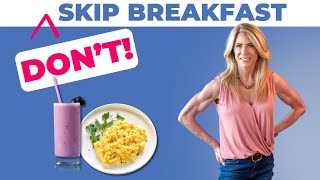
JJ Virgin explains why breakfast timing and composition matter for women over 40. Eat within 90-120 minutes of waking with 30-50g protein and 10g fiber, keep meals in a 10-12 hour window aligned with daylight, and skip the muffin-latte combo.
Chapters
Why is there so much confusion around breakfast and fat loss, especially for women over 40? When did eating breakfast become so controversial? I think it all started with this whole thing with intermittent fasting. All of a sudden, people were skipping breakfast and they were waiting till noon to eat, and then they were waiting— they were eating dinner at like 8 o'clock at night. I gotta tell you, I've looked at all of this, and first thing I'm going to tell you is there's no one answer here. There's no one answer of you must eat breakfast or you must skip breakfast. So I got to get that on the table right off the bat. However, I do believe that for most people, we are better off eating breakfast an hour or two after waking up. And I think the sweet spot's more like 90 minutes to 2 hours, and I'll tell you why. And then if we are going to do intermittent fasting, and I do think that we should be restricting the time that we eat to at least 12 hours a day, like that's normal eating. Let's be real. But probably 10 hours is better. But if you want to even do 8 hours, I'd rather see you do that intermittent fast early, early than noon to like 8 o'clock at night. One of the things that I've learned from Dr. Satchin Panda, who wrote The Circadian Code, is that we want to really eat during the daylight. And that just makes sense. Let's eat when we're going to use it, right? And you've heard about eating breakfast like a king, lunch like a prince, and dinner like a pauper. Yeah, we seem to do the exact opposite. So for most of us, if we start the day with a quality breakfast, and that's really the key, if we start the day with a quality breakfast, we tend to make better choices throughout the day and we tend to eat less throughout the day. There are people who, when they skip breakfast, will tend to binge more throughout the day. But there's also people that may be able to skip breakfast and find that they eat less all day long. So you're gonna have to figure out what's best for you. But I think for most of us, eating a quality high protein breakfast, being careful to not go and have a muffin and a latte, right? A cupcake and a shake is gonna be better for us than skipping breakfast and then getting hungrier and overdoing it the rest of the day. All right, this is for all of my coffee lovers, me being the most, like, it's my most favorite food group. Coffee is my favorite thing of all. And the reality is coffee is actually a health food. You heard it right now. That means you have to drink clean coffee. I'm gonna do a shout out to my buddy Amber Salisbury, who founded Purity Coffee. I'm a huge fan. You wanna drink coffee that's clean, that doesn't have mycotoxins and pesticides with it. So make sure you're choosing one of the clean brands out there. That's number 1. Number 2, learn you. Just like we just talked about with breakfast, you gotta figure out what works best for you. We also have to figure out what works best for you in terms of caffeine metabolism. So there's 2 types of metabolizers. There's fast metabolizers and slow metabolizers. I'm a fast metabolizer. That means that I can drink coffee at noon and I'm fine to go to bed. But some people, if they drink coffee after 9 in the morning, are still feeling it at night. Now you can find this out through genetic testing, but you probably know it already. So that's the first one is see how you do with it. When you look at the research about coffee, coffee is rich in polyphenols and coffee can also help with a little insulin sensitivity. It can cause you to burn more calories when you exercise. And it can help you to burn more fat, but it can only do that with so much. Like, that doesn't mean drink coffee all day long. That result is about 2 to 4 cups. And again, it really depends on how you're feeling. If you're one of those people that 1 cup sends you soaring, then maybe that's your limit. If you're someone like me, I can totally have 4 cups, no problem. But that is one of the benefits there is coffee is going to help you be able to work out harder. Coffee will help you use more fat for fuel. Coffee helps you become more insulin sensitive. It helps with focus. So coffee can be an amazing ergogenic aid. Just use it wisely. So while I'm a big proponent of breakfast for me, and see how you feel, I did have one client, a big famous actress, who if she ate breakfast, it kind of set her off and she overate all day long. But for a lot of us, if we eat the right things at breakfast, it sets the tone for the day. I like to say breakfast sets the metabolic tone for the day. That can be good Or that can be bad. That can be bad if your breakfast is the typical breakfast that most people have of the muffin and latte. Again, to me, a muffin is just a cupcake without frosting. It's a naked cupcake, right? And the latte is like a milkshake, and that is a huge carb and sugar bomb. And what happens when you do that is you start a blood sugar rollercoaster that is going to be really hard for you to get off of because you have that muffin and latte, your blood sugar shoots up, insulin comes from behind, you get blood sugar down, overcorrects. And so within 2 hours, you're like, God, I just ate and I'm hungry again. Boom. You go out and you reach for another carb. Maybe this time you're even going to have a biscotti, right? Another carb hit. Well, insulin never had a chance to recover. So it's still hovering up there. If insulin's hovering up, it's locking the doors to the fat cells. You can't burn stored fat for fuel, plus it's pro-inflammatory. And now all of a sudden you've got more carbs on board. So now you're driving blood sugar up higher. You never get off of that. Contrast that. With having a protein-balanced diet for breakfast. So what I love to see for breakfast is at least 30 to 40 grams of protein. I think for those of us 40+, because we're trying to overcome anabolic resistance, that's means as we age, it's harder for us to build muscle from our resistance training and our protein. So we need more, not less. I think we're better off doing 40 grams, especially if we're doing more on a plant-based side, definitely more 40 grams. So I love to say 40 grams of protein at breakfast or more. I tend to do 40 to 50 plus 10 grams of fiber. That's going to give you good blood sugar, slow release of blood sugar, and that protein that you really need to break the fast. Because think about what breakfast is, it's breaking the fast. You've been catabolic sleeping throughout the night. You've been in muscle protein breakdown. Now you're going to break the fast with enough protein to trigger muscle protein synthesis and to get you more in an anabolic phase. So I mentioned protein and I mentioned fiber. I want you to think about getting 10 grams of fiber or more at each meal. And the reason I want you to do that is fiber is so important for really causing a drip of energy to your body rather than a big blood sugar surge all at once. So it's a slower release of sugar so that you won't feel that big surge and crash that I was talking about earlier. So it's gonna give you better blood sugar regulation. It's crazy when you look at the typical standard American breakfast, and this is why I think it's so important to use a chronometer app and track what you're doing and use a food scale when you're starting out, because most people think that they're doing great at breakfast, they're eating a balanced breakfast, but you look at it and they had avocado toast and maybe an egg. And that is really classic. Someone will have a cappuccino, avocado toast, and an egg. So what happened when they had that? Well, the cappuccino, whether it was almond milk or dairy milk, basically probably had some sugar in there. So we had a bunch of carbs. Then they had the avocado toast. Let's be honest, that's just a fat and carb bomb. That's what that is. And then they had an egg. Which they had about 7 grams of protein in the egg. So they thought they had a high protein breakfast. And I can tell you, they thought they did 'cause I hear it all the time. And the reality is they had a high carb, high fat breakfast, and that sets them up for that blood sugar swing that I talked about. That's really hard to get off of. Plus they didn't have enough protein to get them out of that catabolic state that they had from, you know, not eating for 12 to 14 hours. So let's flip the script. I really do believe that breakfast is your most important meal of the day because it's setting that metabolic tone for the day. So that means that we need to make sure that we're eating our protein first. We're building our breakfast around that. So I think protein and fiber with some healthy fats for breakfast. Let me give you some examples. If you're someone who loves those eggs, what you can do instead, like you could have that avocado toast. I would get a gluten-free bread. I would do a lil spread of avocado. So that would be my avocado toast, but then I would put it together with 2 eggs scrambled with 6 egg whites. So when I do that, now all of a sudden I got a great amount of protein without an overload of fat. So with all of that, I'm getting in at least 30, 40 grams of protein. I could sprinkle a little feta cheese on there as well. There's one example. I love a loaded smoothie. What I like to do is take my Reignite Wellness protein powders. I combine my pea protein powder and my bone broth protein powder. And I'll add a little bit of collagen, even though that's not a complete protein. I love to have my collagen, especially when I'm going to the gym and it is a protein source. And I'm throwing in some flax milk that's got a boost of protein as well, plus some freshly ground flax and a little bit of a barely ripe banana and some of my extra fiber. So with that, I'm easily getting over 10 grams fiber. I'm getting in 40 grams of protein. So that's an easy one. Then one of my other ones I like to do is then I'll do this with either Greek-style yogurt or cottage cheese. I'll mix in my protein powder and some collagen. And same thing here. You can just dice up some, I like barely ripe bananas cuz they've more resistant starch, or you can throw on some berries, throw on some chia seeds and have that as sort of a yogurt parfait, a high protein yogurt parfait. So Greek style yogurt's great in the first place. And then I boosted the protein by adding in some more protein powder that gives it a great flavor too. So I'm not buying any flavored garbage yogurt. And then I'm adding in collagen as well. I always like to add the collagen in because I wanna have, this is our most abundant protein in the body. It's not gonna help you build muscle unless you're extremely protein deficient. But what it is gonna do is it's great for your joints and it's great for your hair, skin, and nails. So I especially love to get 10 grams in before I head off to the gym. So it's interesting that we have this phenomenon of time-restricted eating or intermittent fasting. I, I, I, when I think of intermittent fasting, I'm thinking of time-restricted feeding. And when I'm thinking of time-restricted feeding, to me, what we must do is make sure that we're eating in a 10 to 12-hour window each day. That's like a non-negotiable. And to me, I can't believe we're calling it something that should be normal eating. We just got so far away from that by eating right when we wake up in the morning and eating right till we go to bed at night. The average person, it turns out, is eating 14 times a day. That's just like insanity. We should be having, you know, 3 meals a day, maybe a snack. That's the first thing is I think of that as normal eating, but let's call it time-restricted feeding or intermittent fasting we want to be cool. You can narrow that window down to 8 hours if you want to. And the research is kind of all over the place with this. First of all, they talk about using intermittent fasting to trigger autophagy and to trigger stem cell production. There's some other ways to do that too called exercise. But I think there is definitely seems like some benefit to maybe doing a little bit of a longer time-restricted feeding. Maybe on the weekend you can push your breakfast to a little later, like 10 or late 9 or 10 o'clock and have your dinner a little bit earlier. That's what we like to do on the weekends is sleep in a bit, do a longer sauna, then have breakfast around 10, then have a family dinner around 5, and all of a sudden we've pulled it off and now we have an 8-hour feeding window instead. So see if you can throw that in a day or two a week. I think it's great. And then see how intermittent fasting works for you. Again, I think the biggest thing here is to, is to wait a couple hours before you eat in the morning. I really think 2 hours is a sweet spot. See where you feel best. If I'm gonna work out first thing, I will do a hit of my essential amino acids, my Reignite Wellness Amino Acid Power Powder with my chiotine and electrolytes. And I do a little collagen in my coffee. So I have something on board when I'm gonna work out. I feel better that way. See how you feel. Some people feel great doing fasted workouts. I don't. I tend to feel better with a little something that I can't eat if it's 6:00 AM. So if I'm working out early, that's my hack. But see how you feel. But again, in my perfect world, it's, it's about 2 hours after you wake up is when you eat. And the big key one is to stop eating 3 to 4 hours before bed and really give your body that time because as you're preparing for bed, just think your body's kind of slowing down, shutting down. It shouldn't be the time that has to start to think about pumping out insulin, right? And your pancreas should be slowing down too. The only exception I will tell you is I used to work with a lot of pro athletes and we had to get this little protein hit at night before bed. And so probably you're not a pro athlete. I'm not one either. It's not an issue. If you are dealing with sarcopenia and you are concerned about that, hit yourself with some of that Amino Acid Power powder at night before bed. That can help with avoiding some of that. But if you're getting your protein in throughout the day, you're getting your good solid meals, you're eating within that time-restricted window of 9 to 10 hours, I think you're doing great. And you can play around with, with less if you want to, to help restore blood sugar balance and insulin sensitivity and trigger some potentially some stem cell protection— production and autophagy. Although I will tell you, I never seen the research proving that we know when autophagy actually starts with fasting. We know it happens with exercise though. That's very predictable. So as you can see, what you do in the morning can impact the entire day. Like, you start the day with that muffin and that latte, you can start this blood sugar roller coaster, this cravings roller coaster all day long. And you may find that if you skip breakfast, I know this is with me, if I don't eat breakfast at all, it makes me worse throughout the day. I actually eat more. So see how it works for you. See what works best for you. But the most important thing is that when you do break your fast, because breakfast could be later, that you break your fast with that 30 to 40 gram protein hit with some fiber so that you have that satiety and that great blood sugar control. I want to help you age powerfully, so be sure to subscribe so you don't miss out. Leave a comment on what you're going to take away, and I'll see you in the next video.








