Skipping Breakfast? Here’s How It’s Hurting Your Muscle and Metabolism
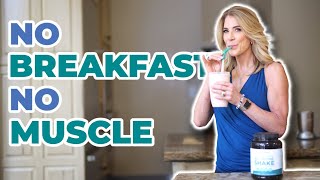
JJ Virgin explains why skipping breakfast accelerates muscle loss in women over 40, especially when combined with fasted workouts. Clinical trials show lean-mass loss with time-restricted eating and higher muscle-breakdown markers when training fasted. She recommends 30-40g protein within 1-2 hours of waking, plus healthy fat and fiber, to preserve muscle and stabilize metabolism.
Chapters
Think skipping breakfast is helping with weight loss? Well, here's why that strategy might be backfiring, especially if you're over 50. If you have been diligently intermittent fasting, shortening your feeding window by skipping breakfast, it might actually be backfiring, especially if you're over 50. Now let's break down why skipping your first meal could be sabotaging your metabolism, your muscles, and even your long-term health and totally getting in the way of you Aging Powerfully. By the way, if you're into optimizing your metabolic health, getting your metabolism boosted, and aging powerfully, you are in the right place. So make sure you subscribe so you don't miss any of the videos. And now let's dig into this, because if we're going to talk about skipping breakfast, this is usually a strategy that's deployed in intermittent fasting or time-restricted feeding. For this video, I'm going to refer to this as time-restricted feeding, and what's typical here is this 16 16:8, where you fast for 16 hours and then you eat for 8 hours. And usually this is done by just skipping breakfast, right? And then just going and having your first meal at lunch. We're going to unpack that and unpack what some of the better ideas might be for you. But let's talk first. Here's the first big question is how does skipping breakfast affect muscle loss in women 40 plus? And remember, starting at around the age 30, We start losing up to 1% of our muscle mass a year. And muscle is really important because this is the biggest way we can impact our resting energy expenditure, how many calories we're going to burn at rest, right? And that's a big part of your metabolism. This starts to get even worse as we go through menopause. Hormones go down and muscle starts to go off the cliff along with bone. And this muscle loss, which if you lose enough of it and you lose the strength of it, is known as sarcopenia. And again, this is going to impact your metabolism and it's going to impact your quality of life too. So can skipping breakfast cause muscle breakdown? Well, it turns out that it can. There was a clinical trial that looked at time-restricted feeding and it led to weight loss, but it was also associated with a significant decrease in lean mass, including muscle, in older people. Now here's the reality with this, this program where they looked at this, they also were not optimizing protein intake. They were not optimizing resistance training. So likely if you were getting an optimal protein and doing resistance training, you could offset some of that. So I just have to say that too, right? There was another study that found that skipping breakfast before resistance training led to higher markers of muscle protein breakdown compared to those who ate breakfast before working out. I will tell you that I did a little experiment. I'm always N of 1ing on myself, like always biohacking, seeing what happens. And I like to do one thing at a time so I can really tell if this is the thing or not. And so for 3 months, my husband and I did fasted workouts. We didn't eat until we came back from the gym, which was usually around 10 o'clock, wake up around 6:30. You know, we'd have our coffee. No one's going to stop me from my coffee. I can promise that. And then we'd go to the gym with just electrolytes. And I'll tell you what, when we went back to eating before we worked out. Now we eat around 8, go work out around 9:30. Game changer in terms of my ability to lift more. And the reality is when you go to the gym, it's all about the volume, the load, how much you can work out. So if you can work out harder, you're going to be able to build more muscle, which is gonna give you better muscle tone, which is gonna give you better bone density. So super duper important. And I say this and experts are saying this, Dr. Gabrielle Lyon and Dr. Dr. Stacy Sims both say that eating protein early in the day is critical for maintaining lean muscle mass and preventing catabolism, muscle breakdown. And if you think about it, we are building up and breaking down muscle throughout the day. When you are eating protein, when you're doing resistance training, you're triggering muscle protein synthesis. And then when you aren't doing that, times away from that, you start to go into muscle breakdown and you're turning over throughout. You're not just always building up. But you don't want to be breaking down more than you're building up. When you go to sleep at night, you're going to be more catabolic, right? And then when you wake up in the morning, when you have that protein hit, that helps move you into the anabolic stage too. So test that out with yourself. If you've been one of those people who likes to go and work out without— before eating, see how you feel, see the difference. And I will tell you, if I'm in a situation where I have to go work out first thing in the morning, like if I'm traveling and I'm going to miss my work out if I don't go first thing in the morning. Here is my hack. I take essential amino acids. So I have a product called Amino Acid Power by Reignite Wellness. So I take that along with my Chia Teen powder, which is creatine HCL made in the USA, plus taurine and magnesium, and my Electro Replenish. I put those 3 things in a big drink bottle and I drink the whole thing, and I find that I'm fine if I do that. Still not quite the same as having had breakfast and waited an hour, but it's my, it's my next best thing. And sometimes, you know, it's either that or miss a workout. I'm going to do the next best thing. What happens to your metabolism when you skip your first meal of the day? Let's talk about that. There was one study that I found that showed that skipping breakfast could reduce your daily energy expenditure, how many calories you burn throughout the day, by blunting the thermic effect of food. Remember, when you eat, you have a thermic effect of that food. Protein's the highest thermic effect of that food. And this not eating slowed the metabolism a bit. And it wasn't— it's not huge, 60 calories a day, but you know, every bit counts. When you're looking at boosting your metabolism, every bit counts. There was also one study, which is interesting because you see this both ways. I'm going to give you another study that shows potential benefits here, but that skipping breakfast could cause some rise in blood sugar that actually led to higher fat storage. I'm going to show you in a little bit that one of the things I see with intermittent fasting, time-restricted feeding, is that it can improve insulin resistance and glucose. So I think this is where wearing a CGM, a continuous glucose monitor, and paying attention to your N of 1 can be really great. Here's the thing that I noticed personally is that when I skipped breakfast, I just didn't have the energy and fatigue. I was hungrier later than normal. And my blood sugar regulation just was not as good. And what another study found in 2020 is that people who eat breakfast tend to better muscle preservation, better metabolic efficiency. I just know when I've looked at all the different studies out there on breakfast or breakfast skipping, that the general consensus is people who eat breakfast, and here's the difference, a high protein, high quality breakfast, tend to eat less overall and have better blood sugar control. Now, This goes out the window if you eat like the coffee shop muffin and a latte. It has to be a high-quality, high-protein intake. If you eat a high-carb diet, high-carb, high-fat diet, even worse, then all bets are off. I'm talking eating protein. So what is the ideal protein intake for you in the morning? That's the question, right? Again, think about this. You've just been catabolic, you've been asleep overnight, and now you're going to break your fast. And this really sets the metabolic tone for the day, what you do here. So it's very, very important. And it also triggers something called the second meal phenomenon. So if you mess it up at breakfast, you eat a high carb, like pancakes and syrup, who does that anymore? But if you did, you're actually now gonna start a blood sugar rollercoaster that's gonna impact your next meal and make it really hard to, for you to get off of it. So we really wanna make sure that first meal is protein-rich. And really, for, for us 50+, I think you're really looking at 40 grams of protein. 30 is minimal, but due to anabolic resistance as we age— and this can start as early as 30— it is harder for us to get the amino acids we need from the protein, plus resistance training and trigger muscle protein synthesis. We're just— it's just— we just need more. We need better resistance training stimulus, we need more protein. And so I say 30 grams of protein, animal protein is minimal, but I think you're probably better off at 40. And if it's plant-based, 40 to 50. And that's where you might wanna do a little, uh, support with some essential amino acids too, just to make sure you're getting what everything that you need. Because one of the challenges with plant essential amino acids is they're not as bioavailable, they're not as digestible, and you don't have the same balance of essential amino acids and you need them all. So there you go. One other thing is eating protein earlier in the day. It just sets up the whole day perfectly. You're going to have less cravings. You're going to have that better thermic effect of food. You're going to have better blood sugar regulation and better caloric control. So protein in the morning is the super duper important thing here. What are some breakfast options then that are going to help you with aging powerfully, with holding on to, or better yet, building muscle? Because muscle is that metabolic spank, super important. And muscle, when it contracts, also helps you with with fat burning because of what it's releasing in terms of your body being able to burn fat better. I really like to think of protein first. Eat protein first. That's my mantra. 1 gram per pound of target body weight here. 0.7 grams is your least, and I'd rather have you err on the higher side, especially breakfast. Think of protein, fat, and fiber as my, like, satiety trifecta. Remember, protein and fiber slow down stomach emptying. They help your body release GLP-1. That helps with satiety. And then fiber also triggers release of some chemicals to tell your brain you're not hungry. So I like this little protein, fat, and fiber trifecta, with protein being the star of the show. So what are some different options? One of them is a smoothie. I have two different protein powders that I use in Reignite Wellness, either a plant-based or a bone broth-based. And so I will do those, and I do scoops to get up to 30 grams, and then I'll add more into the smoothie. Like, I like to use, um, Good Karma flax milk that's got added protein. I'll use some chia or some flax seeds in there, uh, usually a little bit. If I'm not doing the seeds, I'll do a little avocado and then some berries. So you can easily get yourself up to 40 grams of protein doing that. Another thing that I'll do with protein powder is I will add it into Greek-style yogurt. So if you can tolerate dairy, I personally like to use fat-free Greek-style yogurt plain, and then I will add in some chia or some freshly ground flaxseed or stir in a little nut butter. And so that's what I like to do. Sometimes I will go a little crazy and top it with Catalina Crunch, which is a high protein, high fiber cereal. Yup. And a little bit of dark chocolate. I admit it. That's the way I like to make a parfait. And that again, if you're not dairy intolerant, as I talk about in the Virgin Diet. And then also there is, uh, the way I like to do omelets is usually 2 eggs and 6 egg whites because otherwise Otherwise you're going to like go overboard on fat. So I like to do 2 eggs, 6 egg whites, and throw in some spinach and some mushrooms. That's, that's my ultimate favorite. Maybe a little bit of feta and some sea salt, like yum. You can also make an oatmeal, use that Good Karma flax milk, use some of my protein powder in there and add a little bit of chia. And that's good. Or you can make some overnight oats with protein powder and have a side of an egg or 2. And again, since you're using an app like Cronometer, that's my favorite one. If you're you're using an app, and I'll put the link to the app in the show notes, then you're tracking because you're using a food scale. You're actually paying attention. You'll see and you'll know exactly how much you're getting. And the cool thing with the food scale is it also tracks to make sure that you're getting enough of leucine. And leucine's the essential amino acid that really is important for triggering muscle protein synthesis. So that's an easy way to do that. Again, that's why you can also use essential amino acids as needed. I use my Amino Acid Power from Reignite Wellness to get yourself up to where you need to be. You can also have leftovers. You know, I don't know why it is— like, I lived in Japan for a while. I helped bring aerobics to Japan back in the '80s, and we did not eat breakfast for breakfast. I mean, it was their breakfast, but I remember it distinctly. I was living in the small town Kochi, and it was white rice, dried fish, I kid you not, and eggs. But a lot of the breakfast foods that we would have were not breakfast. We would have a salad, you know, it's that type of stuff. So you don't have to eat breakfast food for breakfast. In fact, one of my favorite ways to do oatmeal is to do a little bit of oatmeal with bone broth and then add in some of my collagen powder and then put in some mushrooms and some meat. And that is actually delicious. And I would never have thought about that, but back when Dr. Oz was doing his show, they had me on the air doing savory oatmeals. And I'm like, this is the most amazing thing ever. I never thought of it. But again, the easiest of all, of course, are smoothies. And I will link to my Loaded Smoothie free guidebook that you can get. And in there, there's a little $20 off coupon for the store too. So you can get started with smoothies. So there you can make it easy, easy. Those are some of the things you can do for breakfast. Again, making sure that breakfast is really protein-focused. But let's talk about time-restricted feeding. Like, when's it a good idea and when would it be not a good idea? I talked about how confusing it was before because some research shows that, you know, skipping a meal could make your blood sugar go higher, could, could perturb insulin a bit. But the reality is, for people who are insulin resistant, who are having some issues, they're trying to improve insulin sensitivity, doing time-restricted feeding, shortening that feeding window, can be helpful. You know, so someone who's pre-diabetic, this might be a helpful thing because it's been shown improve insulin sensitivity. Where I see it being problematic, and again, I think we all need to be doing time-restricted feeding, but I want to do it based on the circadian rhythm. I really like the work of Dr. Satchin Panda, where he talks about eating during the day, not at the night. For me, I wake up in the morning, get up, go to the bathroom, get on my Oxaline Pro bioimpedance scale that reports to my phone so I can track my trends, making sure that I'm improving my body composition, do a little meditation, then go see the sunlight. The dogs go out to pee, so we're out grounding, have get my coffee, go get in the sauna and work, get in the cold plunge, and then have breakfast, right? And so, um, so I'm eating about an hour and a half, somewhere between an hour and two after waking up. My favorite is about two hours after waking up. Then about an hour after that, I go to the gym. And I go to the gym with my Chia Team Electro Replenish, and I still do my Amino Acid Power even though I've had breakfast. I take a little bit of that in my drink And then stop eating 2 to 4 hours before bed. And so if you think about it, if you're in bed for 9 hours, sleeping for 8, if you are eating 2 hours after waking up and you're stopping eating 2 to 4 hours before you go to bed, that right there is a 10-hour window anyway. So it's pretty easy to do a 9 to 10-hour compressed eating window. And I think that makes a lot of sense. The other thing that I make— think makes a lot of sense is to eat a real meal and then don't eat. So that you give your body time to digest the meal and clear out. And then you go anywhere from 3 to 5, 6 hours until you eat again. So I generally go, you know, somewhere in the 4 to 5 hours between meals, but I think that's an important one too, is in between meals. That's where you're hydrating, having that coffee, having that iced green tea, having that sparkling mineral water, having the regular water, right? That's when you're doing that stuff. And I try to get in at least. 1 to 2 servings, generally 2 servings of electrolytes a day as well. So where could this be problematic if you want to cut it down more, you want to do the 6 to 8 hour window? I think this can be challenging for you if you are really focused on holding on to or building muscle. Remember, we start to lose muscle around age 30, and just getting in the amount of protein you need in, you know, when you're only eating during an 8 hour window, that's probably 2 meals, can be hard to get the protein in. So just see if you can get it in. Also, if you're eating later in the day, right, and sometimes that might create more stress in the morning, you don't get as good of a workout in. So that can be a problem too. In fact, that's one of the things that Dr. Stacy Sims talks about, is that when she sees people pushing that meal, they tend to have more stress-related cortisol spikes and more hormonal issues. So I just feel like for us, us women here, especially us women 40 plus, that eating breakfast is a super important meal. We just probably need to push it a little bit more. And the reason I say 1 to 2 hours after waking, you want to give your body time to wake up, your pancreas time to get online, your insulin ready to go so that you can deal with all that. So those are my recommendations, is I want you to eat by the clock, eat by the daylight, right? Make sure you're having that protein-rich trifecta breakfast. Protein's the main player there, but you're also getting some fiber from, say, some berries or some chia or flax and a little bit of healthy fat. And then listen to your body and see how you do best. You know how to hack it now if you're one of those people that has to get up and go work out, but see how you do best. And if you do have to go do something without eating, those essential amino acids can be amazing to help you not be too catabolic, not breaking down as much, right? So by the way, I'm posting all my podcasts now on YouTube so you can get all the info that you need directly on this platform. Form. So make sure you check out my latest episode. Again, subscribe so you get notified every time I drop something new, whether it's new video or a new podcast.








