The 2x2x2 Workout: Build Muscle in Just 30 Minutes Twice a Week (Free Weights Version)
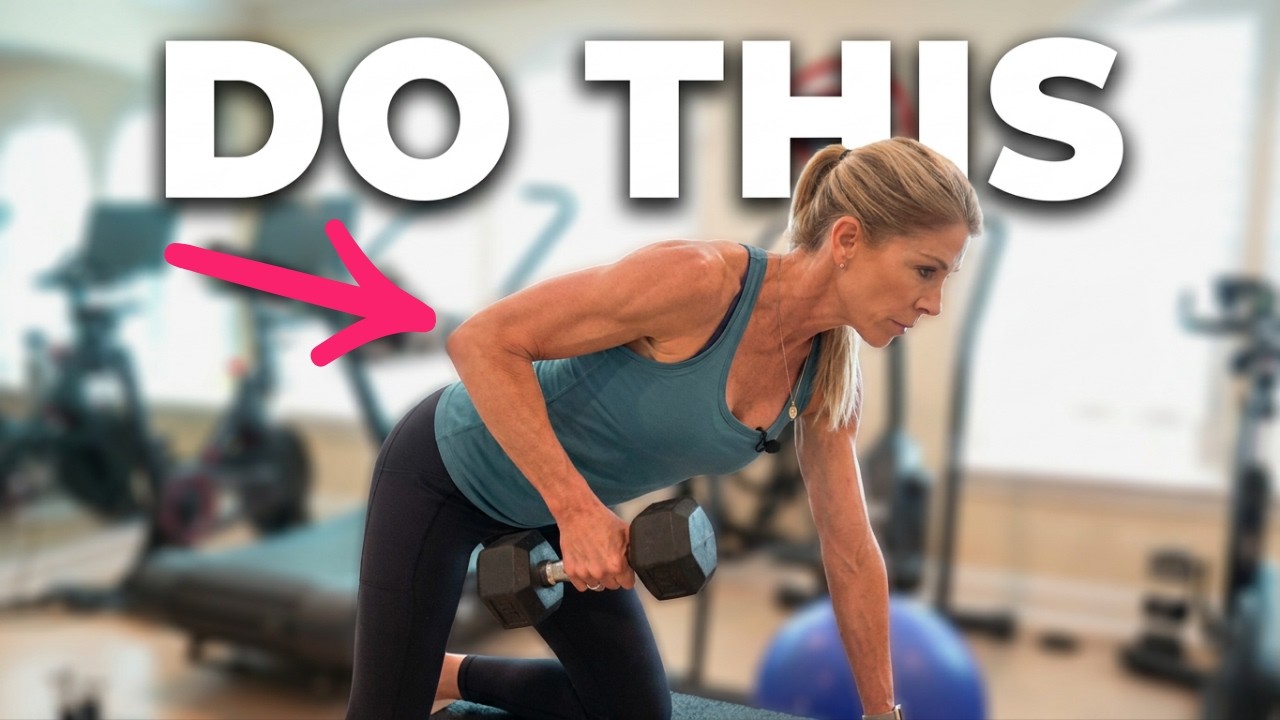
JJ Virgin teaches a 2x2x2 workout: two 30-minute sessions per week using dumbbells to train four major movement patterns with two exercises each, two sets per exercise. She demonstrates proper form for one-arm rows, step-ups, high pulls, chest presses, overhead presses, and Romanian deadlifts, covering common mistakes and modifications for injuries.
Chapters
You're committed to getting stronger and building muscle, but your calendar is looking a little tight. Well, I gotcha. You can tell someone's commitment by their calendar. So the first thing that I want you to do is block out 30 minutes twice a week. Make it non-negotiable. Although what I'm gonna show you, you could even do it 10 minutes every day and divide it up. I don't care how it gets done. I just care that it gets done. Introducing my 2x2x2 workout to help you build strength, Build power and build muscle. Here's how it works. Your body has 4 major groups, upper body pushing, upper body pulling, hip and thigh hinging, and power core. I've incorporated all of those into a push, pull, and hinge workout where you do 2 sets, 2 working sets of each, and you do 2 days of each, and you do 2 exercises per day. body part. Got that? That's why it's 2 by 2 by 2. You're gonna work whatever rep range you wanna do within 6 to 30 reps. Here's the thing. You wanna make sure that you're getting to having about 1 or 2 left in the tank. So if you're doing 10 reps, it should feel like maybe you could eke out 1 or 2 more. How do you know you're there? If you start to slow down and your form feels like it's gonna suffer, that's where you wanna get to. You don't wanna break form. It's always your limiter. Technique is critical, but you do wanna push yourself and challenge your muscles. Very important. Then you need to give yourself a little rest break in between sets. Usually it's 1 to 2 minutes, but I have a hack for you. If you're short on time, which we usually are, what I want you to do is something called supersetting, where you work opposite muscle groups. So if you're doing pushups, when you're resting from that, you're doing squats. So you can keep working and get more done in less time. And that's what I'm gonna take you through today. I'm gonna take you through 6 different exercises to push, to pull, to hip and And thigh hinging that all pull in the core. So I've got that 4th one in there too, but I'm going to superset them to save time. The first thing that I'm gonna do is go through each exercise, show you how to do it, how to work it, and what to avoid and how to modify it if needed. And then we're gonna go through and do the actual workout. Again, what you could do here with this workout is you could just take the exercises and do upper body pushing one day, upper body pulling one day, hip and thigh hinging one day, and then repeat it. So Remember, even if you only have 10 minutes a day, it all counts. Use your time. Now, before you start your whole 2x2x2 workout, one of the things I wanna make sure is your body is warm. So you can do that in a variety of different ways. You could get into a sunlight and sauna and get your core body temperature up. You could take a hot shower, hot bath, but you wanna get your body temperature up. You could do a little bit of a 5 to 10 minute jaunt on the treadmill or the StairMaster, but you wanna get your body warmed up. And you also wanna move your body through full ranges of movement so that you've Really gotten all your joints moving through. So it might be coming all the way down, all the way up, all the way down, rolling up, but you wanna really make sure that you've done some mobility. So I'm not gonna take you through a whole mobility routine today. I'll get you one dialed in though. That will be something on the playlist. But do make sure that you've gotten your body moving, that you've got things working. Now note, I didn't say stretch. You actually don't wanna stretch before you do resistance training. Why? That's telling your body to calm down. It doesn't need to work as hard. We do that after the workout, not before. It can actually hurt your gains. Here are the exercises we're going to do in this workout. We're gonna do a one-arm row. We are going to do a high pull. Those are my pulling exercises. We are going to do a chest press and we are going to do an overhead press. Those are my pushing exercises. And we are going to do a step-up and a Romanian deadlift, also known as a stiff leg deadlift. Those are my hip and thigh exercises. Hinging. What you're going to need to be able to do this are dumbbells that make it challenging enough for you to do the work, right? No pink dumbbells here, please. One thing I want to be clear here, because I've heard this in the comments, I am not lifting at my heaviest right now as I'm demoing this because behind the scenes we're doing a lot of extra stuff. So I'm doing a little less weight than typical for me so that— and you'll see me doing it in perfect When I'm working out, if you see me at the gym, you'll see me lifting probably about 30% more than what you're going to see in this video. So please, no comments are going, she's lifting light, okay? Because there's a reason for it. So the first exercise I'm going to demonstrate is a one-arm row. This works your lats, the back of your shoulders, and your bicep. Anytime you're pulling, you're working your bicep. The way that I like to do this, you will see this done on a bench. I do not like it done this way. You will see it done this way. Why don't I like it this way? Because unless you are exactly the same as the bench in terms of your leg length, you're going to have yourself hinged up or down. So I don't like that. Instead, I like to think of this done— if you do have a bench, I'm going to use this as a bench here. What I do is I put myself over it And then I'm going to put my hand that is not going to be working in the middle. So I'm making myself basically a tripod between my hands and my feet. Then I'm going to extend my spine as if someone took a pole and stuck it through my head and made it come out my back, my backside. I know that's a visual, right?
Okay.
And then from here, I'm going to start and I'm starting down. And rotating up so it's like I'm cupping my chest at the top, right? And what you want to think visually as you're doing this is that your elbow is lifting up and you're squeezing your shoulder blade together at the top. Now notice I'm not doing a big whole movement through my torso. This is happening through my shoulder blade. And my Wrist stays strong. So that is a one-arm row. That's gonna be your first exercise. Your second exercise is going to be a step-up. Now, what's important for you with a step-up is to find a step bench that is at or below a 90-degree at your knees. So right now, see how I'm basically at a 90-degree here? I could do it as well. I'm a little below a 90-degree. I also have a step bench. I'll show you this as well. So if you're new to this, just starting out, you could just use a little step bench and start lighter. You don't have to hurt yourself here, but this would be— actually, I think I'm going to demo them here. So this is actually a great height for me because I'm even. See that? So this would be a great place for you to be. You want to have a 90-degree at your knee and hip. If you're new to this, just starting out, buy these. By the way, these are really inexpensive on Amazon. You could start lower, right? So you could even start using a step at your house. So you do not have to go crazy here. But as you progress, your goal is to do a 90-degree with this. And then to increase the weight. Before I even start with weight, I'm going to show you just what I want you to think of doing. You stay with one leg. So you're not alternating on these. You start up with your right and tap down. So I'm keeping on my right foot. I'm not switching feet with this. See that? So I'm stepping all the way up and all the way down, all the way up. And all the way down. All the way up and all the way down. And all the way up and all the way down. And then once you've done a working set to one side, you go to the other. Now, when you're first starting out, this can actually be a great warm-up for your exercise session.
Okay.
Okay, so there are step-ups. Notice it's one leg at a time, all the way up, all the way down. Okay, next exercise is going to be a high pull. This is a modification of something called an upright row that is better for your shoulders, your, your AC joint in your shoulders. So what you're going to think of is your thumbs leading the way up. Okay, so your elbows go up, your thumbs lead the way up, and you don't bring it up so your elbows do not come higher than your shoulders, right? And you're really feeling like your thumbs are coming up and they're leading the way. This exercise here is working my biceps because again, I'm pulling. But it's really working my shoulder girdle, my deltoids. So all of my shoulders, my middle, my front, and my back, but a lot of medial deltoid. And it's also working my upper traps. I didn't mention for the step-ups, what's going on on a step-up when you're doing that? Well, besides some great balance, right? You've got your glutes and you've got your quads. Going on here. So you've got glutes, quads, calves having to all do some work in a step-up. Okay, so we did my bent-over row, my high pull, my step-up. The next exercise is going to be a chest press. I'll just show you with this. Now, you're going to need something to do these off of. It could be a bench. If you have an exercise ball, you can bridge off an exercise ball. But the reason you don't wanna do these on the floor is you've gotta come down. Your elbows are gonna drop below what the floor would allow you to do. The floor would only allow you to come to here, and that is not going to give you enough stretch in your chest. So when I think of a chest press, it feels like I have a triangle sitting over my chest, and I am taking it out to the widest part of the triangle, and then I'm squeezing it together. Widest part, squeezing it together. And depending on how you feel comfortable, you can either have your feet on the ground as long as you're also pulling your belly button to your spine and anchoring well with your glutes and your heels, or you can bring your heels up.
Oh boy.
Barky party. So chest press. Is working my triceps because I'm pushing, right? And of course I'm working my chest, but I'm also working the front of my shoulder. So when I'm pressing, front of the shoulder, chest, and triceps. So next one for upper body pushing is an overhead press. There are a couple different ways you can do this, but I want to show you something really important here. When I do an overhead press, I personally like to do these standing. The reason I like to do them Standing with a slight bend in my knees and belly button pulled to the spine is I wanna load my hips and my spine so that it's also helping with spine bone mineral density. Now, the thing I wanna do, and this is probably what you'll see that's different, is I have my hands in so that my thumbs are pointing towards my shoulders. And this is really Important, this little pronation here, because if you do this, this actually is hard on your AC joint of your shoulder. You'll feel the difference when you move from here to here. Like the minute I go here, it's like, ow. So do this and then push up. And you'll see that when you do that, it actually ends up— you should be able to see it in front of you, just a little bit in front of you. You're not over here. You're pushing this up and up to the top, as straight up as possible. But you'll still be able to see those weights. In your periphery. Okay, so that's important right there, is that you keep your hands like this, just like this, right? And up, up as much as you can. So you're trying to go straight up, but you're going to end up a little in front of you. Now you're working again your upper back, you're working the front of your shoulders, a lot of your traps there, triceps, front of the shoulders, and then you're having to stabilize because you're standing like this. And that is your overhead press. Finally, we're gonna do a Romanian deadlift. You've heard of deadlifts, uh, Romanian deadlift. The reason I like doing this variation is it puts more stress on your hamstrings. Your hamstrings are hard to work at home. One of the ways that you can work your hamstrings at home is this little contraption I have over here. This is like one of the most difficult, painful things. This is for another video. But this is one way that you can get them at home is through a Romanian deadlift. So I'm gonna start with a really lightweight just to show this. Um, just for context, I usually do this with more like 135 pounds. But what you want to feel like here is that you're hinging back, sticking your butt out, your knees are just slightly bent, and your back is extended. When you feel like your back's going to roll, That's where you have to stop. So if you do yoga, this is just like where you come to that halfway up yoga pose. It's the same feeling with your Romanian deadlift, is that you're coming to that point where your back is extended, and when you can't extend your back anymore, that's where you stop. And if you're doing this correctly, you will feel a lot in your hamstrings. In fact, you'll feel a lot of Stretch in your hamstrings as you come down, but it's dynamic. You're not staying there, and you'll feel it in your glutes. Of course, your spinal erectors are having to work too, but it's really a focus on the glutes. Sit back and the hamstrings. So that is your Romanian deadlift. So really, the only variation I have for you here is if you've got any Any knee issues, start your step up at a lot lower, which you could use just a step to begin with. And if you have any issues with your back, you can always start an overhead press seated instead of standing. All right, we are ready to do the 2 by 2 by 2. So to get started with the 2 by 2 by 2, I want to do this as if you're doing it with me, which means let's not make it as if, let's have you do this with me. So what I'd love you to do Is review all those exercises, make sure you understand how to do them. Please, if you can, watch yourself in the mirror to confirm your form. Remember, form's the limiter. And as we do these, we're going to do— it's 2 by 2 by 2. Those are 2 working sets. So what we're going to start with is a light set to start. That is just a warm-up set. It's mobility, it's getting things moving. And then we'll go into the working sets. Again, what we're going to do here to save time is we are going to superset. So when I'm resting from one exercise, there is no rest for the wicked. Then I'm going to be doing another exercise. That is called supersetting. And I'm doing things that complement each other. So while, let's say, my lats are recovering from my one-arm row, I am working my quads and my glutes in my step-ups. Make sense? All right, so first we're going to just start with easy peasy lightweight sets for this. And a note on repetitions, I advise working somewhere in the 8 to 12 range. If you can't get to 8, lighten it a little bit. If you can go to 12, make it heavier. That would be where I would, I would have you doing this. But if you want to focus more on strength, go down to more like 6 reps. Otherwise, Work somewhere in there. If you're uncomfortable with heavier weights, then go, go up. You can go up to 25 or 30 reps, but I'll be working around 10. And remember, the biggest rule is when you get to the final ones, it should feel like you maybe could eke out 1 or 2, um, that you've slowed way down, your form is going. To help here though, you're not going to see me do that. Again, I'm just going to do 10 reps to do it. Now this is your warm-up set, so remember you're starting out light. And easy. And during the warm-up set, the things I want you to think about— I want you to really focus on form. Nail that form and start to really focus on where you should be feeling this, which is the lats, the back of the shoulder, and the bicep. If all of a sudden you say, you know what, JJ, I'm feeling it in my pinky toe, then we have a problem, right? So that's what I want you to be focusing on. And other thing you should do here is plasm music that you really love and make sure that you've poured yourself a big bottle of my Mm-hmm. chiatine, my electrolytes, and my essential aminos, my Amino Power Powder. You will thank me for this because you will be able to work out harder and recover better and get great results. All right, so this is just my warm-up set here of this before I head on over to doing an easy set of step-ups.
Okay.
And then I'm just going to do a super easy set of step-ups. I'm not even going to use anything. And you may notice that I'm working out barefoot because my buddy Mark Sisson says if you can work out barefoot, that's the best of all. So that's what I'm doing, even with my broken foot.
Keep.
Okay, I'm switching. So again, that was all to one side.
Okay.
Next up, we're gonna get to work. So I'm gonna grab a heavier weight and again, establish my tripod and go.
Good. Okay.
And remember, if you felt like you could get to that and it was easy peasy, crank the weight up a little bit. And I like to raise my weight in 5% increments, max 10%. Sometimes with the lighter weights you have to kick it up a little bit more, but at my home gym I have 5s, 8s, 10s, 12s, 15s, 17.5, 20, 22.5, 25, 27.5, 30. So I crank it up in little increments. Okay, that was my first set of one-arm rows. Now I'm going to start my Step-ups that are working. I'd also love to acknowledge my regenerative doc who's been injecting my broken foot. Because it's amazing to me that I can do this. All right, other side.
Keep. Keep. Keep. Keep.
So again, on your first set, if you got to that 10, no problemo. Get a little heavier. So by this time, this is what I want you to look like. That's how you should look. Okay. How was that for dramatic acting? And again, at this point you should be slowing way down and your form might just be starting to go and that's when you quit.
Okay.
And one more set of step-ups. Okay, switching sides. And the chiotin, aminos, and ElectroReplenish magically appeared by the—
2.
Sheer will of me. So what I'm going to do is a really simple lightweight chest press. And again, doing my triangle. So this is my getting the range of motion, getting those muscles firing, feeling it in my chest, feeling it in the front of my shoulders, feeling it in my triceps. And making sure I'm using muscle, not momentum. And a warm-up mobility set. This is not work. And then I'm going to alternate this with a high pull. Same thing. So warm-up, not work.
All right.
Now, once we've done those, let's get some weight that matters.
Okay.
Where'd my other 25 go? I keep sitting down on that mic pack and it really hurts. Okay, remember, at this point, this is how it should look. That's the goal. When you're slowing down, it shows that you're hitting that limit. Important. All right, now we're going to alternate with high pull. Thumbs leading the way.
Okay.
Pretend it's slowing down. So this is you. It's getting harder. And you're also thinking, could I do a heavier weight next time? If you think you can, guess what? You can. If you're even wondering if you should, you should. All right. And if at any time here you're like, I need a little breather, Just hit pause, but come back.
Okay. Okay.
That does it for the chest press. One more set of high pulls. So you're asking yourself, can I go higher? You know what? I'd rather see you push yourself a little bit, go a little heavier, and maybe only get to 6 or 7 than go too light and just be able to keep going. So if in doubt, Kick it up a little bit.
All right.
And boom, just like that, we are 2/3 through the workout. All right. So we have 2 things left. We have that Romanian deadlift and we have the overhead press.
Yes.
Let's do some RDLs. And this is your, again, your warm-up set. Just feeling everything. All right.
Come on, JJ.
And an overhead press. Watch that form. Hands, palms pointing to each other, thumbs at your shoulders, knees slightly bent, belly button pulling in. Protect your spine. All right. Now grab the weight that challenges you because I believe we're never better than when we're challenged. So for RDLs, if you're doing a barbell, you're going to do heavier than dumbbells, right? And whenever possible, I really like to do dumbbells because It requires more negotiation, more of your central nervous system, a little harder. So I'm gonna take some 45s. All right, sip of my concoction.
And Overhead presses, and I'm going.
I'm gonna push myself a little bit more on the next set. Because if you noticed, those did not get hard. And even though I'm trying to do the fake hard for you, still, what I want you to be gauging all the time is, is that the heaviest weight I can handle in good form? Am I challenging my muscles? The whole way you get stronger is through progressive overload. So you got to overload in order to adapt and get stronger.
Okay.
All right, final set, overhead presses. Okay, remember the last ones, I should feel like this, right? Now, if you're one of those people who loves to stretch, this is when you've earned the stretch. Don't do it before, but you can do it after. If you don't want to though, you don't have to. But the thing I do want to make sure you're doing is fueling your body well. So getting in your building blocks, your protein if you're skimpy, or just to augment, also do aminos. Using that creatine helps you work out harder, recover better. And if you're sweating, throw the electrolytes in the water too. That's my favorite concoction. Have a great next workout. And remember, I'm here to help you fix your metabolism. So for more content like this, be sure to like and subscribe to the channel.








