The Missing Link in Women's Health: Strength Training and Protein with Dr Jaime Seeman
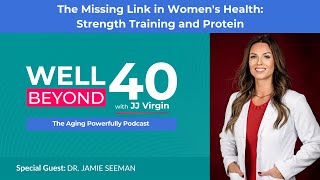
In this hour‑long interview, host JJ Virgin talks with Dr. Jaime Seeman (Dr. Fit and Fabulous) about why women’s mid‑life health is often overlooked and how a few foundational strategies can close the gap. Dr. Seeman shares her personal journey from a pre‑diabetic, hypothyroid mom to a physician‑coach who built a social‑media brand around authentic health. The conversation covers the critical role of resistance training for preserving muscle (preventing sarcopenia) during the 30s‑50s, the importance of adequate protein (overcoming anabolic resistance) and other micronutrients, and how hormonal changes in perimenopause and menopause amplify muscle loss and metabolic risk. They discuss the timing and purpose of hormone replacement therapy, emphasizing that it is only one piece of a broader puzzle that includes progressive resistance work, high‑intensity interval training (HIIT) for fast‑twitch fibers, and regular aerobic activity. Practical guidance on cardio, sprint training, and the pitfalls of “cortisol fear‑mongering” is provided. The duo also explores lifestyle levers—intermittent fasting, circadian rhythm alignment, light exposure, and strategies for shift‑workers—to mitigate insulin resistance, cardiovascular disease, osteoporosis, and cancer risk. Dr. Seeman outlines her simple, protein‑rich diet (eggs, beef, steak, salmon) and supplement regimen (electrolytes, creatine, magnesium), and warns against the commercialization of menopause supplements that ignore the foundational pillars of strength, nutrition, and sleep. Throughout, the tone is conversational, supportive, and evidence‑informed, aiming to empower women to take control of their health before and during menopause.
Chapters
Dr. Jamie Seaman, welcome to Well Beyond 40. So thrilled I had to stalk you to get you on, and I'm thrilled you're here.
I'm super happy to be here.
I love your Instagram where you are Dr. Fit and Fabulous, so I have to ask the obvious question of how did that name come to be?
Well, uh, like most great ideas, it was on my couch one night. It was many, many years ago when I was a physician, a mom of 3 who was a little overweight, very tired, and very unfulfilled in my life and my career. I, um, had just gone through a pretty awful tragedy in my own life, losing one of my best friends. And I decided that I needed to make myself healthier so that I could take care of other people in my life, including my patients. So one night I decided that I would start this Instagram page to be real and authentic to the world, that doctors are humans and we are patients too. And it was really just a way for me to share with the world what I was doing in my own life. I never thought in my wildest dreams that I'd be sitting here with JJ Virgin on a podcast talking about this. But, um, I think that's what's the cool thing about social media is that you can reach the world and it has opened lots of doors for me and opportunities and it's transformed the way that I practice medicine and the way that I parent and literally every single aspect of my life.
Well, how cool is that?
You know, sometimes I kind of laugh because I'm like, oh my God, it's such a silly name. But in that moment, in that moment, and I guess this is an important thing I really want people to know, is sometimes when you feel lost and stuck, you have to declare without any evidence to the world who you really are. And it was kind of in that moment that I was like, you know what? Like, I'm gonna be this fit and fabulous doctor. And when you start bringing these ideas into your brain and really start manifesting these types of things, it's amazing really what happens.
I'm so on your wavelength with this. It's a very Dr. Joe Dispenza way to behave. You know, you just, thoughts create, you behave as if, and you are reaffirming it every single time you log on and there it is, Dr. Fit and Fabulous. It's fantastic. Yeah. And you have this great background. I was checking it out where kind of one of my things, you know how they always say doctors have no nutrition, blah, blah, blah. And I'm like, I think they have no nutrition. They have no exercise. Like, it's even worse. But you have all of it. You have the exercise, you have the nutrition, and you have the medical degree, and you have the menopause advanced training and the integrative medicine, like you did it all. So what a great background. And So when you decided to become fit and fabulous, I mean, you had the background to do it, right?
Yeah.
So did you just design your own thing? What'd you do?
Well, here's the thing is you go through nutrition training, exercise science training, you go to medical school, you literally have all the tools in the toolbox, right? That anyone should have. And here I was as a mid-30s mom who I had prediabetes, I had hypothyroidism. I wasn't healthy. And so this is a prime example that you can have all the knowledge in the world, but if you do not understand how to execute it, you literally have nothing. So what I did was I went back to the basics. I was like, okay, I tell patients all day to, you know, eat healthy and work out. So let's apply it. Let's do it. Let's show people with a full-time job and kids that you absolutely can do this. So I really, you know, really started with, with nutrition. Now I was a pre-diabetic at the time, so I started diving into ketogenic therapy and my journey really kind of started with the keto diet. And this is right before it became kind of a big thing, you know, the most Googled search term in like 2016.
Which, to be clear everyone, it's actually not a fad. It's like one of the oldest diets therapeutically out there, you know.
Right, right. And so, you know, there was a lot of ways to lose weight, but I didn't have a lot of weight to lose. I just felt awful because I had insulin And so the quickest way to fix that for me was eliminating carbs. I mean, I loved carbs. I was addicted to carbs. I was eating more processed food than I'd ever love to admit. But I started with a ketogenic diet and even these days I eat what would be considered low carb by most standards. I mean, I'm really less than 100 grams of carbs most days, usually much less than that. But then I got back into exercise, but I got back into exercise more like Pilates, barre class, like just kind of these easy things on my mom body. And then in 2018, I had been avoiding resistance training since college. So I have, I don't think I don't have, yep. I have that trophy back there. Can you guys see that?
I see the trophy.
Okay. So I was a 2-time weightlifter of the year in college and I hated my muscles. I, I was really. Well, I was a girl who grew up in the '80s, and on the front of Cosmopolitan magazine, Women's Health magazine, was like cocaine chic. That's what I call it. I mean, it was women that were beautiful, were thin, and they were tiny. And so, and I, and I don't want to say I got ridiculed, but I mean, people would always love to mention, oh my gosh, how big your quads are. And although now in 2025, that's something I'm extremely loud and proud of. Um, back then I wasn't. And so when I went to medical school, I was like, I'm gonna get thin. And so I had been avoiding weightlifting since college, and in 2018 I got back into the gym. I started lifting weights, started lifting really heavy weights, and I saw an even more incredible transformation with my body. And then I went back, I did an integrative medicine fellowship, and I really started to change the way I practiced medicine. And I was like, Holy crap, we are really missing the mark in medicine because nobody's talking about muscle. Nobody. I was not really taught that in medical school, that muscle disposes 80% of our glucose in our body. Like, no wonder I got pre-diabetes. I mean, I went to medical school, started counting Goldfish crackers to maintain, oh boy, maintenance calories, and I stopped lifting weights. Like, this is not rocket science. So Gosh, I just got back into doing the basics again. And I think that's really honestly where most women are missing the mark.
Don't you feel like it? Because again, I was an aerobics instructor in the '80s. However, someone asked me to come to their house to teach aerobics and I morphed over to resistance training. 'Cause I've always, I started lifting weights when I was 16 and then wanted to be a model and I was told I was too big and I just went, screw it, I'm gonna be strong, not skinny. But I kind of recognized early on in exercise phys that, like, you could do a lot of cardio, or you could just change your whole metabolism by lifting weights, and that would be easier. So let's do that. Yeah. You know? But it's been really— I feel like women have had such a disservice that's impacted so many areas of their life because of just what you talked about, where it was always emphasized to do cardio or Pilates or barre and be skinny. And now all of a sudden they're 40s and 50s and 60s and screwed. Can you talk about that a little bit?
Well, and you know, when you look at the, you know, commercialization of, of exercise, like if you go to the Target workout section, right, it's like pink dumbbells. Like they're really trying to make it this aesthetic for women. And part of it too is that we don't have good role models in the gym. So when you— a study has shown when you go into the gym and you go into the free weight section of the gym, so we've got dumbbells, barbells, the scary things that women don't want to touch usually. For every woman that's in that section of the gym, there's about 27 men. Now somebody listening is like, no, there's women at my gym. Okay, that's fine. But across the nation on average, less than 20% of women are doing any kind of resistance training, but 30 to 40% are doing cardio. They're on the treadmills, they're on the ellipticals. And it's just because that's, that's what we've seen. That's the story that we've been sold, is you just can maintain your body if you do your Jazzercise or if you do your running. And I was a victim of that too. When I, um, after I had my girls, I decided to start signing up for half marathons because I thought, well, if I sign up for the half marathon, I'll have to start running. And I was running like an hour, 2 hours a day on like long training sessions. But my body, if you look at a picture, my body composition was not what I was really actually desiring. And so women have this idea that if they pick up like one weight, they're going to look like The Incredible Hulk.
Right?
And I will tell you right now.
I wish.
Whatever you're visualizing in your brain that probably came from Instagram. I mean, these women are training. They probably have some genetic potential. They're training for years and years and years. Some of them are probably using testosterone or steroids. I dare you to try to look like that. I mean, I train really hard, and I mean, you're not going to look like a man.
And guess what? It's not drive-by muscle either. Like, it's not like you wake up one morning and go, whoa, you know? It's like you put on a pound a month. If you don't like it, back off. This is not a hard thing.
Yeah, it's incredible how quickly you can lose lean tissue, but it takes years of dedicated resistance training to carve a really lean muscular physique that honestly most women love. I mean, come on, who doesn't like defined arms and defined legs?
And, you know, women want to be strong and powerful, but they still say it in that way of defined or toned. And they literally— because they'll come to me and they go, I want to have your arms, I don't want to get big. Yeah, you know, and they think that I must be spending hours in the gym lifting little dumbbells 50,000 times. And I'm like, You know, it's not the way it works. How do you see this playing out when women have less muscle? Because my belief now, I was looking at the statistics for sarcopenia, and I think we don't have the statistics because no one's looking for it. Like, how are they even— you're not using bioimpedance scales at the doctor's office, much less DEXA. You're not doing grip strength, so they're not looking. So for someone in their 40s, 50s, in the most crazy time, perimenopause, How is low muscle mass impacting that?
So in our 30s is actually when we're at risk for starting to lose some of this lean tissue, and we lose about 6 to 8% of, of our size of our muscles. We start to lose the strength and power, and then we start to lose the speed and explosiveness. So not only is there this gradual loss of lean tissue, but there's a loss of power, there's loss of explosiveness. Which makes us frail and fragile. Now, why is this happening? Well, certainly as we get older, we start changing just our habits. We're just more sedentary. We get into a chapter of our life where it's like all about our kids and we're not, you know, we didn't have the time we had in college to go to the gym, but then you're hitting something right on the head. And that is as women get into their forties, into this kind of off-ramp to menopause called perimenopause, which it's about a 4-year window that happens. And then the menopause window is normal to happen as early as 45, as late as 55. In the United States, the average is about 51 to 52. But what is happening is that in this perimenopause window, women start to naturally gain some subcutaneous fat and they still can gain some lean tissue. But right as we make this transition into menopause, there is an accelerated loss of this lean tissue and an increase in subcutaneous fat and visceral fat. So when women feel like something happened to their metabolism, it's due to this change in body composition, this loss of lean tissue that is causing these metabolic disturbances. And so we have to take an approach as early as possible. So when we're in our 30s, when we're in our 40s, as we're thinking about the next 10 years of our life, how am I going to maintain my lean tissue and my strength and my power? And that's done in— I really think there's, there's 3 big areas that people have to focus on. Number 1 is resistance training, and that's putting a stress on the muscle that sends a signal that says, no, quadricep, I still need you. And so this has to be something that's difficult. Now, that's different for every woman. Some women would have to start with body weight, and then it's something that's progressive. So over time, you are getting to fatigue. It is hard. Okay, the second one is diet. Women are really bad at eating adequate amounts of dietary protein, and if they're eating protein, it tends to be in small little protein snacks. They're just not getting these large boluses of protein that are required to stimulate muscle protein synthesis, which there is a higher threshold. My daughter can stimulate muscle protein synthesis with probably 10, 15 grams of protein, honestly. But for me, that's going to take 30, 40+ grams of protein to stimulate that same response. So we start to get this, this anabolic resistance that happens, and we need more dietary protein. And there's other micronutrients as well, creatine, lots of other things involved, but just the macronutrient protein women are not eating enough.
Why do you think that is? Why are we so weirdly protein-phobic? I mean, I still hear it all the time. I can't eat that much. I'm like, gosh, I can. Just eat it first. Why is this?
Well, I can't speak for every individual, but I think our food environment is low in protein. I mean, when you look at, you know, what's— you go to a restaurant or what, they put bread on the table first. You fill up with bread, then they give you salad, then they serve you your protein with 2 starches on the side. And of course everybody likes dessert. I mean, when you think about the foods that everybody is loving, is addicted to, they're all low in protein. They've either got a bunch of carbs or a bunch of fats or both. So I think it's— I personally know it's hard to find protein unless you're looking for it, right? Unless you're like, no, I'm going to cook up some beef and chicken and salmon and eggs for the week. But if you're looking at packaged convenience foods, I mean, outside of protein shakes and bars, it's hard to find protein. Yeah. Also, protein is so satiating that women have trouble eating enough because they've never actually felt what satiety feels like because they've been eating carbs and they've been on these blood sugar roller coasters. And when they finally eat the amount of protein that their body was actually asking for the whole time, because protein is a major driver of appetite. When you're not getting enough protein, your body's like, go find something else. And then people can't figure out why they're constantly snacking or constantly hungry. That was something that I lived with. I mean, I was— when you said hangry, like, that was— I know what the definition of hangry is like. And when you don't give your body what it's asking for, it will continue to tell you to go search for more. Protein is expensive when we look at how cheap processed foods are, right? Um, but when you look about nutrient density of foods, the most nutrient-dense foods are going to be your protein and fat sources. These are animal foods. These are beef, chicken, fish, eggs, and they have more nutrients in them. So it's hard for people when they think about spending money at the grocery store to see that as an investment in their health. They're on a budget, things are tight, and they're, they're buying very nutrient-poor, cheap foods that don't have a lot of protein in them. And then the third part of that, JJ, is hormones. So as we go through this transition, we lose our sex hormones. So we start to lose production of estrogen and progesterone, and estrogen is very anti-catabolic to the lean tissue. We don't always lose testosterone at the same rate that we lose estrogen, but we definitely start to have an estrogen to androgen ratio change, and we lose this anabolic stimulus. We're also losing growth hormone, we're losing IGF-1 production, we're losing production of a lot of things in our endocrine system that maintain not only our lean tissue mass but our bone mass. And if women aren't taking a proactive strategy during, during this stage with lifting weights and eating protein and hormone optimization and really optimizing their metabolic health, they're going to start to see the effects of that, and that's increased risk of diabetes, heart disease, osteoporosis, and particular types of cancer.
Now, when in your practice, because you are not just— I thought it was so crazy when you think about that OB-GYNs have to then go on for advanced training in menopause. Like, that's so bizarre to me. It's like, what?
Right?
Right. I mean, it's like crazy. But I know that you've also done that. When someone's coming in, at what point are you starting to, to work work with them with hormone replacement.
So a little bit about medical education for people. When you're a medical resident, you're usually a young woman, right? And so it's kind of a thing in OB-GYN practice that you age with, with your practice. You age with the age of your patients. And so when you're a young medical resident, your resident clinic where you have your own patients, these tend to be young women. You start, you're seeing a lot of obstetrics patients, or they're just young gynecology patients, you really don't take care of a lot of older women. And some training programs have menopause clinics, but really, truly, honestly, um, we don't get enough good education about menopause. And so then, yes, here I am as a private practice clinician and I'm treating menopause, but I'm like, I need more tools for these people. And so yeah, I went on and got board certified through the North American Menopause Society. Okay, so The original question about hormone replacement therapy is if and when it's time, because this is going to be— the timing of it is going to be different for every single woman. We need to replace hormones at the time that they're needed and not wait months or years past. The timing of HRT, of hormone replacement therapy or medical hormone therapy, whatever you want to call it, is very important.
Now that's a whole thing too, as to what to call it. I'm like, oh gosh. Right.
We can dice the words however we want, but replacing your estrogen and your progesterone and maybe your testosterone, the timing of it is important. The longer you go without it, it does not mitigate as many of the risks. If you start it early, that is the biggest benefit in reducing risk of heart disease, diabetes, osteoporosis, colon cancer, and what we call all-cause mortality. So by starting hormones at the time of menopause, or at least within 10 years of menopause, You can literally reduce your risk of dying of anything. That's what all-cause mortality means. And so we know that it protects the heart, it protects the bones, it protects the brain. It does give us more vitality. We have less joint pain. Our vaginas are not as dry. We're not having hot flashes and night sweats. We're sleeping better. But the thing that I do tell women is that hormone therapy is one small piece of the puzzle. You still have to do the resistance training. You still have to eat a good diet. You've still got to prioritize circadian rhythm and sleep. Because if you think that hormone therapy is going to be some magical unicorn that's going to allow you to, you know, eat donuts and just walk in the park, that's just not how it is. And I do think there probably is more danger with hormone therapy when, when women are extremely metabolically unhealthy, they're not exercising, they're not eating well. Those are the patients that are more at risk when you're dumping hormones into a system that's not working very efficiently or optimally.
Yeah, well, those are the patients that are more at risk, period.
Correct.
Yeah, correct. To me, it's always made sense. I was fortunate early on, I was working with this doctor named Dr. Diana Schwarzbein teaching these seminars on how to balance hormones, and I was doing the nutrition exercise piece, but it was very clear, like, if you do all the things get your life in order, right? Do your exercise, your stress management, so you can use the least amount you need to use to have good effects. Like, you don't want to use this to mask something. You want to come in strong. So in that, you've talked resistance training. I do want to dig into this thing that's making me a little bit nuts online, and it is like, um, and I think some of it comes from women defaulting to cardio for so long, and now it's swinging all the way the other way where we've got now this fear of any type of cardio because it might raise cortisol. And it's like, it's like as if cortisol going up is some scary thing, um, you know, that we should never do, which I don't know how we'd wake up in the morning, but there's that. So what, what is your prescription for, for cardio? You know, do you prescribe HIIT training?
Um, you know, where are with all of that?
And what do you say about the cortisol fearmongering going out there?
Well, it's kind of like this. I mean, people hate in— like inflammation, right? It's a bad thing, right? Don't want any inflammation. Exercise causes inflammation. So should we not exercise? Okay, so these, these things— sauna, cold therapy, I mean, you name it— these things are hormetic stressors. I mean, that is what exercise is. Now This whole idea of cardio versus HIIT versus weightlifting. Okay, so what most women think HIIT is, is they think it's like Orange Theory classes, right? There's like these boot camps in my town and they're, they are very high intensity for long periods of time. That's not what HIIT is. HIIT is high intensity for short intervals of time. So if you're worried about cortisol, you probably need to leave your boot camps that you're doing. Um, and most of these women sit in my clinic anyway, and they're not getting the results that they want. So what, here's what you really need. You do need to move your body. So, you know, there is data behind 150 minutes a week of aerobic exercise, and that could be brisk walking. It's just generally moving your body. Um, that does improve your VO2 max, um, which is also tied to longevity. So you can't just lift weights. But then here's what I do. I lift weights 4 days a week. I would say at minimum you need 2 days of resistance training. Maybe you're doing full body upper and lower at least 2 days a week, and then you need to incorporate some sort of true HIIT or sprint training. And this is short. This is like, this is only going to take you like 8 minutes. But what this does is it helps you keep your fast twitch muscle fibers. So what happens when we age within the muscle is we start to lose the, the fast-twitch muscle fibers at a faster rate. We maintain our slow-twitch, which is why Grandma and Grandpa can walk very slowly from the car into the house, but you're not going to see them sprinting. And it's when— it's why when they trip on the corner of the rug, they fall to the ground flat on their face and break their hip, because they don't have the fast-twitch muscle fibers to get their foot out in front of them and catch themselves. So by doing HIIT and sprint training, we can maintain those things. And we know that true HIIT and sprint training decreases visceral fat and has a more profound impact on metabolic health than just doing cardio. So you can't just do the one thing. You need to be moving your body. Now I will say, if you are truly weightlifting on a timer, on a circuit of some kind, and not taking crazy amounts of rest It is a good cardiovascular workout. So really, I just do a lot of like incline treadmill walking, sometimes stair mill. I lift heavy weights and I do some sprint training.
And how are you doing your sprint training? Are you actually sprinting sprint or?
So when it's nice outside, I'm in Nebraska, we've got snow and ice outside, so I'm not sprinting outside right now. So in those cases, I would use, you know, a bike or a treadmill or something indoors. And essentially you want to get your heart rate up to 80 to 90% of its max. I mean, you're out of breath, you are like exhausted, can't take one more step. So how I like to do it is I'll— you can start. I have this academy that I teach and you can start with 10 seconds, but I'm at about like a 20 to 30 seconds all out, as hard as you can. And then I take about a minute and a half of recovery and then I go back into it. And I mean, it is as hard as you can. And then you take, you know, a minute or two of recovery. And you simply just do that 8 times. And the crazy cool thing about it is it's cheap and free. You literally can go outside on your front street of your neighborhood as long as you live in a safe neighborhood. And I— once you can do it on a flat surface, I love hill sprints. So I've got this great hill behind my house and I'll go do it over there. You can always start to escalate the level of challenge for yourself as you get better and better and better at this. Or if you've got, you know, access to a gym, most are going to have a treadmill or a bike or a rower or something like that that you can do it put it on there. Um, but it's really easy. And if you're in a hotel room and you can't go out in the parking lot and sprint, um, there are ways to even do it within your hotel room. Maybe you can— well, run in place or use stairwells, or do— I mean, you can do literally any movement at high intensity for a specific amount of time, 30 seconds or whatever it is.
You said something important that I just want everyone to hear because I hear it all the time. They're like, okay, I'm doing that sprint training. And so now I'm doing it, you know, they'll start out doing it that way and then they go, okay, now I'm able to do like 2 minutes, 4 minutes, 8 minutes. I go, no, no, no. So the important underscore there that you said is like you increase the, like as you get stronger, it never gets easier. Yeah.
Yeah. So it's important that it's just as you get better at it, you're going to just increase the intensity of it, but it doesn't mean you're going to do it for an hour.
Right, which I love because I've never— after I got out of teaching aerobics, I was like, enough of that. I've done my life's work there of that.
Well, and it is true. I mean, you can get— you can over-exercise. And this is, of course, I feel like social media, we kind of start to see the extremes sometimes where it's like, oh, well, if this guy ice bathed for 3 minutes, watch me, I'm gonna do it 30 minutes. And just, just like literally everything in the body, the body wants homeostasis, okay, which means that there is this kind of set point in the middle that it is constantly trying to stay at, not above, not below. And hormone therapy, ice bath therapy, exercise, whatever it is, more is not better. There is a particular kind of golden zone that we need to be in. And as you get fitter and stronger, you're going to want to push the limits, okay, which is okay, but it doesn't mean that doing twice as much is going to get you twice the results. Sometimes it can actually hurt the results.
Yeah, which is using things like HRV can be helpful on that one. And what about, um, intermittent fasting?
Oh, intermittent fasting. So here's the deal with fasting. Fasting is a tool. I think fasting is a great tool. I use fasting a lot when I travel, um, because you know, maybe I don't want to eat airport food or I didn't have time to pack anything with me. Um, I like fasting too because I'm a surgeon, and so sometimes I'm in the operating room and I love the simplicity of eating in a smaller window of the day, or maybe only eating 1 or 2 meals a day. That is fantastic for my schedule. But just like we talked about this concept of you can overdo anything, you have to make sure when you are eating, when you're breaking your fast, when you're eating your breakfast for the day, um, that you are replenishing the nutrients that your body needs. Um, especially with that first meal, we want to be hitting 30, 40, 50 grams of protein. We want to be getting nutrients because your body has been in a catabolic state when you've been intermittent fasting. And now we're going to go— we want to create— we want to create an anabolic state. We want to give it the nutrients and things like that. So, um, I love it as a tool. It can for sure be overdone, um, just like everything we've, we've mentioned. But I think it is a good tool. Is it necessary? Do I have some patients that only fast while they sleep at night and eat 3 meals a day or 6 meals a day and still get great results? Absolutely. You have to really figure out what you can implement into your life that's going to work around your schedule and that you're still going to be able to get the nutrition that you need.
Yeah, I think that was one that really got taken to extremes over the last couple years. I don't know how many women decided they wanted to Wim Hof it in a cold plunge for 30 minutes. Forget it.
Well, people got real hooked with this autophagy concept, you know, oh, you've got to intermittent fast because that's the only time that, you know, it's like try exercise. It happens when you exercise. You know, and it's actually happening all the time. There's this background level of autophagy. It's not like the body just, you know, on/off. Okay, now's the time. These are processes. I mean, it's like a computer with 50 windows open. I mean, the body doesn't just stop one thing to do another thing.
So moving into some on the circadian rhythm, because you've mentioned it now a couple of times, and that's where I was like looking at IF going, okay, now you're eating at 12 and 8. This seems problematic. You know, what is your take on how someone can really like optimize living with a good circadian rhythm?
Our bodies, especially women, um, when we think about circadian biology, we were a species that lived outdoors and we got messages from the sun and the moon when there was sunlight or wasn't sunlight. We have receptors in the back of our eye that are tied to a master clock in our brain called the SCN, the suprachiasmatic nucleus. And the presence and absence of sunlight sets the rhythm for a lot of our hormones. And so when we think about what we do these days, we sleep inside houses and we— then we get up and chug our coffee and jump in our car and drive to work. And we're so out of touch with nature and with these natural messages that we're, that we're supposed to be getting from nature, that our circadian biology is like all over the place. So I really do believe that we should eat earlier in the day. It's like American culture, dinner is like the meal, right? Where we're supposed to sit down and have this like big giant meal together. But when we think about when we're most active, it's when we get up in the morning and in the middle of the day. And then when we get home to eat dinner, most people after dinner are sitting on the couch and turning on Netflix and doing much less active activities. And so I'm a fan of front-loading our nutrition in the day, you know, and not waiting until noon to eat. But I get it that American culture has kind of set us up for failure in that regard. My patients who have disruption in sleep and circadian rhythm, their task is to try to get 2 to 3 minutes sunlight in the morning when the sun is rising, in the midday, and in the evenings. There's different wavelengths of light from the sun, and at the sunrise and sunset, at that particular angle of the sun, the way that the rays get scattered, essentially, we're getting more red light. We're not getting as much UV. And it's crazy, people, when you say the sun really can impact your health, people are like, what? What are you talking about? I thought I was supposed to stay out of the sun and wear a lot of sunscreen and never look at the sun. And so I tell them to go watch the sunrise. They, they, they're just mind blown. But, but it is really tied into circadian biology. I mean, when you think about, right, we have a menstrual cycle, we have seasonal cycles, the sun and the moon come in 12-hour cycles. I mean, you know, it's just like it's how we were created.
Now you work in a situation like my son was actually in the ICU for 4 and a half months. And one of the things I didn't think about when he was in a coma until one of my friends was like, put an eye mask on him so he at least is— and I went, oh, didn't think about that. I'm like, his eyes are closed, he's, you know, um, but you know, you're in there and you're watching nurses working these crazy shifts. Yeah. And so what, how would you do this if you were a shift worker? Or let's say you start work at 5:00 AM every morning.
So yeah, so like in our neonatal intensive care unit, they do light cycling for the babies. Um, I wish we did it more with adults, but I mean, our NICU in my hospital actually light cycles with the babies. And how do you do that? Well, basically they, um, I don't know 100% cuz I actually am not a neonatal nurse. I'm only up there usually to see a mom that's in the NICU, but But basically they have more light on the baby and then basically they try to block it out, you know, during the nighttime sleep. And so if a nurse has to go in and do cares, everything is done with very minimal blue light exposure.
Interesting.
So yeah. Yeah. But for healthcare workers and more than healthcare workers, my husband used to be a police officer and he worked nights for ever. Um, the unfortunate truth— I mean, thank God we have these lovely men and women that are committed to their careers and work at night. Um, it is horrible for our health. It is really, frankly, it is a carcinogen. I mean, that, that's, that's how scary it is. More people that work night shift have more metabolic disease, more heart disease, and more cancer. Um, that's how important our circadian biology is. So what are What do these people do? I've literally had some people that have quit their jobs when they found out this information. But we all need a living and we need to feed our families. And so I think the real trouble is the people that flip-flop days and nights like they work a couple of nights in a row, then a couple of days in a row. What I try to do, because babies do sometimes come in the middle of the night. And so what I try to do is when I have to get up in the middle of the night, I still am trying to reduce as much blue light as I can. So I'm not flipping on all the lights. I'm trying to keep the lights low. In the hospital, they do actually lower all the hallway lights, so they do have a, a lower blue light burden in the middle of the night when you go to the hospital. Um, I don't operate with—
you've got a unique hospital because I can—
yeah, no, no, we really do because this is not the norm. But, um, I will sometimes wear blue light blocking glasses when I have to get up in the night. I can't operate with them, but I I still go up to the hospital and do a consult. So everything I can do to keep that blue light out of my eyes when I have to wake up in the middle of the night, and I'm one of the people unfortunately that has to have a phone like 365 days a year near me where I can answer it. Um, you can change the settings, you can get blue light blocking on the, the lens of the phone, but you essentially, if you're a healthcare worker, you have to figure out what what is the rhythm, you know, going to be at some point in your 24 hours? You need to be trying to block it, you know, block as much of this light as you can. And then when you go back on your normal schedule, you've got to try to get back on the normal schedule. And that the people that flip-flop back and forth, it's really hard. It's really hard. And the same thing with eating. I mean, you can't just be eating 24 hours a day. You've got to decide, are you eating on shift or are you eating before you go to bed or are you eating when you when you get up. And there's certainly some things you can do to optimize it, but it's really, really hard for the night shift workers.
Is it something that— because you mentioned the cancer, diabetes, I mean, we know poor sleep impacts insulin resistance, but someone getting cancer, which, you know, such a long, long growth cycle— is this like, let's say that you were a shift worker for 10 years, would you be able to heal that, or have you just set yourself up now for like a lifetime of health problems?
Well, you know, like most things, once we reduce the exposure, I think you probably can reverse some of these things. I mean, the question is like, why did they get more cancer? Well, um, their melatonin is probably really messed up, which melatonin is important for, you know, cancer prevention. And they probably have a lot more glucose issues and oxidative stress. So these are all things that can contribute to basically turning on cancer genes or causing DNA to mutate. So I think once people, you know, come off, because like most of the nurses in the hospital will be on nights for several years and then they finally kind of make their way up the ladder and get to transition to days. And I think if you can, if you can still optimize or control the controllables, eat nutritious food, still get your exercise, get your sunlight when you can. And then, you know, maybe at some point in your life you come off nights and you get to have a real normal schedule. But when you're in the thick of working night shifts, and shift work like that, you have to control the controllables. And I do think it makes a difference. It doesn't mean that every night shift worker gets cancer. Okay. We know that's not true either. So I think you really have to control the controllables when you're in a situation that puts you at risk. And I am one of those people, you guys. Okay. I'm like, I'm preaching to the choir. I do have to get up in the middle of the night and deliver babies and do surgery when I'm on call.
So final question, really around menopause. Is there something that you see out there pervasive right now that you feel like we're just getting wrong around menopause?
Well, I guess the one thing that really makes my skin crawl is that—
There's just one thing?
Yeah, there's one thing that is bothering me. Well, you know, like most things, people are really commercializing menopause right now., and I'm very excited that it's getting its conversation and it's getting its day in the limelight and we're finally talking about menopause. Um, but people are, I don't wanna use the word lazy. They're, they're so vulnerable because they, you know, they see these menopause supplements and they see these menopause programs and, and all of these things. And really, there is, there is nothing more magical than all the things we've talked about on today's podcast. Lifting weights, eating nutritious food. Yes, hormone optimization is a piece of the puzzle, but you have got to master the basic things, the base of the pyramid first before you start these other, these other little things, supplements that you might take. You know, or whatever it is. Um, the, the impact of change is so small when you're, when you're talking about these things. The, the big basic things— a great example I use is blood pressure medications. For instance, when I prescribe somebody an antihypertensive medication, it might change their blood pressure by 5 to 8 points. If somebody starts exercising, they do breathwork, they do meditation, you're talking 20 to 30 point change in blood pressure. So the things that— the tools that people already have in their toolbox right now that are listening to this podcast have a much more bigger, profound change than anything they can offer you in your doctor's office or on Instagram.
Speaking of that, you gotta follow Dr. Jamie on Instagram. It's Dr. Fit and Fabulous.
Right? Yes. Dr. Fit and Fabulous.
It's just great. But again, because you really get to see your kids, you're in, you're in the weight room. It's fantastic. It's— you do a great job. What you eat, all the things that people are always so curious about. Don't you find the biggest things people want to know about are things like, what'd you eat?
Oh, for sure. I mean, the voyeurism is real. And yes, people ask me all the time. So I've started to put in stories Okay, here's my dinner tonight. Here's— I mean, it's like, it's— there's, there's no magic over here. It's just doing things consistently.
Yes. Well, before we close, I would love— as you were talking about your diet, like, walk us through a typical day of eating. Not, not one where you were in the hospital in the middle of the night, but like a typical—
well, crazy— even on those days it looks the same, to be honest. So I, I wake up every day at about 4:30, 5:00, and I mix a mixture of electrolytes and creatine and any other supplement that I happen to be taking. So I think, um, your supplement strategy should be a specific supplement for a specific period of time. There's not a lot of things that I take super regularly every day of the year except electrolytes and creatine and magnesium. Okay, so I'll take whatever supplements I'm taking, and then I head to the gym and I work out. I come home I try to have a post-workout meal that has at least 30 to 50 grams of protein, and that's usually eggs. I love eggs, um, and I'm talking like 5 eggs, and I put a little bit of heavy cream in there, um, maybe a sprinkle of cheese, and I like them very soft scrambled. That's how I eat my eggs. And then I head off to work. Um, my lunchtime routine is generally beef. So I might do ground beef with some veggies, um, or maybe like a small 1 ounce of potatoes or some berries. My— I eat a ton of the same foods. People would think my diet is so boring.
Do you know what they find though, is the people who are most successful on, you know, maintaining their weight— I really want us to move only to body composition, but maintaining the body comp— are the people that eat basically the same stuff every day.
Yeah, because you know, you like, you already know what's in there. You, it's, it's more easy or convenient when you're prepping things, when you're buying at the grocery store. Um, and then our dinners, um, generally we eat a lot of steak, so we buy, we buy a cow from a local—
I know you're in Nebraska.
Yeah, I'm in Nebraska, so we eat a ton of steak in our house and a ton of ground beef. Um, I tell our butcher, I don't Roasts kind of annoy me. They used to take too long to cook before they invented the Instant Pot. So it's mostly steak and ground beef. We'll occasionally do chicken. We like salmon. We love having breakfast for dinner. So like some bacon and eggs. My kids might eat some real sourdough or some like real sourdough pasta or something like that on occasion. My kids have more carbs than I do. And then really, I mean, berries. We, we have an occasional salad around here. I got one kid that likes salad. I don't really eat that many salads. I'm trying to think of all the salads I wasted in my life, just like covering them in canola oil dressings.
Oh no. You know, for most people, a salad's a sundae. Yeah. About it.
You know, it's like most people, they're having all that garbage on, on like 5 calories of lettuce and they ate all this sugar and, and When you look at the absorption of most of the nutrients in a salad, let's say the lycopene from the red peppers or tomatoes or something you put on there. If you don't have good fats, you're actually not absorbing any of the lycopene and the fat-soluble nutrients on the salad. So, oh, it's— yeah, I don't know. I've probably wasted a lot of garbage salads in my life. But we eat a ton of beef, we eat a ton of eggs. I might have a few berries, you know, or maybe real sourdough or potato occasionally. But my diet is actually very simple. People would be bored with it.
We could totally go out to dinner and be fine. Eat off each other's plates.
Yes. Yes. My gourmet dinner is like, you know, some kind of chop house where I can get a filet with some shrimp or some scallops with real butter and, oh yeah, I'd be happy.
I'm right there with you. That's it, steakhouse for the win. All right, we are going to put your IG— now, are you doing any other platforms, or is it really you focus on Instagram?
I am on, I am on Facebook, I'm on Instagram, and I've got a YouTube channel as well.
All right, cool. We'll put that all in the show notes. We are going to put this at— now, got to spell this correctly, it's not spelled like it sounds— so it's going to be at jjvirgin.com/cseeradio. Man, M-A-N-C, man. Yes, yes, because it could be— it could go any which way on that one. So we'll put, put all your stuff there and your website. And again, you've got great content. Everyone will want to follow this, and just for great workout advice too, which I love the fact that you are an MD with an exercise science background. I was like, yay!
Yeah, there's not many, there's not many. They, when I went to college, they actually deleted, they actually got rid of our exercise science program, like altogether. And I panicked and I was like, what am I gonna do? And so I changed my major to biology for like a semester. And then thankfully, and this actually was the best blessing in disguise, they ended up keeping some of the exercise science faculty and moving them over to the Department of Nutrition. So then my degree was nutrition and exercise science. Exercise Science. I got the best of both worlds because originally it was just going to be Exercise Science. Oh, perfect. It turned out fabulous.
Yeah.
And now I tell all the pre-med kids that I ever talk to that, that, like, you— that's what you need your degree in. Like, it still overlaps with a lot of the prerequisites for the MD, but I just think it's—
biochemistry in action. It's fantastic. Yes. All right, well, it's definitely working well for you and working well for everybody who's following you. I love your work, totally appreciate what you're doing, and applaud you. So thank you so much.
Thank you, JJ Virgin. Appreciate the opportunity.








