These Gut Healthy Foods Might Heal Your Gut for Good...
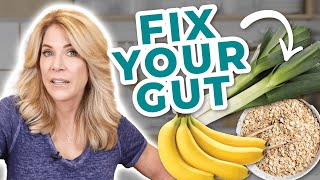
JJ Virgin (host) explains that many common symptoms (digestive problems, skin, brain fog, joint pain, mood swings) can stem from poor gut health—often driven by diet, stress, antibiotics, and processed/GMO foods—and that food-based changes can rapidly improve gut function. Key recommendations: prioritize whole, organic, fiber-rich foods (non-starchy vegetables, whole grains, nuts, berries), aim to increase fiber (host goal 50 g/day; US average ~15 g/day), add fermented foods (start small), consume bone broth for collagen/gelatin, choose anti-inflammatory healthy fats (wild salmon, avocado, nuts, coconut MCT), limit sugar/processed foods/industrial seed oils, consider supplements (fiber/resistant starch, multi-strain probiotics with prebiotics and bacteriophages, digestive enzymes with betaine), and use intermittent fasting (minimum 12 hours, target ~14 hours; occasional 16-hour/OMAD strategies) to allow gut healing and activate the migrating motor complex. Also emphasizes lifestyle factors (sleep, stress management, exercise) and mindful eating practices.
Questions this video answers
50 grams or more
About 15 grams per day
1/2 cup cooked or 1 cup raw (host prefers cooked for digestion)
About two servings of fruit per day; a serving = 1 cup of whole fresh or frozen fruit
Minimum 12 hours; target ~14 hours (can progress to 16 hours or occasional one-meal-a-day)
Chapters
Your gut is the center of your world in more ways than one. It's the control center for your immune system and your second brain. So when it's not happy, neither are you. But odds are, if you've got gut issues, you ate your way into them, which is awesome because it means you can eat your way out of them, too. Hey, it's J. Hi, jj, welcome and thanks for being here. This is one of my favorite things to do because together we're making the world healthier one bite at a time. So like and subscribe so I can support you on your journey to metabolic health. So in this series, we're talking about ways to use food to heal and feel better fast by improving what's at the end of your fork. And in this episode, we're going to talk about what to eat, what, when to eat, and why. For gut health. If your gut is off, it can be hard to connect the dots and find the source of the problem because it can manifest as so many different symptoms and conditions, from fatigue and headaches to digestive problems like irritable bowel, skin problems like acne and eczema, joint pain, brain fog, food cravings, moodiness. There's a lot of different things that can be. If you're dealing with any of those, it could mean there's a problem in your gut and it's trying to get your attention. And one of the most common is a condition called leaky gut. Leaky gut is when the tight junctions in your intestinal wall become loose. They're loose from being assaulted with constant stress, food intolerance, a processed diet, GMO foods, and a bunch of different medications. And it can seriously disrupt your gut microbiome. The little holes get bigger and bigger and bigger and start letting through undigested food particles, bacteria and toxins. And when this happens, you start to have all of these symptoms. You start to feel ugh and you start to get inflamed. So if you've got gut issues like leaky gut, it can be hard to focus on anything else. But the good news is you can heal most problems pretty fast with food. So I'm going to give you some simple ways to shift your diet and swap out foods that could be hurting you for ones that can heal you. And that starts with whole natural food. So my friend, Dr. Will Lee is an internationally renowned scientist, physician, chef, and author. He's all about eating to beat disease. That's actually the title of his New York Times best selling book. And he says when you look at traditional cultures and you're going to see that they eat whole organic and fermented foods, which is way different from our Western diet that's full of ultra processed inflammatory foods that literally wreak havoc on our gut. And he sees solid evidence that eating those processed foods leads to worse health outcomes than eating whole, fresh foods. Kind of seems obvious, right? Foods like whole grains, fruits and veggies, nuts and seeds. Because mother Nature has actually figured this out. Whole foods feed our microbiome and create a healthy gut that is less inflammation. Now, this healthy gut also protects our DNA, slows down cellular aging, and improves our immunity. So eating to feed your microbiome, right, is the key to healing your gut and reducing inflammation. You want to choose foods that support and increase the gut good bugs in your gut, your probiotics. So you're going to feed your probiotics more. Their favorite food, prebiotics. So prebiotics are just basically fiber. But the average American diet is pretty low in fiber, like 15 grams on a good day, which is way below my goal for you. And my goal is 50 grams or more. So there are a couple easy ways to increase the fiber in your diet. Now, one of them is a supplement which, which I have. It's called Extra Fiber Plus. Extra Fiber plus makes it super easy for you to get your fiber and also has resistant starch. You may have heard of resistant starch. It's called that because it resists digestion. It's a type of carbohydrate that has amazing benefits. It can improve your digestion, it can improve your insulin sensitivity, it can lower your blood sugar levels, and it can reduce your appetite. It also helps you burn fat by helping your body produce butyrate and all of that, in addition to helping you have a strong, healthy gut. Now, another way to get more fiber in your diet on top of supplementing is to eat more non starchy veggies. Okay, so my floor for non starchy vegetables is to make sure that you get in at least five servings a day. That's my floor. That's the minimum. Okay? Okay. My goal post for you is 10. And if you want to go past that, I'm super proud of you. So what's a serving? A serving is a half a cup of cooked or a cup of raw. But in this instance, I want to make sure that your veggies are cooked. Okay. This can be a great source of dietary fiber, by the way. And when I'm talking non starchy vegetables, cauliflower peppers, onions, broccoli, brussels sprouts, Asparagus. Now, according to my friend Dr. Vincent Pedri, who's an internist and gut expert and author of Happy Gut, if you're eating a lot of cold foods, it's really hard for your gut to break them down. So think of cooking as the act of digestion outside your body. As an example, just think about the difference in texture between raw and cooked cruciferous vegetables like broccoli. Now, I bring up broccoli because broccoli is not only a great source of detoxifying prebiotic fiber for your gut, but it's also rich in sulforaphane, which has anti cancer properties. So we're focusing on the fiber. But these veggies will do a lot more for your overall health, too. And I don't know about you, but I cannot stand raw broccoli. Like, I love broccoli that's been lightly steamed, like my favorite of all vegetables. But raw, not so much. There are a lot of bioactive compounds in these vegetables that activate our circulation and stimulate our stem cells to regenerate. In addition to helping our gut, their natural defenses become our defenses, and they protect us from invaders inside and outside our body. And this is important because there's been a lot of, like, oh, plants, they've got all these things. We shouldn't eat them. Anti nutrients. But when you look at the antioxidants that these plants have to protect themselves from the invaders, these can be amazing for us. Now, you can also boost the number of good bacteria in your microbiome by adding fermented vegetables like sauerkraut, kimchi, and pickles. And I mean, these are super common when you get outside of the United States, but really not here. And we got to do a better job of getting some of these into their diet because these really help get us the prebiotics and. Or, I'm sorry, the probiotics. Right? So these are super duper important, and they not only nourish your gut, they also help reduce inflammation and strengthen your immune system. Now, here's One thing that Dr. Vincent Pedre said, so this will help you. A word of caution. If you've not been eating fermented foods and you're hearing this, don't go overboard right away. What you want to do with fermented foods is start slowly, like a tablespoon a day, right? Or rotate them in, but don't go crazy. All right? Another one that's great for your gut is bone broth. Bone broth is a rock star for gut healing. It contains collagen and gelatin. Those are going to reinforce the integrity of your intestinal lining and help reduce inflammation. It also contains the amino acids proline and glycine. And those are really important because they help support the tight junctions and they'll help heal the gut. Now, 90% of your gut lining is made up of collagen and those other amino acids. So I have a bone broth shake that I'll use, but I also have bone broth that I put in and I use for cooking as well. And I try to get in. Ideally, this is something that you're adding in and maybe having a cup a day, sipping in between a meal, too. It's super soothing for your gut. All right, healthy fats. So healthy fats help reduce inflammation. Now, they are not to be confused with the nasty fats that cause inflammation, like the ones in industrial seed oils. Those things are highly processed oils, and they're extracted from things like soybeans, corn, rapeseed, that's by the way, canola oil, cottonseed, safflower oil. And they're used in processed foods and also some foods that seem healthy, like packaged hummus. So you got to be super careful here because you could go in that health food store and think you're doing a great thing. And they've snuck in these rancid bad oils. And remember, these inflammatory omega 6 seed oils, when they are processed, they become toxic to our body and they produce trans fats. So we want to stay away from them. Super important. But we want to go towards and get in the good fats, like the ones that you're going to have in wild salmon, in avocado, in nuts and seeds, because these are going to help reduce inflammation. They do everything from keeping you mentally sharp to boosting your metabolism. They also can help stabilize your moods and help keep your energy high, especially the oil from coconut, the MC2 oil that's super easy to burn. They also can play a huge role in weight control because they help keep your blood sugar balanced and they help regulate the amount of insulin released after you eat. So again, here's another shift you can make. It's going to support your gut healing, but then it does all this other good stuff, too. Okay? Some of the other things you can use to help heal your gut are coconut oil and coconut milk. Now, I already mentioned coconut oil, but I want to give it a little bit more time because it's got some amazing properties to it. Coconut is antifungal, antiviral, antimicrobial, and can help balance your Gut bugs. You also can the MCT and coconut oil. Super easy. And for your body to burn, gives you a lot of energy. Okay. You also want to get foods high in polyphenols. So those are things like nuts and berries. My personal favorite. I love blueberries. They're great because they've got loads of antioxidants, and those are going to help you fight off this oxidative stress, and that's going to help you heal. Now, here's the thing. I love blueberries, but I'm not eating like, you know, 10 cups of blueberries. I'll have a cup. You want to make sure you don't overdo the fruit. I say two servings of fruit a day. A serving is a cup because you don't want to get too much sugar. And then you create another problem. And by the way, when we're talking fruit, remember, we're talking fresh or frozen whole fruit, not juice. That's a soda. Not dried. That's candy. Not the jams or the syrups. Right? The concentrates, that's just syrup. Okay, let's avoid that. Now, as a general rule, you also want to make sure you stay hydrated, but especially I want you to drink out a lot of water and green tea. I'm a big green tea fan. I've got it right here. It's really good for your gut microbiome and getting the right gut bugs in place. You also might want to try this traditional Chinese fermented tea called, and I hope to say this right, I Learned this from Dr. Will Lee. It was pure, purer. I'm probably killing it, but he just told me about it and he's testing it out because it's great for health and it's a great digestive aid. So he's been doing this one after dinner. So I got, I got some too. Dr. Will Le. Now, you might also want to add a probiotic supplement for good measure. It's, you know, I mean, we want to start with food first, but this is a way to ensure that you're getting in those organisms, you're getting in those probiotics. So I use it as a top off, right? It's not like, oh, I'm not going to eat any of those fermented foods. No, eat those. And then top it off with some probiotics because you want to get all of these different strains. And so you're going to look for one with a high number of strains and a diverse number of strains, a diverse type of strains as well. So I've got a probiotic that I love. You can check it out at Weeknight Wellness. And it does everything we're talking about here, right? Lots of strains, diverse strains. Okay. Now, I also have some prebiotics in it, and you want to have prebiotics. What I want you to think about with prebiotics is they feed the probiotics. It's like fertilizer for your gut. And one of the things you're going to find with prebiotics is some of them can make you feel a little gassy, right? So you want to. You want to check that, too, because you want to be able to use these things on a regular basis. So that's super important. So, again, I really love taking probiotics, prebiotics, and one that has something called bacteriophages, because they'll boost your immunity by attacking all those bad little microbes in your gut and then supporting the good microbes in your gut, which is so key, critical. So check out the probiotic I have at Reignite Wellness. Now, another thing you might want to do is add digestive enzymes. I personally think that if you're over the age of 30, 35, this is something you will want to have in your diet. In fact, Dr. Vincent Pedre says when your gut is out of balance, you might not be making enough digestive enzymes and you don't have enough stomach acid. And again, this is something you want to look at as you age. In fact, your stomach acid starts to go down at the age of 20. I've always had kind of a rule of thumb, if you're over the age of 30, 35, or under any kind of stress, and it's like, so it's everybody, you want to do a trial of this, so do a trial of digestive enzymes. Choose a blend that has some betaine, because betaine is going to enhance your natural digestive enzymes, right? And then you'll also want something that's going to help break down some of the high five foods like dairy, right? And gluten and soy and corn. Because this is so key. Critical, too. Now, for gluten, you want to blend that degrades the gluten in your stomach and upper GI tract before it can become an issue for you. Now, that's not to say, hey, go ahead and go eat all the gluten. But sometimes when you're eating out, you're doing your very best, and things will still sneak in, right? I always call my digestive enzymes. It's like, okay, mistakes happen. The enzymes will also help Catch you. So that's another thing that I love to take. Now, you want to stay away, and this is super crazy critical, right? We just talked probiotics, we talked enzymes. But I want to make sure that you are staying away from some other things. And one of the things I want to make sure you're staying away from, besides sugar, are antacids. Antacids might seem like this really great solution if you're having heartburn. And if it's like once a year, that's one thing. But here's the challenge. If you're using antacids on a regular basis, studies show that acid blockers reduce healthy bacteria in your gut and can increase infection. So when you reduce the amount of acid in your stomach with antacids, what's going to happen here? Well, it's going to help the bad bacteria survive, and it actually can increase your gas and bloating. You know, some of the things that you were trying to solve when you were taking the antacid, it can actually increase your heartburn, all the things you were trying to avoid in the first place. Now, there are other things you should flat out avoid. I mentioned sugar, processed foods, refined carbs, and the high five foods. Again, I'm going to say shout out. Going on the virgin diet and figuring out which foods work for you and which foods don't. I also have GMO foods on my hit list because they can really wreak havoc on your gut. They're sprayed heavily with pesticides that are going to take down your microbiome, and so will antibiotics. They don't discriminate by the way those antibiotics go in. And it's just like scorched earth in your gut. They're going to get rid of the good guys and the bad guys. It wipes out everything. And then the challenge is you got to go back in there and rebuild. And you can't rebuild your gut microbiome overnight. This is going to take time. Right. Okay, so let's go into when the timing of your meals. This is super important to healing your gut. And the research is clear. One of the best things you can do is to start intermittent fasting. Intermittent fasting improves the health of your gut microbiome. And by the way, intermittent fasting improves the health of your microbiome, but not just your microbiome. It also improves the health of your heart, it improves the health of your brain. So a lot of good stuff here with intermittent fasting. So why are we doing this? The fasting window is going to give your gut the Time, it needs to heal. And then when you do eat, remember we're eating soothing, nourishing foods. So time between meals is still part of digestion. And there's a lot going on when you're not eating. You got to give your body time to digest so that you can start something called the migrating motor complex process. The. The migrating motor complex is the housekeeping that happens in your small intestine when you're not digesting food. It goes in there and sweeps undigested food particles and bacteria from your stomach and small intestine into your colon. But it's not going to happen if your body is focused on digestion, if you're eating every couple hours, if you're snacking. So first off is your first fast. Fasting for 12 to 14 hours, stopping eating three to four hours before bed, pushing breakfast a little later, easy peasy or asleep for most of that. You're giving your gut a rest and a huge chance to heal. And again, you're sleeping for a lot of that. So it's so much easier than you think. Let's say you ate dinner at 7, right? You're done. Done with dinner at 7. You go to bed at 10, you wake up at 7, you have some black coffee or tea, you work out a little bit, then you push your breakfast a little bit. But even if you Woke up at 7 and 8, boom, it's 12 hours. But we're going to push it to 9. You're already at 14. See how easy that is? Super easy. Now, when you break your fast in the morning, you can support your gut with a smoothie, a loaded smoothie, which is what I love to do again with starting with protein, adding in some healthy fats and some fiber, and then for your other meal or meals, and by the way, let's say that you're going to push your eating window to six to eight hours. Maybe you're having two meals you'll have to see. But making sure that with those meals that you're getting in, all of the stuff that we talked about, those healthy fats and the fiber, the protein, all of the great healing foods that your gut needs to be at its best. Now, if you go all in, you all right, I've been eating by the plate. I've been eating my fat, fiber, protein trifecta. I've gotten my eating window to 14 hours. Then I pushed, and I've got a couple days where I'm doing 16 hours. I'm going to do one meal a day. You can do that too. And that is something that you can throw in as a strategy once a week, once a month, that's going to help you heal as well. Now, no matter how you do it, you can see the flexibility that you have with intermittent fasting between, you know, the very minimum here is 12 hours. I think you can push to 14 pretty quickly, stop the snacking, and then you can play around from there. No matter how you do it, it's going to be worth it for you. It's been for me. I feel better than ever having put it in there. And I've watched so many people improve with it. Now, the benefits of it, besides what I've personally experienced and seen with clients, I can tell you the studies super back it up. They show it shifts the balance of good bacteria to get you healthy and protects you against metabolic syndrome. And if you need to lose a little bit, might help with that too. One study showed that a regular meal pattern, starting with breaking the fast and consuming a higher proportion of energy earlier in the day, but fewer meals a day and regular fasting periods and may reduce inflammation, improve your circadian rhythm, which means better sleep, increase autophagy, which is that cellular detox and create stress resistance and rebalance your microbiome. Holy smokes. Could you imagine if that was a drug? It would be prescribed all over the place. Now your gut is the center of your immunity and your whole body's health, your heart, your brain, improving your mood, your sleep and your digestion. And it may help prevent some cancers and autoimmune diseases. Our gut is just so much more complex than we previously thought. And I mean, honestly, there's new research coming out all the time about it. But we do know that for true gut health, what you eat, when and why is critical. And that being said, you'll also want to incorporate things beyond the changes to your diet. You have to get stress management, exercise, and sleep dialed in, because if they're a wreck, they're also going to wreak havoc on your gut. Now, there's one more thing to return to, where we started taking a closer look at traditional cultures. They really revere whole organic food from Mother Nature, the way it's grown, the way it's prepared, and also the way it's eaten. So if you can, as you eat to heal, take a page from their book, not only what you eat, but how. Slow down and enjoy your food with friends and family. Take the time to eat mindfully and pay attention to your body and how you feel. Stop before you overdo it. Ideally, when you're about 80% full. It's one of the best things you can do for your gut. Listen to your body. Helps you tune into what it really needs. Thanks for joining me. If you'd like more content, then please be sure to keep coming back like and subscribe so we stay in touch and you never miss an episode. I'll see you next time.








