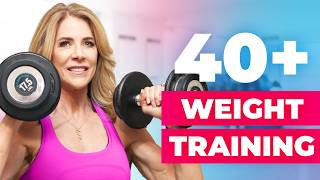
In this instructional video, JJ Virgin shares a comprehensive, age‑appropriate plan for women over 40 to build muscle, burn fat, and improve functional performance. She begins by emphasizing the importance of establishing a baseline through body‑composition analysis (DEXA or bio‑impedance), waist‑to‑hip/height measurements, and simple strength gauges like grip dynamometer and push‑up count. Daily activity is tracked with wearables, aiming for a minimum of 8,000 steps and eventually 10‑15k, with added intensity via rucking (10‑25 lb) and occasional high‑intensity intervals to target visceral fat. The core resistance‑training program focuses on functional, compound movements grouped into three primary patterns: upper‑body push (e.g., push‑ups, overhead press), upper‑body pull (e.g., bent‑over rows), and hip/thigh hinge/step‑up (e.g., squats, step‑ups). JJ explains training fundamentals—sets, reps, rest, and the “reps‑in‑reserve” concept—starting with light loads and progressing to 8‑15 reps, 2‑3 sets per exercise, and eventually 10+ sets per muscle group per week. She stresses proper form, monitoring soreness, and recovery tools such as sauna, foam rolling, Epsom salts, and supplementation (creatine, collagen). Nutrition guidance highlights adequate protein and creatine intake to support hypertrophy and metabolic health. After 4‑6 months, the program can shift toward strength and power development while continuing to track body‑composition changes. The video concludes with a call to watch a companion nutrition video for detailed dietary recommendations.
Chapters
I've been lifting weights for decades now. I started when I was 16, literally. But I approach weight training differently now than I did in my 20s. Now I'm in my 60s, and honestly, I've never been stronger. And by the way, you can be too, even if you're starting now. So I'm going to share what you can do step by step to get started with a routine that's going to help you build muscle, burn fat, and most importantly, look, feel, and perform better than you ever have after 40. So here's where I want you to start. You got to know your starting point, right? So first up, body composition. We've got to stop thinking about the scale. It's not what you weigh, it's what that weight is made up of. And so what you're want— going to want to do is ideally go get something called a DEXA body scan, but the very minimal, do a bioimpedance scan. You can do these at home, they're inexpensive, and I'll put the info on different brands of them in the show notes, but you're going to want to be able to do this on a regular basis so that you can see what's going on under the hood, right? You want to be able to look at not just your weight, but what that weight's made up of, how much of your body is fat-free mass versus fat mass. With that fat mass, where is it? You might think you know, but what you really want to know is the stuff that you can't pinch called your visceral adipose tissue. One of the ways that we do that is by looking at a waist measurement, a waist-to-hip and a waist-to-height measurement. That's how we can track that easily. All of these equations that you're going to get, whether it's a DEXA or bioimpedance, are going to be predictions. And you're really looking for the trends over time because we want to make sure that we know where you're starting from so we can know your big goals, but we can also know if you are improving. The other thing you're going to want to find out is how strong you are. And one of the easy ways to get an overall gauge for your strength is something called a grip strength test. Now, if you've noticed that you can't unscrew the jars like you used to, that's That's a sign that your overall strength is going down. There's something called a handgrip dynamometer that you can get inexpensively. Again, we'll do a link to the— on the show notes for this that can give you the estimate and then also tell you where you are as related to other people in your age group. And you want to be at the top, right? One of the other easy ways to do this is just to look at how many pushups you can do in good form. Next up, your activity level. And this is really important because while we are gonna get into a really great resistance training routine, We also wanna make sure that you are actually moving more all throughout the day. And one of the ways that I like to track this, you could use an, an Apple Watch, a Garmin, a Fitbit, a Whoop. The way that I track my activity all throughout the day is with an Oura Ring. So doesn't matter which one, just it's gotta be the same one, right? And that you're tracking every day so that you can see how you are doing. For now, just pay attention to it to see what your average daily step your average daily activity level is, and if you're going for long periods of time without moving. Knowing all of this, the next thing that we're going to do is set your goals, and you're going to set your goals based on what you've discovered. Did you just discover that you have a lot of visceral adipose tissue and that's a priority to get that as close to zero as possible? Or maybe you're looking, you're going, I'm normal weight, but I've got low muscle mass. Relative to my weight. So I've got a high overall body fat, low muscle mass, and I really need to put on some muscle. So really look and go, what would I love? What do I wanna see changing in my body so that I look, feel, and perform better? Your next step, how many steps you're getting in every day, is to get that up to your minimum, be 8,000 steps a day. Get your steps up. It may take you a month to get to 8,000 to 12,000 steps a day. Doesn't matter. This is a marathon. But then make sure that 8,000 is your floor. And really you want it to be more in the 10, 12, 15,000 steps a day. Once you've got that foundation, now you're gonna crank up the volume and you're gonna add some intensity with something called a rucking vest. Now, if you think about it, we've been rucking since we were little kids, because when we were little kids, we had to throw books in our backpack to go to school. That's what rucking is. And by the way, If you don't wanna buy a rucking vest, throw something in a backpack and use that. You're gonna wanna start with about 10 pounds in your rucking vest, but you're gonna bring it up. Like my rucking vest now is up to 25 pounds. So this is super cool cuz it's an easy way to add intensity into your steps. The other thing that I'd love to see you do once you've got that foundation down is if you're out walking, see if you can add in some little high-intensity intervals into your walk. So you're walking and then maybe you sprint a block, you're walking, you run up a flight of stairs. So you start to add in some high-intensity interval training into the mix as well. One of the reasons this is so important is we know that this intensity, this specifically, this high-intensity interval training can help burn off that visceral adipose tissue. Okay, now that we've got that foundation, We are going to build in resistance training. And if you're listening to this going, you know, I've, I've done cardio my whole life, I've done yoga, I've done Pilates. Is it too late? It is never too late to start this. I was in a doctoral program where you had 80 and 90-year-olds starting resistance training. It's never too late. And now's the best time. Here's the big thing I want you to think about when you're doing resistance training. We are not doing resistance training to get better at resistance training. We are doing resistance training to get better at life. And so the movements I'm going to recommend to you are movements that mimic activities of daily living. And I prefer, if possible, to do free weights, dumbbells, bands, cables, rather than machines, because in life we're not bolted to the floor. I have you focus on 4 body parts, but I'm really gonna emphasize 3 of them. And when you're doing these 4 body parts, we're going to look at moving in a bunch of different patterns. Now, when you first start to resistance train, the first thing that's happening is your muscles and nerves are learning to talk to each other. What happens after that is your collagen, your connective tissue starts to get stronger, and then your muscles start to get stronger. If you are new starting out, 1 to 2 pounds of muscle a month would be amazing for you to put on. If you've been working out for a long period of time, it may be a half a pound to a pound of muscle a month. Putting on muscle is sort of like watching grass grow. You're gonna notice more in terms of your strength development. So pay attention to that. It's really motivating too. And so when I talk about 4 different body parts, I talk about upper body pushing. Upper body pushing are things like a pushup. Now this is in a frontal plane, right? This is horizontal. An overhead press, vertical. So I like to do two different planes. By the way, I don't— I rarely do arm isolation movements. I'm doing these complex movements because I get my arms when I do it. So if you're sitting here thinking, I want to have great arms, push-ups, overhead presses are fantastic. And for upper body pulling, for your biceps and your lats and your shoulders, I love bent-over rows. So again, here's one plane, here's my horizontal. Here's my vertical. Okay. And then for my hips and thighs, I like to do some kind of a hinge. And so that might be a squat or a step up. You'll see these are very functional exercises. Like, think about a squat. When do you have to get up out of a deep sofa, a chair, off the toilet? What about an overhead press? Are you putting things overhead? Are you putting luggage in the overhead rack? What about a bent-over row? What do you have to pick up?. So all of these things are super duper functional, and that's one of the key things that I wanna make sure that you're doing. Remember, you're training to get better at life and you're training in a very controlled environment so that when you get out into the wild and you need that strength, you can call on it. Now, when you're doing an exercise program, there's a couple different terms that you need to know. There's the exercise itself. I'll give you the example of the pushup. So the exercise is the pushup. How many times you do the pushup Those are called your repetitions. And then in between sets. So you have an exercise, let's say you do 10 repetitions, that is called a set. And then in between sets, you have a rest break. When you're first starting out, you wanna go really light. What you're really teaching your body again is getting those nerves and muscles to communicate. And you also wanna see how you feel. And so I like you to go through 2 exercises within each of those 3 areas. Notice I didn't do anything with core because truthfully, If you're doing a push-up right, you're using your core. If you're doing a squat right, you're using a core. So I'm using my core within these other exercises. So what I like to start you with is very easy sets and 1 or 2 sets per exercise to start. And in fact, you might just even want to do 1 and do it 2 or 3 times that week. So this is super light. You're just, you're literally going through the motion. So you might just go through a squat over a chair just to see how you feel. And then the next day you're going to check in and see if you're sort of a to the touch? If you're sore for more than 2 days? And most importantly, are you sore to a joint site? That is generally a connective tissue warning sign, right? If you are sore to the touch, sore for more than 2 days, sore to the joint site, you want to give yourself a little bit more recovery and back down a little bit and really make sure that your form is great. Use the mirror, check your form. Form is always going to be your limiter. Once you've got that underway, You're going to work in sets of 8 to 15 repetitions. Now, here's what's interesting that we know about building muscle. We used to believe that there was a very tight range to build muscle, 8 to 15 repetitions, like it was some kind of magic. Now we know that the range is much bigger, like 6 to 30 reps. But the reality is I want to be time efficient too. And so I find that working in that 8 to 15, maybe 8 to 12 rep range is just the easiest, most time efficient to do. And then you take about a minute or two rest in between sets. There's this idea in resistance training called reps in reserve. And when you're doing an exercise, by the time you get to say that 12th one, you should feel like maybe you could eke out another one or two in good form. So that's how you get started. Just those really easy light ones. Once you've got that under your belt, you've been working on your form, then you can move into adding on some sets and adding in some weight. You're going to want to start with a full body warmup, of course. And then when you do each exercise, do a lighter warmup set and then do 2 medium sets. Then once you've gotten through that, you can move into doing a warmup set and take it to harder sets. And then you can add another set so that we're increasing the volume. One of the ways, or the way that you build muscle, is really what's called time under tension. It's the more that you do in that range, the stronger you're going to get, but also the more muscle you're going to build. And really, this is much more— this type of training is most focused on building muscle. You will get the strength, but this isn't where we're specifically focused on strength. But as you're first starting out, you're going to get more muscle and strength as well. Once you get all of this under your belt, you can start to focus more on strength and power. What you want to do is build up to 10 sets per area or more per week. You want to take at least a day in between. So if I do my upper body pushing on Monday, I wouldn't do it again till Wednesday or maybe even Thursday, depending on how you feel. Again, sore to touch, sore to the joint set, sore for more than 2 days. You might need to get a little bit more recovery in things like hot saunas and foam rolling and Epsom salts baths and creatine, which can help you work out harder and recover better. Once you've gotten, say, at least 4 months, but really more like 6 months under your belt, you're feeling a lot more confident. You got a lot stronger. You're doing the warm-up set and 3 hard sets of each of these. You're doing it 2 to 3 times a week. You can start to look at, do I want to include in some strength and power exercises? Also, I want to make sure you're monitoring your body composition as well and make sure that as you're doing this, you're continuing to put on muscle. And what should happen is if you're trying to change your body composition, ideally, as you're putting on muscle, you're starting to lose a little bit of fat too, because muscle is going to make you more insulin sensitive. It's better for your metabolism, so it's going to make it easier for you to burn fat as fuel. And one other thing that you can do, and it's also going to help in that power side, is increase your speed. And it turns out that if you increase your volume, it can actually help increase your strength as well. That is one piece of the puzzle. There's really three pieces here, of course. And what you wanna think of too is that you've gotta pay attention to fuel, eating protein first, making sure you're getting the protein you need along with things like creatine and collagen. And then of course recovering well so that you can build that muscle because where you really build muscle is in the recovery. So you gotta make sure you're getting the right fuel. So watch this next video where I tell you the food you should eat every day to support your workouts. And have better health and longevity in your 40s and your 50s and your 60s and beyond.