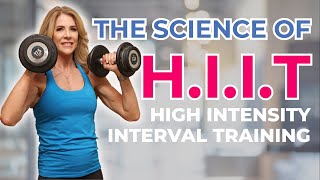
JJ Virgin explains why high-intensity interval training triggers growth hormone, testosterone, and mitochondrial cleanup that moderate exercise alone cannot achieve. VO₂ max is the strongest predictor of longevity, yet 40% of people don't respond to moderate exercise. Intensity, not slowing down, is what keeps you strong as you age.
And it's funny how they become like controversial, especially the plant chemicals. The HIIT versus moderate, would you say then that the priority really is to do short bursts of intense exercise as contrasted with going out and doing like a jog?
Well, you need the jog to be able to do the high intensity, right? If you don't have a base of aerobic capacity, it's gonna be really hard to get to that high intensity. So, I think you're gonna need some moderate intensity to be able to reach the high intensity. But if you only did the moderate intensity without the high intensity, I don't think you're gonna get the same stimulus to the adaptations. So, there are unique benefits. And by that, I'm referring to the fact that when we hit that certain intensity, like we talked about, our brain, our central nervous system gets an adaptation that we wouldn't otherwise with a moderate intensity. So with the HIIT, we're releasing growth hormone and testosterone, and the hormones that we're secreting are different, and that's what's causing our baseline cortisol to decrease. We're also stimulating mitophagy, which is a selective form of autophagy. And so essentially what we're doing is as we hit that super high intensity, we are rapidly depleting our energy. And our cells have an energy sensor, AMPK, or AMP kinase. And that sensor tells our mitochondria that we need to make more. So mitochondrial biogenesis, the growth of new mitochondria starts to occur, and it triggers mitophagy where the old mitochondria are— that are damaged get removed. So essentially, we are creating clean energy in our body, right? We are creating a renewable energy source, and all the mitochondria that are creating these emissions in the form of oxidative stress are being removed. So all the pollutants that are coming with these mitochondria are being cleaned up. So we're essentially making our body full of clean energy and that stimulus of that rapid energy depletion is what really is this potent stimulus. And we also know that just from moderate intensity exercise, if we're trying to improve our aerobic capacity, our cardiorespiratory fitness, which is probably the single biggest predictor of our longevity—
it's the biggest one. Why are we not testing VO2 max? It's like crazy.
Yeah, well, we do in our practice, and we can get to that. But, but I 100% agree that that is missing in medicine, and it is so critical. And 40% of people who do moderate-intensity exercise are non-responders to an increase in their cardiorespiratory fitness. We need to engage vigorous activity for that 40% of the population to be able to really push to the peaks of their cardiorespiratory fitness.
I, you know, I think back, so I'm an exercise physiologist, that's my training. And I think back to a client I had when I lived in Palm Springs, California. And I took her, she wanted to work out at the gym at the Desert Hospital's Cardiovascular Rehab Center. So we go in there and they've got everybody in there walking on a treadmill 2 miles an hour. Now they've got an amazing weight room no one's using, and then no one's really using it, like the treadmills, beyond just walking. So I have her doing little sprinting activity and then doing resistance training. And the funniest thing was then everybody else wanted to do it too. And, and the PTs were absolutely freaked out about this because they thought this would hurt them. I'm like, oh my gosh, come on, you know. And I think And the cool thing about high-intensity interval training is it's what's intense for you. So I would start people out, like I have people walk, but then I'll start them right away because someone's high-intensity interval training might be getting up and down off out of a chair 10 times and someone else's might be jumping onto the chair, you know, and it doesn't matter. It's as long as it's intense for you. So this is, this is fantastic, and I'm really excited this message is starting to get out there because I think for so long the old way of aging was slow down and take it easy and be gentle as you age. And I'm like, nope, that's not, that's not the way to age. The new way to age is to continue to challenge yourself. And I just wonder if so many of these statistics we have about what happens as we age, losing our muscle strength and power, is just because of the way we've approached aging, which is all wrong.