Delphi CEO Dara Ladjevardian Speaks at GrowthDay Summit
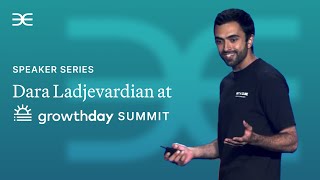
Dara Ladjevardian, CEO of Delphi, explains digital cloning: AI that mimics your voice, mind, and video to answer questions at scale. The system learns from your content, integrates with websites and messaging apps, and includes safeguards against hallucinations and identity fraud.
Chapters
I started following this team and I was like, oh wow, look what they're doing.
Oh wait.
Well, they already figured that out.
Oh wait.
And they were just like leapfrogging. And so I got on the phone, had a couple great conversations with the CEO and founder, got getting really, really excited about it and ultimately invested in the company, ultimately advised, brought them up to Napa, to this epic home where I do these incredible retreats and experiences that overlooks all of Napa Valley. You know, we had private chefs and fancy things. And what was cool is like these guys who came up, these engineers, they were kind of like, yeah, let's talk about AI.
It was like, they're just so hard.
Working, so excited about it. And anyway, I was texting with my friend there was CEO yesterday and helped me really get back in and get Brendan AI shipped, get that out. And he's going to show you some of it. He's going to show you the future of AI. He's going to show how it applies. And this is cutting edge. These guys have been invested in by the big dogs. This guy has it down. He's not like me or in our industry in that way. He's a builder and he's built an incredible company doing this called Delphi AI. And he is so great. And he offered to come here and I was like, yes.
Who's pumped?
Be in the ultra network now. Ladies and gentlemen, in this house we have the CEO of Delphi, Dhar Lajvarian. I'm so excited for you to learn from him. So give him an unbelievable coaching welcome. Dara, let's go, baby.
Just wanna celebrate.
Just wanna celebrate.
Let's go, dara.
Thank you.
Who's ready to learn about AI?
There we go. Well, my name is Dara and as Brendan said, I'm the co founder and CEO of Delphi. And today I'm going to be talking to you about cloning. Not physical cloning, not yet at least. Digital cloning. The most unique thing that we all have as human beings is our mind. It's the collective sum of our experiences, our relationships, what we've learned, our biases and opinions. There is no other version of you.
And up until now, the way you express that mind has been limited by time. You can only be in one place at one time. So the number of people you can impact is capped by this limitation. Yes, there are ways to scale yourself. You can write content, newsletters, YouTube videos, podcasts. But it's not personalized to the end user. Can't keep them accountable like A coach can. You can hire teams and train them in your way of thinking, but that loses essence. That is you. You can create communities, but ultimately you want to sell your time. And that works for people who can afford it. But like we said earlier, there's a cap to that.
Now on the other side, the people who are paying for your time will always pay for your time, because the human experience is the premium that's never going to change. The other people who don't have that opportunity, what do they do? They read your content. Maybe they try to reach out to you on LinkedIn or email you. And they will take notes and try to figure it out on their own. But we all know the best way to learn is one on one. It's the premium experience. I can list dozens of educational studies that talk about this. One on one is really the best way to learn. So the solution, Delphi, allows you to actually clone yourself and scale that one on one time zones are no longer a barrier. Languages are no longer a barrier. While you are working with the clients that are paying a premium for your time, your clone is out there talking to everyone else, building relationships, making money for you. And this isn't just a generic chatbot. This is you. How you speak, that unique mind we talked about earlier. This is you unlimited.
So let's talk about use cases and benefits because we all know there's a lot of. I love that there's a lot of AI tools out there that are cool when you look at it, but it's not actually that useful. So we tried to make this useful.
Number one, which is the obvious, scale your expertise the same way software can scale. Like I said, one on one businesses have been capped. But now one on one businesses can reach the scale of software. We have customers who are raising money to build businesses on their clone. A cybersecurity expert building a consulting firm on his clone. A dating coach building a personalized dating product on his clone. A health expert building a personalized nutrition app on his clone. So now you can think of one on one as something much larger than just time constrained.
Number two, save time. I'm sure you guys are tired of getting the same questions over and over again. And you're like, dude, this is on my website. You can just read that there. Well, your clone can handle these repetitive questions so that you can focus on the people that actually move the bar to the next level. It can also provide 24. 7 customer support. So instead of hiring overseas customer support teams, your clone can represent you the way you want.
Number three, increase value and trust. When you give people access to your clone, you're giving them access to your mind, and it provides a sense of trust, especially that all responses are cited. So they know it's not generic AI. They know it's coming from you. And the number of times that I've been emailed from someone who has told me, hey, Dara, I was just chatting with your clone, and I'd love to hop on a call. And we get on that call, and the conversation is more in depth because they went over all the unimportant details with my clone.
Number four, and personally, my favorite mass personalization.
So your clone becomes personalized to the end user as they speak to it. You can send out a mass message to all of your clone users. Let's say you want to ask everyone, what are your current goals? And they can respond. And your clone actually responds differently to each one of them based on what it's learned from them in the past.
And on top of that, you can leverage analytics around your clone users to personalize outreach to those people. You're learning what these people are interested in, and you can use that to inform how you communicate with them and maybe potential content strategy ideas.
Increase your team's effectiveness. So we have several people who have created a clone, and the clone actually helps their team make decisions when they're not available. They also use the clone for content creation. So it's not only useful for your audience, it's useful for your team as well.
So how do you actually create a clone? You guys want to find out?
Let's do it. So first, define your goals. How do you actually want to use this clone? This is important because it will help the system learn how much data is actually needed to make your clone good. For example, if I wanted to create a clone of myself to help people learn more about Delphi, it doesn't need to know about my personal life or my dating life. It can just learn about the product.
All right, next step, collect and upload all your data. You can connect Your socials, Notion, YouTube podcasts, and it creates feeds so that it stays up to date. If you release a new blog post, a new Tweet, a new YouTube video, it will automatically keep your clone up to date so you don't have to constantly come back.
Next, perfect your voice and face. So we support voice cloning, which means people can call clone. And we recently released video cloning. And this is our friend Jay Abraham, who recently got his video clone, and you can facetime with his clone now.
The next is testing. Obviously you know you the best, so talk to your clone. If you don't like an answer, you can actually improve the response in real time and adjust the tone. And you could also set custom instructions so that your clone can avoid topics that you just don't want it to talk about.
For example, we do have some health experts and financial experts and obviously there's a lot of liability there. So a custom instruction could be like, don't make any stock recommendations. And the clone will abide by that.
Next is sharing it and integrating it into different sources so you can add it to your website. You can give it a phone number. WhatsApp, Slack, Discord, your course. We have integrations with Kajabi Mighty Thinkific. Your clone can live where your audience lives.
Engagement. So your clone will actually notify you whenever it is asked a question that it doesn't know how to answer. And you can hop into conversation and answer that question yourself. And your clone will improve so you don't have to do it again in the future.
You can also send out mass messages to your audience. And like I said before, you can update them on content updates or just check in on them. This is like mass accountability.
Thank you.
Last thing, which I know we all love to talk about, drive revenue. So like I said, there will always be the people who are willing to pay for your time because that is the elite experience. That's why we're all here. Being with humans is great. With your clone, you can provide a more affordable alternative by charging for minutes messages. You can also include your clone as an upsell to your course, your book, your community. And you can even have your clone sell your products for you in conversation.
Last thing is unlocking insights. So there are thousands of conversations, millions of conversations maybe. How do you make sense of all that data? Well, you can ask your clone who are the people I should pay attention to the most? What topics are most interesting to people? What should I write about next? And this allows you to scale your understanding as your clone scales your availability.
So obviously there's a lot of fears in AI and they're valid. Things are moving very quickly and we've tried to build around these fears.
So what if my clone hallucinates? Step number one, you don't want it saying something that makes you look bad. Well, we spent a lot of time building guardrails around this and there is actually a clone quality score that will let you know how ready your clone is to represent you. We also have a strictness score so that you can set it that your clone only says things it is trained on. And I think that's good. If you're a health expert or, you know, a financial expert, it's sometimes best to keep it less strict because if you're in a field where personalized advice matters, your clone needs to be able to reason on new situations. Sometimes people are asking you, what would you do in my situation? And your clone needs to be able to reason there.
What if it's used inappropriately? Well, like I said, costume instructions can prevent the clone from engaging in certain topics. You can also put a disclaimer, and anyone who uses the product relinquishes you or us from any liability. I know that is a stress for a lot of people, but like I said before, we spent months building guardrails around this. So.
You'Re going to be good if you have the data.
What if my data is misused? Well, your data is yours, period. Any data you use to train your clone is owned by you. It can be deleted at any time. There are so many AI companies these days that are raising money on the promise that they're going to use our data to train bigger and better models. That sucks, right? We don't like that. Data ownership is super important for us and it will never be used outside of your clone.
What if you're impersonated? We only let people clone themselves and I manually verify every single person that goes through. Eventually that's not going to scale, but for now, it works.
What if my clone makes me seem inauthentic? And I think the mental model that really works for a clone is that similar to how a book is an artifact of your mind? It's a way of expressing your thoughts or a course. A clone is an artifact of your mind that responds. It's a way that gives people, people the opportunity to experience you. And like I said, it ends up augmenting relationships because they build trust with you and it makes the one on one that much more valuable.
So AI spins out content infinitely.
And when there is abundance, what usually happens afterwards? There will continue to be a premium for human verified content. People are going to be tired of ChatGPT generated content. Which is why I say that having a clone will most likely increase the value of your one on one time because your clone gives you the scale of AI. And a good analogy I like to use. Before AI, we had Wikipedia. And Wikipedia arguably has documented all of human knowledge. Yeah, we still read books, we still talk to experts, we still get coaching, we still watch YouTube videos, we still listen to podcasts. What does that tell you?
Humans prefer humans. They want to learn from people who have experiences, who have that unique thing that we call a mind. So humans plus AI will always be better than AI because it has that layer of trust and authenticity that AI and ChatGPT doesn't have on its own.
So do you know what they say about live demos?
They say not to do them, but I'm feeling a little risky. What do you guys think?
All right.
So live demos plus shaky WI fi. We're going to see how it goes.
So we're going to talk to my friend Brendan. Let's give him a call.
And notice you can call him in any language. So you want to hear Brendan talking in Japanese. We can do that after.
Hey, it's Brendan Burchard. AI, what's on your mind today? What do you want to improve or learn?
Hey, Brendan, I am speaking in front of a crowd of very intelligent and successful people. I'm almost getting a little nervous. Can you help me out here?
Absolutely, Dara. First, remember that nerves are natural, even for the most experienced speakers. The key is preparation and mindset. Focus on delivering value to your audience. They're there to learn from you, so shift your attention from your nerves to serving them. One tactic I use is to remind myself that it's not about me, it's about the message and the impact it can have. Take a deep breath, visualize a successful outcome, and connect with your audience from the heart. When you speak with authenticity and passion, people will resonate with you. What specific part of your presentation are you most nervous about?
Pretty good advice.
What specific part of your presentation are you nervous about?
Follow up.
Follow up questions.
I just had.
I knew they were like, is he really doing okay?
Go ahead.
Okay.
So we just left launched video calling, and it is still a bit uncanny. But if you guys have been following the speed and pace of AI, you know how fast this stuff improves. When we first launched voice calling, that took five seconds for the thing to respond. And so I think video is going to have the same slope of improvement, but let's try it out.
Hey, it's Brendan Burchard. AI, what's on your mind today? What do you want to improve or learn?
It's brendan.
More from Joe




OpenClaw is making AI agents accessible to EVERYONE and this is a total game-changer. 🤯 #ai #ainews







OpenClaw Delete Panic -- The Email Inbox Nightmare! #openclaw #email #nightmare