Building A Team You Love: in 3 Steps with Brad Martineau at Joe Polish's Genius Network
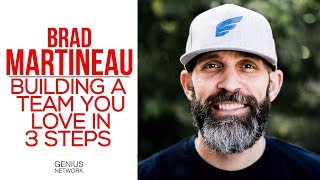
This content was created by Joe Polish. This content was uploaded by Joe Polish. This is a YouTube video titled "Building A Team You Love: in 3 Steps with Brad Martineau at Joe Polish's Genius Network" from July 18, 2018. It features a talk by Brad Martineau discussing strategies for hiring and building effective teams, focusing on fit over skill, hiring processes, and leadership versus management. The talk is part of Joe Polish's Genius Network event.
Chapters
Brad Martineau is the co founder and Chief Baller at 6 Division where he and his team are on a mission to change the world by creating more powerful entrepreneurs. Their belief is that most entrepreneurs are so bogged down in the minutia of their existing businesses that it is difficult for them to find room to exist powerfully. Normally you hear Brad attempt to wax poetic around systems automation, business processes and infusionsoft. But today Brad is going to talk about how to reduce minutia, or as Alex calls it, pressure and noise in a separate but equally critical aspect of entrepreneurship, which is employees and hiring. Brad started as the sixth employee at infusionsoft and got a front row seat to how powerful or crippling employees in hiring can be for entrepreneurs. Over the last decade of working in the trenches with thousands of entrepreneurs, Brad and his team have identified the critical mistakes that entrepreneurs make when hiring that cause insane amounts of unnecessary frustration. Brad's 250,000 10 minute talk is a formula for hiring and building a powerful team to help you realize your vision and maximize your contribution. Give it up for Brad Bart.
Alright, so I'm going to start with two seemingly completely non related questions. Has anybody in here ever been married, dated, or is currently dating someone? Okay, good. Now second question is, has anybody in here ever had to work with or has hired anybody else in their organization? Okay, cool. So as we go in here, I'm going to come back around and I'll explain to you why these two come together. But I want to loop back to something that Alex said. So Alex took us on the arc of contribution yesterday and he had a series of questions that he had us ask. And I want to focus on something that happens for entrepreneurs in between these two. How do I get further ahead? And then he said, eventually we shift to how do I help my team get further ahead? Any entrepreneur that makes it from here to here, right at this point of the arrow has a massive realization. Actually, it's not a realization, it's an acceptance of reality. And that reality is that in order for us to accomplish our vision and in order for us to maximize our contribution, it will take a team. Now this poses a challenge because most entrepreneurs, quite frankly, suck at hiring and they suck at bringing people on board. And what it does is it creates a lot of frustration. So what I want to cover today are three lessons that dating can teach us about building powerful teams. All right? So number one, fit, not skill. Okay? Now this is important. Now think about this. If you're going in the dating process, if you Go through the dating process, and all you're looking for is skill. Just imagine how it's going to turn out, right? I'm looking for someone that can cook really well. I'm looking for someone that can clean really well or makes a lot of money. Now, some of you, and I'm not going to ask for volunteers, but some of you may have learned this the hard way. Okay, now, when we go into the hiring process, let me give you five things. What entrepreneurs love to do is we love to go out and we love to find the person that is the best designer, the best copywriter, the best social media person. I'm going to give you five other things that you ought to be considering in addition to those. Because skill set is not the end, it's the beginning. That's where the conversation starts. So five things. And again, it's all about fit. So what we're talking about here is alignment to these five things. And the first one is your vision. What are you trying to accomplish? Is the person aligned to your vision, or are they aligned to the job that you're currently looking to fill? There's a big difference between the two. If they're not aligned to your vision, you should not even be considering them. Second is values. Does this person look at the world the same way that you do? For example, our number one core value at sixth division is amaze. I don't believe in doing anything that's not amazing. As Travis commented downstairs, in the middle of a conversation, he added, slightly anal retento. And that describes me. Now, here's why this is important. It's a value for us to amaze. If there's somebody who's okay with, like, good enough, we're not going to get along very well. And so we need to make sure that I understand. This presupposes that as an entrepreneur, we know what our own values are, and there's a process to go through to do that. But we have to make sure that the people we're bringing on board share our values. Otherwise, we're going to butt heads. Nothing's going to get done. Number three is attitude. And the way that I can best summarize this, I was at Fort Hood and in the military. They have a phrase, and it says, in the absence of further orders, attack. So the question here is, do they have an attitude of success? Do they know how to be successful? If I drop them in a room and I give them half of a set of instructions, can they finish the instructions and finish the project, or do they Sit down and curl up in the fetal position and start sucking their thumb. Right. Okay, number four, environment. Now I might find someone that is totally aligned to my vision. Someone who matches my values, someone who's got the right attitude and somebody who has the greatest skill set ever. In my office we play music 247 and it's loud. Two and a half. We go above two and a half, the neighbors come tell us to turn it down. If you can't work with music playing, you can't work with us. They have to be able to fit to the environment. And then the last one is chemistry. You've got to stop and consider when you're going to bring another person on board. You have to consider what that new person will do to the overall chemistry of your team and your organization. When we were going to hire our office Manager, we had two finalists. Maybe 20 year old lady, by far the most magnetic personality I've ever met in my life. And then we had an older single mom, raised four kids. One of the kids had special needs. And as we sat down to decide who we were going to hire, it boiled down to when people walk into our office and we have the mom, it creates an entirely different complexion in our office. And everybody else in the organization shows up differently when the mom's there as opposed to the 20 year old. So you've got to consider chemistry and if they're going to be a fit for the chemistry you want. So fit, not skill. All right, number two, hiring, not interviewing. Now again, let's go back. What we like to pretend like is that we're clinical psychologists, right? So what we do is we go online and we search for, we do Google, what's the best question to ask in an interview, right? And then we get a list of like the 19 questions asked. We'll tell you everything you ever need to know. And then we sit down and we ask the question and then they give us an answer. And we're sitting there on our side and we're like, yeah, that sounds like a really great answer, but I have no frickin idea what to do with the answer you just gave me. So we just nod our head and we check off on a list and we come back up and we say, okay, cool, next question. And we're like, well, you don't really sound like you're crazy. And you kind of gave some good answers, so I guess I'll hire you. Now imagine what happens if we do that in the dating world. If you start to date and then you're about to get married and all you've done is you've just gone on dates and you've had conversations. How much do you really know about the person across the table? Not that much. So here's a process. We've identified what we want in terms of fit. Here's a process to actually identify if they're that person. It's hiring, not interviewing. So what we're going to do is we're going to create a hiring process that's based on skill set exercises. Meaning if somebody says, hey, I can build funnels and that's what the job requires, then we're going to have them build the funnel in front of us. If somebody's supposed to manage my email, they're going to manage my email in front of me. And we're going to administer those skill set exercises in a way that will reveal character and attitude so that we can determine fit. So we were hiring our office manager and the first assignment we gave her was, hey, I need you to plan a trip where I'm taking my daughter to the American girl doll store and then I've got to fly to a business thing to speak. And that was all the instruction we gave her. Again, I wanted to check, I want to check attitude. Can she just fill in the details? And then what I also wanted to see is how does she send it back? Remember, number one, core value for us is amaze. So what I'm looking for is the person that will put together a word doc, take our logo off of our website, put it into the header of the word doc so it's styled. That's what I'm looking for. We got about five people that did that. And the person that we ended up hiring sent back. It was literally like a 10 page document. She had thought through travel plans, flight plans, like car, everything, and had our logo on top of the, on top of the document. So what we've done is I know she can do the job. And I've set it up so that as she demonstrates that she can do the job or he, if that's who you're hiring, I know that they're going to be a fit to both the culture and they have the right attitude. And so we should never, ever, ever hire. I was at, I was at a conference recently. I talked to a guy like, yeah, I've got 40 employees and here's how I got them. I hired 400 and I fired 360. Reminds me a lot of Joe. You quoted Dan Sullivan. Getting results doesn't take time. Not Getting them does. That reminds me a lot of that. What if we could just go hire the right 40? It ought to be that before we provide an offer, we already know that they can do the job and that they're going to fit. We don't have to wait until afterwards and cross our fingers and hope. All right, so that's number two, hiring, not interviewing. Number three, leadership, not management. So what I want to introduce to you is a matrix for leadership. Across the bar here, we've got challenge. Low challenge is the person that does stuff for people as a leader. High challenge is where you require the person to learn and grow to be able to do what they're supposed to do. Support is your Y axis. High support is someone that says, hey, you're great. I'm behind you. I'm in your corner. Low support is the person that says, hey, you suck. Now let's go back to dating. In any relationship, anybody ever tried to manage a relationship instead of lead in a relationship? We're going to walk through this, and I think you'll start to see where it comes in. So low challenge, low support as a leader is an abdicator. It means that you don't require anything of your employees, and you don't also give them anything. And what you create is a culture of apathy and low expectation. I don't think anybody in this room is here. I don't think you get in this room. If you're here. My guess is you're going to find most of yourselves in here. Next is Dominator. So you've got high challenge, low support. You demand a lot of the people on your team, but what you don't do is you don't create support to actually help them accomplish what it is that they need to be accomplishing. Right. Think dating. Same problem. Not a good relationship to be in. Now, where I found most entrepreneurs that want to do something important in the world, they actually end up here. It's the protector. And the protector is the person who has high support. I'm in your corner. You, you're great. Low challenge. When something doesn't go quite right, instead of me forcing you to figure it out, I do it for you. Anybody in here ever stepped in and done something for an employee as opposed to letting them learn how to go do it? Protector. Now we get to the liberator, and this is where leadership comes in. The liberator is the person who has high challenge and high support. So when something doesn't go right, the liberator doesn't step in. And fix it. The liberator says, hey, this didn't go right. I'm willing to have the conversation with you and to establish the boundaries of, hey, this is what you were supposed to do and it didn't happen and you need to go fix it. And I'm here to help you. So leadership, not management. So I'll recap. And for those of you that don't speak Spanish, that stands for the recap. Fit, not skill. When you're going to hire, skill set starts the conversation, it does not end it. Second, hiring, not interviewing. You want to put them into skill set based activities that are administered in a way that allow you to determine their character and attitude. And then the last piece is leadership, not management. You want to be a liberator. You want to be the person who both supports them, but also challenges them to learn and to grow. Now, for me, as I look at this, this is an equation. And the end result of this equation, if I draw a line right here, is you have a powerful culture and you have a powerful business and a powerful culture and a powerful business can move mountains. And the reason why I think this is important goes back to our mission. Alex talked a lot yesterday about the entrepreneurial personality type. I don't believe that that's a separate set of people. I believe that it is something that's inside of everybody that just hasn't been awakened yet. And I believe our responsibility as entrepreneurs is to do these three things. So that what we can do is if we exist as powerful entrepreneurs, our employees can't help but exist as powerful people. And then we all go home and the families can't help but be powerful. And when families are powerful, communities are powerful. And when communities are powerful, nations are powerful. And that's how you change the world. Thank you.
More from Joe

This FBI Trick Can Command Respect Without Saying a Word ft. JEFFERSON FISHER & CHRIS VOSS

How To Stand Out, Be Different, and Create Raving Fans, Customers, and Employees ft. Jesse Cole



90% Of Businesses Fail In Their First Year, Here's Why! ft. Dr. Benjamin Hard & Dr. Robert Cialdini

The 1 Piece of Business Advice I Got From Elon Musk That Changed Everything Ft. Kamal Ravikant

The 6 Traits You CAN'T Teach in Entrepreneurship ft. Richard Branson & Gino Wickman

The Leg Method: How to Make Your Book into a Million-Dollar Asset ft. Anna David


7 Millionaire Mindset Hacks for Daily Success and Wealth ft. Brian Tracy & Dan Sullivan
