Game Changers: A 10x Conversation With Dan Sullivan and Peter Diamandis
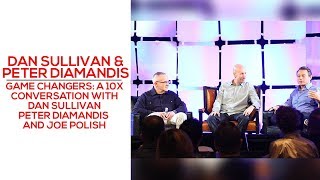
Peter Diamandis and Dan Sullivan discuss how technology and mindset create 10x impact. Diamandis shows how blockchain and diagnostics are democratizing resources. Sullivan argues that buying back time and committing to 25-year moonshots multiply what entrepreneurs can do.
Questions this video answers
All 3.2 billion letters
1.2 trillion digital pictures (claimed)
1.8 billion online in 2010; ~8 billion projected online by 2024 (speaker's projection); ~3.5 billion connected at time of talk
A signed $1 billion agreement with ULA to provide 1,000 tons of fuel (claimed)
Chapters
I'm bringing together two of the greatest minds on the planet that have inspired countless amounts of hugely successful people and entrepreneurs. I could do a big introduction for both of them, but everyone here, I believe, knows who they are. So I want to welcome to the stage Peter Diamandis and Dan Sullivan. Take a chair.
Give me a hug.
What's up, man? Good evening, dad. It's not really evening, by the way. It's good morning. Okay, so you guys have become pretty awesome collaborators.
We have, obviously, because of you. And just one sec. I remember exactly where I was. I was sitting right about where Table 21 was. Joe comes up to me. I'm here at Genius Network, and Joe comes up to me. He goes, peter, I got something extraordinarily important for you. There's something I'm going to tell you that is going to change your life. And I'm like, okay, is it like, invest in this, or is it like you've got. And he goes, I have to introduce you to somebody who's going to change your life. And you go over and you introduce me to Dan. And my life did change in that moment. It changed in an instant, just like that. And it was the conversation I had with you with Dan. I joined Coach instantly at that moment, and something that I commend to all of you here. And in that moment, the conversation we had at lunch in the room just down the hall here was, why don't you fear the future? And do you realize that most people do fear the future? I remember that conversation. And that led to abundance. 360. To everything I'm doing in so many different ways. But I just want to say to both of you with all my heart, how grateful I am to you, who are two of the most generous people on this planet who give and give and give. So I want to give it up for you guys.
Thank you. Thank you.
Thank you.
Appreciate it. Thank you. Awesome.
Yeah.
The biggest pleasure I get is when I can connect people, and through that connection, amazing things happen. And that is exactly what has happened. So much has come out of it. And. And what? My goal for everyone here and for anyone that listens to this is that in the short time that we have together, that they leave with you. Go back to the original definition of an entrepreneur, John Baptiste, say, which I learned from you. The first use of the term entrepreneur, 1804, is to take resources from a lower yield to a higher yield, from a lower level of productivity to a higher level, and to take everyone's mind in here from one level to to another level in terms of how they think about abundance, how they think about accomplishing what they want to accomplish 10 times in their business or any area of their life. And I'd like to have that sort of discussion because both of you are the two best in the world people that I think could speak to this conversation. And before we do that, I wanted to like, since we're here, I wanted to present a new opportunity to you. It's like a, it's a multi level opportunity where we sell 3D printers and the 3D printers 3D print a downline and then the downline 3D prints a bigger downline and it's just this infinite multi level. I'm kidding, by the way.
Okay, so abundance.
What the hell is abundance? How did you get in on all this and how do people think about it?
So I live my life in a very amazing world and community both at the XPRIZE foundation where I serve as founder and chairman and at Singularity University where I'm co founder and executive chairman and all the companies I've started. I'm working on my 19th company right now with my good friend Evan Pagan, which is going to be awesome.
Watch out for him by the way.
Yeah, I know. But I started realizing that everything that we used to think of as scarce is becoming more and more abundant. And it turns out that technology is the force that takes what used to be scarce and makes it abundant. And we forget as humans what the world used to be like. We've got this perverse version of the future that was, you know, we make ideal, but it's not, you know, we used to be based on an energy economy of like whale oil for lighting. Right? Then we discover this thing called petroleum and we start getting after that. And then we have technology that allows us to dig 5,000 meters below the ocean surface and then 5,000 meters sideways get access to more oil. And then all of a sudden we're fracking for more natural gas. And so energy is becoming more and more abundant. And then all of a sudden we realize that there's 8,000 times more energy hitting the surface of the earth than than we use as a species. And there's this explosion of solar production. The cost of batteries is dropping at two to three times faster than the optimists predicted. So we're heading towards a massively all electric economy. And then you think about well, is water scarce? Well, we live on a water planet. One of our X prizes that Ratan Tata out of India's funding a water abundance XPRIZE is About taking the water out of the humidity of the air and giving a family 20 liters of clean drinking water. So the question is, what do you think of as scarce? And I would posit that there is very little that is truly scarce. That technology takes anything that used to be scarce and makes it abundant. Naveen, a dear, dear friend, one of my most successful pupils. I might say he's my older brother from another mother. But we're working on the fact that the Earth is a crumb in a supermarket filled with resources. There is no limitation. A half kilometer nickel iron asteroid has got platinum group metals a thousand times cheaper than you can get it on the surface of the earth. And so energy, water, food, healthcare and education are going to go to zero cost eventually. That's just. We're demonetizing and dematerializing that. We can talk about that if you want to. And at the end of the day, the only thing that is some degree limited is time. Whether you're the richest person on the planet or the poorest person on the planet, we're all born with the same 24 hours a day, three to 65 days in a year. It's how you use your time that can make it more abundant. My work at human longevity and singularity is adding 30 or 40 healthy years in a person's life, which will make time more available, but it's how you use your time. And Dan, you talk about the importance of free days and how you just it coached in this last session we talked about how do you buy back time.
Yeah. So my approach is very single minded, very single focused. So I have, I'll give you an example that these are two of my great successes because I used to worry about not being connected in the world and I'm not a connector, you know, I'm not, I'm. I really don't have the instinct, you know, to be in contact with a lot of people. And Dean Jackson, where's Dean? Dean is Dean. Hear him? Where's, where's, where's Dean?
He's sleeping in, probably drinking and smoking out this.
Can you imagine Dean tying one on? I mean it really. Anyway, we were just comparing cell phone experiences and we determined in our last podcast that Dean in any two day period has more telephone activity than I had had in the previous year and a half. And half of my telephone activity was actually with Dean. So I'm not really plugged in. But I look at individuals like Joe and I look at individuals like Peter, like resources. So to go back to the resource Model. My job is to take a resource called Joe from a lower level of productivity to a higher level of productivity. And when I met Peter, I got a feel of where the center was for Peter. And I said, you know, if we could just free him up, the impact on the planet would be a lot greater. So what I look like is individuals that if I can show them how to buy back their time, just get centered on where the real power of who they are as an individual. In other words, where their confidence is and where they feel most abundant inside themselves. And then you can get them focused and you can create a network of very, very skilled people around them. Then you can multiply the impact of this individual 10 times, 100 times. And, you know, with technology available today, it can become global in its reach. And day in, day out, that's all I'm interested in is that one resource called the, you know, the person with a passion for a particular new thing on the planet who's dedicated his or her life to that. But they've gotten kind of complicated, they've gotten kind of complex in their life. And bring them back to simplicity and then build frameworks, help them build frameworks around them so that they can just be doing what they do on the planet all the time. And that's a source of energy too, for the planet. That's. It's the human side of it. So that's really what I do.
Yeah. When you just even talk about resources, I mean, are you of the belief that we have plenty of resources in all areas? It's just a distribution problem?
It is. So the challenge is that we as humans are dematerializing, demonetizing and democratizing products and services. I talk about the 60s, Dan and I spend a lot of time talking about this. Work with the entrepreneurs that I coach in Abundance 360 and Abundance Digital to help them understand. How do you digitize everything you have? Once you digitize your products, your services, they enter a period of deceptive slow growth. Then they become disruptive and they, in this sequence, dematerialize, demonetize and democratize. And so the digital camera is an example, Right. Film photography used to be very expensive and inefficient. Remember when you used to pay for the whole roll of film to get exposed and you hope a picture came out? What a gimmick that was. So then we dematerialized, demonetized and democratized photography, and film photography falls off a cliff and digital photography grows. Last year, 1.2 trillion digital pics taken, and it's exploding onto the scene. And so there is.
How the hell did they count that?
I think they probably do an average and they multiply by the number of digital cameras.
I just want to make sure you're not making stuff up.
But at the end of the day, well, you know, it is an absolute fact that 27.8% of all facts are made up on the spot.
Yeah. I was good to see if you were going to respond to the audience laughing or just got to go with it. That was good.
Thank you. I appreciate that I learned that from you.
But.
But there's very little that truly is scarce. And so the job of an entrepreneur, your job as an entrepreneur is to actually find an incredible area that you're passionate about and to make it abundant, to digitize it. And we're seeing this over and over again. We're about to decimate banking industry, insurance industry, because of blockchain. Because of the fact that. Can I jump into one fun fact? Yeah. In 2010, we had 1.8 billion people online. 2010. Today it is about 3.5 billion people connected on the world by 2024. What is that? Six years from now? We're going to 8 billion people connected online. So we're getting about four and a half billion people are going to come online in the next six years. Now for this community in particular, it's four and a half billion new customers who've never uploaded or downloaded anything before, have never had digital experience before. Think about this. We're doubling the world's population and these people are coming online not like you and I did at 9,600 baud on AOL.
Right.
They're coming online at a megabit gigabit connection speeds with access to the world's information on Google and Baidu. They're all going to want health care, education, insurance and banking. They're not going to go to an atm, they're not going to go to an insurance broker, they're not going to go to a school, not going to go necessarily to a hospital. They're going to want all of these things digitized at marginal zero cost and huge markets, huge businesses. Add blockchain on top of that and you get changed the world. And one of the things I realized that we're going to make more wealth in the next 10 years than we have in the entire past century. And I predict that the Forbes 500 list is going to be radically different 10 years from now.
Well, okay, so talking about making wealth and creating business for the people here in the Room. What are the mindsets, Dan, that over all these years, are critical for freeing yourself up in order to do it? Because it's sort of an interesting thing, as you said earlier, freeing someone up like Peter so Peter can be a bigger version of his already pretty superhuman self.
Yeah, well, and it's Peter connected to a lot of new people that he hasn't even met yet. In other words, there's going to be people. You know, it was a bit like what Naveen was talking about. He just put out that he wanted to make illness optional for people that you could actually choose. And all of a sudden, talent pours out of the walls of people who've been working on something for 10 years, 20 years, but they didn't have a spokesperson, they didn't have a public vehicle for their work. And so, you know, I really talk a lot about mindsets, and Peter and I are pretty much totally in agreement that basically mindset either closes doors or it opens doors. And I've been thinking, you know, I've been coaching for 43 years, and I said, well, if you had just a couple mindsets, that would make people more open to taking advantage of everything that Peter's talking about. You see, I've delegated all this stuff to Peter. I used to spend 500 hours a year, you know, on the Web, looking at, you know, I had files, looking at the artificial intelligence and everything else. And then I meet this guy. I read about him in the Wall Street Journal. I read his review of Abundance, the review of his book Abundance. And I said, man, I said, this is fantastic, what, you know, what he's saying here. And so when I got the chance to meet him, I mean, you have your own, you know, your own recollection of that meeting and what it did for you. But what it did is just save me 500 hours a year that he's out there every day. And all I have to do is, you know, you know, get him kind of clear, get him kind of focused, and I get his 500 hours. And it's a lot better stuff than I was getting. So anyway, and then Joe. I mean, the thing is, a lot of people have Rolodexes in whatever form they are today. And so I just got one name in my Rolodex, and it's Joe. I said, I'd like to meet so and so, and it's done. So I've just delegated hundreds, thousands of hours to these two guys. You know what I mean? You know, I'm just happy to be up on Stage with these two guys working, working, working away. But here's the two mindsets that I think are crucial. One of them, and they're in short supply, I'm noticing, in public life. One of them is gratitude. Gratitude. I think if you're really, really grateful, you create an abundance related to your past. That's really what gratitude is because you're grateful for what has gotten you here. And gratitude is a proactive skill. A lot of people make it a reactive skill in the sense, well, if somebody does something for me, I'm grateful for that. But the word gratitude, being grateful is related to the word appreciation. How many of you say, well, I really appreciate that. And appreciation is a really neat word because it's got that emotional sense, psychological sense, but it's also got an economic sense that things appreciate. Gold appreciates. Land appreciates. Stocks appreciate.
Could we add bitcoin to your list?
Yeah. Bitcoin appreciates. Everything Peter's involved in appreciates. I hope so, because he's got some of my money. I want it all to appreciate.
And I appreciate you.
Yeah, but what appreciation, what appreciation really means is that you just give value to something. In other words, you say, you know, there's qua. Qua sitting right across from me, and I always appreciate qua. And you know, and I really appre. You know, I can just sit there and think about KWA for a half minute. And, you know, I totally appreciate Babs, as everyone knows. You know, without Babs, I'm just a smart drunk, worried about the rent. And, you know, I just appreciate. And I think about the people. I appreciate so much what Peter does, and that creates a higher value for Peter in my life. So this gratitude principle is one of them. And the other one is generosity. If you truly believe in abundance, you'll be generous with what you have, not worrying about how you're going to get paid back for it. So I think that the twin and they're related to each other, but one of them is related to the past. It's appreciation because you're giving greater value to your experience up to the present moment. And then generosity is that you're making a bet on the future. See, I'm making a total bet on the future with Peter that it's just going to get bigger and better in every way. And therefore, anything that I contribute to that, I don't have to worry about what the return is. There's going to be a big return, and I don't have to keep book on it. You know, I can't Stand keeping book on things. So I see a lot of people who are super intelligent, but they're not grateful. I see people who are very successful, but they're not generous. And I said, you know, you've got all the, you got all the hardware, but you don't have any of the software. And you need the software to actually make your way in the world. And you won't have to worry about competing because there's going to be so many opportunities for collaboration.
Do people get how important that is? How? The amount of wealth, the amount of opportunities. I mean, it's an abundance of opportunities that we all have. And it's a matter of what do you choose to do?
Right.
It's saying no to 99% to focus on the 1%, which is a big problem I have. And Coach helps me focus on that.
Can we talk about the 25 years?
Yeah, absolutely.
Can I also mention. No, no, please.
Can you talk for a little bit? Now?
I just want to highlight.
I'm just being generous here.
You're being very generous because what you just said is exactly how I'm doing my best to curate Genius Network because I want it filled with people that are appreciative and reciprocal and useful and contributing. Yeah, they just want to be in the more I can build a room of these types of entrepreneurs that are high achievers with this real focus and emphasis on being a giver. It just makes this community so much better. So, I mean, you just basically described exactly the goal and objective I have of filling Genius Network up with that sort of person, with that mindset and that behavior. 25 years.
25 years. Two things important. About 25 years, I was again here at Genius Network. I was about to go on stage. I was talking about my Abundance360 program, which is what I spent all year preparing for. It's 360 CEOs that I coach in Beverly Hills. And Dan says to me as I'm about to go on stage, he says, peter, you should make the commitment that you're going to do this for 25 years. And it was an off the cuff commitment. And so I get up on stage and says, and I say, I'm committed to doing this for 25 years. I think I, I don't know if I shocked you or surprised you, but it was interesting.
Right?
My world changed in that moment when I said, I'm committing to doing this event for 25 years and for taking this community of CEOs with me on this 25 year journey. And part of what's interesting about that time frame is that coincides with what my co founder of Singularity University, my business partner, many businesses, Ray Kurzweil, calls the singularity. So we're on a countdown, if you would, to the singularity. This is the moment in time when computers are far more intelligent than people and more importantly that things are moving so fast that we're unable to actually predict what's coming next. The analog comes from that of a black hole, a gravitational singularity where light cannot escape. You can't actually see beyond the event horizon. So I palpably feel, I don't know if you do as well, that the speed of change is accelerating. You can graph this and look at it. The only constant is change and the rate of change is increasing. And so I spend, I start about now, November, December and January where I look at what's happened over the last 12 calendar months and I come up with proof of living in 2018. And it's incredible. We as humans tend to accept what is and forget that it wasn't always that way. But when you stop and you look at how fast things are changing, it's mind boggling. And for me it's exciting and there's ability to actually predict the future. Ray Kurzweil is very good. He's got 86% prediction rate and it's really understanding the fundamentals of what's going on in computational power, sensors, networks, AI, robotics, 3D printing, all these. And we're going to be disrupting every single industry. Healthcare, definitely. Education for sure. Every industry that you're in is going to be changing dramatically in the next 10 years. And the question is, are you the leaf on the river or are you the river? Are you passive and letting it happen to you or are you guiding it?
Yeah. And so I play with time. So I'm a farm boy from northern Ohio and I noticed when I was probably about 6 or 7 years old that I could keep myself constantly entertained and really educated because I discovered one day that I had an ability to actually think about my thinking. Okay. So I could actually. And I think graphically. So everything that I see in my brain I see in terms of diagrams and physical patterns. And I could just be by myself for long periods of time. But one of the things that I really zeroed in on is time. And it occurred to me that we live in time. So you know, we're the fish that swim in time and humans. I've never met two people who had the same take on time. And I would just Ask people about their time references. What's your mindset according to time? Because I've noticed, you know, Einstein had this great ability to take his concepts and really simplify them. And somebody said, could you sort of explain relativity? And he said, yeah. He said he was talking to a man and he says, the woman you love the most is going away for two years and you have 10 minutes to spend with her before you won't see her for two years. And he says, how long does that 10 minutes take? He says, it's just like that. It just goes like that. And he says, now picture another situation where you've gotten yourself into a situation where your hand is on a hot stove for 10 minutes. How long does that 10 minutes take? And the 10 minutes takes forever, you know. He says, well, that's relativity. He says, it's relativity. And what I notice is that if you play with time and one of the 25 year thing, the reason I mention this to Peter, because If Peter spends 25 years every year going out scouting the planet for all the latest breakthroughs, meeting entirely new networks of really bright people, you know, collecting what that year, let's say from last January to next January, all the new capabilities that are coming online. But it's not just that they're individual capabilities, they can be collaborative capabilities. If he can do that each year, that's an exponential jump in a one year period. But it's a compound interest. So I had a picture of what abundance360 would look like in my mind if you stayed with that for 25 years.
It's amazing. Yeah, I mean, it's amazing how it's affected me. Right. So I spend, I'm literally on a search for the smartest people, the most extraordinary events. What is the stuff that's going from deceptive to disruptive in this next 12 months, right. And so this year, for example, going down very deep into blockchain and cryptocurrencies, right? Which are, if you haven't followed it right, we've seen this. It's on an exponential growth curve. And Bitcoin is either worth zero or millions of dollars per coin. It's binary. It's not going to be someplace in between. If you believe blockchain is going to be an important part of our ecosystem for large scale logistics, management contracts, whatever the case might be. And the other thing is longevity. We spend a lot of time, you and I share that in common, a fundamental belief that we are taking controls of our lifespan. Just because the majority of humans have lived on an average today at 78.2 years. That's no reason to believe that's a preconceived limit, period. You're targeting at least twice that.
Yeah, well, you know, I thought I was really being way out there because I have a goal of living to 156, and I'm not halfway there. I'm going to have a halfway party in 2022 when I'll be 78, which is supposed to be the limit. But then I come across this guy and his number is 700. And I says, 700? That's ridiculous. I mean, 156. I mean, that's understandable. By the way, the world record is 122 and a half. That's documented and everything. But just think about that, because that's the biggest time reference that everybody has. And the time reference of how long you're going to live actually has a number attached to it, whether you've thought about the number or not. But I can get people to really redesign their brain in about 15 minutes just by getting them to say what the number is that they have in their mind, you know, And a lot of people, you know, it's according to actuarial tables, you know, it's 78, 85. Family history enters into it. And I said, so tell me the year you're going to die. You know, how old you're going to be when you die. You know, people say 85. And then I start talking to them about how they want to be when they're 84. And everybody gives me an answer of how they want to be at 84. That doesn't set them up for dying at 85. And I said, well, if you were that way at 84, how many years beyond 85 would you live? And, you know, they add 10 years. They said, well, 10 or 15. I said, which? It makes a difference. You know, they say, well, 15 years. I said, so it's 100. The new number's 100. And the moment they get that hundred, every thought in their brain starts restructuring, because all the thoughts in our brain are geared to a number when we've told ourselves that we're going to die. So this is my contribution to the longevity thing, is I can get people to think about their number because everybody's got one.
If I can hit on why that 700 number for a second, because it's relevant. I was in medical school at the time. I was. I was doing a joint md.
You were a terrible medical student.
I was a terrible medical student. Absolutely.
What?
From Harvard, right?
Yeah, I made a deal with my. So I was running.
You were a threat to public health? Actually.
I actually was. I was running two companies. My fourth year of medical school, my dean calls me in one day and I had one of those large Motorola brick phones. And he goes, peter, your residents are telling me you're on the phone all the time. You're sneaking out of surgery. What is going on? I'm thinking, he's thinking I'm a drug dealer or something at this point. And I fess up, I'm in tears. I'm saying, we're running these two companies and I have to graduate. I promised my mom, my dad, I'm gonna graduate. And he goes, okay, I'll make you a deal. You pass part two of the boards and you promise never to practice, and I will let you graduate. And he kept his promise, I kept mine. But while I was in medical school, I remember watching this TV show about long lived sea life. Whales, turtles, sharks, living hundreds of years. And the theoretical limitation was 700 years. I'm going, why the hell can they live 700 years and we can't? And I said, it's either a hardware or a software problem and we're going to be able to fix that. And so that's where I hit this ridiculous Listen. If my dear friend Ray Kurzweil talks about longevity, escape velocity, the year, it's a point at which, for every year that you're alive, science is adding more than a year to your lifespan. And so he predicts that's 10 to 12 years from now. Not bad. So the question is, how do you not screw up until then? One of the companies I'm proud of, Dan, you've gone through it. I think, Joe, you've gone through it as well. A number of you have gone human longevity down in San Diego. And one of the things that we've done is we've created something called the Health Nucleus. So if you go to the hospital, God forbid, and something is wrong with you, it didn't happen that morning. It's been going on for months or years. And the question is, how do you find out about it? Viome is one amazing part of your diagnostic capability. Another part is what we created. The health nucleus at HLI is we digitize you. We sequence all 3.2 billion letters of your life, we sequence your microbiome, we look at the 2,300 chemicals in your bloodstream. We do a full body MRI, brain vasculature, quantitative brain structure, we look at coronary CT, 150 gigabytes of data about you. And the goal is on A list of 26 leading causes of death to identify if you have anything and then do that every year. And then if you have it, catch it at stage zero, stage one, and treat it right then and there. And the concept that I don't want to know is such bullshit. Right? Of course you want to know and you want to do something right about it at that moment in time. And so that's part of it. And then stem cells we can talk about some other time is I'm just.
Curious because both of your rings have lights stemming from them and you must be wearing 4 million trackable devices. What sort of chips do you have in your brain?
Yeah. So I've got my Apple watch, which I use for mostly a pedometer. This is an Oura ring O U R A. It measures my sleep. And on my app I get information about my deep sleep, my length of sleep, my REM cycles and so forth. And it's a great. They're coming out with the next version of it and I'll be actually will be debuting the next version at a360. You might actually get one. And then I've got a small embedded RFID chip in my hand which has my business card on it, but that's a different issue. But the fact of the matter is we are not measuring our internal body moment to moment, day to day, but we will be right. My airplane, my cars have microprocessors and sensors up the wazoo. We're heading from a world in which we know little about our body to a point at which we are becoming the CEOs of our own health. All the data that I have is going to be flowing to my AI. My AI is going to be telling me exactly what's right. And these are the conversations that I think are important for us to understand that we are taking medicine into our own hands. Yeah.
Can I ask you. Because I want to ask about cryptocurrency and blockchain. Just a lot of people here would have interest in what should they do with it. I mean, we recently.
So here's the way that I think about it. I just recorded a video from my abundance digital community this morning. I try and. And just stream to them my thinking every moment of the day. You've heard of blockchain. So blockchain, if you haven't been following, is becoming more and more vital and useful. It's a distributed ledger. It's a mechanism by which Contracts are going to be kept by which data is going to be kept. GE I'm going to be bringing to A360 this year the woman who heads a blockchain at General Electric who's made billions of dollars of savings in blockchain. So blockchain gets basically maintained by a set of volunteer computational systems around the world that get paid in bitcoin. Bitcoin is the utility token of the blockchain. And so the more that the blockchain is getting used, the higher the value of bitcoin goes. And so if blockchain has a future for humanity, then bitcoin is going to be getting higher and higher in price. And bitcoin is sort of the, you know, the primary cryptocurrency. Then there's Ethereum and a whole slew of other tokens. We're going to go very deep into a 360 on cryptocurrencies and blockchain this year. But I just came back from the Ethereal Summit and the expectation is we're going to have, I would say an infinite number, but a huge number of cryptocurrencies, a huge number of tokens that will be interconvertible. We're going back to a bartering system, except we're bartering with tokens of different types.
Yeah, fascinating.
Yeah, it is fascinating.
And the subject certainly to and with abundance digital. Jason Fladlin here has been, we've been very involved in the abundance digital thing. We'll talk about that before we wrap.
Can I just say a word about that? You know, there's a lot of talk about capitalism and socialism these days. And so my sense is that it's kind of missing the point. And that is that the best description of capitalism was really by F.A. hayek. If anyone have read the Road to Serfdom, he was an Austrian born economists and he said, you know, the tragedy of capitalism is that it was named by its enemies. And he said, you know, Marx was one of the prime people there. And he said that capital is just a byproduct of the system that's at work there. And he says what capitalism actually is, and I think the proper name is that it's capableism, you know, that basically what is happening is that there's an exponential growth of individual capabilities and cooperative capabilities going on the planet. And that's been going for several centuries. And the parts of the world that really are expanding their individual and joint capabilities, that's where you're seeing the growth of capital. And he said that capitalism is actually an ever expanding system of increased cooperation among strangers. And my sense is that up until now there hasn't been an accounting system. There's not been a. Basically a safeguard system to actually protect this constant growth of capabilism. And I think blockchain is actually the beautiful.
That's a beautiful description. And blockchain is.
Blockchain is actually the accounting system on the planet that completely verifies and completely protects the constant growth of capability on the planet.
Which gives me the greatest expectation that the world is getting better. There is far more capability, far more cooperation. And I talk about this a lot, that as an entrepreneur, what is your job? Your job is to find a meaty problem and fix it. And your ability to find and fix problems is greater than any time ever in human history. There is nothing you don't have access to. I mean, I really want you to take this in. You have access to all the world's information, right? You have access to more information on Google and Baidu than the presidents and the joint chiefs of staff had 20 years ago. You have access to more computational power as an individual, including a teenager in Mumbai, has access to aws, Amazon Web Services. You can spin up a thousand processor cores if you want. There is no limitation, right? You have access to more capital than ever before. Seed capital, angel capital, venture capital, crowd financing. You know, I'm in discussions with sovereign wealth funds right now that are coming down in to fund entrepreneurs. There is no scarcity of capital. You have access to all the expertise you need, right? If you want a quantum physicist, you can go and find a quantum physicist or molecular biologist or someone on blockchain to help you. The only thing that's scarce, that's limiting, is what is your passion, what is your massively transformative purpose. And then within that realm, what is your moonshot? Because once you've chosen that once you know what drives you on this planet, what lights you up, what gets you up in the morning, what keeps you going at 3 o' clock in the morning. And it's not for your mom or your dad or your friend or your wife or your teacher. It's for you. It's in your heart, it's in your soul. It's why you're on this planet. And once you understand that realm and then where you're going to go 10 times bigger, where the rest of the world is going 10% bigger. You're unleashed. You're unleashed.
Yeah.
So that being said, I would like to kind of sort of, as we wrap this up, ask you both. What are your moonshots?
Yeah, I'll tell you I've had growing up my moonshot with space. I've started a number of space companies I'm very proud of right now focused on planetary resources. Our goal is to build fuel depots. Elon Musk, Jeff Bezos, United Launch Alliance. All of them are depending upon fuel in space. Their entire economy is fuel in space. So we are focused on getting fuel from near Earth asteroids. We have just signed an a billion dollar agreement with ULA to provide 1,000 tons of fuel.
Well, I'm an investor in planetary space.
And then extending the human lifespan has been through HLI and cellularity. The moonshot that's the biggest for me is supporting entrepreneurs. So through the X Prize, through Singular University and through now Abundance Digital, my mission is can I get tens of thousands of entrepreneurs to get clear on their MTP and then pick a moonshot and then support them with the access to technology and the thinking and the experts to go big. And I'm so proud to have played a role in my dear brother Naveen's life and a number of your lives here to inspire you to go for those moonshots. If through my work I can get tens of thousands of entrepreneurs to go and solve the world's biggest problems, that's massive scalability. Right. So the platform that Dan helped me create and you helped me create for a360 now Abundance Digi. A360 is 360 CEOs. Abundance Digital is how do I get to tens of thousands, hundreds of thousand entrepreneurs and support them to solve the world's biggest problems. Now we're talking about something scalable.
Awesome. Awesome. You Dan?
Yeah, well our Babs. You know I have to always remind everybody that it's the teamwork between Babs and me. But we're at the point with Coach now. So I've been coaching for 43 years and we're taking a big jump in the spring and that is that I now see the ability to take a growing number of strategic coach clients who are in the 10 times program to actually show them that their model is actually a game changer in the marketplace. You know I'm looking at everything that Naveen said in the previous hour. I've been working with Dave Bur David Berg. Dave, just raise your hand right there. And Dave has actually worked out the practical on the street model of completely transforming the the healthcare system in the United States at a practical level day to day level. And very interesting. The people who are going to Actually profit most by Dave's model are actually people who are making $15 or less an hour right now. He's got the complete model for transforming, not health insurance, because it doesn't involve any insurance. It's actually health care for people. And then I look at the other individuals that we just have in the room. You know, I'm thinking about JJ Virgin with her mindshare, mindshare program, and Bree, who's Betty Rocker. And, you know, she's gone from nowhere to 2 million people who watch her every day. And so my whole job is to create the structures, the mindsets, the frameworks by which every entrepreneur who comes into Strategic Coach in the next 25 years will be a game changer of some part of the marketplace, and it corresponds to what they're most passionate about. So that's really my mindset right now. What you're doing both with Genius Network and with Genius Recovery are both amazing game changers. And the whole thing is, and I would say this to everybody here, whatever you're most passionate about, commit yourself to staying and developing that as a game changer model over the next 25 years. So walk out of here. We have hundreds of people in this room and the people who are watching in the lounge. If you take the thing you're most passionate about, build it into an entrepreneurial marketplace model and extend it out 25 years, and it corresponds to what you're most fascinated with, what you're most motivated by, then you will be someone who fundamentally creates new capabilities in the marketplace.
Awesome. Awesome. And what I will say with the time we have remaining is since we're going to put this out as an episode on 10x talk, if you're not a subscriber of 10xtalk.com, then go subscribe. Just type in my name and Dan Sullivan's in the itunes, wherever you listen to podcasts, and you will get this and for people, that. For strategic coach, strategiccoach.com an amazing program. Now, my 20 years into it, 20 years, you have influenced my life in so many amazing ways. And just kind of what you said, even how moonshots and how things restructure how you think about it, I mean, that's pretty much what all of these conversations are designed to do is to. Is to frame what is possible. And so for you, Peter, if people want to become part of abundance digital, what do they do?
A360 digital is probably the best place to go. Is that right, Sydney? I know. Real fun. This year at a360, I'm bringing Astro Teller, he's going to spend the day with us. Astro Teller is the head of moonshots at Google. And so my goal, I focus every year with folks and just to plan what Naveen was saying, we do these five every year I do these five year moonshot planners. Like what is your moonshot five years from now? And you can do this yourself today. What do you have to have achieved by the end of this year to get just. You don't have to get. You're not getting 20% to get 10% towards that moonshot or 5% towards that moonshot. And then what are three things you could do this week that gets you on schedule for that first year? Just to start to think incrementally, a slice at a time. But Asher's going to come and talk with us about how Google creates moonshots, how they fail, how they allow failure, how they measure everything, how they digitize, how they run experiments. How do you get your team to become a moonshot team? These are the kinds of things that are very important because each and every one of us in our hearts and our souls has a moonshot to change the world. And we just need to unleash that.
Let me say this too. Both of you have great quotes and great philosophies that are written down. Dan's got all these danisms. You've got Peter's laws and I quote Daniel more than anyone. And you have a couple ones like the day before Breakthrough. It's just a crazy idea. Another one is the squeaky oil. I mean the squeaky wheel gets replaced. So you have some great ways about thinking of things. And both of you, one thing that I think you both have in common is where a lot of the world is scared about shit going wrong. Both of you love shit going wrong because to you it's massive opportunity, raw material for you to create the. The future.
Fertilizer.
Exactly. Shit is fertilizer, right? That's not how you use it. So to the people in the room, there's a lot of resources, human resources here are some of the greatest. I mean, Chip Frank's with Joe Volunteer. It's basically taking human resources that want to contribute and creating a mechanism for people to link them with each other because so many. So this is a room filled with incredible genius, wisdom and knowledge. It's a tribe of tribal leaders. So advice on how to build yourself as a better entrepreneur, how to get the most out of this community. Because both of you have done a great job with it.
Dan, you go first.
Yeah. I mean, I think I just have a couple insights about it. First of all, you have to realize that being an entrepreneur is a life sentence, and you can't go back. How many of you know that once you've gone out, you can't go back? So, you know, I mean, you're condemned to be an entrepreneur for the rest of your life. And a lot of people want to play it half and half. I could do what I'm doing as an entrepreneur, or I could do something else. And I want to tell you it's not true. You have no other option except to continue on the way you are. So my feeling is make it fun, you know, and so go for the part of your entrepreneurial experience that tells you that you're always energized. And the other thing is, if everybody could just cut off today thinking about their entrepreneurial future as an individual future and start thinking about it as a team future. So I'm surrounded by teamwork. I'm not in control of any one of my work days. I walk in in the morning, and I am controlled and managed by other people from morning till night. I'm told when to show up, I'm told what to do, but I am in charge, so I'm not in control. So. So one of the biggest things for entrepreneurs, you have to give up the idea of control and switch over that you're 100% in charge, but other people are 100% in control. Okay? It's like the entertainment industry or the sports industry. The top performers are not in control, but they are in charge. And, you know, and the other thing is, don't try to have a complete life, okay? The notion of bucket list and completing your life and leaving a legacy are all signals to the universe to take the parts back. Okay? I want to die in the middle of eight projects. I mean, if I die, I want it to be a surprise. And I'm in the middle of eight projects. And there's no grieving for the first time two or three weeks because people are so pissed off about the mess. Yeah. I mean, this whole notion, oh, I'm going to bring my life to completion, you know, I mean, God, this is a death signal, you know, I mean, you're talking yourself into the grave, you know, let, you know, death needs no assistance. You know, death needs no assistance, and I'm not giving death any assistance. And, you know, we have fun with Peter, and I have really fun with the longevity thing because people, you know, every time we talk about this 156 and 700 thing, the podcast goes right off the charts. Every podcast people are really interested in this topic. How many of you, if you could extend your active working career for 25 years right now, right at the top, you'd actually make a lot of investment to actually do that.
I want to see who doesn't want to.
Yeah, Who? Yeah. Who's wrapping it up within the next 12 months because I'd like to buy a life insurance policy on you and have me as the beneficiary.
So great.
Advice for entrepreneurs. Listen. We are linear and local thinkers. Our brains, the 100 billion neurons in our brain, the 100 trillion synaptic connections were evolved on the savannas of Africa hundreds of thousands and millions of years ago. And so we have these cognitive biases and what we do is we take our past and we extend it into the future and that's a linear extension. And that puts a self imposed limitation on us, on what we can do. And so I'm going to ask you to think about, are you putting those self imposed limitations on your life? Right? Because are you building a business for what used to be possible versus what is now possible? A world of infinite information, infinite computing speed, massive amounts of capital, all of these things. So in that world of it's the best time ever to be alive in a world of near infinite opportunity, in a world of abundance, My question to you is, are you doing the most important thing that you can be doing, right? Is it, are you doing something because it's a quick buck because you inherited it, because you have a partner you're a obligated to, or are you doing something that gives you joy, right? I cannot believe the shit I get to do. I feel so grateful, so lucky for being able to dream about opening up the cosmos with planetary resources or extending the lifespan with human longevity, or the investments I make with bold capital. I'm a kid in the candy store and I'm just excited about life and. And every one of us has that ability. You can make a career out of anything. What did you want to do as a kid if I gave you a billion dollars of cash and said, go make the world a better place, what would you do with it? That's what I learned from you, Dan, is who do I want to be a hero to. Those kinds of thinking is where your massively transformative purpose is. And so take a second, one second and answer this question. In your heart and you, your soul, are you doing right now the thing that is the most important thing in your life that gives you joy? Are you doing what you're doing right now out of obligation? Or is it truly your calling in life that at the end of your life you can look back and say, wow, I'm so lucky to have worked on that? If you're doing the thing that is your greatest joy and that you feel so lucky to be working on, commit to 25 years. Go 10 times bigger.
Right?
And by the way, going 10 times bigger means letting go of the past. You can go 10% bigger working harder. You can't go 10 times bigger working harder. You have to reinvent the entire business to get 10 times bigger. If you're doing something out of obligation, consider selling it, letting go of it, dumping it, giving it to a friend, and making the white space to live and to live a full life.
Give it up.
Peter Diamandis and Dan Sullivan It.
More from Joe

This FBI Trick Can Command Respect Without Saying a Word ft. JEFFERSON FISHER & CHRIS VOSS

How To Stand Out, Be Different, and Create Raving Fans, Customers, and Employees ft. Jesse Cole



90% Of Businesses Fail In Their First Year, Here's Why! ft. Dr. Benjamin Hard & Dr. Robert Cialdini

The 1 Piece of Business Advice I Got From Elon Musk That Changed Everything Ft. Kamal Ravikant

The 6 Traits You CAN'T Teach in Entrepreneurship ft. Richard Branson & Gino Wickman

The Leg Method: How to Make Your Book into a Million-Dollar Asset ft. Anna David


7 Millionaire Mindset Hacks for Daily Success and Wealth ft. Brian Tracy & Dan Sullivan
