Genius Networking And Industry Transformers - 10x Talk Episode #14
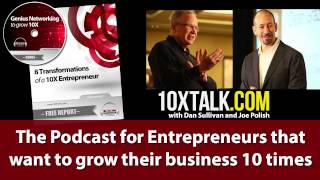
Joe Polish interviews Dan Sullivan, founder of Strategic Coach, on genius networking and 10x thinking. They define selling as engaging someone intellectually in a beneficial future and securing emotional commitment to act. An industry transformer borrows models from other fields to reinvent their own.
Questions this video answers
May 7, 2014
480-725-3094
"Getting someone intellectually engaged in a future result that's good for them and getting them to emotionally commit to take action to achieve that result."
Chapters
Foreign.
I'm Joe Polish.
I'm Dan Sullivan, and welcome to 10 Times Talk.
This is Paul Colligan with another classic episode of 10X Talks. This is the stuff they recorded before they even realized what the name of the podcast was going to be. This is actually the first episode, the first recording. That's a great insight into both Joe and Dan. Before we unleash season two upon you, if you have interest, want more information about Joe's 25k program or Dan's Strategic Coach program? Go ahead and text your name and email address to 480-725-3094. That's 480-725-3094, and we will get you some information. So without further ado, here's Joe and Dan at their very first recording.
Hello, this is Joe Polish, and I want to welcome you to the very first episode of the Genius Network conversation series with Mr. Dan Sullivan, the founder of Strategic Coach. And Dan, you know, I am so looking forward to doing this with you. We've been talking about it for a while. So how are you, Joe?
I think that we were both born and raised and educated to form this teamwork sometime in our lifetime. So ever since I met you more than a dozen years ago, I've been kind of fascinated and kind of amazed at your ability to connect with really amazing thinkers all over the planet and just to be included in on your thinking regarding Genius Networks. And of course, I have, you know, my own take on that inside what we do in the marketplace. So, anyway, this is just an absolute delight, and I was so excited when you proposed this project, and I'm very, very excited right now.
Great. Thank you.
Yeah.
And you know what, to all of our listeners, this is the very first episode that we're going to be doing, and there's going to be many, many more delivered on a weekly basis via the Internet, via podcasts, and via other methods, so you can get access to some of what we consider the greatest wisdom thinking tools, technologies, and breakthrough insights to help you be just a much better entrepreneur. And the purpose of this is targeted towards entrepreneurs that have what Dan Sullivan calls a bigger future and are looking for direction, confidence, capability, clarity, insights, and just simply, you know, things that will help multiply their success as an entrepreneur in the marketplace, sharing their value with the world. And so, Dan, before we really even get into it, I'd love to have you kind of describe what you do so that the people that are listening to us know who you are and know who I am. If this is the first time they've happened to stumble upon us.
Yeah, well, Joe, back, back in the 1970s, I got onto the whole concept of coaching, and I was very early in the marketplace. As a matter of fact, I always say I had a double problem in the 1970s. I had to go out and sell my business, but before I could do that, I had to actually sell people on what the whole concept of coaching was. So I started a whole profession that was just related to finding people who were entrepreneurs, in other words, self employed, or they had small business. And I created this whole thinking process for entrepreneurs to continually expand their notion of how big their future was on the one end, but also to really dig down and zero in on what they were really great at, in other words, where their genius was and to put the connection between what they were uniquely gifted at and then constantly expand their notion of how that genius that they had could be expanded out in the marketplace. And, and so over the years, we've just had well over 10,000 individuals who are connected to us in terms of growing their entrepreneurial vision and taking their genius and constantly expanding it through other people, through networks, through systems out in the marketplace. So, you know, that's kind of how we met, because it was through one of your networks that we connected in the late 1990s. Yeah.
And, you know, I've been a client of Strategic Coach for many, many years, well over, you know, a decade, like you mentioned. And it is just not only been one of the most incredible experiences of my life, it's simply made me a better entrepreneur. And it's made many, many, many thousands of people that are entrepreneurs that have gone through it. And the reason being is because you've literally, Dan, created, you know, what I now call a genius network. You know, part of genius networking is, you know, what you do to become a genius networker. And, you know, in order to have a genius network, you need to do genius networking, which is learning and doing. And you've developed this environment where you take some of the greatest entrepreneurs and you create a place for them to think, plan, have discussions, and by doing so, it creates this incredible amount of perspective, learning, insight and direction. And what we see in the world, what I see in the world, at least I shouldn't say we. It depends on everyone listening out. There is a lot of entrepreneurs that are scattered all over the place. And a lot of them really just, they have all these incredible, you know, what many would consider genius level ideas, but not necessarily the best places to discuss them. An environment where people are supporting them in an environment where they're really able to come to grips with things that they don't have a handle on and get a handle on them. And in a lot of ways, that's what Strategic Coach does. And in my world, where I have genius network mastermind, that's what we do in the area of direct response marketing. And so, you know, one of my motivations for doing this series with you that we're going to do on an ongoing basis, as long as everyone listening gives us great feedback and gets great value out of it, is delivering as much as we can. This sort of insights and perspective from our years of experience and with working with so many successful entrepreneurs and sharing it with the world. And one thing I want to mention is that in my world, I have a company called Piranha Marketing, and I teach small business owners and some large organizations how to use direct response marketing, what I call elf marketing, which is easy, lucrative and fun versus half methodologies, which are hard, annoying, lame and frustrating. And I've been able to transform an industry of professional carpet and upholstery cleaners and restores. Cause that's kind of where I started in business, using a very effective marketing methodology. So not only are we gonna talk about entrepreneurial philosophies, but specific strategies and methods and technologies that everyone can use. And there's a term, Dan, that you use called an industry transformer. You even wrote a book called Industry Transformers, which people can get on Amazon. They can get it@strategiccoach.com and I never would have thought of myself as an industry transformer had it not been for you and had it not been for strategic think. In a lot of ways, we're going to attract people that are industry transformers to listen to this. So I'd love to have you kind of define different levels of what you look at as successful entrepreneurs, because you are known as having developed the highest level coaching organization in the world for successful entrepreneurs. And I'd like to have you speak to that so our listeners kind of see if they're in that category or have the potential to be there.
Joe, it's really interesting because, you know, we live in a wonderful age right now, right at the beginning of the 21st century, because I believe that the dominant way to make your way in life right now is entrepreneurial versus what had previously been where you were a member of a large organization or a large bureaucracy. And so this is kind of the real breakout period for entrepreneurs. And a lot of that comes as a result of the terrific technological tools that have been created which empower individuals to just take what they do uniquely and really develop it into viable business organizations. You can have people now who really aren't big in terms of manpower, but because they have these tremendous technological multipliers, they can actually be very, very major organizations out in the world just because of the value that they're able to project out there, first of all, from a marketing standpoint, but also just in terms of the value that they're actually able to create for large numbers of people. But where it all starts, Joe, and you know, each of us has our own history here, and there's a bit of a misfit quality about people who take the entrepreneurial route. And I think one of it, from a negative standpoint, they're just people who don't fit into other people's systems. They have a certain quality which makes them hard to hire. It's hard to hire this person because they have their own notion of how they would like to achieve results, how they would like to organize themselves. And first of all, it takes that inclination, but then it takes a fair amount of courage. I think one of the main characteristics of someone who takes the entrepreneurial route is they just have the guts to go out and test themselves directly against the world and see if they can create value in such a way that people will pay them directly for that and then just keep getting better at that so that they can actually build a system around them and build an enterprise around them so that they become a viable business. And so I've traced that certainly in my own life. And, you know, every one of my clients, you go back to them just as an individual who decides to jump into the marketplace. I'm going to take it right to the other end, because you brought up the word industry transformer, and I like to sort of set that out as a model right here in our first podcast. An industry transformer, for me, is someone who has gone beyond the. What I would say the commodity beginning of their existence. And what I mean by a commodity is that when you go into the marketplace, regardless of what business you start with, Joe, in your case, you started with carpet cleaning, you know, and it could be any of hundreds of different types of businesses, but you learn that as your basic craft. It's almost like you have to figure out how it is that you develop customers, how it is that you develop clientele, but then at a certain point, you get ideas that go way, way beyond what your industry has taught you. And, Joe, just to bring this back to the Genius network and the incredible value I think that you've introduced because I see you as the foremost exponent of how you put genius networks together. The real key to be a transformer in your industry is actually to be connecting with terrific people who aren't in your industry and actually to develop all sorts of different kinds of models of what other people are doing in their industry to be incredibly successful and then bring these success principles and these systems and techniques back across the boundary into your own industry where it's entirely new, it's entirely different from anything that anyone else is doing. And this is why I think in the 21st century, actually being part of a genius network is an absolutely crucial entrepreneurial skill completely.
And if there's anything that has allowed me to probably accelerate my income, my growth, my success, more than anything is the tapping into incredible genius networks. And you're going to spend the time anyway. I mean, you talk about this all the time. You know, people are going to put in the work anyway. So where do you actually want to put in the work? Do you want to put it in on a scale of 1 to 10 into activities that's going to produce a 1 to 1 or 10 times sort of result? And you speak to the whole concept of 10 times. I mean, even eight days ago, from the time we're actually recording this for the first time, we were together in Chicago at a U times 10 workshop with something that you have a whole group of people thinking 10 times. And if someone wants to become an industry transformer, really wants to develop a genius network that creates massive multiplication of their success, it's really good to just start thinking that way from the very beginning. And so when we do these episodes, these genius network recordings, if you're going to hear this via podcast or however you happen to come across listening to us, you're going to hear myself and Dan speak to certain types of terminology that the more you hang out with us, I think the more you're going to get used to the way that we talk and it'll, it'll start to make sense. But I think you're going to hear things that really you don't hear in other places. One of the things that has always intrigued me about Dan Sullivan, and I'll speak as if he's not even here right now, is that when he talks, you just kind of hear things in ways that you don't really hear any other self help or gurus or experts or authors or people quite talk about in the same way. And that's a really important thing to talk about from the very beginning, because we want this to be a place where you can come and learn and hear and discover insights and ways to think about the world, ways to think about your entrepreneurial business, your career, your behavior, so that you leave with not only incredible confidence, but you always have a place where you can tap into that's going to help you think much, much bigger, so they can help you grow much, much bigger. And we're just putting this out to the world because we want to create incredible value. And what do we want in exchange for it? Well, we want people to use it, we want people to share it, we want people to give feedback, and we want you to spread it to the world. Not per se, just us and talking about what it is we're offering, but we want you to really get in touch with your ability to be an industry transformer, your ability to create tremendous amount of value and. And your ability to speak to the benefits of the entrepreneur, because a lot of entrepreneurs don't have a voice. And me and Dan want to be heroes to the entrepreneurs out there that are creating tremendous value in the world. And this is just one of the many ways that we will do that. And we want you to be a partner with us on that. So, having said that, Dan, when you even talk about 10 times, that freaks some people out. They're like, are you kidding me? I'm going to, what, 10 times the growth of my company, 10 times the manufacturing of my products, 10 times my income or my profits. Some people are like, what do you mean, 10 times? That's such grandiose thinking. What would you say to that?
Well, you know, it's an interesting idea that I've been playing around with for about 20 years, and it really struck me that there's two things that I have to say about it. It's a lot easier to think 10 times today than it was 20 years ago. And part of the reason is because we have a lot of examples in the world around us today, Joe, of things just growing 10 times because of technology. I mean, you know, I was just looking at the time when Steve Jobs died, you know, a couple weeks ago before this podcast. And, you know, he brought out the iPad in April of 2010, and in the, you know, the first year and a half after it's out, they've sold 30 million copies of this. This is just a fantastic growth cycle, but it's being used everywhere. You know, there's whole school systems, the airline industry, the medical industry are just taking this one tool, and they're just spreading it through all their members because it's a platform for them to do thousands of other things. So all of us who have grown up in the world of technology, and you can look around you and you can just see this enormous proliferation of capabilities. So, first of all, we live in an age when multipliers are really, really possible, because the environment around us kind of tells us, you know, things can happen really, really fast. So that's the first thing. Just that we live at a time when going for really big goals will be supported by the environment that we're living in. But the second thing, Joe, is the whole fact that what 10 times actually does to your brain, so part of it is external in the world around us, but the other thing is internal, that there's kind of an emotional reaction to this. If you say two times, like, I'm going to go two times. Here's the logic that goes along with that. Yeah, well, you know, I can probably just do this a little bit more and I can do this a little bit more, and, you know, if I stay with it long enough, I'll get two times. I'm talking in entrepreneurial terms here, but if I say 10 times, there's no way you can continue doing exactly what you're doing right now and get 10 times. You're going to have to change some things. You're going to have to change your attitudes, probably going to have to change some capabilities, probably going to have to change the way you organize your efforts. You're going to have to possibly change your whole support, the kind of support team that you have. You're probably going to have to change the nature and quality of your clientele out in the marketplace. So what I find is that when people will just take part of their business, doesn't have to be their own business, but they take part of their business and they say, you know, we're going to grow this 10 times. All of a sudden their creative mind wakes up and begins saying, wow, you know, there's just a lot that I'm doing right now that wouldn't support that. So, you know, if I start changing this and this and this and I start adding this and this and this, and I start improving here. All of a sudden I can get 10 times. But your actual movement towards a 10 times greater result introduces what I call strategic byproducts that you're going towards a 10 times result. But off to the side, all of a sudden, all sorts of interesting things start to happen. And the Main reason Joe and I'll get this across. My central philosophy in life is that our eyes only see and our ears only hear what our brain is looking for. And you've had this. Everybody listening out there, Joe, has had this experience that you begin thinking a thought or you begin going towards a goal, and all of a sudden you notice that there's just dozens and dozens of things happening every day that are kind of related to your goal that you never saw before, because your brain wasn't telling you to look for those things, and your brain wasn't telling you to listen for those things. So what I'm saying to entrepreneurs is go big, go for 10 times, because your eyes and ears will pick up on all sorts of different kinds of capabilities, different kinds of opportunities, different kinds of resources. But most important, and just bringing back to the subject matter of our podcast here, you'll start all of a sudden attracting and connecting with an incredible number of other people who are doing the same thing. You know, you'll notice that there's a lot of other people who are going for 10 times. You're looking for them, but they're also looking for you. But it's not until you commit yourself to the 10 times that you will become obvious to each other.
Yeah, exactly. I love that. And so that is an offer for all of our listeners of the Genius Network podcast to start thinking this way and make this a continual way that you look at your business, the way that you look at your life, the way that you look at your world. And one of the things I did recently was even look at relationships that I've had outside of business. Like, you know, how could I go into certain types of relationships and go for a 10 times greater enjoyment, 10 times deeper connection, greater bonding, greater intimacy on all levels? You can really look at the world through the lens of 10 times. And even if you don't get there, the fact that you're in all areas, the fact that you're even thinking that way, just really expands what you open yourself up to. If you want to look at it from that perspective now, Dan, one of the things that I absolutely love is marketing. I have a podcast called I Love Marketing also. That's what got me on the path of saying, you know, we really need to kind of do our own and put our knowledge and our ideas and our wisdom that we've developed and learned from others through our own experience out into the world. And I asked you several years ago to define selling, because all entrepreneurs, that's what they do. And no matter what someone's perspective is on selling, nothing happens until a sale is made and the first sale needs to begin in the mind of the entrepreneur. And I asked you to define selling, and you gave a definition, which I'm going to say, and I would encourage everyone to write it down if you're in a place where you can. And you said that definition of selling is getting someone intellectually engaged in a future result that's good for them and getting them to emotionally commit to take action to achieve that result. So basically, getting people intellectually engaged in a future result that's good for them and getting them to emotionally commit to take action to achieve that result. And I thought that was one of the most profound definitions of selling that I'd ever heard. And since then, I've shared it with so many people and talked to so many people. Last Friday, I did something I'd never done before. I have a professor that lives in the neighborhood. She works at ASU Arizona State University, and she has a group of graduate students that got scholarships through an entrepreneurial funded program. And all these people want to run companies. And she asked me if I could speak to some of these top students. So they came down to my office and I spent three and a half hours talking to these graduate students because, you know, I failed owning and operating a small business when I went to a community college. I even showed them a copy of my transcript. They all cracked up. So I don't have a degree in anything. And basically I gave them the definition of selling after I asked them how many of you consider yourself great salespeople? And, you know, several of them raised their hand and said they don't like selling. And I asked them why, and they're like, well, you know, I don't want to pressure someone. I think you're talking somebody into it. And, you know, I gave them some interesting things to think about, such as, you know, people love to be sold. They hate to be pressured. It's really how you look at selling. And I took them through that definition and I broke it down. Now we don't have a lot of time today. I just want to kind of put it out there. And this is going to be something we're going to talk about on the next episode, which are going to be made available to all of our listeners on a very regular basis. We'll decide on what that is, but it'll probably be around weekly. We'll put up a new episode. But I wanted to have you talk to that particular definition and what you even think of as selling. Because I think that'd be a great thing to talk about on this first episode.
Yeah, well, you know, I mean, first of all, the belief that you're not a good salesperson or the belief that selling is bad, I think is probably the most terrible self limiting thought that a person can have in their mind because it actually disconnects them and isolates them from future growth. It isolates them from any kind of self improvement. It isolates them from massive amounts of support that could be in the world. So I think it's very important for individuals to actually not have and really examine themselves here, Joe, not have a negative attitude towards selling. And you know, by my definition that you just quoted the whole thing, it lies on two levels. One is that it's intellectual, so it has to be grasped with the brain. The whole point is that it's the engagement with the future. So the first thing about selling is that you're getting someone to engage with their future. And what you're doing, in fact selling them on is not the product that you're offering to them or the service that you're offering to them. You're actually selling them on the fact that they have a future that's much bigger than their present. So I always say that the first sale I ever make is to sell somebody on having a future that lies in their imagination, but they just haven't defined it and they haven't actually described that future. So I describe that future. But then the second thing lies in the heart and that is that they have to emotionally commit. You can be totally clear about what you want on an intellectual basis, but unless there's an emotional commitment that you would actually be willing to make the effort, you'd be willing to go through the work and in some cases sacrifice to actually get to this future result, then that result will just be in the realm of ideas, it won't be in the realm of reality. And that's what a great salesperson does. If you look around the world, everybody who's successful in any field of activity, not just entrepreneurism, is a great salesperson. I mean, you are at the university. There's great salespeople at Arizona State University. You know, there's people who, you know, any great teacher is a phenomenal salesperson because they're always engaging the students in a prospect about their future that is so exciting to them that they'd willing to go through four years of a lot of study, great discipline and everything else to get to a certain point. So I just feel that selling is a fundamental human activity of creating the future. This is essentially how human beings create worlds around them that are way, way bigger than anything that's existed in the past and what's existing right now. And we do that through the single activity of selling. And it's an incredibly honorable activity. It's the most fundamental activity that I think is connected with any kind of personal success in the world. So I've always believed that my father was a great salesperson and I admired him enormously for how he could engage people and get them to move.
Yeah, yeah. One thing that you said about honorable, that is always something I really do my best to remind entrepreneurs of, because there is, you know, an anti capitalistic sort of movement in the minds of many people, many countries, many cultures, many organizations. And it's absolutely ridiculous because if you were to eliminate sales activities in the world, the entire world would pretty much crumble. I mean, I think salespeople and marketers, in the best of terms, when they're creating value, are the saviors of the world. They're the innovators. They're the ones that are incentivized for doing great stuff, for creating innovations.
And.
And without sales, you know, the greatest products, the greatest services, the greatest experiences, ones that, you know, simply entertain people to, the ones that, you know, make life better to save human lives, they would not exist without salespeople. You know, ideas are a dime a dozen. Products and services some of the best in the world can sit and experience no marketplace share and not even get out there if it's not for somebody that's out there selling them. And I even think of salespeople as anyone that gets someone intellectually and emotionally engaged in a future result, and the ethics come in when it's actually good for them. Because there's a key thing about your definition, which is getting people intellectually and emotionally engaged in a future result that's good for them. And that is the intention and the result behind it. Because you can use selling and marketing to sell people crappy toxic food, cigarettes, alcohol, pornography, and all kinds of things that, quote, unquote, aren't good for people. The point is not the methodology, it's the end result behind it. And if you're an entrepreneur, that creates tremendous value in the world. And that's something you're going to hear me and Dan speak to a lot. Because that's one thing I admire about you more than anything, Dan, is that you not only are a voice for pro entrepreneurism, you're also a huge voice for creating value. I mean, you're a guy that really wants to see good stuff put out into the world. You do it yourself. And you've helped thousands of other people understand what that even means and what their value is, and do a better job of uniquely packaging it, communicating it, telling their story and all of that. And so, you know, on our very first episode of Genius Network, this conversation is really about setting the stage for people to think about selling and doing it in a way that gets people intellectually emotionally engaged in a future result that's good for them. And there's so much more I'd like to say, Dan, but we're kind of at the time where we've agreed to keep the first episodes around 30 minutes in length, and then we will continue to pick up. So hopefully that's a good enough cliffhanger for everybody to listen to our second episode, give us some feedback on what you think of the first one, and then we will carry this on. And so there's so much more I'd like to say, but I'm going to save it for the second episode and just leave any final thoughts that you might have right now to you, Dan. And then we'll wrap up and invite everyone to listen to the second episode of Genius Network.
Yeah, I would just like to sort of wrap it up back into our theme, Joe, that what we really want to do is to be so passionately committed to something ourselves, first of all, that we're intellectually engaged in a bigger future for ourselves and that we are committed to going forward. And when you express that out in the world, then you can begin this whole process of connecting yourself up with like minded people. So I think we're creating a movement here, Joe, with this first podcast. And I can talk a little bit about the incredible world of connections and ideas that is developing in the 21st century at an exponential speed. And I think that, you know, just this theme of selling, first of all, selling other people on a bigger future and selling yourself on a bigger future is a crucial vehicle for accessing the genius of other people in networks right around the world.
More from Joe

This FBI Trick Can Command Respect Without Saying a Word ft. JEFFERSON FISHER & CHRIS VOSS

How To Stand Out, Be Different, and Create Raving Fans, Customers, and Employees ft. Jesse Cole



90% Of Businesses Fail In Their First Year, Here's Why! ft. Dr. Benjamin Hard & Dr. Robert Cialdini

The 1 Piece of Business Advice I Got From Elon Musk That Changed Everything Ft. Kamal Ravikant

The 6 Traits You CAN'T Teach in Entrepreneurship ft. Richard Branson & Gino Wickman

The Leg Method: How to Make Your Book into a Million-Dollar Asset ft. Anna David


7 Millionaire Mindset Hacks for Daily Success and Wealth ft. Brian Tracy & Dan Sullivan
