How Art, Mistakes, and Letting Go Create Real Magic in Your Life and Business ft. Ray Villafane
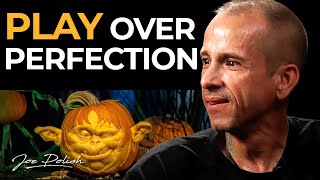
A recorded conversation between Joe Polish and sculptor Ray Villafane exploring how play, embracing mistakes, and using unexpected or discarded materials create powerful art and personal transformation. Ray emphasizes quieting inner judgment, being willing to fail, and finding potential in poor or humble ingredients (rocks, sticks, pumpkins) — which often yields more original work than relying only on ideal materials. He recounts practical milestones (commercial sculpting work for Marvel and Warner Brothers, viral pumpkin-carving leading to TV appearances, judging/competing on Food Network, rock-balancing practice done without glue) and creative projects (applying to the Dear Moon project, building ghost-town environments). The discussion repeatedly draws parallels between artistic mindset and entrepreneurial practice: authenticity, playfulness, resourcefulness, and detachment from attachment/fear enable growth and original output. Closing includes a promised pumpkin-carving walkthrough and promotional CTAs from Joe Polish.
Questions this video answers
Marvel and Warner Brothers.
No — he says the rock balances are not glued.
The Dear Moon project (worldwide contest for creatives to travel around the moon).
Chapters
All right, man. Well, first, you prefer which seat?
Whichever.
Yeah, man. Great to have you here. Awesome. All right. So what is psychologically wrong with you? It causes a sort of.
I just like to play with whatever I have available. Really?
A lot of this stuff you told me you, like, literally can find just trash. You can find some wood. Yeah.
So this is. I worked as a commercial sculptor for, like, a decade, which none of it's on there. I worked for Marvel and Warner Brothers, but I really like playing with nature. I like everything from the rocks are just balanced to finding sticks and seeing things in the sticks, creating scarecrows, playing with ingredients that no one has poured love into yet. So it makes it more magical because it's clever, unique. And I think that that's the big turn on is to see potential in the materials or circumstances that haven't been done yet. Awesome.
So I have some practical questions, but the first one I want to ask you is what is your take on how people's fear of making mistakes holds them back in creating brilliant works of art?
It is the actual. That's the point at which growth stops. Because when you make art, you have to let go of control. You got to be able to play. And in that playful spirit, you allow mistakes, you allow learning opportunities. And one of the biggest. When someone takes a class of mine, the first thing I tell them is, first of all, don't come to this class expecting to. That you need to know every tool, every process that works for me. I'm going to share those processes with you. But be willing to find your own, because your potential is found in your unique expression of yourself, and your authenticity will release that. So sometimes if they're too worried about the right tool or the right technique, they're not. There's too much talking in their head. There's too much chatter. And so they're not going to be able to listen to the inspiration of what to do next, because there is no. I can give a roadmap that might inspire them. But don't try to copy. If you want to create something purposeful or unique, you need to be willing to be brave, to play and stumble into all those areas of growth.
Yeah. So, okay, so I've not yet been taking any classes from you or whatever. Although after this, we're gonna set everyone up in teams and we're all going to carve pumpkins. So he's gonna walk everyone through how to do it. So we're gonna do that at the end of this. Okay. Those of you that want to participate in that. How many of you want to participate in that? Okay, yeah. How many of you are like, shit, I don't know. So how, like I can't even read my own handwriting in the intricacies, like literally in the intricacies of the stuff that you can make in so many different mediums is like astonishing to me.
So it's, I mean, I mean the medium doesn't matter. And yeah, I think the medium doesn't matter as much. And it's all mindset. It really is about like quieting down so that the obvious becomes obvious to you. The level that you're able to quiet down is the level that you'll realize. Because I struggle. If I wanted to get the practice of me getting better at the level I am at requires the same sort of mindset that I had to do in 11th grade to get better, you know what I mean? Like, stacked upon each other, it gets to look like this. But the mental mind state that you have to achieve is just quiet awareness. And it seems like if I told you, you could have a blank clock and you could tell me what time where 2:30 is, but if I told you to draw something where you had to draw a line, that direction, the self judgment of, oh, this doesn't look like a nose, or the chatter of what to do is what stops, what stops the realization like, oh, it's very binary. This is what I should do.
So me and you have talked about artists for addicts. We've talked about addiction, we've talked about art. I mean, and the reason I wanted to, why I think there's a link here which oftentime people won't see is I believe entrepreneurs are artists, right? They're expressing themselves and through dance and through music and through sculpture and through painting and through writing. These are artistic activities. And I also have this viewpoint that I think a lot of things is just pollution under this umbrella called art. Now that's a bad thing to say to most artists, but there's a lot of people I think just produce shit and they call it art and they're just doing weird stuff because they can kind of get away with it sort of thing. And the interesting thing about artists is the sensitivity. I've had lots of conversations with Gabor mate when we were making the film Blackstar, me and Akara Chan and John Butcher and stuff, which is our first film that won the Audience Choice awards at the Sedona Film Festival. Yeah, thank you. And you know, I want to do stuff with you on that to reach people because I Think artists. If you look at. If you look at some of the lives of some of the greatest artists, very tumultuous. I mean, depression and addiction and suicide and all kinds of stuff, but just creating these incredible works of art. And so there's something in all of this. And I believe everything we do is a form of expression. And when I. The only artistic skill that I really developed was throwing pottery. And when I was in high school, I even say this on that movie that was made about me connected that, you know, the only artistic skill that I had was soaring Pottery is the only thing that allowed my brain to escape other than getting high. And so when I was in high school, like, I would get high and I would feel good. And if I. If I wasn't, I just felt I didn't feel good. And I, you know, I used drugs as a way to just kind of deal with the depression and stuff that I had. But when I was soaring pottery, it got to a point where I started to get good at it. And then all of a sudden, my brain. And I'd say my brain would escape, but that was really the closest I got to at the time of flow. And so I think all of us could benefit by having some sort of expression, because I have a tool here in Genius Network called the Fun Times Tool. And it's where people list out the things they do for fun, how often they do it, the people they like to do it with, and they come up with a plan to have more fun. And if people don't have any fun in their life, if you don't have any joy in your life, your life is going to be joyless. And I think there's like, you escape. I've had enough conversations with. You've explained to me, and I'm like, that's just a cool place to be. How could I talk with you so that they can do that in their own entrepreneur endeavors? Because they're all kind of. Some here are. They're already there. And others, what I found with the funtimes tool is people will fill it out. And they're like, they just fill it out. And other people watch this, they have forgot to have fun. They're so absorbed in their business. They're so busy with overwhelm and that they just don't even know what to write down. They've lost that childlike wonder of stuff. And you live it. I mean, you're immersed in that sort of stuff. And I think it's like this cool factor of this whimsical Shit that you create, it's not shit.
It's awesome. But yeah, I like to. I definitely. I spent a lot of time playing. For sure. Yeah. And I think that, you know, as an artist, I'm able to see patterns easily, you know, and it's apparent, like, even the stuff that you talked about here today, it's all. It's business related, but it's all. Still, it's the same subject. I mean, it's the same thing. It just. With me, I'm like doing it with little materials and stuff. And I was talking to someone earlier, it's like, it's like you could change that subject. And I know that the stories I have related to business type stuff prevent me from creating. Like, I could create in my art, in the business aspect, because I have attached to it. I have attached stories. So, like, when I'm trying to teach art, I know that, hey, man, you could do this, but you just gotta stop the judgment, detach the stories, just be present. Because it's really all the same thing. And it's, you know, like when Jason was talking about meditation and the power of quieting down, because we are really all connected. And when you quiet down enough, you'll connect enough to what feels like the right answer. And do that a few times and then the momentum stacks upon each other. Like the rock balancing. My first rock balance. I have pictures on my phone. My first few were just single rocks. They weren't really that crazy. But I enjoyed the process enough and the quietness enough of it that getting to that, like. And I have to get to that same point to do the ones that you see today, but stacked upon each other, you gain momentum and you could, you know. So, like, the story you tell yourself is so important. Or should I say the story you don't like. It's best not to have a story, really. It's best to like, kind of take something for what is. Because then you could feel out all the possibilities.
So with all those rock balancing, none of those are glued together?
No.
I thought he might be cheating here because I looked at those. I'm like, it's just unbelievable.
Anyone could do it, really. It's a great practice.
You've had to have wrecked a lot of shit in your life in order to create some of the stuff that works, right? How do you look at failure and how do you look at struggle? Hey, I hope you're enjoying this video. And I want to let you know that I have a new book that's come out and if you'd like, to get it absolutely free. There's a link below in the description. Or you can wait till the end of this video, or you can Simply go to joe'sfreebook.com and you can get a copy there.
Failure. Like, again, this is a good story. Like, with my art, I feel like Superman. Like, I feel like you can give me any. You give me any. I was. If. I often use the example, like, if a natural disaster happened right here and we were all locked down, especially if there were kids here and had to entertain, that I could take the ingredients on that table and make my life work, I could make something cool out of it. Because it's not the ingredients you have. It's the willingness for you to look at those ingredients and see potential in it so that you can look at stuff and you could say, wow, I could use it this way, or I could use it that way. As a matter of fact, the poorer the ingredient or the less ideal the ingredient, the more bounce. You have to make something magical because it requires you to have a level of optimism and love that's poured into it that. That just blooms into a good idea. Because if you have ideal ingredients, you just get expected outcomes. You know, it's like, okay, well, you had the next step is that. And a lot of people like to just not act until they have the good. The stuff that they need. And that's just holding yourself apart from potential. So when it comes to art, I'm really good at that. I have areas where I struggle with, you know, stories in my head, but I at least appreciate that I have that contrasting thing. So I have awareness to know that, no, it is all about story. And so that I try to explain that when people want to take a class or if I'm speaking and engagement or whatever to perhaps empower and see that everything. Like, I love the challenge of trying to make something. So I like working at the ghost town. Like, all the stuff that you saw in the beginning, the truck, the mine ship, that was nothing. That was a parking lot. I just went searching, and I made that little fake mine shaft. And the truck was just like, pieces of a truck and scattered boards and stuff. And just to pick through materials and create stuff is like, I almost like it. Especially now, lately. You know, I went from, like, sculpting for Marvel and Warner Brothers, making movie and collectible stuff, and then playing with the pumpkins and the scarecrows and stuff. But now I feel really drawn to making environments where people could step into whimsical and upcycled.
I mean, you said some very profound stuff there, at least from my perspective. So let me ask you the boring questions I have. So you've worked with a lot of different mediums. Sand, pumpkins, even snow. What is it about pumpkins that draws you in for projects? Because you seem to have this whole thing with pumpkins. Yeah, well, maybe just really like Halloween. I don't know.
So pretty much pumpkin carving like this. I don't know. It's about. Well over a decade ago, I posted a picture, a little tutorial about my pumpkins online. It went viral and then like, Letterman show, everything called. One of them was Food Network. They had not seen pumpkins like this before, so they wanted to know if I knew anyone that carved like this. They wanted to do a carving show, competition show. So the first three years of competition shows at Food Network, I was on one. The first two. The third year was like a team. It was the first year of Halloween wars, so it was like a whole team thing. And so I did not win that one, but it was like a really cool experience. Then later on, I did some judging for them, but that created. There was a huge white space. This had not been done like this before. So it led to quite a bit of opportunities. It made me realize, geez, I could make more carving pumpkins in one month than I do working for Marvel many months. And so it just. That's what. It's what fostered me to have the courage to do my own thing. You know, nowadays I just carve a couple pumpkins a year. I like, I wanted. You know, I bring in sculptors to. If we do an event, I bring in sculptors. Like, I'm known for pumpkin carving, you know, but it's. I think now I really like building stuff and making. Making things. I like all sorts of stuff. I don't know, I kind of go all over.
I think it's great.
This is really. This is getting a little dried out, but it is a beautiful material to work with. I love to make a pumpkin feel alive. So putting a face on it makes it feel alive for me. And it's a great texture and stuff to work. It has challenges, which I'll talk when I walk you through carving. Which brings us. Bring us right back to whole thing of overcoming fear. Because I could get the most talented sculptors out here, and if they're not used to doing a subtractive method, they won't be able to do what they can normally do because of the fear of failure, like subtractive sculpting. There's no putting back. And. And it really shows that if you're not willing to let go and fail, no amount of teaching is going to help you overcome that. You just got to. It sounds counterintuitive, but if you want to do something really incredible, you almost have to not care. You have to be willing to fail. And I don't want to say you don't care. The best word I can come up with is play, because you don't want to play a game that you're guaranteed to win. So if you use the word play, if you could conjure up that playful state, it's win, win. I imagine for business too, you gotta enjoy what you're doing if you want to build a business. I imagine it should be like a competitive playing because if you're grasping too much, and I'm not a business person, but I imagine you're too afraid to take risks then. So that playful spirit is important.
Yeah. It just made me think of the Buddha quote, where all misery comes from attachment. So maybe if you're so attached, like you gotta get. You just can't let yourself.
And you're just tense and ephemeral. Art is. A lot of people say, why do you make something that's not gonna last? And they don't understand, like, it gets more satisfaction. Actually, I've made stuff where I did a sculpture and thousands of copies all around the world. And I have, you know, I have a box copy of it as well, and. And I can look at it again. But when you spend time creating something and it's gone, then you could. Obviously it's nice to take pictures of it. But when it's no longer there, when you revisit it, you not only get the benefit of seeing it, but you romanticize about it. Because it's natural tendency to romanticize about something that you no longer have. So I often say, well, you wouldn't know what it's like to make something, you know, like, trust me, if you do something that's no longer, whether it be sand sculpting, you know, carving a pumpkin, or even like the rock balances, when it's gone, you get the benefit of a sort of romantic memory of it. Wow.
You know, I bet there's probably quite a few people here that have these children that are budding artists that are just producing stuff that they really wish would fall apart and go away, but they just save it. And so they have, you know, closets filled with all of their kids. Art that's just. I can't throw it away, even though it's probably be awful. But they would never say that about their kids art. I'm just saying that as a joke. Sorta. Sorta. Alright, so you've created art for celebrities, the White House and even ghost Towns, which of course is a bonus as far as I'm concerned. So what has been the most unexpected or magical place your work has taken you.
Place? I mean I've carved a lot of, I've sculpted all over the world really. And I'm an introvert, I prefer nature. So I mean I've carved a Heidi Klums Halloween party at the White House, but this is like I'd rather be alongside a mountain or in a stream or somewhere like, you know, no one needs to be there, you know, that's a. And I have a bad memory. So, you know, I might answer this question in a half hour from now. I'm like, oh, I was there, I was there. I did go to New Zealand, I.
Went to the moon. But damn it, I forgot to mention.
That I was actually in a contest to go to the moon, which was. That's what involved the whole, that's what brought me to this whole thing with Ghost Town. I applied for the Dear Moon project, which was funded by one of SpaceX's biggest contributors. And basically it's no longer. But in a nutshell, biggest contributor is guaranteed the first 10 seats aboard first manned orbit of the moon. He held a worldwide contest for 10 creatives to go aboard that mission, travel around the moon, come back inspired, create something, share it with the world during that time. So I applied for it and then during that time I came up with this idea about mining magic, a whole storyline and I've done a lot of stuff, I've searched for none of it. In other words, I don't market, I don't like, I've done a lot of stuff and it all seems to come to me. So I feel like I leave a lot of stuff on a shelf, probably, you know, like on a table or whatever. But a lot of these opportunities come to me. So because of that I feel that there's a mystical aspect to this world because I'm certainly not doing it. And so like just when I like a week or two after not getting accepted to this whole moon thing, my story of mining magic ended up manifesting by running into someone that owned a ghost hunt, a ghost town and a mine. And I wasn't even thinking about a real mine, I was thinking about mining magic on the moon. It was all about wishes and dreams. And how some dreams are heavy in self doubt and fear that they're still stuck on the moon and that we were going to go mine that magic, blah, blah, blah. But the fact that I serendipitously came into this ghost town right afterwards and my name was carved in like so many things, even how I met you. He gave an abbreviated version. But there was a lot of coincidences that were left out of that that lead me to believe that more in this sort of. My wife calls me obsesso because when I get on, well, you can see with the rock balances, I get obsessed on stuff. Some of those rock balances, I stay like this literally for seven, eight hours. If they fall on my attempt, I go to the bathroom real quick, but I will sit until something's done because I could see, because I already know it's complete before I start. And so I wait until I get to that part where I can let go. And there have been times where. There have been times where I let go after seven hours and it's done. And as I get up, my foot hits the table and it knocks down. And then I. But then I stood and I'm like, oh. And then I get it back up in an hour or so. So there was a picture of my living room, had like all the rocks all like people would, you know, during COVID I had all my stuff in the house. And like my kids don't even, you know, they're like, feel weird, dad. They just want a normal house. And it was like I thought, well, that's cool. It looks like a witch lives here or something. You know, I feel like a magician or something.
That is hysterical. So, you know, Charles Bukowski, the alcoholic poet, said, take the writer away from the typewriter and all you have left is a sickness which started him writing in the first place. And I say, take the entrepreneur away from business and all you have left is a sickness which got them starting a business in the first place. You're probably compelled to do this. I cannot see you not doing this.
Yeah, I'm always playing.
I mean, if you could not do art, what do you think would happen to you? What would you do?
I use this analogy. If my limbs got cut off, I would probably still be happy because I would make stories in my head. Like I'm always creating. I'm perpetual optimist. So in the same way I could look at something and make something physical. I'm pretty good at telling funny jokes and stories because it's the same. It always comes to being Able to see opportunity and ingredients you have, whether it be physical material ingredients to move them around in certain ways to see, okay, this shape goes with this or to see, okay, well, you know, like someone, like a comedian is usually a good. It's very creative. They say, okay, that, that and they can weave together. So I think that I'll always be in a playful state of making something, whether it's with my hands or not.
Yeah, that's awesome. I don't know about you guys, but are you extracting like really interesting business and life lessons out of all this? Right. So you describe your work as whimsical and magical. Can you share a moment if you can remember where you saw your art truly impact someone in a way you didn't expect?
Yeah, I often get emails. Sometimes there are times I have like a self criticism of me that, you know, like just judgment or whatever that I don't. I don't interact with much people here. I am kind of like one of the leading people in Halloween pumpkin and it's a big community. But I'm not really into pumpkin car. I mean, I into carving a pumpkin. I'm not into like, I watched the episode of those Food Network episodes once when it happened and then not again. I don't ever watch any seasons of anything. I don't watch tv. So it is nice to get feedback from people who are inspired to pick up materials and they might say, oh, I was suffering, you know, I had cancer. And your art and your perspective on things, you know, to help change my life and whatever. I get a lot of emails on things, on things like that. And so that's probably. That's very satisfying. I mean, like, like sharing, sharing the art with people or even like at events. I used to do a big Halloween event. I don't know how many people here are local, but I used to do one on Carefree, a big pumpkin event. And just seeing people laugh, like some of the stuff might look scary on the surface, but it's all. It's if, If I, if I don't make someone smile or feel in a sort of whimsical way, I think the work failed because that's at least what I'm trying to do.
Yeah.
Wow.
So you've often spoken about making things from unexpected materials like rocks and sticks. What is it about working with discarded or natural items that fuels your creativity? Because I think you're incredibly resourceful. Like, one of my favorite traits of humans is people that operate with a sense of urgency in the right way, which is different than, you know, frenetic, neurotic, Go nowhere, spin your wheels. But people that, you know, place a sense of urgency. Not in all cases. The other is resourcefulness. Just being resourceful. And so you're.
Oh, I'm sorry. Like I said before, I'm drawn to. First of all, if you look at, like, the tree purse, there's a little tree character there that very little of it was sculpted. I have some scarecrows, the fingers, very little of it sculpted. When I go out into nature, when I start looking for fingers and stuff, when I see Mother Nature respond, some people might say, you're just lucky. I see. I find pieces that have, like, incredible things grown into them. So that sort of hide and seek play with nature. I didn't have to, Like, I could take clay and sculpt it. That's not as fun. Going on a hike and finding something that was grown, like, might have grown for 50 years. And I found it, and it's a perfect meeting of me looking for something that seems magical. So there's something that I love about playing with, sort of collaborating with nature that. So I like to. And plus, when I'm. And also, like, upcycling certain materials that have old patinas, it allows for me to make something that looks like it's been there for 100 years as opposed to, like, I don't like anything fake. I mean, I do have these little arms and legs that I made, but the first ones that I made, I actually peeled pumpkin vines. Like, I love real stuff. I love to blur the line between what's real and what's fake. And I love authenticity. So in a world, you know, like, almost my whole body of work now is all authentic. Well, it's an authentic expression of me, but the materials are, you know, like, I don't like plastics. I like real sticks and real straw. Even if. So Gordy Guligan, the tall, skinny scarecrow downstairs, he has. He has a little spigot and two rusty nuts that no one will ever see. But I made. Everything I make is for me. It really is. And it might sound selfish, but I make it for me. And then in that making it, yeah, there's so much. So there's details underneath. Like, every once in a while, I might have to, because he's articulated. So he can get into any pose. Like, I can take off his clothes and wrench on and get him into any pose I want. And then during that process of making him, I spent needless amounts of hours doing stuff like the business model would like, if I had a business manager, he'd be like, what are you doing? That's a waste of time. But I love to indulge myself because I know that if I could, it's so important to a create that magic for yourself. When I'm making my art, I am constantly paving my environment with things that make it feel magical for me. And then often the universe responds back and makes me realize or allows for me to realize magical opportunities. So it's sort of a. I don't know, I could feel my interaction with things in a more tangible way that's not just left up to chance. And I can go on to. That's really like, my passion is to like wake people up to that because I'm not really doing it. I would be.
Yeah, you know what? I've been thinking a lot about now and this really helps with. So I have this visceral annoyance with people that steal, you know, and Picasso had that thing where he's like, good artists copy, great artists steal. Now, I don't think he meant it in the way of plagiarizing, like people would steal someone's IP or something. But maybe, I don't know, I didn't know Picasso. And he had, I think, two wives and a mistress that committed suicide. So he was interesting character, but that means. And I even have a real Picasso at my house that Mary Morrissey gave me, which is interesting. But the thing with like this world of influencers and creators. So I went with Michael Humphries and Chris Voss and who else went with us to the Snapchat headquarters in LA and met with the guy who's in charge of all partnerships in America for Snapchat, all the celebrities, everything. And they refer to everyone as their creators. Their creators. And you know, I would be like, you know, someone could like just fart and dance on social media and call themselves a creator, like all these influencers. So the whole term influencer and creator has gotten labeled as if there are people that are doing like amazing stuff. So Sam Qurachi is probably sleeping right now because it's God knows. Is he still on?
No.
Yeah. So we should maybe share this with him later. But you know, he's a real creator. He puts thought and he puts work. But here's the thing. Doesn't mean it needs to be hard work. A lot of this is your plane and creating but flowing like really totally.
The most impressive stuff I make now. Yeah, it's doesn't mean that there's not from a third person perspective, you're still up. Like, what are you. Like, aren't you gonna stop? Like, yeah, but I'm gonna flow. But I feel like in a flow, like, it's. There's no resistant in me, and things are occurring to me.
So this is what I'm getting at. So when I feel like I'm really on and I'm really doing something valuable, I want to film it, I want to share it, I want to do it. But when I feel like I gotta shoot a video, because we gotta make sure we get enough videos. Where's Evan Carmichael at? Yeah, this is exactly where he should be hearing right now. But it's like, if you just crank out content, because that's the way you're supposed to. To get a following on social. I equate it to someone really loves playing guitar, and then they try to turn it into a business of teaching guitar lessons that they don't know how to run a business, and all of a sudden they hate playing guitar. Or. I've seen this happen with doctors. You have great doctors. Then they become celebrity doctors. And now all of a sudden, that focus that used to go into caring about their patients goes into trying to be a celebrity doctor. And all of a sudden they start becoming a shitty doctor. And so it's that fine line of growing and building yourself, but not losing. And what I find interesting is that, you know, making the. The nuts and the rusty bolt for the. No one's gonna see it. That's exactly it. And so if we're creating work that we just are really genuinely connected with, and we're not just doing it to pump it out, you know, like that famous, you know, Phil Knight and Steve Jobs, where, you know, Phil Knight, the, you know, founder of Nike and Steve Jobs, they had this conversation where Steve said to him, you know, you just make too much shit. You're just creating a bunch of garbage here. And, you know, take a look at the quality of the stuff that you're doing and start producing better quality stuff. And, you know, I kind of find it like, you know, that there's something to that as it relates to this world of telling everyone how they should look and how they should present. And you have a bunch of people just copying other people, but they're so disconnected, they don't even like doing it, but they feel like they have to.
Yeah, it doesn't. That's one of the reasons I'm not, like. When I talk about AI. I don't care about AI. I don't do this for, like, I don't Even care about cancel culture. I'm fucking doing this for me. I don't care. I really am doing all of it for me. In that pursuit of me, it plucks at my heart in a way that is felt by others. And everyone has their own plucking that could happen if they are brave enough to authentically pursue what it is that they want. Like, I lie and a lot, and I'm okay. Like, a lot of people copy my stuff all the time. And I always get. I always. I'm just. For me, if my son. If I do something and my kid copies me, I'm like, oh, cute. I feel proud. I honestly. Not that I look at other people. It's like, they're my son. But I don't ever. I don't ever care if someone copies me. I feel honored, really. And so when I hear people talk about, like, oh, I did that to copying, or like a trade secret, like, that's another thing. When an artist talks about a trade secret, I'm like, you don't understand how the universe works, do you? Like, there's no shortage of ideas. You don't realize your power. If you're really worried about having to grasp onto withholding something, you don't really quite understand what's going on around you, not that it could ever be understood, but you at least don't understand your potential, then you know. So you know, areas of copying, and this is just like chasing culture, you know, I tend to create culture. My work has created a culture around pumpkin carving. I know that I created that. And I think as individuals, we have the ability to push forward. It doesn't mean that it's not going to take bravery. It does take. I do have to. I have talking in my head at times, and I'm just easier for me to overcome that in my art. I think I would be if I had the courage to take a phone and just document everything I was doing. First of all, people would think, like, what is he crazy? He's going to cut his hand off. He's doing this wrong. He's doing that wrong. So there's a part of me that's like, I'll just get it done and show him the finished product. But if I were to show people my process more, I know that in that connecting with people is a lot of my own. Like, it's my own suffering. It's like that energetic exchange, like, that's the real commerce, you know? So in different ways, we all have that going on within us. And so it's you don't ever get rid of the discomfort of stepping into that. It's. It's just a releasing of stories and ideas, like things. It's not. I don't know, it's like letting go and not caring seems to be. At least for me, seems to be letting weight go.
Okay. I hope you found that video awesome and useful. So if you want to get a free copy of my book, I want you to click here. And if you want to watch some more videos that will be useful and awesome, click here. Go ahead. You're over here. Do it now.
Come on.
Thank you. Watch them.
More from Joe

This FBI Trick Can Command Respect Without Saying a Word ft. JEFFERSON FISHER & CHRIS VOSS

How To Stand Out, Be Different, and Create Raving Fans, Customers, and Employees ft. Jesse Cole



90% Of Businesses Fail In Their First Year, Here's Why! ft. Dr. Benjamin Hard & Dr. Robert Cialdini

The 1 Piece of Business Advice I Got From Elon Musk That Changed Everything Ft. Kamal Ravikant

The 6 Traits You CAN'T Teach in Entrepreneurship ft. Richard Branson & Gino Wickman

The Leg Method: How to Make Your Book into a Million-Dollar Asset ft. Anna David


7 Millionaire Mindset Hacks for Daily Success and Wealth ft. Brian Tracy & Dan Sullivan
