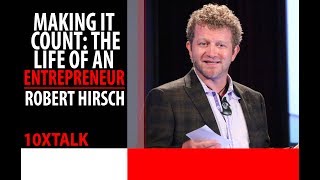
Robert Hirsch survived leukemia and chemotherapy before his wedding, which forced him to rethink success. He argues entrepreneurs fall into the accomplishment trap, mistaking money for freedom, and should measure life by people, energy, and synchronicity instead. He asks: if a crisis changed everything, why aren't you living that way now?
Questions this video answers
22 rounds of chemotherapy.
He was diagnosed two weeks before his wedding.
38 years old.
25 years in business (next June).
Chapters
Like some of our other presenters, Robert Hirsch began his entrepreneurial career in high school and hasn't stopped learning, growing, and sharing his wisdom. As you all know, it's make an account. That's important. And that's the part of the title of his talk. The rest is the Life of an Entrepreneur. Now brace yourself, because this guy had some crazy stuff happen in the last couple years. And this is going to be a very fast paced 10 minutes. Give it up for my good friend Robert Hirsch. Thank you. Thank you.
Good afternoon. Oh, it's good to be here. And you know, it's funny, I was just talking to Joe when we were putting on the headphone, and I think this is the single best event I've ever been to. I mean, I look around and I see some of the people that I learned from, that I've taught, that inspire me, and it's just amazing. So how about a round of applause? Applause for Joe. So I want to talk to you today about the single biggest mistake most entrepreneurs make. And I kind of call that the accomplishment trap. Sometimes we have these old stories or beliefs, and I'm not saying truth or not truth. If we believe them, they're true. I mean, we're all entrepreneurs. We create our own reality. And the biggest mistake we make in so many ways is really not creating the life that we want, that we really want. And we have these stories. So I'm going to talk to you about a couple things. One, that, two, how do we change the scoreboard to measure what's really important to us? And the third piece is if we know what's important at the end, why don't we start there? And so what I'm going to ask you to do at the end of this is really to take your husband or your wife or that special someone and to get away, to get away from your normal life, all the pressures that are coming towards you, and to go ask yourself two questions. And so the reason that this is really important is so we can die peacefully in our sleep like my grandfather, not screaming like the. Screaming violently like the poor passengers in his car. And so in this story, I want, you know, we are all together, right? This is a group of our peers. And isn't it great, like oxygen, when we find a group of our peers, right? And so I've been a hard charging entrepreneur. You know, I was a paper boy when I was 8. I bought lawnmowers when I was 9. I employed my friends. I started my first bead shop when I was 16 and I had six stores by the time I graduated high school. And then I was screwed for a straight job. So entrepreneurship was the only thing that really fit. And you know, we've all gone through this life and it's been extraordinary. We've been able to create our realities and that's why we're in this room. And you know, I remember Joe said to me when we were on Necker island, he said, you best thinking got you here. And you can say that whether you land in jail or whether you land in this room. So all of us, our best thinking got us here. I mean, this is where we are. And I want you to think for a second about that special place. Some people love the beach, some people love the mountains, some people love the river. I'm a mountain guy. And my, my kind of alchemist story was I started businesses and I ran them. I moved to San Francisco. I did venture backed startups because I thought that's what the big kahunas would do. I did that for four rounds of financing or four companies, seven rounds of financing. Nine years before I realized that it wasn't a fit for me and my flat spot. I've always been in big peer learning groups, whether it's 25k or what used to be Yeo or Eo and Ypo and Tiger 21, et cetera, et cetera, et cetera. And my flat spot was always love, you know, I was always looking for that special someone. And I was doing consulting and this woman who was a director of marketing, who was an absolute angel, walked through my front door. It was unbelievable. She told me she read Atlas Shrugged in eight days and modeled her life after Dagny. And my head kind of spun off its rocker and we went in and we went into the doctor. We were getting married in the Cook Islands, which, if you don't know where that is, I didn't. It was in the middle of the South Pacific. It's like the Hawaii of New Zealand. It was just stunning. And we were two weeks before my wedding and I went to the doctor and then they made a mistake when they sent in my blood. So I went to the doctor again and then they called me in for a third time. Then I went to an oncologist, then I went to a radiologist, then I went to a hematologist. And two weeks before my wedding to the woman of my dreams, I was diagnosed with a rare form of leukemia. So my doctor said, you can't go to your wedding. I've sold out the whole island. I mean, I have mentees that have spent their entire life savings to come be with us in the Cook Islands. We've got the whole resort rented. And they're like, you can't go to the wedding. And the doctor tells me, well, it's doctor's orders. And I said, no, it's doctor's suggestions. And so I started to explain to him freedom and sovereignty, but I don't think he ever understood what I was talking about. And I explained that I had plans and so I went non compliant to our wedding. And I got my diagnosis in between the wedding pictures of the guy has the worst timing ever. And I get my diagnosis literally between my groomsmen pictures and my wedding, which by the way, was this form of leukemia. And by the way, when they gave me this list, right? Seven things on the list. HIV 1, HIV 2, Hodgkin's lymphoma, non Hodgkin's lymphoma. I'm like, where's the common cold? I mean, this is like serious stuff. And so I get the diagnosis and we went on a wedding and we went to our honeymoon in New Zealand and we fly, fished and took helicopters around and had an amazing time. And I went to my body came out and I came back and I went through 22 rounds of chemotherapy. And so that's why I've been a little bit off the radar. And I was hoping my 10 years of green smoothies would pay greater dividends than they did at the age of 38. And I needed to really reassess my life at that point. And I had time. I actually had a lot of time. I couldn't walk from my bedroom to my kitchen. And I learned some lessons in there. Would sharing those lessons be helpful for you? All right, so the first one was the trap of the working wealthy. Money does not equal freedom. I had these goals and I set them early and I was on my way and I was more successful than I. I imagined it, but I was more successful than I needed to be. And money does not equal freedom. And I got caught in this big trap of the working wealthy. And that was the first piece. And I realized that was a big mistake. The second one is life, in many ways is like a constrained resource problem. You know, you have unlimited wants and needs and limited resources. And generally there's two types of resources. There's money and there's time. And the problem is, when we set our goals, we're usually in our 20s and 30s. And the value of those resources are dynamic. They're not static. Money goes down in value as you get older. Time goes up in value as you get older. We solved for it when it's correct, but we have dynamic shifting resources. What would Warren Buffett pay for a year of healthy life? All of it. And the third piece is we have all these different kind of connections in our life. We have our connections to nature or to business. Next June will be my 25th year being in business. For myself, I've got this great connection to the business world. But growing up, I was a fly fishing guide. I spent a lot of time outdoors, had this connection to nature. And at the end of our lives, what do you think is more important, our connection to the business world or our connection to nature? I haven't been living congruently with that. And the final thing, and this is a really big one, this is how you change your scorecard. Because I used to measure my life really in three things, goals, objectives and achievements. That was my scorecard and I don't think that served me well anymore. So I've changed that. And I really measure my life in people, energy and synchronicity. And what I mean by that are people that I love, energy that I share, and synchronicity are those kind of special moments that let you know that you're on the right path for you. Does that make sense? And so I wasn't measuring what really mattered to me. And so I knew I needed to change my scorecard because my old scorecard, although I was successful, I wasn't happy. And so my questions for you, I mean, I had this absolute. It was unbelievable. I went through these 22 rounds of chemo, we lost a baby, a whole bunch of things that were just crazy. And the two questions are really, and I'll get into those, but are you creating a life that you want? I mean, that you really want? So in the story before, what happened to that mountain guy? Well, I'm in remission or I wouldn't be here speaking to you today. And so again, my takeaway for you, find that special someone. Get out of the usual place, Go find a place, hotel, wherever. Break your pattern and really ask yourself two questions. Because you don't need to get cancer. You're in the prime of your lives. I mean, nobody could feel this could happen to them, including me. You're in the absolute prime of your life. And the two questions are, one, how would your life change if you had a life altering event and really focus on that with your partner? And the second question, I mean, again, you don't need to go through this to be able to answer that first one. And the second question is, why aren't you doing that now? And then you can make your life as an entrepreneur really count. Thank you.