How We Went From Being a $250K Business, to $1.2 Million a Year in the Cleaning Business
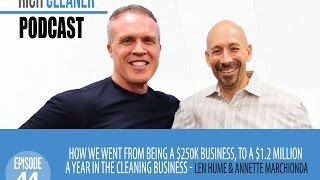
Podcast interview (Rich Cleaner) with Len Hume and Annette Marchionda of Professional Cleaning Specialists of Niagara describing their journey from a struggling $250K/year “half-business” to a $1.25M+ company. They describe practical changes: joining Piranha/Platinum, annual planning retreats, implementing systems (CRM, live phone answering, uniforms, checklists), tracking/measurement, marketing (newsletters, guarantees/free room), price increases, mentorship/masterminds, incremental improvements, and acquisitions/expansion. The episode mixes concrete facts, tactical recommendations, and motivational lessons (failure not an option; progress over perfection).
Questions this video answers
About 25 years (celebrated 25 years).
About $250,000 per year.
2005.
Approximately $1,250,000 (1.25 million).
They won the Better Your Best contest (Platinum program) and drove away with a red Corvette.
Chapters
Hello and welcome to this podcast episode. Have you ever wondered how a cleaning business may be different during the startup during the first few years than it is after that? Have you ever felt like you want to give up the business and go into something else? Do you want an elf business? Easy, lucrative and fun as opposed to a half business? Hard, annoying, lame and frustrating? Today I am speaking with Len Hume and and Annette Marchanda, friends I've known for 15 years, and owners of professional cleaning specialists of Niagara. I want to welcome you both to the Rich Cleaner podcast episode and thank you for being with us today.
Well, thank you, Tim. It's our pleasure and nice to be speaking with you again.
Yeah, you know, we've hung out a little bit before. We've had some good times. So you were members of the the Platinum plus program for a number of years. We spent a lot of time together in those meetings and at boot camps. So anyway, it's just, it's great to be with you. If you would begin because I've got some questions that I want to ask you. You have such great insight. First of all, tell us what your company does. Of course it's cleaning, but tell us what you do. Tell us how long you've been in the business as well.
Go ahead, Nick.
Well, we've been kicking around for 25, 26 years. We actually celebrated 25 years. And the first 12 years was a classic half business. At the end of 12 years, we were about $250,000 a year. Didn't like our clients, couldn't get prices up. It was, you know, we did no organization. And by then Annette had joined and we were primarily carpet cleaning at that time. Upholstery as well. About 50% residential, 50% commercial. And we've maintained that split over the years. I think it's a healthy split. It helps spread business over the years. But we joined piranha in 2005 and never looked back, quite frankly. We learned how to market. We also really started doing planning back then. Business planning as a startup, keeping it simple is hoping to make money. Each year isn't a plan. You have to have a plan. And so every year we go off in November and and spend a week putting our whole plan down for the following year. Financial and marketing and everything else. But over the years since we've been in prana, we've started developing area rug cleaning business. We do a lot of upholstery. Everybody, I think, in the cleaning industry now is doing tile and grout, as do we. We also have added doing marble Restoration as well. So we used to be professional carpet systems. We changed it to PCs of Niagara to get the carpet out of that word. So, you know, we eat on it, sleep on it, sit on it, or walk on it. We can look after it.
Oh, that's good. I like that. So your life. And I want to mention, by the way, that you are former champions, winners of Joe's Better your Best contest as part of the Platinum plus program. You drove off with a beautiful red Corvette. And I know you have a picture in your background. Even now I'm looking at you, Annette and Len and the police officer who gives us tickets all the time. But you really, you bettered your best. You went to higher levels of success. So you are extremely credible. Really, you had, I think you had 12 or 13 years. This is really interesting, 12 or 13 years before Piranha and 12 years after Prana. So I think it would be instructive to kind of look at this. What was your business like before Piranha? A lot of individuals who are listening to this podcast episode, they're relatively new in business, and then there's others who are in kind of a growth stage, and then there's others in more of that mature stage. So you've been kind of in all three. So I think that you're going to be able to give some really good insights that'll be helpful to all who are listening. But if you could actually tell us a little bit about kind of the beginning. The beginning of your business. What was it like the first several years of your business? And we could even say the first five. We could say the first 13 before piranha, because it sounds like they were kind of the same at five years as it was at 13. But tell us a little bit more about what the business looked like then.
Well, it started with just me and a little in a small truck and portable equipment. And I would go find my own jobs. And I very typically, I used an answering service to. I'm sorry, I used voice. Voicemail. So I wouldn't get live calls. I would take messages and go out and find my own work and do the work. And I did that for about three years. And we started. We hired our first person because we had some hotel work. And about five years in, we bought our first truck mount. And I think we were three people then. We still were using an answering service and pagers and that we weren't answering live. And there's an aha there. Annette came on board with us because she was doing something else about 90 about eight or nine years in and started answering the phones. And the business just like that took a big jump.
Interesting.
When people phoned, they were interested.
Yeah.
And I remember it was a real aha moment for us. You know, all the time we've been taking people's numbers and, you know, when they called is when they wanted an answer.
Yeah.
We were still working out of our house at that time too. And. But it was, you know, someone was phoning and they were interested because they were interested at that moment. So it was easy to, you know, educate them, you know, and. And be able to get the job. Because at that time, a lot of clients would, you know, phone. And if they got someone in still today, they phone. They don't get a human voice, you know, they'll hang up and. And try again. Although there's other varying factors today that's happening with social media and reviews and things like that, that why people will call you specifically. But that about 20%, I think, increased.
Our residential just immediately that just answering our own isn't that interesting. That is something sightful.
We're doing that. And we bought two more truck mounts in three years running. And we were pretty good at writing business plans and convincing people to lend us money to buy this equipment. But so there's. Knowing how to borrow money or knowing where there's sources of funds is very helpful because, you know, you're leveraging. You're leveraging someone else's money to grow. But as we got to the 250 to 300,000 mark, we were answering our own phone calls. We were doing. We were doing audits before we went to do the work we do to this day, we still do that. So we'll go out and. And price the job for a new client before. Before we ever do the work. Back in the day, we were also charging by the square foot and not the room. And when you go to do audits, that's easy to do that.
Yeah.
People understand square foot too. You know, the big more I'm going to clean, the more it's going to cost you.
Yeah.
So.
But by the end of about the 12th year, before we got involved with Prana and really started doing our better planning, it was awful. We didn't have systems in place. We were trying to get them in place. Right. Annette.
What kind of systems? When you say systems.
Oh, boy.
Well, everything. And that was going to be one of my things for new businesses to start out, whether it's yourself or just one other person, to really start documenting everything you do and how you do it, so it's easier to pass that on to a new employee, you know, and that. That's everything. How you want your phones answered when you do hire that person to answer your phones, how you're doing, how you're doing the cleaning, you know, you're ordering your maintenance, you know, and then it just gets more and more involved. You're hiring, you're. There's back at the start.
It's as simple as a checklist. What is supposed to be in the truck?
Yeah, yeah.
Developing good habits through checklists and okay, today we have a tile and grout job. What. What is the kit that we need to pull together out of our garage or out of the shop to make sure we don't get to the job and not have the right equipment. So those sort of things were real basic and especially as do people come on board, because we were then maybe about five, three, four. Three or four people in production and ourselves by the end of 12 years, but we had trouble getting our prices up because we weren't marketing properly. We're doing a lot of work and we weren't getting our monies for it.
Yeah. So in retrospect, if you were giving advice to Len and Annette from the first day that you were starting your business and you've already really articulated some advice that you would give and you're giving to others now, but in retrospect, what would you start doing day one that you weren't doing years later? What would have made it less hard, annoying, lame and frustrating from the very first day?
Very first thing, I would get a CRM. I'd get something that keeps track of my customers and allows me to do the invoicing and all of that. And there's choices galore today. But, you know, I don't. Monster.
Gosh, Service Monster.
Service Monster is one. There's another one that's been around for years. Service CEO is another one. They're all reasonably priced now and they're all in the cloud, so you don't have to have a lot of computers. You can do it portable. Do that right from day one.
Day one.
Well, so just before you go on, I think that's really instructive because prior to that you would have just had like maybe three by five cards with the person's names on it or something like that.
Written invoice. And then it would just get filed somewhere and one thing leads to another. Once you have your client database, then all of them, you're able to market from that.
Yes.
So it's kind of a twofold thing. So once you have an area that you have all your client database in one place, then you're able to market to your database as well as marketing to bring in to the funnel and then marketing to your existing. You have to be doing both all the time. But if you don't have that information then how can you market to your existing clients?
Which that's a great example of half versus elf. If you can put the marketing, make the marketing easy and really on autopilot, it changes the game, doesn't it?
And some of today's models will even they'll do. You'll give them a budget for say postcards or what have you and they'll, they'll just look at it gets out, you know.
Yeah, it's yourself.
You think you're going to do it.
But.
Oh, I'm too tired today, I'm going home. Yeah, yeah, that would be number one. It doesn't matter whether you only have 100 clients or 10,000 clients. Knowing what you've done for them is critically important.
Which also falls into being able to get your financial information too, probably from that whole same database. So it's actually threefold marketing. You know, client retention and financials can all be spun from that one thing.
Uh huh. What else would you tell us?
I would tell us, you know, as soon as you can to answer your phones as live as possible. One of the, well, two of the biggest things that I have to mention which brings us back to Joe and Piranha is have your network mentors and coaches. You have to have mentors and coaches. So Joe has been one of our mentors as well as people in the group and coaches. You know, we talked about doing our financial planning so we had a financial coach, we've had coaches through our banking facilities that have. And to this day we are still doing that. So you start that off immediately and continue that because as things change you need different coaches and you need different levels of mentoring and coaching.
And it just at the start, one person starting out, I mean local colleges, the bank, I'm sure there's volunteer mentors and things like that to business clubs or something like that. Anything where you keep the conversation on the business, that's, that's.
Yeah.
You know, so that's great. Expensive I don't think. Because I know when you startup you don't have a lot of money for it. So you look to people who you feel are successful and go ask them a question, what might I do? How can I help you first and then would you give me some advice?
Yeah, that's excellent. You know, in a previous podcast episode, actually Multiple spoke about Napoleon Hill, think and grow rich, some of those principles that he found as commonalities between the most successful people in the world. And you've hit on a couple. One is a mastermind alliance. So mastermind alliance is that coach and those coaches you get help, you learn from your peers, you're part of it as well. Another is being goal oriented. And I think that that's a big thing that you did even before we push the record button on this podcast episode you were talking about in November, how you go away and you do some planning. Tell us about that first of all. Tell us what you do and the importance of that.
That is where we plan our whole year, starting in January the following year. So a number of things come out. We do a complete fiscal budget for the year. What are our sales going to be? Well, then you got to step back and think, well, are we going to get those sales? So you break it up and identify targets you want to go after to over the course of the year. Well, now you've got your targets. What is your marketing and business plan going to be for the year? And are you going to have to add more equipment next year? Are we going to have to do a new hire all of those things? So we get away, spend a week and a half, really nice spot. And there's other folks, some of them are past better, your best folks as well. And we usually a group of about 30 entrepreneurs together. We all are working on our own stuff, but there's a lot of interaction and good stuff goes, good conversations go on. It's like the boot camp advanced with a very small group like the Prana boot camp advance. So when you're in that spot, you may as well enjoy A, the weather because we do it where it's warm, and B, enjoy the company of people who are smart as you and smarter and get your plan together. And for the first time ever, as we've done budgets every year for the past 12 years or so, first time in history, January, February and March, we beat our budget. Oh, so which is celebration time. But that's, that's an aside, you know. So we go into January knowing what we plan on doing. And part of that's, we know what we did last year, we know what clients we had last year, we should better get them back again. And then how are we going to grow? So that's what, that's what that Whole week is about. And knowing that you probably shoot for more than you're ever going to get done. But there's nothing wrong with shooting high. Yes, that's great.
I like that. Before I forget, so you're so. Just to review here, you've spoken about answering your phones live, how that was a monumental change in your business. Having systems mentors, mastermind, groups management, software, marketing, planning for the entire year in advance, shooting high. You've hit us with a lot of stuff. And those apply to. I mean, just in 10 minutes, you've hit some really good, really good points. And so this applies to individuals who are just starting, but you look at this and you say, okay, this applies, of course, to individuals in that growth phase and in the mature phase. These are things that you do. Before I forget, I want to ask you because there have been times, I think you mentioned to me before that you felt like quitting, like, hey, we're out of here. This is enough. What was it that caused you to feel that way and what did you do to change that and stay in the business and do so much better?
Well, I'll do the first one. Back before we joined Piranha, I mean, we were ready. The amount of money we were making from this, either of us could have gone and got jobs doing something else without, you know, the long hours and everything else. You know, it was just. But we didn't, you know, it was. Failure is not an option. So that's. That was before Piranha. There's probably time since, too.
Yeah, well, I mean, we actually had. We were interviewing for a position just a few days ago, and he said, well, what, you know, what made you keep going? And there's still some, you know, Tim, we talked about. It's not always elf. Every day, even now, is it? Absolutely better, yes. But there's new challenges that you're faced with as you grow, different challenges and. But, you know, nothing is perfect. But it's what you learn from your coaches and mentors to, you know, push through some of those times, get over the, you know, the hill there and look back and see how much further you've come as opposed to keep looking, how much you have to go. So you learn some of those things. So that gives you the insight to keep moving, moving ahead. And, you know, it's just sheer will and tenacity. And as Lynn mentioned, you know, just failure is not an option to. In moving forward. I mean, we both always, always have a willingness to serve and be the absolute best customer service company we can Be. And we strive for that every day. So to that. And you know, not everyone's your client. So that's another thing. People. If we could pass on another tidbit to, you know, new and growing businesses. So that comes in with marketing. But not everyone's your client. And that's okay.
That's great. When we go out and do estimates, we feel if we close 65% of them, turn them into jobs, that's probably good. If we were closing them all, then our price is too low. So a couple of things. We started increasing prices after we start doing Piranha.
Yes, that's right.
And that helped get us through because we're answering the question of how we got through the bad time we start. We'd get angry one day. We're putting our price up. We put our prices up, we get more business. Literally. There was. I don't know whether it's a pride of spending or just because our prices were higher, we were doing a better job. I don't know. Another thing that kept us from quitting. I think sometimes because every company you run into problems, you got to dissatisfy your client or somebody run at the problems and get them out of your way. If it takes a few dollars to solve them, spend it and move on. Don't let things sit in the back of your head because that can drag you down so much. Get your prices up and look after the problems fast.
That's fantastic. So to recap, I asked you a simple question. You gave some really good stuff on that one. Failure is not an option. And so again, going back to Napoleon Hill, you know, burning desire. It's kind of like, hey, we've got a burning desire here. We're going to be successful here. Failure is not an option. Annette said will and tenacity. I like some of your other comments. Nothing is perfect and that's okay. Push through the tough times. Things are not always easy. Lucrative and fun being your willingness to serve. I love that. Annette, to be the best customer service company possibly can be. Not everyone is your client. I like the increased prices. So many people are afraid to do that. They think they're going to lose all of their clients. And it doesn't happen that way. I mean, Len, you said you got more business and when you increased your prices. And I like, you know, some people, it's a pride of spending. But also, I like what you said, which was when we raised our prizes, maybe we did a better job. We took more pride in the work that we were doing. And then you also say when problems come up, challenges, and they always do. Hey, handle them right away. Don't let them fester. So segment two of this podcast episode, you hit us with some really good stuff, too. I want to get to. First of all, I don't know that you've mentioned it yet. You said that before Piranha, before you got involved with that, which is today the elite Piranha, elite cleaner system is kind of what we call it, but the equivalent of that back in the day, you were doing about 250,000, maybe 300,000. And then you went to. What is your company today in terms.
Of revenue, budget this year is 1 million, 250 thereabouts.
So you have 5 times your business on the way to 10 timing, we like to talk about 10x. That is phenomenal. And so you say it's not all. I mean, some people would say that and say, oh, my gosh, they're doing a one point, you know, one and a quarter million dollars a year. It's got to be easy, lucrative and fun. And sometimes it's still half hard, annoying, lucrative and frustrating. But you know what? You stay at it because you know that as you continue on, you're going to be able to overcome the challenges and go even to another level. Is that fair to say?
That is fair to say. In fact, you know, we were at a sort of a plateau, you know that there's this beginning stage, growth stage, mature stage. We're at a bit of a mature stage a couple or three years ago and we got bored, so we added another business, we bought another business, and we doubled the size of our building a year ago just to take. And we bought another truck mount. So. So now we're on a big, huge gross thing again.
And so I love it. So that's.
I mean, you don't do that if there isn't a lot of elf in there, you know.
Yeah, but go ahead.
Well, just one of the things I missed saying earlier, and it's not the right time to say it, but uniforms, uniforms, whether they're polo shirts, everybody should be dressed the same. And you know, up here, I don't know about the States up here, khaki pants or one of those pants with the pockets, you know, not blue jeans, but the new pants we have.
Come on, Annette, you're supposed to know the uniform.
Uniforms has helped me because it's mentioned to me when we've had two or three people at a job, everybody looks the same. And it's been back to me and saying, you guys all look the same. You all look like you're here to do business.
Yeah. Oh, I like that. I like that.
I'm sorry.
No, thank you for that. And that's what. These are pearls of wisdom that we want to hear. So I have. I'm just making a note of what you just said. I like that. Here to do it looks like you're here to do business. I like that a lot. Okay, so you got. I love this. You got bored business and you doubled the size of your building and you bought another truck mount. And so that's a good way to get over boredom, I suppose. But you're challenging yourself, and I think that that's instructive as well. You're not just settling for the status quo. So I want to go now to. In the few minutes we have remaining, talk about the better your best contest. And. Oh, before I do that, you know what we were talking about? I'm talking about, wouldn't it be cool to have some sort of a reunion event with individuals who had been part of Piranha Marketing, part of the Platinum plus program, attended boot camps before we do some sort of a reunion event where we get together and not just spend 30 minutes with Len and Annette, but they're perhaps on the stage with other better your best champions, and we spend a lot of time going deeper with some of this stuff. Wouldn't that be nice? Would you guys like that?
If it's in a warm climate, I'd love it.
Okay, good, good. We'll keep that. We'll take that under advisement.
Just not November. Not November.
Okay, so you won the contest, better your best and the better your best contest. Again, just to review, it was taking really a portion of the year before the previous year. What did you do during these. At least three months. And then compare what you did the same three months or more the current year. So you are competing against yourself. You bettered your best more than any others who were in the contest. So if you can help us understand, what did you do? What happened during the year you won that beautiful red Corvette? What. What were some of the things that you did differently that would be instructive for us?
I gotta put it in context, because when I went to the first boot camp, I went by myself. I came back and said, annette, we have to join Platinum. And she. It was a huge. Our dollar was worth 65 cents.
Yeah, huge chunk.
And she looked at me and she said, as long as we implement what we learned. Oh, so we did. And that sort of sets up for the better your best contest.
So that meant we had to go in the contest right off this start.
So the. The hundred and Joe's book. I Forget the name.
106 strategy book.
Strategy book. We combed through that and we didn't try to do them all at once, but we picked what you could get on the books, get to 80% and kick it out the door and get it going. You know, badges, systems, all sorts. Guarantees, guarantees free room of cleaning, which we still use today. We still use free room of cleaning as a bait for clients. So we doing all those things and we documented it. We developed our marketing plans in that year and then we did it. We implemented, simple as that. We didn't try to do all06.
That is so instructive. I love it. By the way, did you use a client newsletter? Do you still use it?
Oh, yes.
Tell us about that. How valuable is that to you?
Well, we electronically send the newsletter. It's. And so if I can elaborate a little bit on some of that, it was newsletter which goes to marketing, which talks all about relationships. So relationships are important in so many levels, not only to clients. Right. So you want to market to your client. You want to have a relationship with your client. That's people do business with people who they know like and trust, and it's a good relationship. So, you know, in that model and doing all that, it was learning that. Tracking everything we did, we tracked everything. That's something we learned in that contest. And we do that today, Tim. We track everything. We track the call that comes in and how we got it, where did we get it? How did we get it? So that was one of the integral things that we learned with priority and doing the contest. And we still do it today.
What's Joe say? Things. Things that you. Things that you measure, improve. Things that you measure and report on improve exponentially.
Yes.
That reporting in that time was reporting to the group, you know, the better your best contest. But now everything we measure goes into reports that we read and look at.
Yeah.
How many dollars did we get off our website? How many off of yellow pages and all those things? We have all that stuff and we look at it, report it. That allows us to improve it exponentially.
What would have happened. What would have happened if you never got involved with Prana and all of the marketing help and stuff? I know it's hard to say, but if you were looking into a crystal ball in retrospect, where would your life be if you didn't get involved?
I'd be probably Doing something completely different as. And that would be probably back in retail, which she absolutely loves. So, yeah, yeah, we'd be probably working for other people.
Would you have a Corvette?
We wouldn't have that.
We just took it out this weekend. Just came out of storage.
Oh, good. Annette, go slow.
Slow down.
For those of you who don't know, Annette did confess that she got a ticket driving that car, and she will never reveal the speed, not even the lens.
Nor the size of the ticket.
Yes. All right, so in this third section of this podcast episode, you talked about challenging yourself. You talked about joining Platinum. And I asked you, what did you do different that year that you won the contest? And you said you implemented what you learned. I think that that's really important. It's like, okay, so let's take this, for example. Individuals are listening to this podcast episode, whether they're in the business for a day, for 20 years, 30 years. You shared some insights that are really, really valuable. And so even implementing the things that you have discussed today on this episode will be beneficial. But you implemented. Became implementation machines. I like how you said you took Joe's strategies manual and you didn't try to do everything. I think that's so important because some will get that. They'll gain access to that, and they'll think, oh, my gosh, you know, okay, let me do number one. Now let me do number two. Now let me do number three. And I've got to do all 106. I love that. I think that's instructive. You didn't do everything. And you said something, Len, I love this. You said, we got it. We didn't have to get it perfect. We got it 80% right. And then we implemented. Some people, you. They never implement because they don't think that the letter or the newsletter or the script or whatever it might be is perfect. You just went out and you did it. You offered guarantees. You offered a free room of cleaning. And these are old staples, but some people still aren't doing that as well. You documented everything. You tracked everything. I love Pearson's quote. You said, pearson's Law, that which is measured improved that which is measured and reported exponentially. So it's going to improve when we track. You developed a marketing plan. You implemented the use of the client newsletter. And Annette, I love what you said. In terms of relationships, it's about building relationships with your clients. So all of that, I think, is a great review. There's things in there that we can all do. I think even better. Is there anything you would add to that.
It all sounds overwhelming. Even I get overwhelmed hearing what you're saying. It is a work in process. The thing to do is never get overwhelmed. Just take one or two things and say, by the end of the month, I'm going to have this out the door. And you know, next month it's going to be a small improvement, but it'll be an improvement. And then once that's working, so you got that little improvement each month and you put something else on top of it. And for the smaller starting, the starting businesses mid size, it's probably more impactful than it is for us now because a new thing that generates an extra $20,000 in business sort of gets buried. But $20,000 to somebody who's doing 100 or 150,000, that's a lot of money in their pocket, you know. So those incremental increases are what to go for and not get overwhelmed by where I'm going to be, where I need to be off in the future. Look back and celebrate the fact that something is going right.
Yes, I like that. Incremental increases. So some will say, okay, you five times your business, 250 to 1.2 million and wow, I want to do that. Well, that didn't happen overnight, did it? That was incremental and I love that. Picking two things a month. I love the old quote. I think it's Dan Sullivan, progress. It's about progress, not perfection. So, you know, doing something, taking action, learning from our mistakes, striving to go from half to elf, but not being frustrated when we're not to elf quite yet, you know, that takes time. So anyway, I think this has been wonderful. Thank you. And Annette, I'm going to try to give the Italian pronunciation of Marchionda.
You did it.
Oh, yes.
Got it, Tim.
As you say in North America, Marshanda. So you know what, let's close this. Thank you both so much. You are so awesome. And these are things that you think about and just maybe every day to you, a lot of this is going to be like light on for others. So thank you so much for sharing in this podcast episode. This, you guys have always been that way, always been about sharing. What can I do to help and uplift others? So thank you for that.
Well, you get that reunion thing put together. We'll see you there.
Okay.
So famous last words from each of you. Anything that you would like to say to conclude.
Oh, goodness. Well, relationships are important with your clients, but they're important with your mentors, coaches, JV Relationships which Is something else we learned through Joe. It was through those relationships that allowed us a. To buy our building, if you remember, and buy. The business that Len was talking about was a joint venture of ours, a retail who heavily referred us. That's the business we bought. So we had that relationship and that. That's been instrumental in where we've gotten today. So that. That was huge. And one other thing I can mention in starting out or you're in your growth is try to put a little money aside and so that you're able to seize an opportunity when it presents itself. I'm not sure who mentioned this, but it might even be Joe or something. I read, you know, luck is nothing other than being able to seize an opportunity when it presents itself. So when, if you have, you know, that little bit set aside, you might be able to do that. That's been something else that's really been able to push us forward a little bit as well.
The first check every month is a little money that goes into a savings account. The business owns the money, not us. But that's good advice, I guess. My words of wisdom is two things. Don't get overwhelmed. Don't try to do too many things. Slow but steady really does work.
Yes.
And remember to have some fun, you know, work hard, play hard, Enjoy your family and friends as much as you can. You know, we only get one time around at this and it's. It's. We're here to add value to the world and add value to our clients and to our family. So just don't get overwhelmed. Just work it.
Excellent. Great advice, great wisdom, great counsel. You both are absolutely awesome. Joe Polish will be listening to us. So one thing say to Joe before we end.
We love you, Joe, and miss you. So hopefully we'll see him.
Yeah. Remember that very famous thing that people used to say was thanks Joe?
Yes.
That was how people signed off on their videos. And that for the better, your best contest. And absolutely for me. Thanks, Joe. Because, you know, this sounds. Getting involved with Joe and that thing really was a life changer for us. Yeah. Really was. I mean, we figured out that what was really wrong with our business, most of it was between our ears. Okay. We had the wrong attitude about things. We looked at ourselves as subservient. When you start looking at yourself as we're providing a valuable service, then all of a sudden you can sell it better, you know? So once we got what's going on in our head straight, it helped a lot.
Thank you. That's great. There are some listening to this who are not yet part of the Piranha Elite Cleaner program, if you can imagine that they haven't stepped up. And so everything that you've been talking about here and all those changes and the gratitude to Joe comes through being part of that program. So we would certainly encourage everyone to step up and be a part of this. So thank you again, and you keep up the good work and I hope to see you soon.
Okay. Thanks, Tim.
Bye, Tim.
Goodbye, everyone. This is Timothy Paulson, Rich Cleaner podcast. Have a tremendous.
More from Joe

This FBI Trick Can Command Respect Without Saying a Word ft. JEFFERSON FISHER & CHRIS VOSS

How To Stand Out, Be Different, and Create Raving Fans, Customers, and Employees ft. Jesse Cole



90% Of Businesses Fail In Their First Year, Here's Why! ft. Dr. Benjamin Hard & Dr. Robert Cialdini

The 1 Piece of Business Advice I Got From Elon Musk That Changed Everything Ft. Kamal Ravikant

The 6 Traits You CAN'T Teach in Entrepreneurship ft. Richard Branson & Gino Wickman

The Leg Method: How to Make Your Book into a Million-Dollar Asset ft. Anna David


7 Millionaire Mindset Hacks for Daily Success and Wealth ft. Brian Tracy & Dan Sullivan
