Idea To Implementation with Doug Andrew at Joe Polish's Genius Network
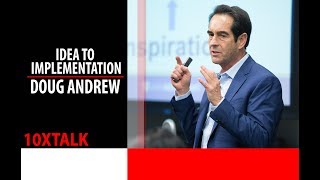
Doug Andrew presents a 10-key scorecard for turning ideas into results. Score yourself on profiling ideal clients, raising objectives from experience to transformation, operating within your unique ability, building predictable systems, and balancing life through Dan Sullivan's Freedom Time framework. The focus is implementation over inspiration.
Chapters
How many of you are members of strategic coach? About 12 people in here. Awesome. Well, as you may know, I've been a raving fan of Strategic Coach and an active member for 20 years. Mainly because I get so many really great insights and ideas that I can implement into my life and my business. And I'm sure that's why you're part of Strategic Coach as well as Genius Network. So what do you do when you get a great idea at a place like Genius Network or Strategic Coach? Do you write it down on our elegant idea sheet? What do you do with them? Those sort of things? Do you then bring it back home to your team, discuss it, review it, tweak it and then estimate the potential return? Or do you just forget to and then don't implement it? How many of you just forget everything, don't implement it? As we all know, without implementation, nothing really great happens without a great idea. That's why I've asked Doug Andrew to give this talk about the implementation of your ideas. Doug has been a member of strategic coach for 20 years, just like me and he joined Genius network back in 2012. If you were to look up the word implementation in the dictionary, you would see a photograph of Doug Andrew. We call him the poster child of implementation. I could tell you that Doug has an extensive experience in economics, accounting, financial and estate planning, tax planning, wealth management and real estate. I could also tell you that Doug is a New York Times and Wall Street Journal best selling author, sought after speaker and has his own radio show. It's also been rumored that he is a male model, does voiceovers for television and movies and is a licensed pork inspector. Actually, I'm just kidding. I just. I can't verify the last three, but I can tell you that everything prior to that is true. Doug's title is Idea to Implementation. Please let me welcome the awesome Mr. Doug Andrews. Thank you.
Thank you, Joe. Appreciate that. Thank you. You bet. Confucius said, tell them and they'll forget. Show them and they may remember. Involve them and they will understand. When we come to the Genius Network or Strategic Coach, we often get insp. Maybe motivated to change. But implementing the idea is what's the most difficult part of the process. The objective today is to give you at least one idea that's worth a quarter of a million dollars that you can take away. Now, when you're about to go on a trip somewhere for the very first time, what's the most important piece of information you need to know? Most people blurt out where you're going or how to get there? Nope. When using a GPS, it uses triangulation. It hones in on three out of about 27 to 30 satellites that orbit this earth for that very purpose. Once it has clarity on where you are at within 2 square feet on this globe, then you program in where you're wanting to go. And it will show you all kinds of ways to get to your desired destination. Now, Dan Sullivan and my mentors have said, doug, you can always tell where somebody's at by where they're at. And Dan is famous for saying, all progress begins by telling the truth. And I would add to yourself. Now let's assess how you may be implementing some of the ideas that are shared in Genius Network or Strategic Coach. So I've created a scorecard of 10 of the most dynamic ideas that I've been able to implement. I want you to quantify where you are at, complete your 10 key scorecard, turn it over, and we're going to go through this, and I would like you to do this by tomorrow. So here's an overview of how to fill out your 10 key scorecard. On this screen right here, you'll see that there are 10 principles listed here on the left. And then on a scale of 1 to 10, you will score yourself across horizontally. Poor, fair, good, better, best. And then up here at the top, you'll put a score of where you are right now and then where you're wanting to be right there. And at the end, you will total your score. So let's go through and get some ideas on how to do this. Key number one is to identify and focus on the profile of your ideal client. You all know the 8020 rule. Where most of us, when we started, 80% of our revenue was derived from the top 20% of our clients. We've been taught to flip that to be able to ask questions about what are the attributes of my ideal client and what makes my ideal client tick? What do you need to do to understand to better deliver to your ideal clients and improve your relationships with your ideal clients? So if you were going across this scorecard right here on that very top portion, you would read through all of these and figure out what your score is. If you feel desperate and you'll work with anybody who will fog a mirror, that's a one or a two. Okay. If you know the attributes of your ideal client, but you don't know how to reach or market to them, that would be a score of 3 or 4. If you have adequate clients but you're not sure how to improve relationships. That would be maybe a five or six score. You know the profile of your ideal client, but you're still spending only 20% of your time with those top 80%. But what about if you devoted 80% of your time with the top 80% of your clients? That would be a 10. Okay. Key number two is move your professional objectives to the highest value level. Dan Sullivan recommended years ago reading the book the Experience Economy. And in that book, the authors use an example of coffee in its pure commodity form, coffee beans. It's only worth 2 cents a cup. When it moves into a unique product, a cup of coffee, it goes up in 10 times in price. But when that cup of coffee enters a convenience sector at a restaurant, or a 7 11, it goes up about four times greater. But Starbucks made their success by creating unique experience. Okay. Now, there's one level higher that people value even more, and that is a meaningful transformation. So on the number 10 for that second key, you have the highest compensation with the least competition. By providing a meaningful transformation. Key number three, provide greater clarity, balance, focus and confidence for your clients. Dan Sullivan has taught us that there's constant global change going on in the scientific, technological, economic, political, social and cultural arenas. People have this loss of context, individuals and consumers. He told us the formula to be able to ask ourselves, why are these people feeling confused and isolated and powerless? How can we give them better clarity, confidence and capability? And you do that by mustering up as much lrc, leadership, relationship and creativity. You show people the darkness of the night if they keep living life the way they're living it, and then you show them the brightness of their future, the day, if they will change their ways and follow your strategies and concepts. When you provide clarity for people, they will have unlimited energy. When you give them balance, that takes the wobble out of their life. That increases the velocity in which they achieve their destination. When you give them focus on what matters most, that increases the accuracy in which they'll achieve their goals. And with those three, you'll have much greater confidence. Confidence attracts opportunities. Lack of confidence repels opportunities. So mark down where you're at on that score tonight when you do this exercise. Key number four, operate within your unique ability. This is something Dan has trademarked. Delegate everything else. When I started in Strategic coach and took my Colby score, I began to realize in my activity inventory, there were a lot of things I was doing I was incompetent at. I had to delegate that, then delegate what I was even confident. What was really hard is delegating what I was excellent at. But when I started focusing on what I was superior at, 80% of a focus day is doing the three things I'm superior at. And that's what gives you energy and passion. As Dan teaches, I come up with the ideas. I'm a quick start. My process, my project manager makes the ideas real. They do the fact finding and implementation and my process managers make them recur like a well oiled machine. Key number five, find your niche and develop a unique system based on predictability. Now you're only going to get what your system will deliver. Do you know that most prospecting and marketing Systems only deliver about 6% of the results they could otherwise achieve? Marshall Thurber, who's a systems Genius, stated that 94% of all failures are a result of the system or a lack of a system. Now I use system as an acronym that stands for save yourself time, energy and money. And Dan taught us to put on one 8.5 x 11 sheet of paper and laminate it. Our unique process that we take people through. When I started doing this, this simplified in one form what our clients would go through and they knew what came Next. And then Dr. Edwards Deming taught that 85% any successful result you want in life is determined in the first 15% of the process. So you make sure you get that down right. And filling out a scorecard is one way to do that. Key number six, create more opportunities than you have capability. Dan calls that big old little C. And then you filter which opportunities you're going to seize. So in the book Blue Ocean Strategy we learned how to create uncontested market space and make your competition irrelevant. Have a blue ocean instead of the red ocean of tearing down your competition trying to be the tallest building in town. Dan taught us to focus on our customers, dos, dangers, opportunities and strengths and to create a value creation monopoly so that people can only get from you what you provide better than anybody else they could go to. Dan taught that many people go through life with more capability than opportunity. We want to flip that and make sure we have more opportunities than you have. Capability. That's a nice problem and it's easy to solve. I wrote an article for Harvard Business Review about how to prioritize your opportunities and I cited Dan. It went to the front page of HBR in 48 hours. This is serious stuff. And so you filter opportunities based on utilizing ability, referability, impact, enhancement and appreciation. Key number seven, balance your life. Prioritize by using a freedom time system. If you know Dan's entrepreneurial time system of free days, focus days and buffer days. What a game changer that has been for me, as I'm sure it has for you. So I like to have 120 to 140 days a year earning 60 to 105 days a year learning and then 140 to 160 days a year recreating. See, recreating is recreating and downloading, getting away and working on the business instead of in the business. Key number eight Use professional coaches and mentors. Form strategic alliances. These are some of my favorite. We have the dos. I have used this in my business to solve the dangers for my clients financially and showing them the best vehicles and opportunities. A Whole New Mind by Daniel Pink. You want to teach high concepts coupled with high touch. Folks, you know that coaches, mentors and alliances are an investment, not a cost. Key number nine Use the best tools. Use a scorecard. Strategic coach tools. Key number 10 Redefine your business every seven years. You know the business enterprise has only two functions, marketing and innovation. All the rest are costs. So what I want to challenge you all to do is to create strategic byproducts. Be in motion, add value. Dan Sullivan says, rather than trying to be the smartest person in the room, I just like to be in a room where everybody's trying to get smarter. Now that's by sharing. So add up your score and then how many of you would like to raise your score? Yeah, I think we all would like to do that. There's more than one poster child of implementation. Join the family. It's you. Thank you.
More from Joe

This FBI Trick Can Command Respect Without Saying a Word ft. JEFFERSON FISHER & CHRIS VOSS

How To Stand Out, Be Different, and Create Raving Fans, Customers, and Employees ft. Jesse Cole



90% Of Businesses Fail In Their First Year, Here's Why! ft. Dr. Benjamin Hard & Dr. Robert Cialdini

The 1 Piece of Business Advice I Got From Elon Musk That Changed Everything Ft. Kamal Ravikant

The 6 Traits You CAN'T Teach in Entrepreneurship ft. Richard Branson & Gino Wickman

The Leg Method: How to Make Your Book into a Million-Dollar Asset ft. Anna David


7 Millionaire Mindset Hacks for Daily Success and Wealth ft. Brian Tracy & Dan Sullivan
