Jared Cohen: How Technology TRANSFORMS Business in the Digital Age!
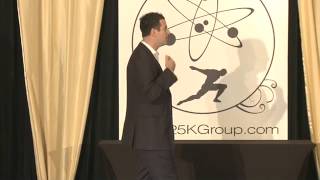
Jared Cohen, founder of Google Ideas, argues that five billion more people coming online in the next decade will transform identity, privacy, and innovation. He uses examples from Iran, North Korea, and Tunisia to show how mobile and internet tools create unexpected uses in constrained environments, and warns that raw growth statistics miss the human stakes.
Chapters
Our next presenter I actually met through Peter Diamandis. Go figure, right? And he is the founder and director of Google Ideas. He's also the co author of the New York Times bestseller the New Digital Age Reshaping the Future of People, nations and Business with Eric Schmidt, who's the chairman of Google. In 2011, Jared was named one of the hundred most influential people in the world by Time magazine. He's a former advisor to Condoleezza Rice and Hillary Clinton. Plus, most importantly, he speaks Swahili. Swahili.
Say it.
Say it.
Swahili.
Swahili. Yes. See, I can't even pronounce it. He fricking speaks it. I mean, he's obviously more intelligent than me. So give it up for my friend, Jared Cohen. Okay, awesome. Thanks, Joe.
Thank you. Thank you, Joe, very much. It's really an honor and privilege to be here today. I want to begin with a quote by a reasonably obscure American inventor who we are all going to appreciate because we can give him partial credit for inventing the air conditioner. His name is Charles Kettering and he once remarked, we should all be concerned about the future because we're going to have to spend the rest of our lives there. Now, in addition to this being a nice and charming quote, I like it because it lends itself towards a natural follow up question, which is, if I should be concerned about the future, how does one go about doing that? Now, maybe it's because of the generation that I'm part of, or maybe because I have a natural attraction towards technology. But I believe whether you're in business, whether you're a government, whether you're an individual, if you want to understand the future, you have to understand technology and where it's going and the impact that it has on people, nations and businesses. Now, in order to understand where we're going, we need to understand where we are today. Now, most of the people who talk about the power of technology and the technological revolution, they like to focus on the speed and pace at which all of these tools are spreading in every corner of the globe. So we know that in the last 13 years, the number of people connected to the Internet has risen from 361 million users to roughly 2.4 billion users. We know in that same time period, the number of mobile devices in circulation has gone from a mere 907 million to well over 6 billion in just 13 years. We know 72 hours of YouTube footage are uploaded to the Internet every minute. We know that 4 billion hours are watched every single month. We know the number of SMSes sent text messages every single day exceeds the entire population on Earth. We know there's 1.5 million Android activations a day. We know the number of Android users worldwide is around a billion, and the operating system has been around for less than a decade. You get the point. But in case you don't get the point, let's look at the age old battle between communications and sanitation. In India, there's more mobile phones in circulation than there are outhouses in existence. There's 4.2 billion toothbrushes worldwide. Last time I checked, toothbrushes cost less than mobile devices and yet there's over 6 billion mobile devices in the world. Now, why do I tell you all of these sort of fun facts and figures? I do it because it's dramatic and I want to follow that drama by saying none of it matters. It tells absolutely no significant story other than one that we already know, which is the spread of technology is inevitable and it's going to be some combination of mobile, video and Internet. So what is the story? How is it possible that we are underselling the Internet and technology and the power of what it can do for the world? It's because despite all the facts and figures, despite the data, despite the quantitative analysis, none of that tells you why any of this matters. None of that tells you why this is literally the difference between life and death in certain pockets of the world. Now, my favorite quote in the entire world is a quote by Woody Allen where he said 80% of life is showing up. This is what I've tried to do in my life, whether it was when I was in government or now in my time at Google. So I've traveled to more than 80 countries around the world looking at this question. And I have a natural affinity for less safe, more unstable environments because I think things that happen there are far more interesting. But I remember I got my first lesson in this sort of Woody Allen comment when I moved to the Islamic Republic of Iran in 2004. A totally normal thing for a nice Jewish boy from Connecticut to do, but nonetheless, I thought it was a good idea. And I went to Iran to interview opposition leaders, reformists, journalists. And about three days into the trip, the Revolutionary Guards came into my room, threw a bunch of shit around, got really mad, interrogated me and basically threatened me and all sorts of not fun things. And I was like a week into my trip and you can imagine my research kind of collapsed and I was stuck in this terrible place. And what did you do in that situation? You wander around the country looking for friends. And that's what I did. So I found myself in the southern Iranian city of Shiraz in a busy marketplace, which is called a bazaar. And there was a busy intersection of about four or five different alleyways. And I saw something remarkable, which was about 20 to 30 kids, all lining the walls of the shops, holding a mobile device that wasn't too unusual. What was unusual is none of them were making eye contact with anybody. And so I asked one of them, what are you doing? He said, I'm using Bluetooth. And I said, where's your earpiece? He said, what are you talking about? I said, isn't that what Bluetooth is? He said, no. I said, well, show me what it is. He then showed me how, because his Bluetooth was turned on, he was able to find, call and text complete strangers as long as they were within 20ft. And they had funny names on his phone, like Tupac for Life and a variety of other things, some of which are not appropriate for this room. And these young kids were either, like club promoters out calling and texting complete strangers, telling them what time the party was. Several of them were trying to get a date. One of them was trying to recruit a new bassist for his band. A number of them were selling drugs, and some were selling illegal playing cards. So I went to one of them and I said, aren't you worried about getting caught? And he said, no. Nobody over 30 in Iran knows what Bluetooth is. And I said, nobody in America knows what Bluetooth is either, because this is a totally different use case than the one of, how do we talk and drive at the same time? But necessity drove innovation because they were repressed and they don't have civil liberties and free expression. Now, this sort of discrepancy between the engineers who build the tools and the creative users in difficult environments that find unbelievably imaginative use cases for them has really become the theme of my primary methodology in life, which is showing up. So in the process of writing the new digital age, Eric Schmidt and I traveled to close to 40 countries in the last two years, and I made him go to some of the more difficult parts of the world. And let's start with the most difficult of all, which is North Korea. Now, let me ask all of you, by show of hands, how many of you would find it difficult to function in life without your mobile devices and without access to the Internet? Raise them high so I can see. So basically everybody. So in North Korea, do you know what the penalty is if you are caught with A mobile device that was smuggled into the country and isn't one of the few sanctioned, heavily monitored devices. It's the death penalty for you, your parents, your grandparents, your kids, your first and second cousins, and anyone else that's related to you ends up in one of the gulags. Now, we all think we can't live without this, but how many of us would risk getting shot and our entire family being killed just to access a mobile device? We have no frame of reference for how important these tools are, and yet literally tens of thousands of North Koreans every day take that risk. In Libya during the NATO bombing campaign, Libyan schoolgirls used Google Maps so they could plot where the bombs were falling and find a safe passageway to school. So effective were these maps that the NGOs decided, you know what? The Libyan schoolgirls know how to get the food to people that need it. And the NGOs started relying on the Libyan schoolgirls to figure out where the hell to go. In Tunisia, the revolutionaries from the Jasmine revolution basically gave up on the prospects of democracy and became Android developers. In Kenya, a 24 year old named Anthony Mutua developed an ultra thin crystal chip which he figured out when you apply pressure to it generates electricity. So frustrated that he couldn't charge his phone, he cut a slit in the sole of his shoe, put the chip in it had a wire connecting from the sole of his shoe to his phone. And now he charges his phone in the rural Rift Valley simply by walking. That is very, very nice. In Burma, as recently as six months ago, a SIM card was $5,000. They don't want people using phones. So what did the young people in Burma do? They basically found a way to use the same Bluetooth technology I mentioned in Iran to basically share peer to peer. In Ciudad Juarez, known as the murder capital of the world, just south of El Paso, Eric and I were greeted by police officers wearing face masks. All the police officers wear face masks there. And why do they do that? They're so scared of the drug cartels. Now, if you're a citizen living in Ciudad Juarez and the police officers are so afraid of the cartels that they wear masks, do you really think you're likely to go and report a crime to them? So what do they do? The citizens use the Internet as their mask and they recognize that they have the power of numbers online and they as a crowd, report the crimes, report the cartel activity, say what parts of the city are safe to go to and which parts are not. Perhaps the most dramatic and powerful example that we've seen by showing up of why this technology matters was in Pakistan, we met a group of women who'd been attacked by the Taliban with acid. And through no fault of their own, the physical scars that they bear on their face carry a terrible stigma in society that essentially prevents them from living life. So we went to go visit these women who all live in a house together. They had mobile devices, they were learning technical skills. And one of these women made it very clear to us that her scars are invisible online. And because of the Internet, she now has a second chance at life. She was able to meet a man online, develop a rapport with him, admit her situation to him, and now those two are married in real life. So if you think the Internet matters, if you think mobile technology matters, it matters a lot to those women who are able to live their lives. Now, I could tell you that Pakistan, in 10 years, has gone from 300,000 mobile devices to 110 million devices. I can give you Internet statistics, speed analytics, et cetera. None of that is going to reveal to you just how much that level of access matters in that particular society. What's even more extraordinary than the impact that these tools are having in some of the world's most difficult places is the fact that this is only the beginning. 5 billion new people are connecting to the Internet in the next decade. And 5 billion new people, most of those people live in parts of the world where the government's autocratic, where it's violent, and where there's huge amounts of instability. Now, the two lessons that I'll leave you with based on that next 5 billion appeal to two categories of people who are likely in this room. Business people and parents. How many of you, by show of hands, are parents? I'll start with you. With all these people coming online, our virtual entourages are going to become gigantic. What we say about ourselves and what other people say about us is going to have huge implications for who we are. Data permanence. So what is the lesson for parents from Saudi Arabia to New York? The lesson is you need to talk to your kids about online privacy and security and data permanence years before it's relevant to talk to them about sex. Because it's going to be relevant years before it's going to be relevant to have the sex talk. And that applies in every part of the world. And then the second lesson is one that I take from the technology sector, which is the smartest people in the entire world that build things, whether it's strategies, whether it's A product, whether it's a technology, even the smartest people in the entire world, living in the developed part of the world that's free and open, they cannot begin to imagine the impact that those tools have when they're thrown in the types of environments where people are coming online. Innovation drives necessity, and it's the places that have the greatest amount of needs that are going to be the future connected societies. And we may continue to build in the developed world, but the rest of the world is going to export the use cases right back to us, and we're going to learn a tremendous amount from them. So thank you very much.
That was great.
Thank you.
I want to talk about your book. We actually spent a lot of time talking about your book. The Draw Shop is actually in the room. They did a whole video on the New Digital Age, which we're going to send everybody so they can see it. But if someone reads the New Digital Age, what will they learn? What will they get out of it?
We wrote the book because we were tired of the existing debate that's taking place around technology, which is, is it good or is it bad? It's an interesting question. With no prescriptions, why debate the inevitable when you have this unbelievable number of people who are coming online in parts of the world that we don't understand? So we wrote this book to try to gaze into the future and understand how 5 billion people coming online is going to impact everything from who we are as individuals to where wars take place and how they play out, to where the next revolution is going to be to how states intervene and interact with each other, the future of foreign policy, the future of business, and the future of who we are as people. Awesome.
I'm going to get every 25k member.
A copy of the book.
Okay. And what are you currently reading right now? What do you pay attention to? Blogs? What do you read?
I actually just bought Robert Caro's. I think it was his first book on Mayor Moses. I read his book about lbj, and even though I knew that Kennedy was shot, the suspense leading up to it, I was like, what's going to happen? And I was told that as good as his book on LBJ was, his book on Robert Moses was even better. And being a new New Yorker, I wanted to understand how this city was built.
Yeah, cool.
Cool.
And what are the chances of people like. I went and spent some time with you at your office here in New York, and it's fascinating if people want to go into Google and get a tour here, San Francisco wherever. Is that doable?
Yeah. Get in touch. We love showing people what we do. We're very proud. I always try to sell the idea of people coming to Google by saying, normally I would never sort of suggest it would be fun and interesting to visit an office, but this is the only place where you can go and write, rub backslash in the search box and schedule a massage 30 minutes later.
It was just fascinating. I'm sure it's kindergarten to you, this stuff, but when you were showing me the weapons, tracking of where all the weapons are going and just fascinating. So, so awesome. Thank you so much.
Thank you very much.
Really appreciate it. Thank you.
More from Joe

This FBI Trick Can Command Respect Without Saying a Word ft. JEFFERSON FISHER & CHRIS VOSS

How To Stand Out, Be Different, and Create Raving Fans, Customers, and Employees ft. Jesse Cole



90% Of Businesses Fail In Their First Year, Here's Why! ft. Dr. Benjamin Hard & Dr. Robert Cialdini

The 1 Piece of Business Advice I Got From Elon Musk That Changed Everything Ft. Kamal Ravikant

The 6 Traits You CAN'T Teach in Entrepreneurship ft. Richard Branson & Gino Wickman

The Leg Method: How to Make Your Book into a Million-Dollar Asset ft. Anna David


7 Millionaire Mindset Hacks for Daily Success and Wealth ft. Brian Tracy & Dan Sullivan
