Jason Fladlien Productivity: How to Avoid Burnout While Growing a Billion-Dollar Business!
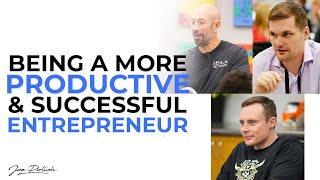
Jason Fladlien and Benjamin Hardy discuss how to scale without burning out. They share frameworks for prioritizing work: Ben's single-core-goal funnel, Joe's possibility/probability/time/money filter, and Jason's 80/20 vital-few. They also cover networking profitability and transitioning from day jobs to agencies.
Chapters
You're never too cool for school. I don't have a PhD. You have a PhD. I failed owning and operating a small business at Chandler Gilbert Community College and I got a C minus in Principles Marketing. I have no formal education. If there's anything that I've learned, it's because of reading books. I mean, I'm sitting in one of my conference rooms in an 11,000 square foot building that I own, which is my headquarters. And there's 2,200 plus books in the room that I'm in right now as we do this webinar. But I'm like Abe Lincoln, I'm self taught. But you're just a great student. And people, if you want to learn anything, there's someone out there that has put the time, effort, energy into learning the skill. And if you could avail yourselves of those people, you're well served to do it.
But essentially, I first heard of genius network in 2014. Just so you all know, in 2014, in the fall of 2014 is when I started my PhD program at Clemson University. So my wife and I, we moved to Clemson, South Carolina. I was starting a PhD program in organizational psychology. And around that exact same time, at about end of 2014, my aunt Jane actually joined Genius Network. So at that time in 2014, I knew that I eventually wanted to be an author. I'd never written a blog post. Benjaminhardy.com didn't exist. I had never actually started writing online. But I've been studying self improvement and even business for the last time, 10 years. So I knew that I wanted to get a PhD. I wasn't actually sure when I was going to start my business at this point in fall of 2014, I wasn't really interested in that. But my aunt Jane, who is really close who me and her are really kind of close, she runs a great business and she joined Genius Network. And I didn't know what Genius Network was. I didn't know who Joe Polish was. But basically over the two year period of time when Jane was in Genius Network, I watched, I watched a lot about her change. She became totally, far more motivated, clear and passionate about her life and her business. I saw her business explode, but I also saw her kind of reach a different level. What I call it now is the psychological upgrade. I developed that kind of concept through the last few years studying entrepreneurship in a PhD program. But basically I saw her experience a psychological upgrade, which often happens when you invest money in yourself and when you put yourself in big networks and then when you experience huge growth and so I just watched her change and I watched her business change. And actually one of the things that she let me do during that first semester of school was she actually, she kind of cheated. She let me have access to the network, like to the business portal. So when you join Genius Network, you get access to like a membership area and you can watch some of the 10 minute talks or some of the interviews that Jo did. And Jane actually let me have access to her membership portal. And so when I was in my first semester of my program, I was watching of this Genius Network material. And as someone who's been studying self improvement, you know, I listen to all the podcasts, Tim Ferriss and stuff, the level of training that I was watching at the Genius Network stuff, which you can only get access to, like most of, Joe puts out an enormous amount of content. He's got a lot of podcasts and things like that. But the stuff that's taught at Genius Network on the stages and at the events, you can't actually get access to that content unless you're a member. And and so I was watching this stuff and was just blown away. And essentially what happened was during that first semester, I made myself kind of a personal commitment, a personal goal. And my goal was, is that I was going to become a member of Genius Network before I finished my PhD program. That was my goal. And usually a PhD program is five years. I actually just finished it about three or four months ago. And so basically from that point forward, I started studying and following Genius Network. And a lot of the members who were in Genius Network, like, a lot of the talks that I watched were like, people like Peter Diamandis, Tim Ferriss, you know, like, there's so many people who have spoken at Genius Network, and Joe is going to be able to kind of explain that to you later. And a lot of basically my heroes, a lot of the influencers, the authors and the entrepreneurs who I followed, studied and aspired, I realized they were part of Genius Network or had spoken at Genius Network or had previously been members. And so I was like, holy cow, this is like where all of these people hang out. Like, this is exactly where I want to be. And I just realized, learning more about Joe, that he was kind of the connector that kind of, in a lot of ways propelled a lot of these people forward, but also brought all these people together. So basically, in the beginning of 2015, my wife and I, I decided that I was ready to get a website. I decided that I was ready to start publishing online. It was $800 to buy the domain name benjaminhardy.com and that was an enormous amount of money at the time. We were first year graduate students. My wife was also a graduate student. And my wife was very concerned about me buying this domain name, you know, for $800. And she's basically like, if you're going to do this, you better be serious about it. Like this is, you know, you've been saying you've wanted to be a writer for a few years, but ultimately I ended up buying that website and started studying how to blog. So I took an online course, a John Morrow course, and I started learning how to blog. And that's kind of where I found medium.com I started blogging on medium.com in about May or June of 2000. I think it was around May of 2015. And within a month or two I wrote viral articles that blew up. And from that moment forward, I just started kind of getting millions of views. And I wrote on Medium for a long time. And it was basically at that point when I started getting a lot of views that I realized I needed to start growing my email list. One of the big things that helped me was that I had one specific goal. I had one specific goal and that was to get a six figure book deal. And so everything was filtered through that goal. And so I knew I needed to get an email list. And so over a few years I learned how to optimize that. I learned how to get a ton of traffic and I learned how to get a ton of emails. And I've actually written a lot of articles on how I've done that. But ultimately, over about three years, I went from zero to about 400,000 email subscribers with, without using any paid advertising, pretty much all through medium.com, just getting millions of views. And for about two years, I was averaging about 20,000 new emails a month. And I'm still even right now to this day. I think this month I've gotten about 600,000 views on Medium. But I'm not actually doing anything with Medium really right now. But I'm not getting any email subscribers anymore either through Medium because they've changed all their platforms. But in 2017, it was at the end of 2017, I got my first major book deal for what became Willpower Doesn't Work. I had more money than I'd had and I felt like I was in a position where I was ready to join Genius Network. That was something I really wanted to do. And to be up front. It's $25,000 to be a member of the entry level program. And so $25,000 is a lot more than buying an $800 domain name. This was a big investment at this point. I had already paid for some coaching. Like I had spent a few thousand dollars to get coaching to help me deal, but I never paid anywhere near $25,000. But I talked to my wife about it. At this point, when I joined, which was in, I think September of 2017, I had about 200,000 email subscribers. And I was making like I was making. I was starting to make hundreds of thousands of dollars. And so I felt like I was ready to make that investment. It was still very scary. But ultimately I did make that investment. And one of the things, kind of one of the hidden benefits that I had because my aunt Jane was a former member, was she told me that I should give a 10 minute talk. And so one of the things that happens at Genius Network when you go is that a lot of the people there who are kind of the top in their industry, they give 10 minute talks that basically are just high value. One of the purposes of those 10 minute talks is to provide at least $250,000 worth of value in 10 minutes. And that's really one of the purposes of Genius Network is that you pay $25,000, but you should at least get 10x that value and return in your business, or else you're probably not a good fit. There's a lot more involved in Genius Network, but that was one of the things that excited me, was the whole 10x thinking concept. So during my first Genius Network meeting, which was In September of 2017, I gave a 10 minute talk all about my blogging strategies. And it really went off well. I ended up being able to give that Talk at the 2017 annual event. Joe invited me to give that talk at the annual event, which was amazing. And basically what happened to me was that at that first Genius Network meeting, I call it kind of a peak experience or a subconscious enhancing experience, but that first meeting blew my mind. It totally exceeded expectations. When I walked out of that meeting, I was just like, this is the next level. I already felt my mind stretch, my future stretch. Like I was so excited and so clear based on the people that were around me, that this was kind of the environment that was going to get me to the next level. And so I decided after that first meeting to join Joe's higher tier group. And his higher Tier Group is 100k, 100k per year. It's called Genius X. And that's actually what Jason's in as well. Jason's in there, Dan Sullivan's in there. People like Russell Brunson have been in there, and there's a lot of people that are in Genius X. And so after that first meeting, I was kind of like on this extreme high and I decided to, you know, I talked to my wife about it and just said, I really know that this is kind of the group, this is the environment that's going to help propel us over the next several years. And I think I should make this. And luckily my wife kind of allowed me to make that level of an investment. And then I guess just to fast forward now to today, you know, over the last two years I've been in Genius Network, developed a really close friendship with Joe and Jason and other members of the group, and it's kind of really just changed a lot about my life. Like I was just kind of budding, kind of a fledgling entrepreneur. And I still am in a lot of ways compared to most of the people in Genius Network. But I have, I can honestly say I've been able to pretty much 5 to 10x my income. And I've learned from people like Jason. You know, you just get immediate access to wisdom and a bunch of givers. And so, you know, over the last two years, my business has in a lot of ways exploded. But even more than that, because what Genius Network is, it kind of has helped me in all areas of my life. And so now my business is making well over seven figures. I'm still continuing to learn, continuing to kind of set bigger and bigger targets, prepping myself for the next book launch, and just really, really kind of just excited about entrepreneurship. And so that was kind of just a background of my story that I wanted to share. A lot of the growth in my entrepreneurship is because I've made investments like Genius Network, put myself in mentoring experiences like Genius Network, and surrounded myself with people who are in those networks and learned how to be a contributing member of those groups. And so it's just an amazing opportunity. I just wanted to kind of share that story with you because wherever you are as an entrepreneur, I believe that you should take those kind of leaps.
I mean, the biggest thing that I would say to this, which is a term I've heard from you, is the whole psychological upgrade. And one of the commonalities with me is when I was a dead broke carpet cleaner living off credit cards because people that don't know my story, I didn't learn marketing because I thought I would ever teach it to people, run groups, or anything along those lines. I did it because I needed to eat, I needed to survive. And I was always even when I was a Deborah carpet cleaner, before I learned anything about marketing, I actually volunteered to be the Arizona director of the Carpet and Fabricare Institute, which was a trade association way back when. Because I just wanted to be around other people that knew how to do the business better than me. And I actually had to figure out how to learn marketing selling something nobody wants to buy. Because there's probably not a single person that's watching us right now that like looks forward to hiring a carpet cleaner. And when you have to figure out how to build a business that really nobody wants to buy, it forces you to actually learn a lot about marketing, about messaging, about list selection, about identifying people's problems and how to present it in a way to where they'd want to hire you, especially in a low barrier to entry business, and on and on. But I always was trying to just get better. And so no matter what anyone takes away from this, there's one thing that you're never too cool for school. I don't have a PhD. You have a PhD. I failed owning and operating a small business at Chandler Gilbert Community College and I got a C minus in principles and marketing. I have no formal education. If there's anything that I've learned, it's because of reading books. I mean, I'm sitting in one of my conference rooms in an 11,000 square foot building that I own, which is my headquarters. And there's 2,200 plus books in the room that I'm in right now as we do this webinar. But I'm like Abe Lincoln, I'm self taught. But you're just a great student. And people, if you want to learn anything, there's someone out there that has put the time, effort, energy into learning the skill. And if you could avail yourselves of those people, you're well served to do it. Three ways to learn. You learn through the school of hard knocks. It's one way to learn. Most inefficient way to learn. You get bloodied, you get beat up, you make a lot of mistakes, whatever. Second way is you learn through the experiences of others. You read their books, you attend their webinars, you go to their seminars, you learn from them, you find mentors, you find teachers, you join groups that are valuable and that's a very valuable way to learn. And then the third and one of the most effective ways to learn is once you've learned Something, you teach it to other people because it really causes you to hone your skills. And that's what you are doing. That's why you have so many millions of people that have read your articles, that read, and now your books. And same thing with Jason. We're all students first, and teachers is part of it. But the ultimate situation is to be both.
So, Ben, please address how to approach first things first. It can take a lot of time to organize, clean out, and then attack the to do list from the top of the morning on. Do you take a month to clean it out, then begin with goals? Hope this question makes sense here. Thank you so much. So, really, the form of the question that I would like for all of us to answer for the benefit of the group here is to do lists in really productivity as a concept of what do I work on, what don't I work on? So what's your thoughts on that, Ben?
Yeah, I mean, as for myself, I usually have, like, one core goal that I'm working towards, and that becomes the funnel, you know, through which I determine if, like, opportunities or people are relevant. It's something that it's kind of like the garden I'm always weeding because as you become more and more successful at your work, way more things attract. And so this is kind of where my morning and my morning journaling come in. Like, consistently aligning myself with what are the things that matter to me. And I'll be honest with you, I often struggle with this battle of first things first and also eliminating options that are bad. But for me, it's always been about, especially in business, one specific goal, there's one specific target and one specific outcome. And if the things that I'm working on are not in alignment with that, then I can tell that they're distractions.
Joe, what are your thoughts?
Yeah, well, you know, I would have to echo what Ben says about having a challenge with it. There's something when you. When you're first starting out and you know you have no place to go but up, it, frankly, is a lot easier than when you have a lot of what people would perceive as success, because success traps are harder to get out of than failure traps, especially when things are good and when they're working and when you have a lot of options. And so the challenge is if you have a thousand options, you don't have any options, it seems like psychologically. So I always have to go back to. Out of all the things I want to do, could do, have available to me, I go through four Things if I'm like especially have a lot of options, possibility, is it possible I can do this? And I'm a possibility thinker, so I can think, I can imagine anything is possible, but that's a trap. The second is probability. What's the likelihood this would work? Third is how much time is this going to take? And the fourth is how much money is it worth to me in order to do that? And then all under the umbrella is like what Ben said, am I aligned with it? Is this really what I want to do? So the question is what's the result that I want to produce and what is it possible, is it probable? How much time will it take and how much money is it worth? And that's a really good filtering mechanism because every single day I am presented with all kinds of distractions, options, possibilities to kind of say what Ben says. The habits, the environment, the rituals that are developed around the result that you're wanting to produce is critical. If one of the things that needs solved in your life is you need money, then you got to focus on at least that one foundational aspect that's, that's going to do it and you can only do what you can do. So his whole thing about editing, pruning and narrowing down just your options I think is really critical. And I have a hesitancy to try to tell people what success should be for them because all of this is an individual thing. I mean, if I could direct everybody, my opinion would say do this, do this, do this. But that's not what we're here for. We're just here to give perspective. And so people like a 12 step group, take what you like and leave the rest.
Yeah, for me the biggest thing is the 8020 rule. And that's the law of the vital few that for any outcome, only a few of the inputs matter. And so I don't really have a to do list. It's pretty, it's obvious and clear to me and it's been improved over time that if I want to achieve this result, there are maybe three things that matter to that result significantly. And then there might be 10 things that slightly matter. And then there are a million things that probably don't matter at all. And so I always try to stay focused on what's the biggest lever that helps me achieve this. So a to do list is worthless when you don't have a bigger, brighter future. But if you have a bigger, brighter future, the to do list isn't necessarily going to help get you there. It's an Understanding of if my bigger, brighter future is blank, what seems to be the thing that will contribute the most to it. And if that's the only thing you do every day, you're going to be successful. If you do that first and then you say, okay, the rest of the day I'm going to screw around and try this and this, and I don't care if I succeed with any of the rest, then that's still okay. Because that one thing that you're doing that is most important, the trick is figuring out what that is. And so if you're constantly evaluating, okay, I did this. Was it the most important thing or not? Okay, let's try it again tomorrow and then we'll reevaluate it again and again. So, yeah, it's hard to do, but it's. Billionaires do less than millionaires in the sense of activities. They have a few refined activities that they're world class at, whereas millionaires, typically, in our experience being interacting with them, they have like a hundred things they're really good at. So technically speaking, they're good at more things quantitatively than billionaires. But billionaires are really good at a few things to a level and a degree that nobody else can match.
Hey, I hope you're enjoying this video. And I want to let you know that I have a new book that's come out and if you'd like to get it absolutely free, there's a link below in the description. Or you can wait till the end of this video or you can Simply go to joe'sfreebook.com and you can get a copy there.
So there's the answer. And then I'm gonna throw this one to you. Your environment radically influences you, and it's super important to only surround yourself with the right people. My question is, how do you draw the rind and how you decide who to work with and what to do? What are your thoughts on that?
What was the second part of that question? How do you what?
How do you draw the line and how you decide who to work with and what to do?
Yeah, so I like the quote from Dan Sullivan that you should surround yourself with people who remind you of your future more than your past. That's kind of like how I frame it. And so, you know, I'm always just looking for people I can learn from, people who I want to learn from, people who I want to contribute to. And so, like, when it came to Joe, just as an example, or Dan Sullivan or other mentors that I've sought, I've Been very influenced by their work. I really want to be around them. I want to learn from them. And so I'm always looking for, like, people who have the characteristics or the experiences or the environment that I'm looking for. And then I just look for ways to contribute to that environment and to serve in that environment and to adapt to that environment. As I talk a lot about willpower doesn't work. So a lot of it's just, do these people resonate with me? Are they doing what I want to do? Are they where I want to be in my future?
Joe, what would you like to add to that?
So, you know, I guess the way that I go back to the term alignment, right. Because I only want to align myself with people that are aligned with me. I do check my gut feeling. There's no such thing as a good deal with a bad partner. And I really, you know, I'm at the point in my life where there's, you know, I think of Dan Solar as five ways to get paid. Money is only one way to get paid. Another way is people utilize you. So I like working with people that actually utilize what it is I offer. I like people that appreciate me, I like people that refer me. And I like when things enhance me. So what I choose to work on is when I can kind of not just double dip, but five times dip. I not just get paid money, but I also get paid with appreciation, utilization, referrals, and enhance. And my most important thing is enhance. I think one of the most ultimate things is to put yourself into an environment where you're not only getting referred to, rewarded financially, but in all other ways. Because there's financial capital, but there's relationship capital, spiritual capital, physical capital, there's all kinds of different capital. So I really like relationship capital. So that's kind of how I gauge it. I'm not sure that's super easy for people to understand without doing some soul searching. But you have to look at your own value system and who you spend time with. I always think of elf. I want people that are easy, lucrative and fun. I want businesses that are easy, lucrative and fun. I like elf marketing. I like having an elf business versus a half business, which is hard, annoying, lame and frustrating. So my criteria is, is this elf or is it half? Because you could have hard, annoying, lucrative and frustrating. But I don't like half. I like elf. So I put people, projects and things all through the elf filter.
Awesome. I'm going to go to the next question and I'll start that first and kick it to you guys question is this one. This is interesting. A little background. I have a day job in sales and on the side and building and scaling a digital marketing agency. I want to leave my day job ASAP to work on my agency full time. But I want to hear from you guys some thoughts as to when it would be a good time. X dollars in savings agency matching monthly revenue etc from day job, etc.
Etc.
So my answer to that first is the question is, is your day job fulfilling to you? Because it is very, very okay to simultaneously have a job and still build your business on the side. And I would hate for you to stop doing something that brings you fulfillment and joy to try to just build a bigger business because I think that will actually be harmful to you now if your day job doesn't bring you joy. And it's very tedious and very painful. Listen, I've been there. I launched a business doing that where I paint houses 12 hours a day. And then before I would go paint and after I'd go paint. That's how I started my business way back in 2007. And so my goal was to as quickly as possible be able to transition over from working for somebody else to working to myself. Now the thing though was that is I didn't go from one extreme to the other. Like what I wanted to be in. Digital marketing wasn't where I started. So I started ghostwriting articles for other people. So I essentially traded one job in for another. I went from instead of working for somebody else by the hour to working for myself, but by the hour. But it was an easy transition because I was selling services, not selling something that's super complicated and selling it really easy. So if nothing else, I was able to buy myself some autonomy and freedom and make a little bit of pay. But it also put me one step closer to what I ultimately wanted to do. And so I was able to improve myself, get a foundation, get a building to build off of, but be able to slide in very easily outside of that business into the other business as well. But very often what you'll see in the real world is if you have a good relationship with your work, it might make sense that they're your first big client. I've seen so often that when you become a consultant, your first person that hires you is the company that used to pay you as an employee. And you find out that they would pay you way more if you were a consultant than an employee. So it doesn't have to be this binary, one or the other or black and white. Typically, binary thinking is usually not the way to go. It's the grays that make the difference. So I would say take a look at it and be very clear what you want in your digital marketing agency to look like and what steps are needed to get there from first, second, third, fourth, and then are there synergistic ways that you can accomplish more than one thing at once? So can you simultaneously build goodwill over here while improving your acumen over there while still increasing your revenues and so on and so forth? Joe, what's your thoughts on that? You want me to say the question or you want to just dive in?
You know, here's what I would say. I'll keep it short. Getting results doesn't take time. It's the not getting results that takes up all the time, which is a Dan Sullivan quote. And I was a dead broke carpet cleaner. Going back to that again. But I would read marketing newsletters a night. I do hard manual labor and. But back then, I was in my 20s, I'm 51 years old now, and I was just wanting to run a business. I didn't want to work for someone, and I didn't even like the business I was actually in. That's what you know, because I was actually paying money to run a bit. I was going broke. I was literally living. I racked up about $30,000 in debt in credit cards when $30,000 in debt back in 1992 was a lot of money. And it's, you know, so the thing is, though, it's, you know, there comes a point in time where you can either burn the bridges, and the real key is once you know that you have the ability to produce a result and you sit and think like, what's the opportunity cost of staying in this existing situation? And like you said, you know, is it fulfilling? Am I learning something? You know, if you're not getting paid well, if you're not appreciated, if you're not utilized, if it doesn't. If people don't refer you and it doesn't enhance you, then you got to do it as short as possible and learn how to produce a result so you can get out of that situation as quickly as possible and. But at the same time, bridge it. Some people stupidly take risks that they don't necessarily need to. So part of it is doing a little bit of soul searching. And when you know that you have the ability to produce a result, if you're an entrepreneur, you know, you're an entrepreneur. I mean, if people have to Question it. You might need to develop a little bit more skills and see, because what's an entrepreneur? It's solving problems for a profit. And once you know that you can create a result, all of the time that you spend not creating result is really the opportunity cost there. So that's what I'll say for now.
Ben, anything to add?
No, I just very briefly, I know a lot of people who I've coached who are in a similar situation and kind of going to kind of combining some of your thoughts. Once you know you can create a result, then all of a sudden your confidence explodes and then you, you know. So a lot of it's just a lack of confidence kind of going to your 8020 concept. Jason, I've seen a lot of people when they're kind of newbies and this is one of the reasons why I have one specific target in a lot of ways. When you have one specific target, like for me it was get the six figure book deal that really filtered all of my activities. I think that what I see like for example, this person who wants to start a digital agency, I see a lot of people when they're starting, they try to do everything. They try to build an online platform, they try to get their website perfect, they try to master a thousand things and they end up doing nothing. And so I think if you can produce, you know, you're going to your 8020 concept, if they can quickly start producing a key result fast and they start to realize that their money can be replaced from their job, then they can start to optimize. And so I just think whoever this person is who's talking, it's possible that they're focused on way too many things right now. And if they actively just get the minimum viable dose or just get the one result that they're looking for, then they would might not even be asking this question.
Yeah, it was harder for me to make my first hundred thousand dollars than it was for me to make my first million. Getting started is always the hardest part. So.
Me too, me too.
Momentum and then usually these questions answer themselves. All right, then let's go with Joe with this one first. What are the best ways to be profitable as a networker? The actual value of helping people make connections and find dynamic mentors doesn't always seem to match the transformational value they provide. Provide. Not exactly sure what that means, Joe, but let's tackle the first part first. What are the best ways to be profitable as a networker?
Well, understanding that how much you charge for something is totally the formula. If people want to know the formula of how much you charge for something, I'm going to share with you this secret formula. The formula is, it's totally based on your ability to sell it. The difference between someone buying like a Timex, one watch in a Rolex is what are they, Are they buying like a watch, are they buying jewelry, are they buying status? And so how you position yourself, the level of credibility, the ability to produce a result. So what are you connecting people with? I don't necessarily want to network with people. I want to actually connect capabilities with each other. Someone has a capability, I have a capability. Putting the capabilities together can produce a result. This result is worth X for that person. If you couldn't charge money for what it is that you're selling, and if the only way that we got paid is our ability to produce a result, people would have to rethink what they're networking for. Some people just want to go out and get a bunch of followers. I make more money than many of my friends and colleagues that have millions of Instagram followers, hundreds of millions of views on their YouTube videos, and all of this social media stuff because it's all focused on getting attention, getting attention. But when you're able to give attention to, you know, a particular ability to produce a result and link someone to it, you can charge them for groups, you can charge them for consulting, you can take a piece of the action. I mean, it's all the model that you operate in. It's, you know, we don't have enough time to go over different structures of financial models and things like that. But certainly, you know, I'm happy to, you know, give people links to where if they want to listen to my podcast, read my, I mean, I talk about this stuff all the time in the emails that I send out to people for free and that sort of thing. So, you know, there's, there's all kinds of, it's all unique packaging and. But the biggest thing though, when it comes to connecting and being a networker is not focusing on what do you want, but focusing on what the other person wants, what's, what's in it for them and you know, getting them to what it is that they want, finding the pain, the suffering, the opportunity going in and be able to help them link it to it. And then you can, if you're good at it, you can make an enormous amount of money. I've made millions of dollars being a quote unquote networker, but you have to do genius networking, not just networking and there's. That's a distinction.
Yeah, it's. The word networker has been kind of polluted. Right. Because when we say the word networking, you get this picture in your mind, typically, of somebody trying to take something from you, you know, handing out business cards and not really listening to you, just waiting for their turn to talk. It's unfortunate because at the heart of it, that's not what networking is. So I like how Joe really reframes it as connection. Now, here's the one thing that I'll address specifically to that. If you expect to be reciprocated in what you give to match what you'll get in return, you're going to be very disappointed. The world doesn't quite work that way. So you have to be okay with giving $100 million worth of value and only being compensated in return. Million dollars?
Yeah.
You should have been compensated for 100 million, but you weren't. Right. But the wonderful thing about this world is there's a lot of strategic, intelligent ways where even though everybody is always getting the best of you and giving you less in return, you can still be more profitable, more valuable, more prosperous, more wealthy than everybody else, because that's a mindset. It's not necessarily a bank account. And so the generosity of giving. So this is what Joe describes about me. He says, jason's a guy who pays me and then shows up and works. And he does the same. Ben does the same thing. And it's no coincidence that Ben and I have typically gotten the most out of the group. Now, here's the challenge, though. If you don't have a lot to give, that strategy doesn't work for you. And so I always think of myself, and Joe has this book coming out. I think, hopefully soon. It's called what's in it for Them? If I can engineer nine big wins, and only one of those guys comes back to me and says, hey, listen, I want to do some business with you because you helped me out over here. I. I would call that a huge success, but I can deliver wins for other people with relative ease. So making yourself more valuable will be something where you can attract wealth as opposed to pursuing wealth. So the real question is, what's the skill? You could cultivate that even if other people took advantage of you to access that skill, you would still be so well off financially that you really wouldn't care. Ben, do you have anything else to add to that?
Yeah, I think that one of the things that is essential. So I'm going to quickly share my Screen. Just to kind of add to the point of what Jason and them are saying, this is an article I wrote on Inc. It's called what happened when I paid $100,000 to help someone. You read that correctly. I paid six figures to help someone. So if you want to look up this article, I explain a lot of the psychology behind it, but this explains kind of the mindset. So this is on ink. What happened? You know, but just a quick thought. When I went to my first Genius Network meeting, I was a little surprised that a lot of the people were asking the question. You know, they even asked Joe, because at the small meetings, there's probably about between 40 and 60 people. And one of the conversations was, how do we make sure we get our 25k investment back? And I thought that that was like such small thinking, because in that environment, you should be able to get 250,000 or. Or $2,000,000 worth of value if you know how to give value. And so my single thought is this. If you know you have something to give, be very proactive about giving it. I mean, one of the things that Joe says is make it elf. So don't make it more work for the person. You're trying to give that value to make it really easy and clear as to why it would be helpful and beneficial. So you got to kind of know what their goals are, and you got to know that what you're doing is not going to take time off of their plate because they've already got a million things on their plate. So that's kind of what I've always strived for, is just how do I make it so easy and so useful to the people I'm trying to help that it doesn't take any of their time. It's just adding value to their life, and it really helps.
All right, Ben, I got another one. Would you like.
Or.
Sorry, Ben, would you mind talking a little bit more about the whole body being inside the subconscious mind?
Joe and I have similar perspectives on a book that you should probably read. The book would be David Ozanich. Right. And the book, Healing. What is it called again? The Great Pain Deception.
So John Sarnozanich, Steve Ozanich and John Sarno.
Yeah, yeah. So I'll just give a very fast overview because this is a big part of the book I'm writing right now. Personality isn't permanent, but the main idea is that your body. I really want to focus on the business side in this conversation, but your physical body and your subconscious mind are the exact same Thing, you know what I mean? And so the core is that your subconscious is connected with your memory, it's connected with your emotions. And a lot of what happens. Well, I just don't know if I want to go too far down.
How would that apply to a business scenario, Ben? How would knowing that help you in business or with making money?
I mean, I would try not to go too, too deep into the weeds on that. But what I'm talking about is, you know, so William James said, what happens at the subconscious level is expressed at the conscious level. So basically what psychologists have found, and it's just totally true, is that the results you get are subconscious, not conscious. And so what you want to do is, is you want to consciously upgrade your subconscious. And you do that through powerful decisions, through change of environment, through the people around you. And so I'm always focused on who's the future self. Like, who do you want to be in the future, and how can you start operating as that person now? What are the environments that that person's operating in? Because then you can upgrade your subconscious. I mean, one of the things I talk about is subconscious enhancing experiences. Basically, your subconscious represents what's normal to you. So if you're making $100,000 a year, like, that's what's subconscious, that's what's normal. In order to get to a hundred, like in order to get to a million, you've got to upgrade your subconscious. And in a lot of ways, you've got to get exposed to new environments. And then you've got to make those environments and those behaviors and that identity your norm. And so I don't know, I don't want to go too far down the rabbit hole, but certain behaviors and environments and exposure to thinking are a very fast way. So actually, to be honest with you, my hope with this webinar was that it's a subconscious enhancing experience, that being around Joe, Jason, maybe myself, it's an opportunity for you to get exposed to a level of thinking that's different from your norm, so that then you can start to imagine and process and think about possibly seeing yourself in that scenario.
Nice. Let's go with the super tactical question then to offset that very hyper spiritual question. Right. Can you guys offer any insights into the optimal strategies to build a blog or a website? My plan is to create a platform blog based on the transformative ideas I'm living embodying learning along my own journey. Its purpose is to offer value as an educational platform and also to create coaching clients. So I'll start with this one, then I'll throw it over to you. Joe, really, at the end of the day, the number one optimal strategy of building a website or a blog, if you will, is you should be able to offer something of tremendous value that other people desperately want and being able to offer it in a way that's unique and specifically empowering to a certain subsegment of that audience. So there's a tremendous amount of stuff I just said there that I'll try to unpack briefly and succinctly is, unfortunately, you might have the greatest transformative ideas in the world, but if people are not aware that they should care about those and they're not actively seeking them and they're not desperately wanting them, you will fail almost every single time. I mean, you might win the lottery, but probably not. Right? So that's the first issue. The second issue, though, is once you've identified specifically how to match your message to what the audience is experiencing, keeping them awake at night and troubling them and bothering them, you now have to present your message in a unique way. So when they hear it, if it's for the right person, they'll say, I've never heard it that way. That sounds interesting. Ooh, there might be something here. This might have a paradigm shifting capability for me because it's not the same old, same old. So that's the second biggest challenge. The first one is to identify those things that people want desperately but are being neglected, underserved, or not served at all, but want it really badly. And the second is giving it to them in a way that hits them right between the ears, as if you're reading their mind and saying, you're the only one I believe that has the solution for this problem. And if you have that, then the rest of it's just window dressing. Then it's just a matter of writing different articles and seeing what hits and what doesn't hits, making different offers, seeing what hits and what doesn't hit. But Those are the 80, 20 of that situation right there. Now, that's not, you know, it's a dose of reality. A lot of people don't want to.
Do it like that.
And we can all point to occasionally somebody who just follows their passion and gets rich and famous. But that is a very unlikely outcome. So just to be aware of that, Joe, what would you add to that?
Well, I have to preface this by saying I have never focused on building a successful blog. I mean, you and Ben are way more qualified to answer that question than I Am. I don't even need a website in order to do what it is that I do. I only have it because people sort of have this expectation to think that, you know, like it's important. But I honestly could run my entire company based on referability and just the many, many years of creating value for people, which is how I started Genius Network in the first place. You know, there's not some magic secret strategy that has built it. Now to what you said, what I would say, as long as there's other people in the world that are having success using a distribution system, a communication system. Because there's three things you need in order to sell something. You need a product or service is number one, you need a sales picture and marketing message number two, and you need a delivery system number three. What most people focus on is, here's what I have. How do we tell people about it? A blog, a website, social media, going back to yellow pages, direct mail, tv, you know, phone sales. I mean, these are all manual or digital or whatever. They're all delivery systems. So a blog is a way to communicate. What I would do based on what you said is look at where are there models of people that are doing something not in the same niche, not in the same category, but they're having enormous success with what you would consider. Who would you look up to and get to know those people, reverse engineer what they're doing, how have they built it, Learn their stories, listen to interviews with them. If you have the ability to reach out to them and create value and get to know them. And even if you have to pay those people, that will shave you weeks, months, maybe years off the learning curve. And I'm surprised at how many amazing individuals doing amazing things in the world are not approached in a way of really being of service. So those people would want to reciprocate and help you. And that's pretty much how I build to this day. Like, if I want to meet someone, learn something, do something, I'm like, how do I be valuable to this person? So I could learn more what it is they know how to do that I don't. And that would be applied to a blog or anything for that matter. Okay, I hope you found that video awesome and useful. So if you want to get a free copy of my book, I want you to click here. And if you want to watch some more videos that will be useful and awesome, click here. Go ahead. They're over here. Do it now.
Come on.
Thank you. Watch them.
More from Joe

This FBI Trick Can Command Respect Without Saying a Word ft. JEFFERSON FISHER & CHRIS VOSS

How To Stand Out, Be Different, and Create Raving Fans, Customers, and Employees ft. Jesse Cole



90% Of Businesses Fail In Their First Year, Here's Why! ft. Dr. Benjamin Hard & Dr. Robert Cialdini

The 1 Piece of Business Advice I Got From Elon Musk That Changed Everything Ft. Kamal Ravikant

The 6 Traits You CAN'T Teach in Entrepreneurship ft. Richard Branson & Gino Wickman

The Leg Method: How to Make Your Book into a Million-Dollar Asset ft. Anna David


7 Millionaire Mindset Hacks for Daily Success and Wealth ft. Brian Tracy & Dan Sullivan
