Knowing When and How to Start a Fund, Not a Business: A Roadmap To Your First Fund ft Grant Hensel
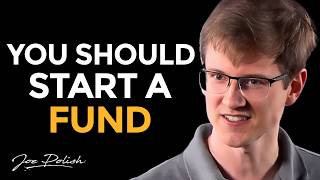
Grant Hensel went from building ten companies to raising his own investment fund. He spent $30,000 on legal setup, put in $1 million of his own money, had 156 investor conversations, and raised $12.5 million in eight months. His advice: build your thesis from what you actually know, commit your own capital, and treat fundraising as a growth opportunity.
Chapters
As entrepreneurs, we're wired to spot and act on opportunities, usually by starting companies. But sometimes the right move isn't launching a business, it's launching a fund. What if the opportunity you see requires more capital than you personally have? In that case, you raise a fund, an investment vehicle you control by a show of hands. How many of you would feel confident raising a fund if the right opportunity came along? 1, 2, 3, 4, 5, 6, 7, 8, 9, 10, 11, 12, 13, 14, 15. Okay, great. So by the end of this talk, the goal is for every hand to go up to give you the confidence and know how to raise a fund if the opportunity arises. Grant Hensel knows this journey firsthand. While his main business, nonprofit Megaphone, helps Nonprofits access Google's $10,000 a month ad grant and now employs 65 people, Grant recently raised a fund of his own entrepreneurial capital, which invests in stable, profitable, and boring small businesses. He started 10 companies. Two were acquired, seven flopped, one thrived. And now he's sharing how and why he stepped into fund building. His talk is titled Knowing when and how to Start a Fund, Not a Business. Please help me welcome Grant Hentle. Thank you, sir.
Appreciate it.
Yep.
Okay. 15 was way more than I thought. So this is excellent. Most people, or more people than I expected have already done this, which is awesome. The year was 2006. Justin, who just spoke was two. I was like three, probably. And Joe had just started Genius Network, and he knew a couple things in his bones. He knew that he was very good at marketing. He knew he was very good at bringing people together. And so he created the thing that has brought us all together today, Genius Capital and Genius Network. Except no, actually, no, he did not. He did not. He probably didn't even consider the idea of starting something called Genius Capital. I certainly wouldn't have because I'm an entrepreneur. Joe probably identifies as an entrepreneur. You probably identify as an entrepreneur. And when entrepreneurs, when we see opportunities, we have very simple formula. And the formula is that we start a business. Yes. And a business is often the right approach, but not always. And so the goal, as Joe mentioned, is that by the end of this, everyone has a little bit of a sense of how, if they saw an opportunity to start a fund, that they could do that as well. As Joe mentioned as well. I have always been a guy to a man with a hammer. Everything is a nail. I've started lots of businesses 10 times. Two years ago, I started thinking about what other opportunities might look like, and my wife and I actually acquired a business which she now runs. She works for Boston Consulting Group, which is a wonderful job, except they chain you to the desk for 14 hours a day. And she wanted to have more freedom and flexibility. So we bought a business from an owner who is retiring. She now runs that business, has like 25 people, does SEO for law firms, which has been wonderful. And I fell in love with that model and started investing in other people who were also buying what we call stable, profitable, boring businesses. We're investing in one that does tombstone engraving. So stuff like that where owners retiring. Yeah. I had a wonderful chat with Scott. Valuable business death and taxes. Something about those being ongoing things. And as I shared these opportunities that I was investing in with mentors and advisors and a number of them said, you should start a fund. And I, in my head said, that's impossible because I did not know how that would work logistically. And I figured that someone like me, and not just because I look like I'm 12, but someone like me who is an entrepreneur, would not be able to do that. And that's not a thing that was in my sort of opportunity horizon. But they said, you'll figure it out, just go do it. And so that is what we've done. And I want to share about that story with you because it was significantly easier than expected in kind of a wonderful way and opened up more opportunities in a wonderful way. So.
Hey, I hope you're enjoying this video. And I want to let you know that I have a new book that's come out and if you'd like to get it absolutely free, there's a link below in the description or you can wait till the end of this video or you can Simply go to Joesfreebook.com and you can get a copy there.
Part one. The thing that I thought was impossible was logistics. Does anyone raise your hand if you remember the first company you incorporated? Like first time you incorporated an llc? When I did that, and maybe this is your experience as well, it was very nerve wracking. I used like legal zoom and paid way too much money. And now it's like you just go to like for me, the State of Illinois's website, you pay 80 bucks and you push one button and then they issue an LLC. I had a similar experience with starting a fund. I figured it would be very hard, very complicated, very expensive. We have all probably read the book who, not how, and it turns out that's the answer. We hired a fund formation attorney who does nothing but form funds. They did all the paperwork. It was like 30 grand so more than legalzoom, but not crazy. They introduced us to all the people that we would need to know for fund admin insurance and software. And it was just like dramatically simpler than I would have ever expected. So then the thing I figured, okay, if that's the easy part, it's probably the fundraising that's the hard part. Right? Because I don't know how to do that. Never done that before. What I thought was that no one would invest in something that I was raising money for because they would say like, okay, show us your 10 year track record of investing in this asset class and how has it gone? And I do not have a 10 year track record. I've been doing some, but like no long track record. And what I didn't realize is that people invest in first funds all the time. A first fund does not have previous funds. I'm a first time fund manager. So there's nothing to look at except for a person's story and journey thus far. And I was able to tell a coherent story of I've started a bunch of businesses. We bought one under this model of people buying boring businesses ourselves. I've invested in 11 of them. And that was actually a very compelling and sort of like coherence journey. So people are like, oh great, fantastic. The other thing that was really helpful and Jeremiah actually had a talk on this about Skin in the game being deeply impactful. I personally was like, I'm going to invest a million dollars of my own money into this thing. That ended up being the largest tide for largest check. And so everyone figured like, well, if it totally sucks, at least it'll be really painful for him. And if it goes well, then he'll probably be happy. So that's a good sign. Skin in the game is a good thing. Yeah. Anyway, yeah. Which has been a joy. So that was sort of the pitch. So we put that into a deck and I started having conversations. No one will tell you these stats, but I will tell you the stats. We had 156 conversations with potential people who might want to invest. Mostly small business owners, because that's who I know. 80 of them said nope and 76 said yes. So almost half, which was way better than I expected. We set out to raise $10 million and I thought it would take 18 months and we ended up raising 12 and a half in like eight months. And now the fund is raised and it's like, boom shakalaka, we're off to the races. Which is particularly impressive because I look like I'm 12. So if I can raise $12 million for like one year of every visual your appearance, that's pretty good. I'm so glad that Justin has joined and other younger people because it's like I'm not the youngest person, like clearly. Anyway, thank you. All that to say it's been a wonderful opportunity. Prior to this experience, I had never borrowed a dollar of money in my life from anyone for anything and never raised a dollar for anything because I didn't want there to be other people that had like influence over me, frankly. And I wanted to just be independent. And this has been actually a surprisingly wonderful experience of having like an interconnected web of people who have invested in our vehicle. We look at deals, we share them with those people, they give very helpful feedback. And it's actually been like a really cool thing of expanding possibilities and expanding opportunities in a symbiotic and mutually beneficial way that I hadn't expected. So it's been a wonderful journey. I think it's interesting to think about. And I'm not recommending this to Joe, this is just a thought experiment. But if you think about Joe could have started something called Genius Capital alongside Genius Network, super connected, he could easily raise like tens or hundreds of millions of dollars. There have been lots of cool people that have come into Genius Network and had this been like a really transformational experience for them. And you could see a world where Joe is like, yeah, we have this thing, Genius Network. We have this thing, Genius Capital and we invest in Genius Network members and there's a world like an alternate universe that you can paint where Joe is a billionaire for having made that decision. Because capital just scales really well. And I'm not recommending it. I think you'd actually hate it because of anyway, there's some personality oriented tweaks that maybe make it a good fit or bad fit. Anyway, I don't think you'd like it. You'd be really good at it, but I don't think you'd enjoy it. Can he do it anyway? Poor Joel. So that would be my recommendation to you is consider it as a path that you could take. I excluded it categorically from myself for a long time for reasons that did not make sense. I thought the logistics were really hard. They were not. I thought it would be impossible or not fun to raise money. It was actually super fun to raise money and I thought that it would be like a constraining, limiting thing. And it's actually been an expanding, growing beautiful thing. So if this is something that you never want to do, Just shred your notes and don't worry about it. But if it is something you'd want to consider, I would encourage you just to have a thesis of like, for us, it was word. Invest in people buying boring, profitable businesses because that's what our experience was. So something based on your experience. Set a goal for money you want to raise, set a timeline you want to do it, and just get out there and see what happens. I was surprised by how much fun and how surprisingly straightforward it was. So in conclusion, raise your hand if you now feel slightly more confident that if you did see an opportunity that you could raise a fund. Thank you so much.
Okay. I hope you found that video awesome and useful. So if you want to get a free copy of my book, I want you to click here. And if you want to watch some more videos that will be useful and awesome, click here.
Go ahead. You're over here. Do it now. Come on.
Thank you.
Watch them.
More from Joe

This FBI Trick Can Command Respect Without Saying a Word ft. JEFFERSON FISHER & CHRIS VOSS

How To Stand Out, Be Different, and Create Raving Fans, Customers, and Employees ft. Jesse Cole



90% Of Businesses Fail In Their First Year, Here's Why! ft. Dr. Benjamin Hard & Dr. Robert Cialdini

The 1 Piece of Business Advice I Got From Elon Musk That Changed Everything Ft. Kamal Ravikant

The 6 Traits You CAN'T Teach in Entrepreneurship ft. Richard Branson & Gino Wickman

The Leg Method: How to Make Your Book into a Million-Dollar Asset ft. Anna David


7 Millionaire Mindset Hacks for Daily Success and Wealth ft. Brian Tracy & Dan Sullivan
