Never Fear Cooking Delicious Food: Cook With Iron Chef America Winner | Mark Tarbell and Joe Polish
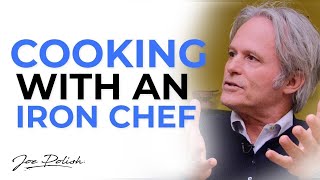
Iron Chef America winner Mark Tarbell teaches Joe Polish how to cook without fear, walking through vinaigrettes, fresh ricotta, hand-stretched mozzarella, roasted vegetables, and a chorizo-bean stew. He covers acid and fat ratios, heat management, and knife work, then tells you to stop worrying about mistakes.
Questions this video answers
About 40 minutes.
4 to 1 (four cups liquid to one cup cornmeal).
About a cup of salt used in roughly 2–3 gallons of water.
Chapters
Trying to. It's like tree bark over here, man.
What the hell? It's upside down. It'll go a little better if you do.
Are you serious? No wonder we gotta leave that in. It says right here you're one of the top chefs in the world. But how did you get here? And how did you become so good at what you do?
Well, you know, practice and practice. I mean, really training and practice is everything. And I talk about that and creating good habits. But, you know, I have to say, I had good mentors, too. Luckily, I was. I was living in Europe for five years, training with the best people, and worked in a three star restaurant, a one star restaurant in Paris. So I really had just great teachers at a young age. And that. That. That foundation I had was really great. So vinaigrettes are pretty basic, right? You know, it's always about acid and fat, right? So oil and some sort of acid. My favorite vinaigrettes are using, like, fresh lemon juice, because I think it just has lemon juice, salt, and olive oil. That's my favorite vinaigrette. But you're always dealing with the same thing. Now, the wheel is also sugar and sort of, you know, other things. Sugar, fat, salt, those are things you're dealing with. So what I like to do, when you're building a vinaigrette, you have to build it and the structure really high. So lots of acid, lots of salt. If you want a bit of sugar in there, lifts it up, something fatty or rich or peppery, that brings it up. So that's what I'm going to do here. I'm just going to build a little vinaigrette. We have red wine vinegar here. Now, if you want to emulsify it, you need something to have it hang on to. So I'm going to use a little bit of. I mean, in France, they would use egg yolk, but we are not using egg yolk.
Okay.
This is just a little mustard. Mustard.
Okay.
So that's just going to bring it together, and then I'm going to add a touch of molasses. Now, molasses might be, you think, for sugar, but what it really is, is. Is it's bitter. So what you're doing is actually bringing a bitter component, which is another component in a wheel. So when you're trying to build these flavors, you get bitterness, sugar, acid, of course, a little bit of spice from the mustard. Of course, that makes it a nice color, too. So all we did is take some shallots like this, slice them thin, and caramelize them in a pan. So how do you caramelize? I'll just talk you through it. Just get a heavy bottom pan, like a stainless pan, over low to medium heat and keep it moving and don't be afraid. Just let it go. And what you're going to end up with, if you're patient, you'll end up with this, which is almost like jam.
How long did that take to cook?
Probably about 40. Good. 40 minutes, if you really want to do it right. Those are caramelized shallots. So we're going to whisk those up. Yeah, that's coming together. Nice. This is quark. Basically, it's like, for lack of a better way to describe it, it's made from goat's milk right here in Arizona, this great farmer named Wendell Crow. I've loved goat cheese my whole life, since I lived in France. I traveled all over trying to find the best, and I never thought in a million years I'd find it in Buckeye, Arizona.
People have dairy allergies and stuff.
What do you substitute goat cheese? Yeah. I mean, if it's a dairy allergy, I mean, you have to ask your doctor. But most people who are lactose intolerant can have goat cheese, can handle goat cheese.
Yes.
So it is a great substitute. We use this for a different reason. I mean, goat cheese has a high level. This has high fat, which is. We're looking for fat, but a high quality fat. But also goat cheese to me, has a high acidity. So it's a sort of tart. And I like that. So we're gonna lay that down as a base and then we're going to just slice up some of these. Root vegetables are really interesting. Most people are scared of them. Like beets. You probably had them as a, as a child, canned beets, and probably never want to touch them again. Turnips, the same thing. Carrots, obviously, we love carrots. But all you really need to do is put these in a deep pan and cover them with either cellophane and then some aluminum foil and then roast them over it at 350 for, say, 40 minutes. Any seasoning, they really don't. You can throw. We threw a little thyme in this, but no seasoning, no salt, no nothing. They actually cook inside their skin and they basically roast and create their own flavor. Especially beets. It's important because you don't want to leach all that beautiful sugar and wonderful character of beets. So when you roast them and then just stick a fork in it, and if they're tender they're good. So, Joe, when you're working with knives at home, how do you do it? Do you just kind of do this? No, I'm kidding.
Sometimes.
So the idea is, I tell my little kids that you always grab things, right? You're basically cutting like this. You're not cutting like this. Now, you can do this on a slicer. You can do it a lot of different ways, but I'm just doing it by hand, just because. Okay. And I'm going to pull some. I normally would slice these beets right on my cutting board, but then cutting board would be a mess for days on end. So I'm just going to kind of put a little bit of that vinaigrette that we made earlier.
Okay.
Oh, some sea salt. I know. I need some sea salt. All right. And then this is really just for dancing, the kind of contrast, if you will. So arugula. This is micro arugula. It has a little bit of peppery quality to it. And there you go. So what we're doing is making orange supremes. So these are adding a little bit of acidity to this dish. And I was just gonna.
I'll tell you, though, look. Look at this, though. If you look at this, look at how perfect Marx is. This just shows years of. I mean, literally, that is perfectly round before I screwed it up.
Oh, it's all good. Yeah. There's no mistakes in cooking, especially when you're doing it for friends and do. Some aren't Supremes. That's what they're called. They're just, you know, basically things that they used to torture me as making these hour after hour as an apprentice. But what we're doing is we're just going to put a couple of these in, and that's just going to add a pop of flavor and citrus and a little acidity to this dish. It's kind of a hidden surprise that.
Actually makes it, like, I think, infinitely.
I think so too. Yeah. Perfect. Look at that. Okay, good. And voila.
Wonderful. Should we let try this first?
I'm endlessly interested in flavor. You know, like, I will. If I could taste air, I would. But if I. Every time I put water in my mouth, like, I'm going. I'm analyzing it for minerality or softness or acidity level. I mean, I'm constantly always thinking about flavor. And then when it comes to everything else, it's sort of texture and the visual thing, you know, it's. It's just fun to create an image. And also, what's really nice is it's fleeting, you know, in many ways, like life. But you do something really beautiful, you hand it to someone, and then in seconds, it's destroyed. And it used to kind of bug me like, a little bit sadness, but now I'm like, that's beautiful. I just have to do another one. This was one thing that Adrian created, because we have these great farmers and town here. It's like a lot of places around the world now. There's a lot of great farming going on. This guy, this crazy guy named Carl Seacat came into our restaurant once. He's a farmer, and he brought these squash in, and we're like, I didn't think of this, but Adrian's like, huh? We like tuna, raw tuna, and we like squash. Let's see if it works together. The other thing we were getting a lot in Arizona was pomegranates. A chef made a reduction of pomegranates and made it into a glaze. So I want. Let's get a couple plates, but I want you to do, like, a paintbrush right across there. There you go. Perfect. Now let's do one more, but a little straighter. Okay. There you go.
Perfect.
Isn't that good?
It's unbelievable.
He's hired.
Yeah. You don't see that every day.
No, you do not see that every day. So now we're going to do this. You're just going to take these, and we're going to create a little. A little line here. Okay. Just go right down that line. Okay. Starting to look good. Nice and straight. Yeah. Like, they're perfect.
Is that enough?
Yeah, that's perfect. What do you think?
I think it looks great.
It looks great. This is cucumber. Cucumber, lemon, a little bit of horseradish. Okay. So horseradish is normally comes looking like this. So we're going to peel this. Or actually, I want you to peel it, because I really want to see you do that. Normally, we'd build this little vinaigrette, right, with horseradish and cucumber and white wine vinegar or rice wine vinegar. So now we're just. I think we're just going to kind of do it, demonstrate it like this. Just, you know, soften that up with a little bit of oil. Now, this is a nice Tuscan olive oil. And what that's going to do is add a little richness, a little peppery quality to it. I'm just going to sprinkle a couple of these on there. And even though this is not exactly how Chef Adrian does it, this is What I'm going to do now, these are just water and crisp, Right. They're just going to add a little punch to it. Rice wine vinegar, naturally, it doesn't need a lot. And you wouldn't want to really put this on until pretty much late in it, because that's going to cut what I consider the richness and more like the meaty richness of tuna. And the last thing you're going to do, and you're going to do this, because you own this now, is you're just going to shave a little horseradish over the top of that.
Watch me go good.
And just kind of go up and down. It's almost like you're grinding pepper on it. Just imagine you're grinding pepper on it. Looking great. See, you've got little specks going there.
Yeah, I feel like a real champion here.
And so this is going to add that little, you know, that je ne sais quoi, which is going to really pop this thing up, you know, almost like heat, spice, but not. And there you go.
Is that enough?
I think it's great. Okay. It's pretty. It's perfect. Yeah, it's perfect. Now let's just. We're going to just go nuts with this arugula because we just love it.
So if I wasn't here right now, you'd probably be doing this in like, 10 times the speed, maybe.
There we go. Joe, you did this. This is beautiful. All right. Yes. So we make ricotta. Now, you know, these are things you can do at home. If you've got a gallon of milk and you got a lemon, you can make ricotta simple. So all you do is you boil the milk or simmer it, and you take the juice of one or two lemons and you put that in the milk. When it's simmering, you bring it up to heat again. It separates all the curds from the whey, strain it out and then season it with salt. We got some cornmeal going over there. We took. You know, you also, when you're cooking at home, double use of things. So the beets that you can do for the first course, what we did is puree them and then strain them and made like a. Make a saucy puree of them, you know, so it's just like a. We use it for flavor and color. And so what you see what we did over here is take the polenta, which is just literally just cornmeal, and it's a 4 to 1 ratio. Super easy to make any kind of polenta it's four cups of water or any liquid and one cup of cornmeal. You just sift it in, boil it. It'll come together quickly. You can adjust for the thickness a little bit at the end. That's where things part ways. You can throw olive oil in it. You can throw butter in it. You can throw goat cheese in it. You can throw Parmesan in it. You can throw a bunch of herbs in it. You can do. You can make a salsa verde and throw that in and fold that into it. What we did with this one, largely for drama, was put the pureed beets in it from the first course. And so what I love about it is I like the drama. It's almost like a vibrant purple pink. It's really, really vibrant. And it also has deep flavor because beets have a little bit of sugary quality to them, which is natural, and also a little bit of root vegetable sort of earthiness.
What temperature do you cook this at? Medium?
Oh, no, this is. You're boiling the water or liquid, and then you're sifting or just slowly putting in the plantain, whisking it as it goes along. It's so simple. I mean, it's one of those things. It's simple, really. But you have to be brave. And one of the things I want to talk about, and hopefully this helps you, is people get so constricted and fearful about food. Fear is what blocks us from doing anything, really. But what you need to do is get really. Look at it, smell it, you know, get comfortable. Get comfortable with making mistakes, but don't be fearful of it. Don't get too restrictive to a recipe. I notice sometimes people read a recipe and they go, oh, I put, like a quarter ounce too much. And you're like, oh, no, it's gonna be rude. Not so much. Just taste it. You might be able to adjust it. This is ricotta. I'm sorry I told you about ricotta earlier. And then what we did is put it in a Vitamix and blend it, pureed it. We made fresh ricotta. Then we put it in a Vitamix, and then we put some. Some tarragon, made sort of an emulsion out of it.
And that's it.
That's it. Yeah. Salt. A little bit of salt. Remember, every herb is. Is not to be used in multiple form. It is a specific character that you want to introduce. And tarragon and rosemary, and a lot of them are very dominant. So you have to go, okay, that's my central flavor. That's My. That's my North Star. So you build flavor around it or you support. You don't go, oh, I'm gonna throw tarragon and basil and all this other stuff in. This is a crazy cool mushroom. Yeah, it's a lobster mushroom. These actually grow wild in Arizona. Northern Arizona.
Really?
Yep. What these do are they have sort of a meaty, thick quality to them, and that's what they look like when they've been sauteed. So they still have a little bit. They've certainly got the meatiness to them. And the trick to cooking mushrooms is super hot fan. Keep it hot, keep it moving. Don't let them boil. You know, if the pan. If the temperature is too low, they'll steam out and become rubbery and pretty, pretty distasteful. So what do you want? You want to arrange some of these? Just how do you finish the decor on that? Is there like a.
Should it be limited or as many as you want?
This is your plate. Big dog right here. We're going to start with a first course dish, which is super easy to make, and everyone gets scared. You ever made cheese at home?
I actually rarely eat dairy, but I don't make cheese. I've never made cheese at home.
Just toe cheese. All right, so we're gonna make real cheese stuff you can eat. So what we have is cheese curd, which you can buy at any high end store. And we're gonna make fresh mozzarella. But mozzarella is creamy and wonderful and rich. When it's warm and freshly made, it's the best. It's like. It's like anything. It doesn't get better with age. It gets harder and straight. We're going to do something really simple. I'm going to talk about how you balance sort of sweetness and herb, herbs and pepper and salt together, and it's all in one dish. But first, we're going to make the mots. A boatload of salt. A boatload of water.
Like, how much salt was that? Like a cup?
It was like a cup of salt, but you're looking at like 2, 3 gallons of water here.
Okay.
Now, it seems like a lot, but we're going to bring this to a simmer and heated up float pod. What this is going to do is that salt will not absorb in our cheese. It will get a little bit of leaching in there, but very little. But if you put none in, it will actually draw the flavor out. So you can see it's already. We're going to just start ladling a little Bit in. And this is basically get it warmed up. Now, making cheese is really kind of cool. I'm going to put this here, and you're both going to do this. So with the back of your hand, I just want you to start pushing down and putting it together. All right?
One hand, two. Does it matter? Is there, like a process?
It doesn't really matter, but you can see you're starting to bond it together, warm it. So the cheese curd was cold, and this hot water is going to kind of bring it together.
Now, I understand what you're saying about not burning your hands by doubling up.
So making cheese is simple. It's just not always easy. It's more about technique. And I'm just going to go over that a little bit, see if we can start to bring this together. So the cheese, the curd is warmed, and I don't want to overwork it because I don't want to leach out that wonderful butter fat. That's what makes it really rich. So I've pressed it like this, and I'm only going to use the palms of my hand, and I'm going to start doing this. It's almost like you're tearing something, but gently. Okay. Back in the water. It's going to need a little bit more warmth. So what you're doing is playing with. As it cools down and warms up, you just need to add a little bit more warmth to it.
And what do I do? Do I pick it up now?
Yeah, pick it up and start forming it gently into a ball. Okay. By stretching it slightly. Yes. Dip it back in, get it warm again. You're so gentle, Joe. Yes, you're very gentle. So it's all ready to go. And I'm going to finish it up here and make it into a mothball. All right. I'm just. Now, normally you would put it into a. Some half and half in warm water and a cup or something and form it into a ball. But we're going to actually just kind of finish this up like this, make sure it's really nice and beautiful. She starts seeing it stretch out. Now what I'm doing is I'm fix. I'm kind of closing the bottom and I'm pinching it like this, putting it in the hot water and pinching it and then just forming a perfect ball. There you go. Now you have a ball of mozzarella. Some cheeses are meant to age, and they get better when they age. Mozzarella is never better than right now when it's warm. And fresh and soft. And it's going to have all of its butter fat and richness and tenderness. You'll see when we eat it, we're just going to slice these into like, you know, I guess strips, if you will.
That is so strange, like holding something that way. I'm so not used to that.
But you're doing well. And see the. Let the blade do the work. You know, having great knives is important. The sharper the knife, the less, the less, less work there is.
So just like that.
Yeah, just. You're perfect there. So now line it up like you've. Line it up like a stack of logs.
Okay.
Like that. And now you're going to chop it into little bits.
Uh huh. Like just.
Yeah, bird slice it. Yeah, or just. There you go. Perfect. See you have the natural. See you're using the what your cut was before as a natural measure for the next cut. You're a natural buddy. Olive oil is very important. There's two kinds of olive oil. Cooking ol olive oil and finishing olive oil. This is Eddrino from Friuli, I'm sorry, from Liguria, which makes beautiful fruit forward, not so peppery. That region of Italy, near Genoa, near France, very beautiful. And this is the best producer and they are just fantastic.
So if someone's gonna go to a grocery store, like anything from, you know, a Whole Foods to a conventional, like a Safeway or something, what do you look for?
Well, you know, money probably is a good indicator if you can't, if the label is. Because I don't know what's out there. But a high quality olive oil is usually more expensive. And remember, high quality olive oils like this should never see heat or light. So you don't cook with them, you don't fry an egg with them or something like that. Use something inexpensive but good quality for that. Because all of the expense and the quality of this, the aromatics and the flavor disappear the moment it hits heat. So it's a finishing oil and it's like a cabinet spice. I want the more fruit forward for this one. I don't want something really peppery. Sometimes when you put olive oil in your mouth and it's very, it's like, you know, it chokes you. So we're going to put a little bit of this in there and that's just going to loosen it up more than anything. It's going to add a little bit of that olive flavor, which gives it some like a savory character to it. And we're going to use a little Bit of flaky salt here. That. That crunchiness is part of the texture we're looking for.
So if you're. Do you use the same oil for, like, salads as you would for this, or do you have different oils?
All oils have different characters. So when we want something for salad, you know, let's say I'm using lemon and olive oil, but I want a peppery olive oil because it's going to dance a little bit, like it's a lighter green. Let's just say it's a muted green, like a baby red oak or something that doesn't have much flavor. You know, you would use that. But if you're using kale or arugula, you would want to use a fruity olive oil, because arugula is already peppery, so you don't want to get that in there. All right. So you see how I stack those leaves, these little furry leaves. So you're going to do this, but you're just going to cut these into strips like this. I'm just kidding. We're growing this great sage in our garden here at home. I mean, sage is a very pungent thing. So sage on its own, you don't want anything else with sage, you know, you have a lot of your sage wisdom. Both you have sage wisdom, and the top guy in the financial world.
Is that the same sort of sage that you go around to do spiritual ceremonies?
It is the exact same word.
It's blessed is.
It's a blessed herb, but it's also really intense and oily and kind of like, crazy. So I'm gonna. I'm gonna do a little drizzle here because I just love how it looks.
This is sage.
There's sage. Oh, good. I just wanted to do it, like, simple. You see, you can do this at home. Now, if you didn't want to make mozzarella and you were eating cheese, you could just buy mozzarella and then just make this little compost. It took two seconds. Two seconds. I'm gonna put a little bit more of this on there just because it's awesome. One of the greatest delicacies in the world is called chicken oysters. And right at the back, right here, there's two little indentations right at the back of the chicken, and you can actually go in and scoop them out with your finger. Okay. Now, you only get two per chicken. So we. We go through. We have these great chickens from Dave at two Wash Ranch, and they're organic chickens. We get them fresh every week. And we have to break them down for various things. And we collect these, and then we create a special. So we're going to just rice flour. So this is just half and half rice flour and cornstarch. Organic cornstarch, of course. Okay. A little bit of ancho chili, paprika, and salt in here. While I'm heating the pan for the chicken oysters, we're going to make some polentas. So we talked about this, Joe, once before, how easy it is. Now, this is real cornmeal. So this is from here in town, all non GMO organic heirloom corn that's been milled by the Ramona family. It's fantastic. This is how you would do it, Joe. Just a little at a time, whisking sort of aggressively. You can get down in there. You can kind of see it. So here we go, Joe, if you want to just whisk that aggressively and put it in, I'm see if I can get that going just a little.
Bit at a time.
So this is not like regular cornmeal, Jim. This is. This cornmeal is much more strengthened. It's durable. It's not heavily milled, so it's going to take longer to come.
Is there a reason we want that one on?
Yeah, I want to burn you.
Am I using all this cornmeal?
All of it. Just. I think, yeah. Let's go for it.
Boy, look at that.
In another 20 minutes or so, Joe should be finished. All right, here.
Can we let at least Jim do it?
So let's that go. Let that go for a minute. Pour the rest in and stir it.
Okay.
And then let's let that roll for a little bit. And roll is a term that Chef Adrian would use by just letting it boil. All right, Jim, put. He's not the only one. Put about 2 or 3 tablespoons of oil on that right there. Sure. Do I measure or do I just pour? Yeah, I just go. Just use that. There you go. A little bit more. Okay, now real quick, we're gonna go fast. See how hot that is? Yep. It looks like it's ready to. You don't want it smoking. You want those little dimples like you see on your oranges you in the morning. Do you eat oranges?
Once in a while.
Once a while. Okay. And you want it hot. So heat the pan first. Always so important. And then put the oil in. If you put oil in a cold pan, what's going to happen is you'll burn the oil and take all the great properties out of it. So when it'll taste really bitter.
So when they say things like olive oil is not like a high heat oil, like an avocado oil or coconut oil, what the heck does that mean?
It means it breaks down at a lower temperature. So. So high. Oops. High heat oils. I don't know who's paying attention to that?
Yeah, not me.
Did you catch that boiling over? That was sweet.
I just kind of.
Luckily, it's.
See, that makes no sense, because they say a boiled pot. A watch pot never boils. I was staring right at it.
Then he watched it.
That is totally. That whole myth is not true.
He watched it boil over.
So once it gets white, you still finish it. There. You put it.
Let's just flip it over or if we can. Yeah, See, Boom, boom, and boom. These are just going a little hard here. So that's gonna be good.
So how many phases of screwing up food does someone usually have to go through? How many hours of food before you're actually considered a good chef?
Well, some people are faster than others. You're going, you know, at a nice, even pace here.
Should I not have done that?
No, you did wrong. Keep it going. That's good. Now, if you ignore food, it will ignore you. So that is almost done. So what we. What Joe's been doing here is working on this little deal for a while. So now we're just going to do.
I'm going to eat one of these.
Do it. Well, actually, we're going to plate it up first, and then you can eat it. All right, so now we're just going to do a little drizzle. This is the latest thing. You want to get that?
And then, by the way, we're videotaping.
Also a little heart for Mimi. What do you do when you have hamburger? And Hamburger Helper just doesn't really gonna do it for you. Tonight, you make chorizo. Beef chorizo. Wow. And if you don't eat pork. Do you not eat pork? I can't remember. Yeah, sometimes. Yeah. If it's good quality. So really, what you're. What chorizo is, is a mixture of really bold spices. Okay, so what we're gonna do is this little pantheon that we have up here. We have cracked black pepper, we have chili, chili flakes, and we have garlic powder, salt, paprika, ancho chili, and onion powder. So let's dump away and mix it in like this. Let's start dumping, And let's just mix that up. I'm gonna throw a little olive oil in there, because I just do that's. What I do with olive oil. I just like it. You want to go for it? Go for it. Let's do it. Come on. Let's do it as a team.
This is. Boy, you know what? Some of the stuff you do for a good video, you're getting a little handsy. I can't even say it's a good video.
One of these gloves does not look like the other.
Quit touching me.
Your touch is so gentle. Is that your hand? Is that your hand? Oh, dear. Okay, don't throw angry lettuce in here. We'll have a big problem. I know. There we go. See? Now, does that look like chorizo to you? It does, doesn't it? Kind of does. Yep. So that's as simple as it is. Now, if you have ground pork, it's the same exact thing. Now, beans, as we talked about earlier, you done with these gloves? Yes, we are. These are tapiari beans. These are beans from Ramona Farms. Again, our family friends down there in Phoenix, South Phoenix. These have been soaked overnight. Why do you soak them overnight? Do you know, I was wondering. I think because you want to get them moist and get the flavor completely aroused and make sure that they are soft and gentle and ready to eat. Ding, ding, ding, ding, ding. No, for that, the prize on that is pull my finger.
Yeah. So it doesn't gas him up like a big bear.
No, thank you very much. It does help with. That was my second answer. That was my second answer. The gassiness. The gassiness. We want to reduce the gas. Okay. So those are going to get sauteed in a pan just like this. Now, to prep this, though, let's take a beautiful tomato, and I'm going to show you a little trick. You can do this with. With. With oranges. You can do it with anything. Just take it and slice just the meat of it off. So if you don't want the liquid and the seeds and the crunchiness of seeds, just do that. So let's just try that. If you guys want to do this, the angle is like this. You. You did it earlier.
Yeah, I'll let Jenny do it.
There you go. Yeah. Just watch over your fingers. They're very close.
And when he says earlier, it was the last cooking show that we did.
Look at that. A little bit more of the meat. You did it well, especially if you just wanted skin. Okay, now you're good. There you go. Perfect. Now he's coming around. He's doing it just like this. Curve, curve, curve. Look at that. Beautiful. Wow. Look at that.
That's amazing.
So we seared our chorizo, and then we're gonna just mix it in our bean mixture over here, so. And what we did is we tossed a little bit of. You are so quick. You are. I'm just. It's like 1, 2, 3. Yeah. So I put a little kale in there. Why kale, you ask? Because it's good for you. No. And also what it does, and it adds a little structure to it. You know, a little bit of spice, a little bit of structure. Kale can be a little bit peppery and bitter. Tends to be. Yes, but there you go. That's our mixture. It's beautiful. Yeah. That's going to be our stew, and that's going to be our entree for tonight. There is no gluten in this whatsoever, really what this is all about. And it's so much fun cooking with both of you, because it's really like a bunch of. You just don't know what the heck we're doing. Yeah. We've never worked together, but it really works because a lot of the questions.
I mean, this is. Is this a positive thing?
No, it's all. All the questions that come up and all the fun that comes up out of it. Cooking should be fun, and mistakes are okay.
All right. So for people at home that are going to do some of this stuff, what. And if they're a perfectionist or whatever you said earlier, before we were record, like, you burn things, you make mistakes, you do sort of stuff. So if someone literally learns how to cook and we're going to do more of this.
Yes.
Okay. What advice would you give in terms of time? How to give themselves some slack so they can try it out? Because what I like. My goal with recording this is that you actually cook for yourself. You actually learn how to cook healthy meals. You learn how to have fun. You know, whatever. Whatever you're going to do in the.
Kitchen, let go of the fear and have some fun. Just let go of the fear and start cooking. I mean, if you make a mistake, no one's gonna know. They love you. They're still gonna eat it. They might give it to the dog under the table, but that's okay. Next time, it'll be perfect. It's just all about this. Trust your palate, trust your nose, and trust your eyes. That's what we're gonna get you to do.
Yeah. So, as always, thank you, Mark. You're awesome.
Love you. Love you, too.
And if you ever have a chance to come to Phoenix go to.
Love you too, Mark.
Really? Not as much.
Let's do this next time. Let's do this next time without Joe, okay?
Yeah.
All right.
Well, thank you for watching and cheers.
Thank you. Cheers, Sam.
More from Joe

This FBI Trick Can Command Respect Without Saying a Word ft. JEFFERSON FISHER & CHRIS VOSS

How To Stand Out, Be Different, and Create Raving Fans, Customers, and Employees ft. Jesse Cole



90% Of Businesses Fail In Their First Year, Here's Why! ft. Dr. Benjamin Hard & Dr. Robert Cialdini

The 1 Piece of Business Advice I Got From Elon Musk That Changed Everything Ft. Kamal Ravikant

The 6 Traits You CAN'T Teach in Entrepreneurship ft. Richard Branson & Gino Wickman

The Leg Method: How to Make Your Book into a Million-Dollar Asset ft. Anna David


7 Millionaire Mindset Hacks for Daily Success and Wealth ft. Brian Tracy & Dan Sullivan
