Patricia Arquette’s GIVELOVE Mission: Why Sanitation SAVES Lives Worldwide
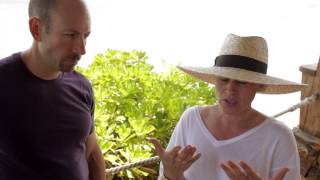
A short YouTube interview (recorded on Necker Island) in which Joe Polish interviews Patricia Arquette about her humanitarian work through GIVELOVE in Haiti. Patricia explains the program’s focus on eco-sanitation (pilot school projects, tent-camp work, and Habitat for Humanity household models), describes sanitation’s health and environmental impacts (parasites, diarrhea, cholera outbreaks, water pollution, deforestation/compost benefits), and asks viewers to visit www.givelove.org or contribute skills/funding to scale treatment-focused sanitation solutions.
Questions this video answers
80% (as stated in the transcript).
Sickened 500,000 people and killed more than 8,500 people (as stated in the transcript).
www.givelove.org
Chapters
Hello, this is Joe Polish. I'm here with the wonderful Patricia Arquette, and we're in a windy area overlooking the beautiful ocean on Necker Island, Richard Branson's private island. And we've been here for about a week, brainstorming, talking about doing amazing stuff in the world. And I wanted to share with you all of the cool things that Patricia is doing. She's most well known for being an incredible actress. However, there's a lot of humanitarian things that she is doing that are very complex, that a lot of people are not dealing with, and she has really helped reduce a lot of suffering for a lot of people, and she's really doing some incredible stuff. So I want to ask you some questions about it. So first off, thanks for doing this short interview, and let's. Let's share with our viewers and our listeners kind of what you're up to, and people know you for being an actress. What are things that people would probably be surprised to know that you don't know what you do that you're actually doing, that you've been up to for a while now.
I spent quite a bit of time in Haiti. We have done several projects, but our main focus at this point is eco sanitation, because most people don't know the lack of sanitation kills more children worldwide than aids, malaria, and tuberculosis combined. And it's the number one pollutant in water. So we started really focusing. We did a lot of work in tent camps. We built some dormitories and orphanages and some school programs. And we started to hone in on sanitation because we saw the enormous need for it in parts of Haiti. Much of Haiti, 80% of the population, has no sanitation, and that's replicated in lots of the world, in the poorest areas of the world. So we started working on these projects, and we have several pilot projects with schools, a little tent camp, school, and also we just are scaling up the Habitat for Humanity project, which is household models.
So how did you get involved in this? Why did you choose that as an area of focus?
Because when we were down there, we saw the real need for sanitation. I never thought I was going to have to know anything about sanitation, but you sort of have to pivot and shift the greatest need and what's the greatest need that's not being addressed? And how could you really help ease that burden? So for us, we started working on that. I was fortunate enough to bring in a bunch of experts who volunteered their time and came down and we ran our first tests, and they were really successful. And it was very exciting results. And now to be here is such a blessing because to meet with all of these great business minds and get all this input, because the truth is, in scaling up projects like this, that will be the most effective for humanity. We need business minds. It's not enough to just be a boots on the ground person or come from a heart or be willing to do the work. We really need these business minds to help make it scalable.
So although you're focusing the majority of your efforts on Haiti, even the whole concept of sanitation, I mean, this is a worldwide problem. And it's kind of funny, you probably learn things along the way of why I wasn't aware of this. So what are some fundamental statistics, things related to sanitation that most people would never even think of, that have such a huge impact on disease and death and suffering and just progress in general? Everything from, you know, I mean, starting in the womb with birth defects and just malnutrition and just disease. What are some things that would make most people be like, why? No idea.
Right. Well, for instance, one, the Napoli's UN unit came to Haiti, and they were there to try to help people, but they were not treating their sewage, so they were dumping it into the river. And what happened was they unwittingly brought cholera to Haiti. And since that one treated, untreated toilet has infected that river, it's sickened 500,000 people and has killed more than 8,500 people. And right now, during the rainy season, it will bloom again and it will be there for decades, sickening and killing people. So you can look just at that one model. What happens if you have disease in one toilet that gets into a water source? And all these children, also in these poorest areas, have malnutrition, and they have parasites from the lack of sewage treatment. And the little food they get gets first absorbed by these parasites in their bodies. They have massive bouts of diarrhe. Five or more heavy bouts of diarrhea before you're five lowers your IQ level. It drops productivity for women because they're home with their children who are sick. It's a very different kind of way to live. But sanitation is the number one pollutant to water. So when your roof's leaking, you don't just say, I'm going to patch my ceiling. Oh, my God, my ceiling's leaking, and I'm patching my ceiling. You work on your roof. If we want to have clean water, we must remove the number one pollutant. And with our program, you end up with the End product that is compost, high nitrogen compost that can be used to reforest. And much of these areas get deforested because what do you have that you can sell? I have all this wood. I'm going to cut down all this wood. And then you lose your topsoil, you compromise your water table and now you can't grow anything yet. You have to put nutrients back in the ground and as a whole world to grow vegetables. We're all mining certain minerals, but in the next 30 years, that's a scarce, depletable resource. So we have to look at how do we feed the earth now to make sure that that's not an issue in the future. And the great thing about our program I feel very strongly about is that we're looking at multiple system breakdowns in these poor areas. And our system addresses multiple systems without causing more injury. It actually helps many problem.
So talk about how they find out more information about your program, how to get involved, what they should look at, read, see. I mean, I know you've said many times physically being there, you can't show it on a video or explain it and have anywhere near the full effect of physically being on the ground, building tents, doing all of the things that you do. And you're not down there just as an observer, you're an active participant, building, driving, going everywhere, dealing with insane conditions, void of someone being there. What could they start reading, looking at, watching to get more information about this and see if it resonates with them.
We have a website, www.givelove.org so you can look at some of that. We have some videos on YouTube with our work in Haiti where you can see people. Because also it's a very trainable program. It's not just most sanitation programs, if there are any, they're usually pit latrines and they leak or what they call flying toilets most of the world use, which is just a plastic bag that they thr flying toilet, leaking pit latrines then go into the water table and then that lady's drinking it and then that kid's drinking it and then they get the parasite again. So most sanitation systems in the poorest part of the world are just collection systems. They're not treatment systems. And ours is both of those part of the things. Of course, obviously getting your message out, getting awareness, getting people to give a shit about what the hell's happening in the world, but also creating brain trust and the agricultural department and testing the compost and what's the ideal crops and business people to help make the system as affordable as possible. How do you scale this up? All of those things are useful. We're very few people. We're lean and we're mean, and we don't have certain skill sets like getting the message out there and videotaping and all of these kind of things and blogging and all of that stuff. So all of that useful. Great skill sets are useful also.
Well, and the purpose of this video, of course, is just one way to capture the message and share this. So I would really love if you share this video, post it anywhere, social media, just share it so other people can watch it. Me living in America, and a lot of people that may have this mindset of, well, there's plenty of issues to deal with in America. Why should we care about this one? How does this. Why should someone care about something that's not in their own country, their own hometown?
Well, I'm never gonna try to talk someone out of helping other people in America. So if you're helping people in America, that's great. Thank God for that. But I've come back from Haiti before, filthy, dirty, covered with dust right after the earthquake, and been able to go into a bathroom in America, in the airport in Miami, and flip on, the light is on. There's a light in here. I washed my hands, I went to the bathroom, I flushed the toilet. I could have Dr. The water out of that sink and not gotten sick. The level of poverty, and poverty is really radically skewed. I mean, I've spoken to women in 10 camps who are like, I have these three kids. This one eats on Monday, that one eats on Tuesday, that one eats on Wednesday, and this one eats again on Thursday. And that's business as usual for much of the world. And in the next 20 years, half our world will be living in mega slums. More people have cell phones and have toilet systems. It's so radically different, and the impact is so humongous. We really can't imagine in our wildest dreams what it's like to live with this extreme level of poverty.
Yeah. And, I mean, even the people here that we brought together for this genius network, the mastermind group, they're all working on various things, from homelessness in America to poverty disease, to climate issues to entrepreneurism. There's a whole gamut of things that people work on. And I think everyone gets a reward psychologically, in many other ways, just by helping. And I've always believed that from a karmic standpoint, life gives to the giver and takes from the taker. What do you get out of doing this? There's a lot of things that you could spend your time on, and you spend an enormous amount of time on this, and I think it's awesome. And I know, you know, having spent many hours this week talking about it, your eyes light up when you talk about helping these people. What do you get out of it? And the reason I'm asking you this is I want, as much as it can be conveyed on camera, for people to kind of take in what they can get out of this and experience by helping people.
It's really hard to convey how someone else is going to feel the impact from it, from not being there, I guess. But for me, when I went there and started work was very difficult to work in that environment. It's very different than working in America. Anything you need, you may not be able to find in any store. And you might have to go hours and days running around town looking for things. But when I would look at the kids, they just opened me up. When I met the mothers and saw their kids suffering, and when an old woman picks you up when you come onto a site, oh, I love you. I love my toilet. I love my toilet. I love my toilet. You're like, oh, my gosh, how do I stop doing this? You look into a kid's eyes and you know, if you don't do it, guess what? Nobody's gonna do it. There is no. We live in this bubble, and it's really a mirage that these big aid groups and all these governments are doing this work. It's not happening. That's the truth. It is not happening. And when you're there, you be so cowardly to turn around and say, oh, this is fine. Let me get back to my life. Good luck to you all, and sorry you're gonna die soon, but see you later. Like, you love these kids, and they're the sweetest creatures on Earth, and you just go, I love you, baby. I can't stop working for you.
You know, one of the things that I learned early on when I would ever get into a bad place psychologically, and I've certainly had many times in my life where I've been in bad places. Mere act of, you know, volunteering for something. You know, I tell people all the time, if you ever get into, like, a really depressed state, to whatever degree, you can go volunteer at a children's hospital, an AIDS clinic, a burn clinic, you know, elderly home, and just spend time with people that are lonely, that, you know are in need. You know, I mean, there's a certain level of human bonding that takes place even in situations where there's misery. And the fact is, you know, it's not going to fix itself. It needs people to step up. And there are so many things that are happening in the world that, you know, the more people that can just step into it, you can save lives, you can make people happier. You may not be able to eliminate suffering, you can certainly reduce it. So the question I always like to ask, if you could wave a magic wand and anyone watching this, get them to do anything, persuade them, suggest them to do something, be it, offer support to your organization, any form of need, what would you say that is?
I think it would be the things that I said before. Even if you had a specific skill set that you could really contribute or financially, I mean, we're constant. It takes so much time to figure out fundraising and there's so few of us. And to focus on that sucks up so much time. And it would really be great to be able to focus on the work on the ground and not so much on trying to do that.
Awesome.
So give your website one more time, www.givelove.org.
Awesome. And maybe a future interview with Patricia will be on acting classes and how to be funny and all those things, which you are. I think what you're doing is so important. And having spent a week with you, it is just such an honorable thing that you're doing. And I know you're a mother. And so parenting advice, let's end with that. So what sort of parenting advice do you have? Because I know you have some good philosophies on loving your kids, allowing them, you know, a way to just excel as human beings.
Well, two things came to mind. One was when I was having my second child, I was worried that I wasn't going to love this second child as much as I love my first child. So I loved my first child so much, and everyone laughed at me and said, of course you're going to love your second kid as much. But really, it was a little fear I had in my mind. And of course, I did end up adoring her and loving her just as much. But at the time, someone said, I have five kids, kids, and this one is nothing like this one. So your parenting techniques, you almost have to be a linguist. You can't be so rigid. This is the way we always do things. This is how we do things. Because you may lose your child's spirit, magic, their drive, their road. They're supposed to be on, which is really different than this other kids road. So I think it's important to let them each be their own individuals and to know it's a learning process and to let them know, hey, I'm human. Sometimes I make mistakes, but I love you and let's work through this next thing. Or maybe I need to say I'm sorry. I think it's okay for parents to be human and say we're a family and we're working through these things together.
So thanks for watching this. Thanks for sharing. Patricia and I would just request that if you took the time to watch this, which you have, and you wouldn't be hearing this right now, think of one action that you could take. If this doesn't resonate with you, that's fine. Just think of one action you can take that this may be inspired. Got you to think about how you can literally, you are powerful. All people are powerful. Not thinking about being powerful, not knowing about something, but actually taking action on it. So what is one action that you can take? And maybe this is thinking of who you could actually share this video with. Maybe this is going to Patricia's website. Maybe this is doing your own thing. But let's do whatever we can and make something happen. So thank you so much.
Best.
More from Joe

This FBI Trick Can Command Respect Without Saying a Word ft. JEFFERSON FISHER & CHRIS VOSS

How To Stand Out, Be Different, and Create Raving Fans, Customers, and Employees ft. Jesse Cole



90% Of Businesses Fail In Their First Year, Here's Why! ft. Dr. Benjamin Hard & Dr. Robert Cialdini

The 1 Piece of Business Advice I Got From Elon Musk That Changed Everything Ft. Kamal Ravikant

The 6 Traits You CAN'T Teach in Entrepreneurship ft. Richard Branson & Gino Wickman

The Leg Method: How to Make Your Book into a Million-Dollar Asset ft. Anna David


7 Millionaire Mindset Hacks for Daily Success and Wealth ft. Brian Tracy & Dan Sullivan
