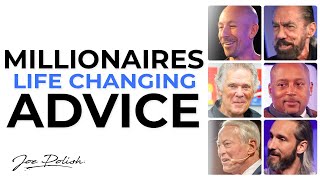
This YouTube panel (hosted/uploaded by Joe Polish) gathers several successful entrepreneurs — Keith Cunningham, Patrick Bet-David, Brian Tracy, Garrett Gunderson, John Paul DeJoria — to give concise, actionable business advice. Key themes in this chunk: Cunningham contrasts product obsession with building a business via structure and leverage; Bet-David describes a staged talent model (prove yourself → paid contributor → partner); Gunderson emphasizes turning assets into cash flow and measuring velocity; DeJoria recounts starting John Paul Mitchell Systems with $700 and creating a culture where employees take on multiple roles and care; Tracy argues that thinking (and remaining calm) is the highest-value work, and warns against constant digital distraction. The host intersperses promotional CTAs for a free book.
Chapters
You name me any product or service. I don't care what it is. Give me one week. You could say chewing gum, shoelaces, seminars, pins, socks. Name me any product or service. Give me one week, and in one week I'll come back and name you one person who's made millions. 100 people that have gone broke with the exact same idea. The problem is, as entrepreneurs, we become obsessed with the product. We become obsessed with either the quality. And I'm not opposed to great products. That's not the message. The message is, what is it as a business person, what is it that we're focused on? The artist side of me wants to focus on the product and making it better and longer lasting and prettier and more robust. And I'm good with that. We need artists. The operator side of me wants to get busy and get a bunch of stuff done. I just, I got so much to do and holy cow, if it's going to get done, I'm going to have to do it myself because I don't know how to hire a team or keep a team or have a players or create a culture. I don't know any of that. I just got a lot to do. That's the operator side. The business person side says, wait a minute. The job is not to react to the problem du jour. What I need to do is leverage and structure. Write those two words down. That's the difference between a solopreneur and one person army. A solopreneur and a business owner. A business owner has mastered two things, structure and leverage. And without structure and leverage, there is not a way to create a sustainably successful business.
You know, when I speak, I can only speak off of my experiences and what's worked best for me so people can't object. What I've learned about in talent is, first of all, I don't pay a high price for talent coming aboard. I want people who are willing to bust their butt and prove themselves. And I think we both then are a little uncomfortable. And this is how I structure it with anybody in my company. Number one, you have an obligation to the team that you must do, and this is in your silo. Number two is if you are able to contribute to part of the team, there is some form of compensation, a percentage or whatever the case is. And number three, if you do well enough, we will start this business together and we will be partners. Now why do I do that? Number one, you have to have a dedication to something. Number two, you have to show that you're A team player, but you compensated. And number three is great. People are very hard to keep. And sooner or later, they will either leave and be your competition or they will just leave or they will be such a large cost. So if you make them a partner here, you basically take them off the market. You increase your margin and your revenue. They start teaching everybody else down the line, and it becomes a pyramid and domino effect. And that's the way that I've always run my business.
Okay, cool, cool.
So our entire game is this. We look at people's assets and we say, are there ways to accelerate cash flow with your assets? Any asset not producing cash flow, meaning the assets not producing income, is a dead or lazy asset. Then we help them manage liabilities. Liabilities are what create your expenses. Most people think you have to eliminate liabilities, but liabilities, employees are liabilities on your balance sheet. But the reality is, if you have a good employee, they're actually an asset. Yes. So it has to be training the eye to see the unseen, to measure the greater productive nature. So if people are only focused on accumulation, they're just looking at is their balance sheet going up. But if that balance sheet is going up, but they never learn how to turn it into cash flow. This is why retirement sucks for so many people. The number one fear of retirees, according to USA Today, is the fear of running out of money. Because their entire life, let's say, they had a business, they earn money with that business. Now they sell the business, they don't know how the hell to manage that money. That was never a skill that they figured out as an entrepreneur. Now they have to go put it in something other than their business. Are they gonna be an expert at that? Is our interest rates gonna cooperate? Is inflation gonna do what they hope it does? And the whole time they were saving money in a retirement plan, it was never cash flowing.
So that's.
That's backwards. I want people to cash flow with every asset that they possibly can, and so they can measure how effective it is versus the expense that's against it. And if it's providing cash flow, I call that turning on velocity, where you're keeping your money in motion. So I think of, like, the balance sheet, like muscles, they're critical. You know, net worth is important, but if you have no blood flow in your body, what good does your muscle do?
Right?
And so cash flow is like the blood flow. And that's why they say cash flow is king. Because you can die and go bankrupt without cash flow. But net worth, you can have zero net worth. But if you had a licensing agreement that paid you a million dollars a year, would you rather have that or would you rather have $5 million with a 10, $10,000 of cash flow a year, or 20,000 or 50,000 or even 100,000 for that matter? The game is cash flow. And once you get where you have your expenses covered from that cash flow that's coming in from your assets, every dollar you earn can build more assets and create more cash flow, which is the most unfair advantage I know in finance.
Hey, I hope you're enjoying this video. And I want to let you know that I have a new book that's come out, and if you'd like to get it absolutely free, there's a link below in the description. Or you can wait till the end of this video, or you can Simply go to joesfreebook.com and you can get.
A copy there.
By accident. One of the biggest business things that I ever learned was I started John Paul Mitchell Systems with $700. The business partner I started with was a top hairdresser, but he didn't do business. I didn't do hair. So we had no money. No money, okay? So I did 10 or 15 things. After six months, we were able to hire our first employee. Shirley Wong was her name. I gave Shirley 10 jobs and said, I hope you could do them, Shirley. Whatever you can do, honey, I'll figure out how to help you. Shirley learned how to do 10 jobs. Not one, but 10. Then I realized, wow, it's not just the person that started to cut me through necessity, but people do a heck of a lot more than what people say you should be doing. We're all capable of that. So that point forward, I paid people very well, but gave them the opportunity to do more than. This is just your job. This is just your job. Now that might be anti union. Okay, no disrespect to the unions, okay, no disrespect. But when one has the ability to do whatever they can do that they want to do, I'll give you the end result. Four months ago, I'm in my office. I fly from Austin to la, had to do some work. My staff closes up at 4:30. Some come in at different hours in the morning to miss traffic. So by 5:30, I'm there to hear something in the office. So I go back there and there's a couple girls working, a couple guys who said, what are you doing here? Hey, it's an hour, two hours after we close. What are you doing Here. They said, jp, we love working here and we wanted to finish these little projects. I said, how many people are here? They said, I don't know. Hey, who's here? JP's here. 12 people came out with the same exact thing. JP, we just want to be here. We know we don't have to be here. We're not paid for this. We want to be here. We love what we're doing jp, we just want to finish this. You know, they didn't want to leave. Well, needless to say, we all went out for a really good dinner and a couple great bottles of wine and a little bit of good tequila too. Anyways, we were a team. But when people feel good and respected and you give them the ability to do more than this is just what the job is. You'd be amazed at how they expand their business for our size company. Take John Paul Mitchell Systems. I should be in the thousands with employees. John Paul Mitchell Systems alone. Now this includes the warehouse has 300 employees. That's it for the world. Now we have about 800 part time but 300 full time employees for the world. Petrona has a lot more because hand bottles blown out of recycled glass. We have a lot of labor intensive there but you can't have fewer moving parts. But my people do, my family, they do more. More than three times that many people because they love what they're doing and who they do it for. Very important.
Over the years I've done a good deal of reading and I came across a concept that I want to share with you. And we were talking about this a little bit earlier and the concept is the question is what is the most valuable and highest paid work that you do? It's a really interesting question because when I heard the question, I didn't know what the answer was. What do you think the highest paid and most valuable work is that you do? And the answer is thinking. Thinking is the most valuable work. Now I am the best selling author in the world in time management. Also on goals, also on some other subjects. But I began studying time management about 30 years ago and I came across a word, you know, in my studies and the word was consequences. And what it basically said is that something is important if it has big potential consequences and something is unimportant if it has low or no potential consequences. Number one reason for success is people focus on things that have high potential consequences. Number one reason for failure is people focus on things that have low or no potential consequences. Exactly what Joe was saying earlier that the famous Drucker quote, very worst use of time is to work intently on something that need not be done at all. And one of the things that is holding back entrepreneurs, business owners, is killing them, by the way, and it's wiping out an entire generation. It's this obsession with technology. I see people that are walking with their phone. It's almost like drug addicts that are mainlined. They cannot stop staring at their screen. They cannot stop pushing their buttons. I hate to say there are people in this room that had that problem, but the fact is that this obsession with looking at the screen and staying connected is killing people because it stops them from focusing. You cannot focus if you are distracted, like an attention deficit disorder dog. So you're constantly ringing and responding to bells, almost like a crazy person in a toy factory. And so, just as a quick aside, if thinking is the most important thing you do because of the consequences of thinking determine the entire quality of your life, then the quality of your thinking determines the quality of your life. And so the more time that you spend thinking and thinking well and thinking clearly, the more successful you are. Over the years, I've worked with some very powerful people, billionaires and multi billionaires, people who are on the Forbes 400 list repeatedly, over and over. And I've had a chance to be with them during crises and times where something was happening that was serious, it was a major problem. And I noticed that they all had one quality in common, is they all went calm. It's just they went calm. People around them were angry and upset and worried about what happened and who did it and so on. And they would just go calm, almost like a pawn would go calm. And they knew. And I learned later, I didn't know why this was. I admired it, but I didn't know why it was. Is that when your mind is calm, your entire cerebellum, the thinking and deciding brain, functions at its highest level. Like turning up all the lights on a dimmer switch, it's functioning like a Christmas tree. But when you get upset and angry, what happens is your thinking reverts to your limbic or emotional system, and your ability to think clearly diminishes dramatically. And you make a lot of mistakes. That's why when you are facing a difficult situation, you have to use every skill, trick, game, whatever it is, stay calm. And that's why they teach you to meditate. And they find that meditators in business are far more successful because they can automatically trigger their mind into the calm of meditation when they're facing crisis. It enables them to think. Okay.
I hope you found that video awesome and useful. So if you want to get a free copy of my book, I want you to click here. And if you want to watch some more videos that will be useful and awesome, click here.