Transforming Poop Into Purpose: A Conversation with Suzy Batiz at Joe Polish's Genius Network
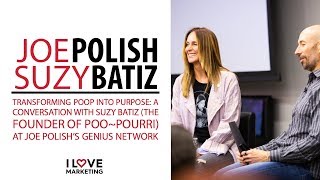
Suzy Batiz built Poo Pourri from a nine-month product idea into a $700 million company that's sold over 60 million bottles. She credits her success to surviving poverty, abuse, and two bankruptcies before a spiritual shift led her to the concept: oils floating on water. The interview covers resilience, radical honesty in business, and choosing work that feels alive.
Questions this video answers
2001; she was 38 years old.
"Over 60 million bottles" (stated in the interview).
Joe Polish references the company as "worth over $500 million"; Suzy later says "more like $700 million."
About 13 years (she says "I've been doing this for 13 years").
About nine months of mixing and testing before launching (she describes nine months of experimentation).
Chapters
This interview is going to be unique. The reason it's going to be unique is our special guest is very unique. She thinks uniquely, she acts uniquely, and her results are very unique. Plus, she likes tackling taboo topics and reshaping some of what society calls normal. Let me give you a few facts to prove how unique Suzy Batiste is and why I'm so excited for you to be able to meet her, hear her, and most of all, learn her amazing experiences as an entrepreneur. Here are some of her life's low points in her journey. Poverty, sexual and domestic abuse, depression, attempted suicide, two bankruptcies. And as you heard that list, just one of those life events is enough to bring any one of us in this room to our knees. How would you respond if all of those happened to you? Fortunately for us, none of those stop. Susie. Now, here are just a few of the highs from her life. Finding spiritual awareness, Achieving internal happiness. Being featured in Forbes, Fast Company, and cnbc. Starting a business without a single investor, without borrowing a single dollar. Growing that business to be debt free. Oh, and by the way, that business is worth over $500 million right now. And that was the company that you just saw one of the commercials. So please help me welcome my friend, Susie Batist. So awesome. So awesome. I'll have you do that one here. And here's some water for you. Yep. Thank you. Thank you. All right, so we've got. Let me got some poo pourri here we got for everyone in the room so you can try it out.
I need this shoe spray. I didn't wear deodorant this morning. And actually you can wear this as deodorant.
Really? Wow, this is great. That's awesome.
There we go.
No, thank you. Thank you. And so you've given everyone samples here too. So the shoe odor eliminator. And there's this great little card here that says I'm so thrilled to have the opportunity to share my story and encourage others to dive into their live ideas at Genius Network. I hope you enjoy the latest from Poo Pourri and my new love child, Supernatural. Get excited to clean your home. And conscious with our high vibrational cleaning concentrates. In an effort to practice conscious shipping, we love to send Supernatural directly to your home. And then you can please email and it gives an email address to receive a complimentary starter kit. Get ready to experience the new realm of cleaning that in and of itself, dive into what turns you on. And then Suzy Batiz. I mean, this is just really. It's the little. It's the attention to detail. It's awesome.
Thank you.
Yeah. And our friend JP Sears introduced us, and he's a rock star, and so. And we totally hit it off. And you're awesome. So I. Really.
Amazing.
Yeah. So great to have you here. So let's talk about some cool shit.
Great to be here, actually. It's fun. I actually feel a little nervous. I speak to really big groups, and I was like, this is a group of geniuses. This is different.
Yeah. How often do you speak?
Probably two or three times a month.
Yeah.
Actually, JP's my coach. He's my heart coach. So what I realized is people wanted me to talk, and I didn't. I'm just telling my story, and I really felt like. I don't know if we can say curse words here. Are we okay? Yeah. So I felt like I was masturbating on stage. It was like, oh, look how wonderful I am. And what I realized is that I didn't feel like I was giving anything. And so I've been coaching with JP for a couple years, just getting into my heart and trying to find out, like, what can I authentically give and what do I want to share from that place? He's a great heart guy.
He's super cool. And it's.
People think he's just funny.
Right. And what they don't realize is he spent years literally coaching people with traumas and with just very difficult situations. And within that, he actually found this ability that he has, which is really kind of a setup just to connect to people.
Yeah.
Yeah.
He's amazing.
Yeah. Awesome. So obviously, we're going to start with talking about your business, and we'll get into whatever you want to talk about. And if there's time, we'll do a little bit of Q and A with the. With the audience. And just remember, there's no such thing as a stupid question. There's a stupid, stupid people that ask questions. So this thing, let's. I mean, you told me the story, but I'd love everyone here to know, how did you come up with the idea for Poo Pourri?
Yeah, so I came up with the idea for Poo Pourri. I'll take you back just a little bit. I filed my second bankruptcy in 2001. I was 38, and I really swore off business. It was like, I thought business was it. Because the way I did business overrode, you know, sold out, pushed it, did all the stuff you're supposed to do. And then at the bankruptcy, I realized that I often say, what's worse Than losing everything is losing everything and realizing you didn't have a good time, you know? So I was burnt out, went on spiritual sabbatical and became happy inside myself for the first time in my life. And I really didn't want business. I made business the bad guy. And I'd been a serial entrepreneur all my life. And I was at a dinner party with my brother in law and he asked a question. He said, can bathroom odor be trapped? We were talking about a small bathroom and I remember feeling like this little like zing up my arm and feeling like I felt alive. And I was like, I can do that. You said, what are you talking about? And I was like, I work with oils. And I just saw it like oil floats on water. And I knew everything in me knew I could do this, but I still didn't think about it as a business. I just for nine months was mixing and stirring and traumatizing everybody. Nobody thought it was a good idea. I'm not joking. When people would come over for dinner, they would be like, I'd be like, do you got to go to the bathroom? And they'd say, yeah. And I'd be like, number one or number two? And they would just look at me really weird. Why? And I'd say, because I'm making a bathroom freshener. And they would all just kind of look at me like, you were completely nuts. Yup. So that took about nine months. And then one day, my husband was a tester and he pooped three times a day, which was amazing. Yeah, yeah, yeah. And he came out one day, he was really, like tired of all the oils everywhere because it really was in my kitchen. And he came out one day and he just stood at the doorway and he goes, oh, my God, we're going to be millionaires. And I said, what do you mean? He goes, do you realize what you've done? You've taken the smell out of shit, like that's what you've done. And I was like, it works. Yeah. So then what happened after that was just like, I sent it to friends because I thought it was in denial. Right. Okay. Am I just crazy? I think this works. They were all like, oh, my God, best thing I've ever seen. So I brought it to market not because I wanted to be in business. I never even had a dream I would be where I am right now, but because it was so good, I had to share it with the world.
Yeah.
And that's it.
Yeah. Which is awesome. Look, the fact that you even just that entrepreneurial mind of taking on this shit and, yeah, trying to insert something to be funny, but it wasn't that good. If I had to critique myself there, it was just kind of a lame thing.
That's even worse when that happens.
But I'll tell you, the conversations we've had, you just know how to identify things that the marketplace needs, and then you put the energy and the resources together to deliver those. So, I mean, in a lot of ways, you're looking for, you know, you're looking for something that is needed, especially in an area where you had no competitors. I mean, this is like a. It's funny. You tell them the story of the test market, you know, oh, you're looking for people that can validate this sort of thing. I mean, it would have been hysterical to have been a fly on the wall in those conversations.
Well, you know, you would think it would be funny, but I made it funny because of the way people looked at me. I mean, no one wanted to talk about it. There was not a single person in my life thought it was a good idea. So that's what I often say is when you have an alive idea, like, it doesn't matter if anybody thinks it's good. Right. If you have enough compelling energy within you, then I always say, almost put your blinders on. Don't ask anybody if it's a good idea. I believe the opposite, because everybody so what. I knew because of their reaction, I knew I had to make it funny. When I started telling jokes about it and they sort of leaned in and they were a little bit open. So people ask me, well, how'd you do humor? And I'm like, well, I had to, right? Nobody wanted to talk about poop at all.
Do you ever get sick of talking about this or do you still find it just amusing as hell because of the reactions of people?
Yeah, I find it amusing because I still, still. I just pinch myself every day, you know, I just. Yeah. And I feel really. I get like. I feel blessed.
Yeah, yeah. Which is awesome. Awesome.
So I love talking about it. This is such a blessing.
I want to cover some of the entrepreneurial principles and things you've done because clearly you're in a room of entrepreneurs and they would love to hear, how did you build this into this multi hundred million dollar company? But let's go back to you. What was your life like growing up, your upbringing?
Oh, wow. So my life was. I grew up in. I grew up poor from what today's standards are. You know, the wonderful thing about growing up without any money Is that I knew I could make things. So for me, I never thought about buying things. I just made everything I needed. So that was one great thing that came up. But I grew up in a situation where my dad was a bipolar alcoholic. My mother was addicted to pain pills, and my dad was very violent and verbally abusive to my mother. They got divorced when I was 10. I was molested by my stepfather at 12 and left the home when I was 18. And I actually started my first business, and I got married, too. So by the time I was 20, I was married, bankrupt, and divorced by 20 years old. Okay. I mean, that was like, whoa. And then when I was 21, tried to kill myself and 23 in an abusive marriage. So most of my life was literally, you know how, like, you go skiing and you lose a ski at the top of the mountain? That was most of my life just tumbling downhill, being, I thought, at the mercy of life, Right. I was just like, shit, man. If I can just get a grip, if I can just do something. So I was really fighting and clawing my entire life just to just to make money to survive. You know, they always talk about thriving versus surviving. And when you're in that situation, you're like, yeah, sure, I want to thrive, but are you kidding me? Like, I just want to keep my head above water right now. So that was my life. And I got that final pause when I filed bankruptcy the second time, and I really gave up. I wanted to kill myself again. But because I had children and family, I wasn't going to do that. But I was done.
So, I mean, looking back, what are the lessons that you think that came out of all of that?
Yeah, really resiliency. I'm extremely resilient. Also really strong. My friend Marie Forleo talks about a figure outer muscle. Like, I developed the strongest figure outer muscle. Like, put me in a situation, dude. Like, I can figure it out, right? So that was really good. Anytime I hear anyone, as a matter of fact, with a tough life, I look at them and I'm like, okay, this is great. They're resilient. They can figure it out. There's some strength and courage. Courage in there, Right. Just to face the next day takes every ounce of courage you can believe. So if you can actually harness all of those skills, get out of the trauma a little bit, get a breath from the trauma and harness that, it's incredible. Rocket fuel.
You're absolutely right.
With a tough life.
Yeah. Because, you know, I mean, I even say with someone who's an addict, who is functional addict, depending on how someone wants to determine that, meaning the ability to do things and still be an addict as an example or a criminal, or just someone that has had so much shit they're dealing with in painful levels. It requires an enormous amount of ingenuity and resourcefulness to be a good addict, you know, in order to lie, cheat and steal in certain ways. You know, it requires some coordination. And like what you said, if you can harness it, though, And I think successful entrepreneurs, so much of it I see more the really successful ones financially and really accomplish a lot. Most of them are not inspired individuals. Most of it came from adversity and just difficulty. But they have somehow managed to parlay that into pain, into progress, pain into productivity. And so it's interesting and that's. I always like trying to figure out how did it, you know, what flipped the switch. You know, when you have failure, you have failure. Suicidal. When you, you come from such a background, how can you convey that in a way to somebody to where they can say, oh, I can learn from that? Because everyone's going to learn from their experiences to a degree. And when I say learn, it doesn't mean they'll actually do anything with it. They're going to get hit with it. But to be able to. A real genius is learning from the experiences of others that are painful without having to go through per se, that thing. Although everyone goes through their own pain, everyone has their own shit. I mean, there's no one out there, you know, if you like someone or dislike a successful person, what you cannot take away from them is they. It didn't just fall in their lap. Everybody. You know. What was the Marie Folios thing again?
Figureouterable figure outer. Yeah, figure outer muscle or something. Figureoutable. I think that's her things. I always called it a figure outer muscle before I met her. That was one of our connections.
Yeah, yeah.
I'm like, oh my God. I always said I had a strong figure outer muscle because you get yourself in enough shit and you figure it out, right? It's like, I can figure it out. What I do in my company is I teach my employees how to figure it out. There's so many solutions, so many easy solutions I come up with, you know, they'll be in a big problem and I'll say, you know what? I know what to do. I really do. I'm going to walk out of the room. I'm going to give you guys an hour to figure it out. Right? Figure it out. Because what happens Is if I keep solving the problems, my muscle's getting stronger, but theirs isn't. And I want them to develop that same muscle.
Well, it's funny is that we never even discussed this, but I've known Marie Foglio for years.
Really?
The very first seminar she ever went to, we were at together because Eben Pagan invited her. And we sat next to each other and just told each other dirty jokes and wrote really crude things on paper. Just pass it back and forth for like three days straight. It was hysterical. Yeah, she's great. What's your perspective on business? And how would you define this word success that everyone throws around?
Yeah. Wow. So how would I define business? That was the question.
Yeah. Or perspective on business. And how would you define success?
Yeah, my perspective on business, for me, I use business as a creative exploration. It's a creativity. It's not what I am or who I am. Even though I'm known as an entrepreneur, to me it's just an outlet for creative expression. I have an idea. What turns me on is having an idea and manifesting it in the physical world. So I have an idea and I'm like, oh, this would be great. Let's make it into a product and then let's share it. That's marketing. Right. And I really look at business and like Poo Pourri, I call her a living, dynamic organism. So we do marketing a little bit backwards. We don't have a target consumer.
Why isn't a she versus a he Poo Pourri?
Well, that's just where she was. She was a woman. I mean, it was just very clear to me.
So women do poop.
Women poop.
Yeah.
But, you know, so what it is, is we talk about, everyone in our company knows women. What she would do at any moment, what she would say, how she would act, whether she. So that helps keep decision making. Almost like in a holacracy environment where people would know, oh, Poo Pourri would never do that. Poo Pourri would. So we look at the brand as an energy within itself.
I mean, what you're saying and doing right now is so interesting. I mean, does that strike you as kind of interesting, what you just said? Yeah. Like what a. A unique and very smart and strategic way to interact with your company because it gives a whole nother life to it. And it's so funny because it's poopery. Right. But I really like what you're saying. I mean, it's the whole thing about energy. Yeah. Because, you know, even when people say time management, because One of my questions for you is that. But it's really energy management. It's energy management and it's how you. I mean, it's like time management. Well, you know, everyone here has got the same 24 hour franchise as everyone else. And they're going to eat and they're going to have meals, they're going to have commute time, they're going to have bathroom time, they're going to have sleep. You know, everyone's got these things, but it's what they do within it in that energy and how they contain it and what they generate. Because I don't think success just happens. You generate it, you create it.
Yes, well, actually, so I had a conversation a few years ago with Dr. Bruce Lipton because I had this theory that ideas are alive. And I called him and I said, are ideas alive? And he said, why do you ask? And I said, because it seems to me the ideas that are alive within my being and my body, man, I get excited and I feel like a physical sensation. Those seem to work out more than the ones that I create with my strategic mind because that's what someone told me I should do. And he said it was a great question. And he said everything's alive, everything's an energetic vibration. So. And then he taught me about resonance and dissonance. Are you guys familiar with resonance and dissonance? So resonance is when you take two energy waves and you put them together and they're both traveling at the same speed and the same height. Those two together create more energy together than they do apart. So imagine that you with the amazing idea, create more energy together. Right. Than you do apart. So I'm going to get back to your question because this is so fun. Dissonance is when you take two energy waves and they're traveling at different speed speeds and different wavelengths. Those create less energy than they do together. That's the reason that job's killing me. My relationship, whatever, it's literally draining your life force energy. So what's really fun about this is I started thinking about resonance and these alive ideas. So if an idea is alive, it's a living, energetic vibration. So what I'm talking about, a business being alive is not far fetched. So you put that with me. Those two together create more energy. So what I'm doing as a business person is I'm looking and censoring and sort of going, where are the alive ideas? I'm reading the room.
Yeah, you know, that's awesome. I got to show you this tool. We haven't done it in a couple of years here, but I created a tool for genius network called anatomy of a successful business. And it shows like a human body. Just like a doctor would point, you know, the brain, the heart, the nervous system, the muscles, the skeletal structure, the lungs, the stomach. And I have lines where it's like, go and fill up all of the different areas of a business. What you think. And it's funny because some people will put the heart is the marketing or the marketing is the brain, or the people are the heart or the lungs happen to be the finance. And it's interesting because everybody has a different perspective on how they think of what the anatomy of a successful business. Because if you look at the anatomy of a successful human, it's all these different parts that are working together, which is why health is so important to have a healthy organism. But when I have people do it in business, it's so interesting to see the different ways people would frame a business like they would a body. Yeah. And you're giving me a whole different meaning of this now, like thinking, wow, based on what you said, it's a whole different way to interact with that. But the whole point is I want people to feel like, yeah, how do you make something more alive?
Yeah. And what I love about this when you talk about success. So the way I define success is my child, my business, happy, healthy, and are they thriving? And they are. Right. I mean, it's so amazing. Whenever I have people come to me and they ask about should I get investment or whatever. And I really have them feel into with each investor, like you're going into a relationship. It's not about money. There's so many that fail because they make these bad investments you're putting. There needs to be resonance. When there's resonance, it's golden. Those are Those case the 1 or 2% that just fly and make it the other is not resonance. And I just say walk, get rid, don't take the money.
Do you know how many, how many startup entrepreneurs are going out and raising money if they actually took seriously what you just said, how much grief it would prevent? How much wasted money time and effort and energy. And there's so much because there's no such thing as a good business deal with a bad partner. And a lot of them, they just go into it simply because it's money.
Yeah. Now, the thing with resonance also though, is it's based on your subconscious mind as well. So we can get into a whole thing here, but you're going to resonate so it's also a way to kind of co create with life and co create with your business. If you keep creating a problem, you can kind of go in and go, oh, wow, what's happening in my subconscious mind? And how am I creating this?
We've got a little plan for you.
Okay, good. So I know I just kind of came out. I've been doing this for 13 years and growing my business, but I really did it through a lot of medicine journeys. I went down to the jungle the first time 12 years ago, but I really started looking at everything as energy. And that's when I found out about money as energy. Because I thought I wanted to be a shaman. I'm called to be a shaman, as every person that goes down to Peru thinks. It's like, this is my calling. And the shaman said, actually, you're going to be able to do that. Money is just energy, and business is the greatest way to move money through the world. And you're going to affect more people by doing business, by running that energy in the world than you are down here pouring ayahuasca to 20 people at a time.
Yeah, that's awesome.
Which I thank him.
Now, what do you think of the advice? Do what you love.
Oh, it's the only advice, like, literally, in our company. If we don't love it, we don't do it, and we don't do it if it's hard. So we'll only do stuff that's easy. So we have a rule that literally we have. We'll be in meetings. We need to start filming this. We talk about it all the time. We have meetings and someone will say, I think we're in struggle. I'll say, okay, what's happening? And they'll tell us when it's in struggle. Like, I've literally. It doesn't matter. $250,000 contracts. I can tell you story after story where I'm like, cut it, quit it. We just don't do it if it's hard.
Yeah, well, you know, my whole elf thing. Easy, lucrative and fun.
That's it. I love that.
Yeah. Versus hard, annoying, lame, and frustrating.
If you.
If someone or something is half. And it could be hard, annoying, lucrative and frustrating. But if you're, you know, all money's not created equal.
So for us, hard. When it starts to be a struggle, it's not exactly a stop. It's definitely a yield sign. And that's why I want to go. Tell me what's going on. Right. Because we want to kind of stop and Sense in. And there's so many stories I could tell you that validate how this is, you know. But I always like if the phone won't, I can't get a call through. I literally notice that if the Skype, if the zoom won't work, I really notice that energy like oh, this will be interesting to see what happens. And almost every time there's either no connection or and I'm really walking around. If I am an energetic being, just like dating, I'm walking around in business kind of going, does this feel good? Does it not? Because what I know is that whenever I lost everything before, it didn't feel good.
Well, were you checking in with those other things also in the past when they failed or were you kind of disconnected?
No, I was super disconnected. I thought from just tear up. I had no access to any of my intuition or my body. I remember the first time a therapist said where do you feel that in your body? And I literally said what body? Like what are you talking about?
Yeah, interesting.
Yeah, because it was all mental.
Well, you know what I mean, look, you've done a lot of, you've done a lot of work and the personal work is parlayed into the business success.
Well to me they merge. You can ask anyone in our company, anyone, they'll tell you that. Literally I look at the business, I think business is the greatest catalyst for your own personal growth because then you can go what's going on in there? And then oh, what story do I have and how can I create a different reality and people. For me, success is what I'm constantly opening up to. You know, there's a level of where you have to keep expanding to be able to receive. Right. I just got interviewed like the Forbes Richest self made women and I'm like, what I mean like literally I'm on the floor crying just two nights ago just going like okay, like just taking all that in. Like, okay, this is it. Like this is keep going bigger and bigger and bigger. That takes as much muscle as I think anything else in life does.
Now a lot of people wouldn't get sympathy for having built a big successful multi million dollar business and having what they consider the trappings of wealth. And as you know as well as I do, there are some people that have poured everything into building enormous companies and money that and there's so much pain and there's so much struggle. What is the difficult parts of interacting with this success still? Although I know just from our conversations you've worked through so much of it.
Yeah.
It's always there, but it's always there.
I think the difficult parts are that, you know, feeling worthy. And also, like, I cry a lot lately, and I cry from awe, you know, I don't know if you guys have ever, like. It's literally like whenever I just tune in and stop and just present just the awe that, to me has been really like, what do I do? Just running around crying all the time. I mean, it's ridiculous.
Maybe it's kind of. It's got it.
Yeah. You know, it's like, okay, there she goes. She's crying again. You know, I was in a meeting at the office recently, and they were saying that our supplier doesn't think they can make enough sprayers. And We've sold over 60 million bottles now, and they could only make 40 million sprayers a year. And next year we're going to do more than that. And they're freaking out, and I start crying, and they're like, what's going on? I'm like, I remember the first thousand bottles I bought, and it was in the trunk of my car, you know, And I'm just like, sitting and just being grateful and gratitude.
Do you cry in front of all your team members?
100%, yeah. Yeah. And one thing that we're doing now, we work. Do you know Brandon Hawk? Brandon Hawk. Okay, so he's an amazing coach. It's all about feeling. And he comes in once every two weeks and works with our executive team. And it's radical honesty. It's lots of.
I know the guy that wrote Radical Honesty. He's a character.
Oh, yeah. I don't know about that. But what I do know is it's radical honesty of my team members and executive team. It's also like, we had this big deal, and it was like $30 million, and Brandon's like. And I was like, no, we're not going to do it because it's discounted. Brandon goes in. Where's that? Anyway, I'm on the floor crying and processing, remembering when my aunt had told me, told me that I'll never amount to anything. And I'm doing this with my executive team. You know, my VP of creative is crying afterward, and she's like, oh, my God, you're a big, beautiful mess in the most beautiful way. She said, I feel like I just witnessed childbirth. So that's what we're doing in our business.
That's fun, you know, and it's radical.
It's awesome, though. We do. We talk about her feelings. We talk about what's Going on. Yeah, it's pretty wild.
You know, there's interesting. I guess there's different ways that you can use crying for either connecting people or just being perceived as an insane person. Or it could be both. Yeah. You know, Mike back here, who worked at Apple for 18 years, and then he spent a couple years in China and opened up 40 Apple stores in China. And so, you know, we've had a few conversations about Steve Jobs, and I have a friend who was counsel for Steve Jobs for 10 years. And then after he left, he spent two years suing Steve. So he has mixed feelings. And he said that. So he sat through hundreds of meetings with Steve Jobs, and he said that he would literally be crying and screaming and snot just coming out of his flaring. Just, like, insanity, like, driving vision, though. But he's like. But people. It would scare the shit out of people, and they would follow him. So, you know, I often think of the. No, but I don't think so in your case. I think it's a different sort of thing because, I mean, he was also not known to be a very nice guy. But the thing is just the expression and the channeling and the harnessing of emotions, because in a lot of ways, I think Steve probably. Look, how do I know this? What I know about trauma, I mean, he died of cancer. And I think in a lot of ways, his driveness probably had a lot to do with his health conditions. That being said, becoming more connected with your business, becoming more connected with yourself, with others, because that's what I'm hearing. As you became. So what does the word connection mean to you?
Yeah, it means engaged. It means locked in, for example, with employees. I tell people, if you haven't grown professionally and personally when you're in this company, I haven't done my job. So we're not just about professional development. That's why we bring in these radical coaches. We're gonna talk about feelings. People are, you know, we do it with our whole company, you know, and it's amazing the transformations that happen, but that's connected. Like, we're locked in, and we're dialed in with you, and we're here. You're committed, and let's do this thing. And it's so funny. Like, somebody will say, like, you know, we'll be in a meeting, and they'll say, I feel really angry. And this reminds me of when my mom was, you know, when I was young. And we're like, okay, go ahead and process that, and then we'll move on. Like, that's the way we're doing things. Because it really is. There's no difference. Someone just said there's no business problem. It's a personal problem. Who said that? This morning. Yeah, that's it. Right. So there is no problem within our business that doesn't go down to our core.
Totally.
And I'm interested. I'm not interested in making a ton of money. I do, and it's amazing. It's an amazing outpouring. I guess I am interested because it happens, but I'm interested in my own personal development. The personal development around people, around me. That's the reason it's fine. I'll be on the floor processing this $30 million deal. You know, I'm gonna do it. I don't care. Because I want to get down to that, to clear that. And that's my MO Period.
That's awesome.
And if you think I'm crazy and stupid, whatever, but this is my commitment.
No, I think it's great. So what's something you.
It's not normal.
Well, look, I mean, well, this is the Star wars bar here.
But see, that's the luxury. When you've lost everything, you're like, I don't care. Come on. This is the way I'm doing it.
Yeah, I often think that in terms and look, I mean, this is. I only see the world through my own interpretations and viewpoint. I don't think the treadmill of shit in business ever stops. I think it's just nonstop. And in many cases it speeds up and it gets bigger and more intense. Depends on depending on how much you're growing it. What does change, though, is you. And when you change your tolerance of it or your. Like. There's one of the signs up here that says don't react, respond. And the more that you can respond to life, you're going to just be more functional versus react. And so the more tired you get, the more stupid everyone seems, is what Dan Sullivan was just talking about.
Does that make sense?
Yeah. Like, you know, you notice the more fatigued you are, the more annoying and more ridiculous and stupid other people appear to be, you know, sort of thing. So what's something that you want to change about your life?
You know, I love. That was a hard question for me when I just saw it earlier. I don't have a life partner, you know, so I haven't done love. Well, yeah, I've achieved success. I'm happy. I know my heart and I know my soul. My being like that to me, and I haven't found or made space or room. So I'm working with Annie.
Great, great.
Yeah, she's following me on all this stuff, guys. She's good.
Isn't she good?
She's so good.
Yeah. She's the one that helped me, you know, helped me with my profile, which you've read. Using Marketing to Find True Love. And. And as crazy as that sounds, it's sort of. It's not really about using marketing, which sounds like trickery. It's really about using identifications of what you want and what you don't want, what your standards are, what you're looking for, and being able to put it out in the world so that you can attract what it is that you're looking for. And when you have a tree that has ropes and all kinds of things pulling at it, that tree never grows straight. It's got roots that are weird in certain ways. It's interesting because I look at a lot of spiritual leaders that in some are, I think, incredibly authentic, and others are the biggest frauds that the world actually perceives them as being. Oh, they're so real. And also my friends. Oh, what do you like about that person? Oh, they're so authentic. It's like, no fucking idea. They're just really good at faking authenticity.
That weird. Faking. There's a book Faking Authentic that happens a lot.
Yeah.
Instagram.
Well, no, you know what? Think about this, though, because I'm going. This will be a little bit of a tangent, but it ties into what you're saying is, like, I often think about, like, who the world admires, and having seen a lot of these people behind the scenes in their worst stages from, frankly, being in addiction groups and seeing these people, and the world looks up to them until you find something out about them, they get exposed or they're human or whatever. And when you would look at people on tv from politicians to sports figures to artists to celebrities, I mean, you name it. Just all the different people that attract followers and fame. And when people used to say, oh, the media is bullshit, well, then there's this thing called social media, as if somehow that makes it more real. And now when everyone is the head of their own PR department, and the more that they edit things and they put it out there. So we've got a whole world where young people are viewing their worth based on how many followers they have. You know, we've talked about Instagram a little, and my idea is I want to do an Instagram movie of a documentary to help kids realize that your worth is not based on how many followers you have. Because what a lot of these young people don't know is all of that is strategized. Oh, yeah, it's all people are hired, and it's, you know, it's fake. And, I mean, I have people that I work with that you would think their lives are so amazing that. That are suicidal on a regular basis. But they just put Instagram things out and they put Facebook, and it's just like. And I sit and think of all these young people where. Who do they admire now? Who are the role models? It's fucking thousands of fake things. And this worth is based on that. And then this is gonna sound. The largest group, other than people over the age of 65, that have erectile dysfunction are males between 18 to 20. Because they've consumed so many hundreds of hours of Internet pornography, by the time they are holding hands or kissing someone, they can't even get aroused without that. And it's like, so you're thinking, I think love relationships are so difficult, you know? And even the people that.
Oh.
I can count on one hand the couples that I know, that really don't seem like at some point they have not gone through enormous struggles. Not that there's not many. It's just my own experience with it. So just the fact that you say that publicly, Most people would not say that. And actually, I really like that. I mean, I really like it when someone's like, what would you like to change about your life? Oh, you know, so, what are you going to do?
Well, that was on my sheet. It was like, oh, find love. Why aren't I living by the ocean? Why do I live in Dallas? So those were my goals.
Yeah, but those are awesome.
Yeah, they were. It was incredible to just look at that. Like, yeah, why don't I live by the ocean? What am I doing?
Yeah.
Yeah. So, any real estate for sale?
So, well, let me ask you some business questions. Well, no, these are actually all tied together. How did you deal with failure? And what advice could you give to entrepreneurs going through difficulties or struggling? Because certainly you've had a shit ton of that.
Okay, I'm going to try to explain this, because I had a download about this a couple months ago, one of those downloads. It's one of those things that sounds so simple, yet it's so profound. I know. And I haven't quite the magnitude. Okay. So I saw success and failure, what we consider success and failure, like, as a yin. And, you know, like this energy. And what I saw was that at the same rate you fail. So the amount of failure that you put into, let's just say failure is the black part of the yin and yang. It's the Yang part. And the success is the white that the amount of energy that you put into that failure is the amount of energy that you can have in success. And I suddenly saw why my life, I'm like my God, most my life was failure of what people consider right? So now I've had the success that's so big. And then I thought back to like a concert violinist. Think about how much failure there is and how many years. That's the 10,000 hours. Those 10,000 hours aren't 10,000 hours of success. Right. So there's something energetically that I haven't quite quite figured out. But do you guys understand what I'm talking about? So I think that we should all be aiming for failure all the time. Lots of it. Lots and lots and lots and lots of failure. Because you're going. I believe that we have a natural propensity to learn and that we're not going to. It's just like oh, fire. We naturally know not to do things and that is going to actually increase the magnitude of your success.
Yeah, that makes good point. This thought's coming to me about. I'm trying to. I have a friend who actually talked about how we measure success in let's say love relationships more so over not depth, but duration. Like if you've been married for 50 years, well it could have been 50 years of total misery. But if you were married for 50 years, you're like, Ah, it's a successful couple versus maybe you're only in a relationship for one year, but that one year had enormous depth and growth and things like that. Or you've been in business for 20 years but you fucking hate it. You don't let you know. I mean everything about it's been miserable versus you had a certain period of time where you just, you were winning and you were connected and that sort of thing. So I think depth and just squeezing much juice out of life in all areas is, is a far more to me admirable than just long drawn out duration.
I think that's great. We have a saying that we just have to win more than we fail. Because I want my team to fail. I want them to because we don't take those long shots. You know, I want to take the long shots and I know, you know, you know, I'm debt free. I don't have any loans. So we're all Self funded. So I make sure it doesn't hurt the organism, but I want them taking these risks because the only way and it might not work. And what's the worst thing that happened?
You know, I think, here's like, I think the entrepreneurs that get rewarded the most in life is relative to their ability to take those risks and put themselves. And this could be totally taken out of context where it's like, oh, that means be crazy. Because when people hear the word risk, they sometimes think, oh, that just means do crazy shit and be willing to lose it all. When you can point to those sort of stories. I mean, I remember in a meeting with Elon Musk, there was about 20 of us there and Peter Diamandis had set it up at SpaceX. And one of the guys had asked Elon, you know, how did you have, you know, how did you become successful? And he said, you know, I'm willing to endure more pain than anyone that I know. That's what he said. And he also said that he was borrowing money from friends and sleeping on couches and he was bet everything that he had and had that rocket not flown, he would have just been done. But he was willing to do that. And, you know, and I don't know if that's necessarily a smart thing, you know, because, you know, there's now looking back, everyone's like, of course, you know, and this super admirable. But for every one of those things, there's so much human wreckage and so. Yeah, but the thing with wrist, though, is your thing on failure. No, the thing on failure, though, what you're saying, here's what I'm getting at, is that every time you're willing to put yourself out there, you're building that muscle. And by doing that, you develop an endurance and a stamina that cannot come any other way. You can't just think yourself into successful entrepreneurship. You have to just do shit. You don't build a great reputation by talking about what you're going to do. You build a great reputation by doing shit that ends up leading to a great business or a great whatever.
Yes. And I would say, and maybe, hopefully that idea was so alive within him. And that's what I tell entrepreneurs. Wait till the idea's alive. We will literally go into eight months without making a video. And we've had hundreds of millions of views. That seems like a long time in marketing. You would think content, you have to have all this strategic content. But we wait until that idea is so delicious that you can feel the energy and you can feel the aliveness. And then we go towards that campaign. So that's the way we operate. And so hopefully it is worth the risk. So for me, if everything fell tomorrow, which I've been in that situation before, like, I'm happy, right? Like, I. There was nothing that I didn't go for that I wanted to go for, maybe love. Okay, so we already talked about that, so let's take that one off there. But. But as far as business, there's nothing that I really haven't shot for. And in our business, so that's what I want everybody to feel. Hey, we went for it.
Yeah.
Because to me, the worst thing is when you didn't go for it, you held back and then you sold out. And that shit, it doesn't feel good. I gotta tell you, it sucks really bad.
Well, you're either winning or you're learning. That's one thing I learned from Tony. And I remember telling that back to Tony when he was going through some media shit that he was dealing with. And it's like, yep, you're either winning or you're learning. He's like, yeah, so what does money mean to you at this point?
You know, it's. What does money mean to me? I don't know. Money's energy. You know, I have a. I've written three books and I've never published any of them, so somebody needs to kick my ass. And one of them's called Rich as Shit.
Rich as Shit, Yeah.
And it's just, well, don't worry, I already got your number. I pinged that about 30 seconds. Seconds in. I've just been waiting for the right energy. But anyway, yeah, so it's rich as shit. So that was what I. That's one of them. Because money is just energy and it's not all of the energy. So, for example, my life is rich and I happen to have money. So what I do is I work on my internal state, my internal compass. And when I'm rich here, my experience is it just keeps being richer outside myself. And that's the way I want to live. I don't want money where this doesn't feel good. I just don't. It's not a part of my being. So I focus. I do inside out. I focus here. Yeah. And I want people to be focused on being energy rich. Because there's so many people that may have what we consider success, but they're miserable. They are not rich inside themselves, themselves, energetically. They're in relationships that drain them. They're in careers that drain them. They're doing stuff that doesn't turn them on. So I say dive into what turns you on, man. I mean, that's all you got to do. Then you're rich. And to me, it's a natural occurrence. We can all get into metaphysics here in the way universe works. But abundance is the natural outpouring of that state.
Yeah, well, look, let me say it this way then. You got this stuff, you said, we'll talk about shit here. So you got this spray. You spray it in a toilet, okay? Or wherever there's a pond of water that has a porcelain, like, gel or whatever you call it, and it makes the smell of poop not go. And you sell millions and millions and millions of dollars worth of this stuff. And I've always loved that. Entrepreneurs are people that solve problems for a profit. However, there are people out there that make profits creating problems. I can point to tobacco companies, I can point to food companies, I can point to alcohol companies. I can point to a lot of different companies that actually make profits off misery, right? And then there's entrepreneurs that solve problems for a profit. And if you really identify a problem, you can wrap your head around it. You can use your artistic, creative energies, you can use your resourcefulness, and you can solve this problem and you can put it together and assemble it all the right way. You have a quote unquote successful company, which is what you've done. And so rich as shit. We've had quite a few people that have had New York Times best sellers that actually started Ingenious Network. Now, you've already written this book or it's partly written or what?
No, it's pretty much written. I had two ghostwriters write it too. So anyway, it's written first time I put it on.
What are the obstacles that would prevent one from putting the book? And I'm not saying this. Don't take this aside.
No, I like this.
I'm like, okay, yeah, so, like, I liked it. I mean, I think you know all of the things that you know and talk about from what I know you, from what you're talking about right here, you've got really important, valuable stuff that would help a lot of people. And I want to see that out into the world. And I think rich as shit is funny. I mean, it just sounds kind of cool. And I'd love to, like, see this happen. And I'd also, like, in a certain way, putting you on the spot here of what will it take for this to be made? Put it out in The Wild and let it start helping people.
Probably partnering with Tucker. Yeah, that could be step one. No, I don't know. So it's a little bit of a complex system because I love this question about games. So I had a download about six years ago. There was no plant medicine involved at that point. And I saw this game that actually elevates consciousness. And. And I am now working with one of the top game developers in the world. So I kind of see the book and the game sort of coming together. So I mean I could just put Richest Shit out right now, but really this is about the game is the game of life. Right. Because we're all playing it, whether you believe it or not. At some point you'll be on your deathbed and you're like, oh shit, I figured it all out. So my thing is, why don't we figure out and realize that we are co creating with the universe and that we are actually playing a game all the time.
So part of it is this, assembling this game and putting it out together. Yeah.
Because look, is it packaged together, is it not? It's like a timing.
Yes. So do you know Choose Muse? The Muse headbands. So Ari Gartner, she spoke at our Genius Network annual event last year. She's a sponsor again this year at the event. And when I first did a two and a half hour interview with her on a project probably like four years ago. And she has, I think the largest database in the world, the brain research. And she had raised over $50 million when she was first starting that company. And she said something really interesting to me when we were doing the interview a few years ago. And she said, a good idea will not die. You cannot kill a good idea.
It's alive.
Yeah, yeah. And I was sitting and she's like, you know, and she said, it will keep coming up and if your idea is good enough, even if you're not able to launch it, it will keep coming back because it's just ready to go out into the world. Right. And it may not be right now. So the whole richest. Because a lot of times I don't want to say, Susie, let's make sure Richest Shit is published in the next six weeks. That's one approach. Because you will get things out there and then see what happens. But at the same time, you know, I just want to whatever degree I could, positive pressure, like, let's make this thing happen.
I know in my being so my prayer with Poo POURRI for the 13 years I've been in Business has been, show me what this is for, right? Because come on, it's kind of a cosmic joke. It's like anybody that's on a spiritual level, it's like, I make. Actually, the company's worth More like 700 million right now, but $700 million from selling a poop spray, like, it's just kind of stupid. I mean, think about it, like, really from a deeply spiritual being. It's like really, like, it's like some big plot twist. So I've always wondered, like, what is this for? And I know that it is only to have a platform of some sort of credibility for me to be able to share. The message that I'm telling you guys right now is that we're all energetic, spiritual beings and our business is no different. Everything. That's it. And I know that.
So when you think about your life and business, in your opinion, what games are worth playing and what games aren't worth playing, how do you. How would you respond to that?
Well, I play zero games as far as what games are. You know, I had a guy come over the other day and he wants to do business. And I said, you know, I need to be honest with you. You're married, and I actually have a lot of energy running in my body when you're around. Like, that's the conversations I have. I said, I just want to let you know if you feel a distancing, that's what's happening within me. And I want to put this on the table. So I don't play any games as far as, like, I'm going to be able to get something or not get something. I play the opposite game of I want radical transparency and honesty. But we're always playing a game like, it's all a big game. And if it all is a big game and if this all is a big illusion, you know, like, let's just play. Play the best damn game we can, right? And I'm working on those parts of seeing where I don't step up. And that's like, why aren't you speaking on the big stages, Susie? You know, so I got to look at those little parts of myself that think I'm not good enough, not worthy enough, not whatever. And I actually need a poo pourri to like, which is kind of stupid. I mean, all of that really makes sense. So for me, it all is a game, but it's an inside out game. And those are the games that I play in business. If it's a game. So the game is, how did I create this, and then what am I going to do about that creation? That's the game.
Awesome.
No, I like it because I'm creating it all, apparently. It's like, oh, how do I do this? Okay, what's going on in here? Ooh, that's fun. Then investigate that. And then I can clear that. And then I know I'm coming at live, and I'm playing the game from a different place, a different perspective. Have I shifted dimensions? Have whatever. We could get into all that talk, I don't know. But what I know is everything changes. Then the game is completely different every single day when I come in.
More from Joe

This FBI Trick Can Command Respect Without Saying a Word ft. JEFFERSON FISHER & CHRIS VOSS

How To Stand Out, Be Different, and Create Raving Fans, Customers, and Employees ft. Jesse Cole



90% Of Businesses Fail In Their First Year, Here's Why! ft. Dr. Benjamin Hard & Dr. Robert Cialdini

The 1 Piece of Business Advice I Got From Elon Musk That Changed Everything Ft. Kamal Ravikant

The 6 Traits You CAN'T Teach in Entrepreneurship ft. Richard Branson & Gino Wickman

The Leg Method: How to Make Your Book into a Million-Dollar Asset ft. Anna David


7 Millionaire Mindset Hacks for Daily Success and Wealth ft. Brian Tracy & Dan Sullivan
