What Highly Successful People do When Bad Things Happen - Mary Morrissey
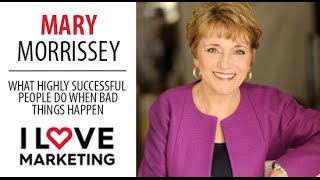
Mary Morrissey shares how successful people handle bad situations in three steps: accept what happened, search for hidden benefits, then stop dwelling on it. She uses her own stories of layoffs and lost money to show how this mindset shift works.
Chapters
All right, you ready for our next presenter? I am like, this woman is awesome. She's tiny, fit and mentally tough. Plus, Mary Morrissey has earned two black belts. One in success, the other in failure. Her successes are amazing. Author, speaker, life coach, entrepreneur, business owner with 41 employees and over 120,000 customers. Yet on the flip side of success is what her message is about what highly successful people do when bad things happen. Please give it up for the amazing Mary Morrissey. I love the dress.
Thank you. What highly successful people do when bad things happen. Woody Allen said, sex without love is a shallow experience. But as shallow experiences go, it's one of the best. Being an entrepreneur without a plan for what you're actually going to do when bad things happen is not only shallow, it's a recipe, really for a life threatening experience. It was. Well, let me just say something. Thanks to Joel Weldon for this. I was telling him as I was working with him about this talk. I said, you know, nobody gets in the room in a Joe Polished room like this without being a tip of the arrow person. Every one of you have taken a lot of risks. You've made decisions, you've put yourself in situations you've tried some things on, some things work, some things didn't. You've had some highs, you've had some lows. And whether or not you know it, you have a method you use that you apply when bad things happen. What highly successful people do. I want to suggest to you, whether you're aware of it or not, are three simple steps that are deceptively simple. It is what it is. Harvest the good, leave the rest. It is what it is. It was 1971. I was in a lecture I didn't want to be in listening to a man I didn't want to hear. But I went because I wanted to please the person I was sitting next to. And the lecturer said, nothing is bad unless you think it's bad. I was 22 years old. I remember crossing my arms and thinking, well, that's just not true. There's bad stuff in this world. Car wrecks are bad. Murder's bad. War is bad. I mean, there's bad stuff in this world. And then he said, I know what you might be thinking. You might be thinking, hey, there's really a lot of bad stuff in this world. And at the level of fact, you, you would be right. But I want to suggest to you at the level of truth, that there's not one thing that can happen that you can't find some good in if you're willing. So the next time something bad happens, instead of immediately reacting, hit your internal pause button and then wait three days. And during that three days, don't just wait, but you're going to wait three days before you react. During the. During that three days, turn the volume up on your curiosity and really consider and write down every possible good you might derive, pull from or create out of this situation. Two days later, my children's father came home and he had been part of a massive layoff at work. 100 people were laid off and he was part of that. And immediately I was, oh my gosh, this is really bad. And I started to react to it and I said, oh my gosh, I heard that guy speak and he said, nothing is bad unless we think is bad. This just seems so bad now. I don't know how you would feel or what you would think if you were in a situation. I was getting my undergraduate degree, we had two sons. And if something happened in your life where it literally to you looked like the source of your supply, your children's meals, the place you lived, were threatened, you might have some emotion. What that lecturer had given me was a methodology for approaching something that I thought was so bad that I could have this situation without the situation having me. I just didn't know it yet. I said, oh, gosh, that Guy said, Wait three days, it's Tuesday. This will be Friday. It's 5 o'. Clock. Friday at 5 o'. Clock, let's do what he said, like, think about what may be possible good. I don't know what good is going to be in this, but what possible good could happen? And then if we can't find any good on it, Friday at 3 o', clock, then we'll panic. And it sounds funny, but it was the first time in my life that I ever touched the part of myself that could literally schedule my own panic. You don't be a really successful entrepreneur without not only touching that place, but learning to live from that place. Whenever a situation happens, it just is what it is. We tend to put an emotional charge on it. This is good, this is not good. And the emotional charge itself dictates the opportunity. The emotional charge itself dictates the opportunity. We can't even begin to see some possible good because we lose our creativity. We heard Peter Diamandis this morning, and all day long we've been hearing amazing speakers who have not only shown us a level of success, but framework in which they have developed that success. He said that our mindset is Our most important asset. And I would say, especially when we know how to create a really healthy mindset, that when we can set our mind on success, even in the presence of what looks like a big problem, when a situation happens, it just is what it is. We begin to write four or five things that we could possibly. Maybe there's some good. It could have shorter hours, work closer to home, make more money, and within 48 hours. Because in that mindset, ideas started coming that we're not on the frequency of CNN constantly negative news or the problem cnn. Once you're on a different frequency of thinking, you have different ideas than when you're on the frequency of the problem. All of you in this room know this. You do it all the time. So it is what it is. It just is a situation. How do I harvest the good? Napoleon Hill said, every adversity, every adversity has within it the seed of an equal, the seed of an equal or greater benefit. But like any seed, it must be found, planted, nurtured, and harvested. Every adversity. He didn't say some adversities. So think about an adversity that you might be afraid of right now, or one you might be facing right now, an adversity that you might be afraid of. And when we think about might be, you face all kinds of things. You know, somebody suing you for $10 million. The spouse leaves, you come home, the doctor calls, the phone rings. Every one of us faces tough things. It could simply be that when you went off to college, your mother sold your Joe Montana rookie card, and you're still pissed about it, it's still there. It is what it is. Harvest the good. Bob Proctor and I, in fact, we gave you a gift. Bob and I have been friends for 20 years, and we created a program on the invisible laws that govern the visible results of our lives. And something that we had both studied for a long time. So we gave you each one of those. It's the entire program. So I'm happy to be giving you that. So he and I did something about 15 years ago, and we've done a lot of work together. But he got involved in a project, and very quickly he lost $2 million on that project. And a couple of months later, I saw him and I said, oh, Bob, I'm so sorry about that. He looked at me and he said, don't do that to me. I said, what do you mean? He says, don't put me in that mindset. Don't you hold me in that mindset. By golly, if I invested $2 million in that learning, I'm going to multiply that 10 times within two years. And you watch me. He not only multiplied it 10 times, he multiplied it 20 times. And I really think that's only because he hadn't heard Dan Sullivan's talk about having a 10 times goal rather than a four times goal. It is what it is. Now, I'm not going to pretend with you that this is easy. It's very easy for me to say these three things to you. It is what it is. Harvest the good. Leave the rest. So two parents get an email from their daughter. Hey mom and dad, I'm sorry I haven't written lately, but you see, all my things were destroyed in the dorm fire. My eyes are almost completely healed now and I will have no permanent damage from the smoke. While the dorm is being rebuilt, I've been living with my boyfriend, Roy. I know how much you have always wanted grandchildren. You'll be happy to know you're going to have a grandbaby next summer. A few spaces down. Please excuse this exercise in English composition. There was no dorm fire, there was no smoke damage, my eyes were not hurt, and I'm not living with my boyfriend and I'm not pregnant. However, I did receive a D in English and an F in French and I wanted to be sure you got this information in proper perspective. That's the power of having a framework pre decided, advanced decided that the next time something happens that I think is bad, rather than knee jerk, this is bad. I'm going to feel that feeling. I'm going to notice that opportunity to react. I'm going to hit my internal pause button, wait three days, and during that time I will dynamically exercise my capacity to pause, look for the good, cause myself to think from what possible good could I derive from this, make a decision for it. And when I notice the temptation, it's in our human nature, the temptation to rehearse and nurse and curse that situation, to talk about it, to tell other people about it. What it does for us and what it does to us is dial down our creativity. It actually takes longer to harvest the good when we're pouring toxic energy on the very soil of the opportunity that's been given to us. When we think about it, all the energy that it took to bring it right to that moment of the big problem. We don't want to have to go around the cycle again and get right back to that moment. We want to grab it, get a hold of it, get the good out of it. Right then and go forward. So like any arrow. And again. Thank you, Jo Weldon. There's three parts to keeping it safe, stable, so you can hit your own bullseye. You're going to have problems. It's in life. It is what it is. Harvest the good and leave the rest. Thanks. Awesome.
Thank you. Awesome.
More from Joe

This FBI Trick Can Command Respect Without Saying a Word ft. JEFFERSON FISHER & CHRIS VOSS

How To Stand Out, Be Different, and Create Raving Fans, Customers, and Employees ft. Jesse Cole



90% Of Businesses Fail In Their First Year, Here's Why! ft. Dr. Benjamin Hard & Dr. Robert Cialdini

The 1 Piece of Business Advice I Got From Elon Musk That Changed Everything Ft. Kamal Ravikant

The 6 Traits You CAN'T Teach in Entrepreneurship ft. Richard Branson & Gino Wickman

The Leg Method: How to Make Your Book into a Million-Dollar Asset ft. Anna David


7 Millionaire Mindset Hacks for Daily Success and Wealth ft. Brian Tracy & Dan Sullivan
