How Samvritti Pranayama (Square Breathing) Affects Sleep Quality - NAYO Research Program 1
A three-week study of 54 yoga practitioners found that nightly square breathing reduced sleep problems slightly more than standard sleep advice, and cut anxiety substantially more. Both improved sleep, but the breathing practice's anxiety drop was striking, suggesting it works through mechanisms beyond just calming nerves.
Chapters
Hello, everyone. Welcome. I'm so glad that we can all be here. I know I'm really excited to share these results. I think Paolo is really excited to share these results. And just to open up, I have to say that with all of the neuroscience and yoga content that we do, my biggest goal is to share neuroscience and yoga with everyone. I hope that you'll walk away with a better understanding of both the theory and the practical behind all of this. that you'll be inspired to support and participate in scientific research on yoga, and that you'll advocate for yoga in schools and healthcare settings and every possible setting with all the information that you learn. And for those who watch later, thank you for joining as well. I'm sorry that the time didn't work out. And so today's really exciting. We're talking about the results from our Neuroscience and Yoga online research program. Many of the people here participated in the program, and so they were subjects in this study and their data are included. And the whole kind of idea of this, the whole mission behind the research program is we all know that as scientific research on yoga has exploded and more and more papers are coming out, there are still obstacles to conducting high-quality scientific research on yoga. And one of those is funding. So I think this is improving honestly with the NCCIH, which is one of the branches of the NIH, but it's still hard to get people into studies. And so our whole hypothesis with this is that we'll be able to put scientific experiments before and after yoga classes that students are already interested in taking and making it fun and game-like and still collect high-quality data and understanding about how yoga affects people. And we'll also be able to reach more people all over the world rather than just being restricted to geographic locations around academic medical centers by doing it this way. And for this presentation, we'll take questions at the end of each section. You're also welcome to type them in the chat as we go. So I think we can start with introductions. Paolo, would you like to go first?
Okay, thank you. So thank you everybody for being here, first of all. And then I'm Paolo Paciolla. I'm a neurobiologist and a yoga teacher. I studied neurobiology in Italy and I've been studying and working here in Italy and in Spain. I've been investigating rewiring of neurons in Spain, and then I came back to Italy and I started to work on clinical research. At the beginning with rare genetic neurodegenerative diseases. the amyloidosis specifically. And then I started to work in clinical research in other fields like oncological and hematological diseases. And then at the end of 2021, I decided to dedicate myself just to yoga, but I didn't want to stop going with the investigation and I really wanted to give something to the scientific community. And I really think it's interesting to see the beautiful that there is in yoga through the tools of science. So I'm very excited to be here tonight, and thank you very much for being here. I, I really like the idea to share my passions with you.
And I'm Jonathan. It's so nice to see everyone. I am a neurologist in New York City, which means that I'm a physician that specializes in disorders of the nervous system like stroke and epilepsy and multiple sclerosis and Parkinson's. And so I found out last week that I'm a board-certified neurologist now, which is super exciting. And I am also a yoga student here in New York City. My teacher is Sridharma Mitra. And I've just been really interested in how yoga affects the nervous system naturally. And so I've been hosting events and trying to get my feet wet in scientific research on yoga as well. So that's a little bit about me. Okay, so for today, and I'm actually just going to spotlight us as we talk.
Okay.
So for today, we have a few things we'll be going over. So for this research program presentation, we'll start with what the goals of the study were. So what were we trying to accomplish here? We'll go over some theoretical background that's helpful to know. We'll go over the structure of the study. So how it really worked. What did participants do? We'll go over the demographics of participants. So you know who really participated. How generalizable are these data? We'll go over the results, of course, and then we'll talk about some conclusions and next steps. And so for goals of the study, I'm going to hand it off to Paolo.
The goals of the study that we decided to have was to test out, as you can read, a different way of conducting online yoga research, particularly a randomized controlled trial, which is the kind of study that we designed for this study. Identify ways to optimize the approach, Because of course we wanted to give the opportunity to many people to participate. So we wanted to create something easy and really doable for everyone. Connect with people interested in this topic. As I said before, I think it's very interesting to see yoga through the tools of science. So, and I guess I'm not the only one thinking that. So it's very exciting, the idea of connecting with more people. all thinking the same, and examine how a simple pranayama intervention compares to sleep hygiene for improving sleep quality. Okay, so we wanted to finish with this nice thing: accomplish your goal one step at a time.
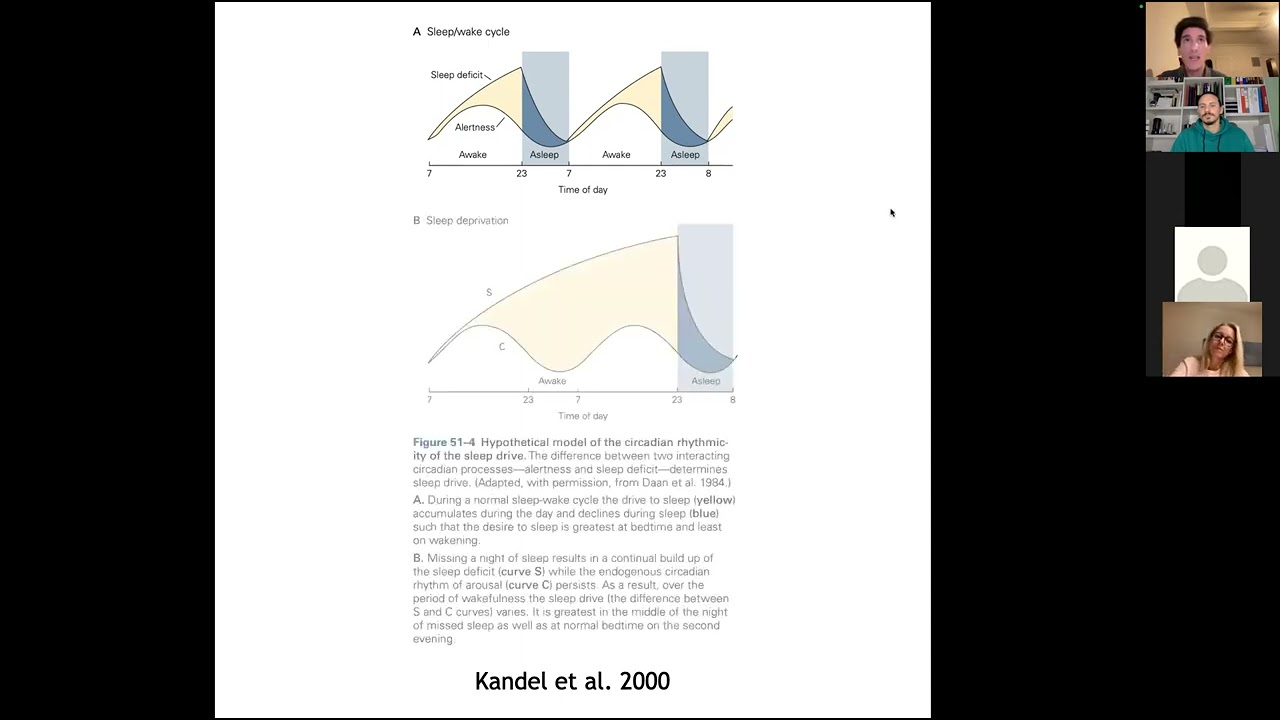
And so I think, I think I'm doing theoretical background. I'll switch. All right, so for the theoretical background, I just want to go over what neuroscience is really quickly and how normal sleep physiology works. I think that will be really helpful for contextualizing what we're going to talk about. And I think we all know that neuroscience is the study of the function and dysfunction of the nervous system. And then the thing that I always emphasize about neuroscience that I think is easily forgotten is that it is gigantic, that it is a massive field that spans so many different layers of science. So just going from small to big. There is a molecular layer to how neuroscience works. How does— how do molecules like neurotransmitters or signaling molecules affect the function of the nervous system? There's also a genetic layer. So how do specific genes and their expression change, and how does that affect function? There's a synaptic layer. So how neurons actually talk to each other, a cellular layer. So how individual cells can take inputs. And turn them into decisions and outputs. A network layer, so how those cells interacting ultimately leads to processing of information and storing of information and decision-making. A system layer where multiple networks can interact and you can have a whole complicated system when you think about like the motor system or the visual system or the attention system. or the sleep system. And then of course the behavioral layer, which is what we observe every day. This is what people are doing, how they're interacting with the world. And then there are the emergent properties of nervous systems, like how we socialize, how we form political situations, how we create economies. And so yeah, neuroscience is gigantic and it spans every other layer of science. And the way we study it is Pretty limited. So if you look, any individual test or any individual experiment available for studying the nervous system only covers a small part of the spatial scale. So that's the y-axis here. And you can see, like, looking at, like, EEG or fMRI, that's a very small spatial scale. It just looks at systems and whole brain. function. Whereas if you really wanted to get down into like molecules and synapses, the types of experiments are pretty difficult to do in humans, right? It's very hard to get inside someone's brain while they're alive because it's unethical. So there are a lot of animal studies that are done, of course, however you may feel about them, that look at these. But our problem in the yoga world is animals don't do yoga as far as we know. And so we're really limited in how we study how yoga affects the nervous system. And yeah, so for example, if I want to know how yoga affects sleep, I think the main thing we would really look at is on the behavioral level. So really looking at how do people report their sleep is. How do they function during the day? And maybe even measuring how long they sleep and things like that. And then you could also look at things like EEG or fMRI while they sleep. And while none of these is a perfect measure, what we ultimately decide is if you put all of them together and they all point at a similar conclusion, then that's something trustable, right? And that's really how all of this kind of work. So what we're presenting today is a very small piece of the bigger picture, and right now I'm just telling you the theoretical background that you need to know. And so there are many systems in the brain that regulate sleep and sleep quality, and then ultimately our function during the day. This is a summary of beautiful experiments. This is from one of the most important books in neuroscience, and You'll notice that each of, from 7 to 7 is a 24-hour period. And there's this pattern where sleep deficit accumulates while awake and then drops while asleep and then accumulates while awake and drops while you're asleep. But there's also this function of alertness that seems to have a very different, it correlates, but it's a different pattern. And these were some of the first clues that there might be different systems that regulate sleep. And if you expand on this, what is that? If you sleep deprive someone, if you make them stay awake, sleep deficit actually accumulates while that undulating function level of alertness stays the same. And so this really disentangles that there are 2 systems contributing. And so I'm just going to tell you about some of the systems that have been studied in detail. So there's the sleep deficit system, as you see here. And one of the main signaling molecules in this system is adenosine. You may have heard of this, but adenosine builds up in the cerebral spinal fluid the longer you stay awake. And this is just driving you to want to sleep as it builds up. There's a very famous substance that's an adenosine receptor blocker. Does anyone know what it is? You can put it in the chat. It is caffeine. Nice, you got it. Yeah, so caffeine, one of the most commonly consumed drugs on planet Earth, is an adenosine receptor blocker. And so it prevents us from feeling that sleep deficit, and that's how it helps us stay awake. And then this kind of undulating one, this is really the circadian rhythm, right? This is a 24-hour cycle where there are peaks and troughs in alertness. And the circadian rhythm has many signaling molecules, but one of the main ones that you're probably familiar with is melatonin. So melatonin is regulated by how much light you perceive at different times of day. And so melatonin secretion is signaling that it's time to be— if it's not a lot of melatonin secretion, it's time to be awake. And if there's a lot of melatonin secretion, it's time to go to sleep. Of course, there are other systems like the stress response system. So cortisol, the sympathetic nervous system, as well as other signaling molecules like dopamine and norepinephrine. And so all of these are working together to determine how we sleep. So this is one of the ways to study sleep. Another way to do it is to look at EEG, and believe it or not, all of the stages of sleep are defined by EEG. So you may have heard of stage 1 sleep, stage 2 sleep, stage 3, and some people say stage 4 doesn't actually exist. So some people lump 3 and 4 together. And so these are the different EEG signatures of what they look like. And each of these stages of sleep is thought to have different functions. So stage 1 is light sleep as you transition from wakefulness into sleep. Stage 2 is where there's this emergence of sleep spindles and K complexes, and these are very important neurophysiologic markers of memory consolidation. So turning memories into long-term memory. And then deep sleep is very restorative, where the brain really slows down. And having a normal pattern like this, where people have deep sleep at first and then spend more time in REM sleep where they're dreaming. as they go through the night. This normal pattern of sleep is very important for sleep quality and kind of the benefits of sleep, feeling alert during the day, feeling like you have enough rest. And so there was this really awesome review paper from 2022. I think it's from the Mayo Clinic, and they surveyed all the literature and they, they looked for associations between different measurements of sleep. So including the EEG characteristics, the circadian alignment, sleep duration, sleep interruption, sleep disorders. And then they looked at how that affected sleep quality and then performance during the day. And no surprise, there were tremendous associations. So it seems like slow-wave sleep, so that stage 3, stage 4 sleep that we looked at, was really important for having better cognitive performance. And so was sleep spindle. So having stage 2 sleep was really important for having cognitive function during the day and feeling like you had good quality of sleep. These also affected mood, reaction time, and performance on physical tasks, and blood pressure and heart rate. And they even had studies where they looked at serum levels of some of the stress hormones, and there were correlations there as well. And so, okay, in an online study, we're not able to look at all these things, right? But what we are going to look at is a summation of this quote unquote sleep quality, like putting all of this together. How is your sleep? And Paulo is gonna go over that a little bit. And so I just want you to have a context, like we don't know exactly what mechanism, what brain changes, what signaling molecule changes. what synaptic changes, what network changes really underline what we're presenting. We're looking at the behavioral level right now, but it's probably fun for all of us to speculate a little bit once we see the results, what underlies these changes. So I'm going to hand it off to Paolo for the structure of the study.
Okay.
So yeah, it's very important what Jonathan just said. I think it's something that we always have to remember when we think about this study because There are many different things working together and we just have to decide what kind of things we can investigate every time because it's not possible to do a study all over it. So the structure, before talking specifically of the structure of the study, we have to give a couple of definitions. We use 2 different tools. One is the Pittsburgh Sleep Quality Index. This questionnaire is a standardized subjective report measure of sleep quality. We had to modify it because with the permission, of course, because usually it's used on a time of 1 month, but we, our study was just about weeks. Uh, the, the study was about 3 weeks in total. And, um, uh, Pittsburgh Sleep Quality Index was used on each week of pranayama in one case and sleep hygiene rules in the other. Also the State or Trait Anxiety Inventory, which is a standardized subjective report measure of anxiety as a snapshot in time, state, and as a personal characteristic in trait. Just to explain a little bit better the difference between state anxiety and trait anxiety, we can say that state anxiety is something that changes frequently and reflects the current condition. of the person, and the trait anxiety is more stable and is something inherent to the person. So it's a trait of the person. Okay, so the study design, we had some inclusion criteria. The age between 18 and 65 years old. The second one was read and understand the consent form, which is something very important. When I've been working in clinical research, I've learned that Basically, this is the first thing that you always have to care about. So the consent form and be sure that the patient or the subject can read and understand it. And then working internet connection and the ability to participate for 3 weeks. So people can sign to the study, signing, signing up just with their name and their email, and they paid $30. Which are $10 for a week, or if you want to see like that, $2 for class. And we didn't have any problem in recruiting people. We only sent a few emails and discussed it in yoga classes. And then they received automated emails giving the weekly assignments, which were nightly practices for 10-15 minutes. With PSQI and STAI measures taken every 7 days. So at the beginning and at the end of every intervention, whenever it was convenient for, for their schedule. So they are, they were flexible in that too. And once they clicked the links, they were guided through what to do and the duration on each items was tracked. So we were able to track the compliance of people. All of this was automated, of course. And if people completed all parts of the experiment, they received $15 back. And the study, yeah, was offered in 3 different languages, which were English, Italian, and Spanish. And that was done because we wanted to really give the opportunity to more people to participate. So the randomization was for about 55— 54, sorry, people. And 25 of them were in the group of sleep hygiene condition and 29 of them in the pranayama condition. As I said, the study was, was designed to be done in 3 different weeks. The first week in which, depending on the group in which you were, you could perform the sleep hygiene education, the sleep hygiene education, or the pranayama, the guided pranayama at the baseline and post first week or before starting the third week, or at the end of the third week, you had to complete the Pittsburgh Sleep Quality Index and the State Trait Anxiety Inventory, as I said before, so we can collect the data before and after the interventions. And in the middle, there was a rest week that we consider like a sort of washout week in which people, they basically didn't have to do anything but just come back to their normal routine. It was crossover randomized controlled trial. As we said, and the difference between the 2 groups was that the sleep hygiene started with the intervention of sleep hygiene, and then they practiced the pranayama on the last week, while the pranayama group started with the pranayama and then finished with the sleep hygiene rules.
Okay.
So the interventions, people had the possibility to access to the videos that I recorded in which I led the complete pranayama. It was 10 minutes of pranayama. The video was about 13 minutes, but they could skip the introduction because in the first part I just explained how to perform correctly the pranayama. That was important to everyone to find his own timing or her own timing, and they could decide just to skip the first part. Maybe after the first days they already knew what to do, so they can skip that. And go directly to the other part. And the sleep hygiene was very quick, a very quick review of sleep hygiene rules every day. For the sleep hygiene rules, we had to choose 10 of the most common sleep hygiene rules that are usually used in the scientific literature because you can actually find many different sleep hygiene rules. We just decided to choose the 10 more common. Okay, so the intervention was, as we said, very quick.
I just— we have a question, I think, before we move on to the hypotheses, and it's from Fernando. Hi, Fernando. And the question is, why cross the intervention? So why have people switched from sleep hygiene to pranayama or from pranayama to sleep hygiene? And I think the best reason to do this is it really Provides a within-person control, meaning that each person is doing both, and we can compare how they responded to both. If we only did it where they did this one, then this one, so you didn't do the pranayama condition at all, but they were just doing both in this order, we wouldn't know if the difference that we saw was because of the order. So having it this way means we can say if pranayama was more effective. order did not contribute to that. I don't know if there's anything you want to add, Paulo.
Yeah. Also, we can see if there is a correlation. If you start with something and then you add something different, maybe if you start with pranayama and then come to the sleep hygiene, you can notice something, I don't know, more effective or less effective. So if you structure the study this way, crossing also the intervention, you can also see If there is something which is working in this direction, or maybe there's no correlation between the 2 things. Okay. So our hypothesis, a short-term daily 10-minute pranayama intervention will be as effective as short-term daily sleep hygiene education at improving sleep quality. That was the first one. A short-term daily 10-minute pranayama intervention will be as effective as a short-term daily sleep hygiene education at improving state and anxiety, but there will be no change for either in trait anxiety. And this because probably you need more time to see a difference in, in trait anxiety. That was what we thought. And changes in sleep quality will correlate with changes in anxiety. So if you can rest better, maybe your anxiety levels are lower or something like that. We just— that was just hypothesis. So We had to demonstrate.
All right, so I'll go over some of the demographics. So these were the participants and the population that participated. So we had 49% from the United States, 14% from Italy, 9% from the UK, and then France, Canada, Australia, Germany, and several others. This is an improvement from last year. We did a pilot experiment last year and 71% were from the United States. So I think really expanding the language options helped a lot. 77% were white, 9% Asian, 2% Hispanic, 2% African American, 9% other. Again, this is, we want the demographics to represent the population as a whole. This way we can say what we conclude generalizes to people everywhere. And so last year it was 86% white, so making it a little more diverse. So it's still hard and you'll see why in a second. And then 88% were female. Last year, 93% were female. The age, average age was 46.4, and that's pretty typical. So this is level of yoga practice. So 9% identified as beginner, 65% as intermediate, 26% as advanced. And this is number of times practiced. practiced per month. I am shocked that 40% of our sample practiced 21 or more times per month at baseline. That's very impressive. It was also a very educated group with everyone being at least college educated and 42% holding a doctoral or professional degree. And I think this and this together are very reflective of the population who are interested in neuroscience and yoga, right? It tends to be People who practice yoga. So it tends to be in the United States, white females, same thing in Europe, and they tend to be very educated. And so I think as we try to diversify and reach out to more people, we have to think about how to do that. And, and there are a lot of models that are successfully doing that that we can talk about. This is always really interesting. We always include this. We ask people, why do you practice yoga? And this is the self-reported reasons. And then this is a word cloud, meaning that a computer kind of took the words that were most common and makes them bigger. So the more common, more commonly a word came up, the bigger it is. And so health, mental practice, physical, grounded, body benefits, connection, energized, greater focus, love. All of these seem to come up, which is pretty cool to see. Spiritual. Okay, so now on to the part everyone's waiting for, which is the experiment results. And we're going to start with the main outcomes, meaning the things that are based on the hypothesis and, or hypotheses, and then we'll look at some of the other analyses we did. So the first thing to look at is attrition. How many people actually stuck with the intervention? And to go over this graph, this is the number of participants who completed each step. So this is doing the practices of week 1, doing the survey after week 1, doing the survey after week 2— that was the rest week or the washout week— doing all the practices of week 3, and then doing the survey after week 3. And this is how many people completed Everything. And you can see that there's quite a bit of dropout. So just some questions to go through. So the first question is, will people sign up for something like this? And the answer is yes, right? And you might notice that there were 54 who were randomized, but only 43 started the introductory day. I'm not sure why that is. I think some of those people even did not do the introductory day, but then did other parts of it. So yeah, it seems like Sometimes people missed emails, something like that, and that really led to just a little bit of not completing the intervention. So will people sign up for this? The answer is yes. It really— we had 54 people sign up and 43 just from a few emails, even if that's what it was, is still pretty good. But then will they stick with the program? And the answer was about 58% of them stuck with the program fully. And that really came from just missing small parts. No, it wasn't— even if someone missed doing some of the weekly practices, they even came back for the later parts. So it wasn't that people were sick of the experiment and they like dropped out. It was just that it was hard to keep up and do everything every week. And yeah, so that's how the attrition looked. So now we can get into some of the main outcomes. So this is the sleep quality data and the way sleep quality is measured. So it asks questions like, how many hours did you sleep? How alert do you feel during the day? How sleepy do you feel during the day? Did you wake up a lot at night? All those kinds of questions. And higher numbers are worse sleep quality. Higher numbers are worse sleep quality. And so we're really looking for sleep quality, PSQI, to go down for better sleep quality. And so this is at baseline where the 2 groups were, and you can see they're pretty similar. Then after week 1, so for week 1, the pranayama condition is doing pranayama, and the sleep hygiene condition is doing sleep hygiene. They both come down pretty similarly. When we do the washout, the pranayama condition comes back up, the sleep hygiene group stabilizes, and then they switch. So now the pranayama condition is doing sleep hygiene. They don't seem to improve that much. And the sleep hygiene condition does pranayama, and they seem to improve even further. Okay, and I'm going to show you another graph that makes this much easier to interpret. But one of my teachers always said you have to visualize the data exactly as you recorded it just to make sure it makes sense. Okay, so then we have State Anxiety Inventory, and there actually was a difference at baseline here between the 2 conditions, which is just important to note. And it's interesting because you randomize in order to make this not happen, but it happened anyway. So the pranayama condition, when they did pranayama, they had a dramatic decrease. In state anxiety, the sleep hygiene condition had a more moderate decrease in state anxiety. When they do the washout, they both say stay stable from where they were. Maybe the pranayama condition goes up a little bit more. And now when the pranayama people do sleep hygiene, they continue getting a bit worse. And then when the sleep hygiene condition does pranayama, they get better. Okay, for trait anxiety, there really aren't too many changes. Oops. So if you look at this, the main different— the steepest decline is when the sleep hygiene group does pranayama. They have a pretty big drop. Okay, but now we're going to look at this data in a much easier way to interpret. So this is Regardless of when you did it, how did your sleep quality change when you did sleep hygiene? How did your state anxiety change when you did sleep hygiene? How did your trait anxiety change when you did sleep hygiene? And same thing, but for when you did pranayama. If they were at zero, that means there would be no change. So you'll notice that the change in sleep quality with sleep hygiene And with pranayama, regardless of when you did it, seems to actually favor pranayama, which is stronger than what our hypothesis was. Our hypothesis was that they would be similar. Sleep hygiene is one of the gold standards for improving sleep quality, but it seems like pranayama may have a bit more of an effect. Of course, these lines are not non-overlapping with each other, but this line includes zero and this one does not. For state anxiety, this was much more dramatic. So sleep hygiene resulted in a modest and overlapping with zero improvement in state anxiety, but pranayama resulted in a pretty dramatic and very different from zero improvement in state anxiety, and they were quite similar in terms of trait anxiety, as we predicted. So you might be wondering, why aren't there any p-values for kind of the stats aficionados out there? The answer is that I need to do Wilcoxon rank sums in order to do this, and I don't have access to the fancy software I used to use. So I was trying to figure out how to do it just in my regular spreadsheet software, and it was not going well. So I just decided visualizing it with standard errors of the mean was better. Okay? And then the last one. We were hypothesizing that the change in sleep quality would correlate with the change in anxiety, meaning that if you improved more in your anxiety, you would improve more in your sleep quality, that they would be connected. And that's actually not what we found. These are very weak correlations, meaning that they don't really explain the data. So you could have had a really good improvement in your anxiety, but not that good of an improvement in your sleep quality, or you could have had a really good improvement in sleep quality without an improvement in anxiety. And the reason this analysis is so important is it gives us some insight into the mechanisms. Before, we were talking about how melatonin, adenosine, stress hormones, all of those work together in order to determine sleep quality. Well, it looks like For both pranayama and sleep hygiene, it's not the changes in stress and anxiety that result in changes in sleep quality. They were not correlated, right? So perhaps it's some of the other systems like adenosine or melatonin or some others that are contributing. Okay, so yeah, keep putting questions in the chat. We're gonna get to them. And so just some of the other findings. So While we didn't see that the change in sleep quality and change in anxiety were related, we did see that at baseline there was a pretty strong correlation, meaning the more anxiety that someone had at baseline, the worse their sleep quality was at baseline. And that was both for state anxiety, and it was even stronger for trait anxiety. We also looked at whether this differed by level of yoga practice, meaning if you were like a beginner, intermediate, advanced. Did that change how your outcomes were? And I don't even want to go over these graphs. Apollo and I were looking at them. We tried to make sense of them. They are just so noisy and they make no sense. So it's, I think what we can say is we just can't comment on that with the data that we have. It's just too noisy. We also looked at whether order mattered, like we talked about before. And so this is all for when any— when you did pranayama, how was your change in sleep quality if you did pranayama first versus if you did it second? Same thing with state anxiety. If you did it first, if you did it second, trait anxiety first or second, and first or second, meaning if you did pranayama first or second. And then same thing with sleep hygiene. So how is your change in sleep quality if you did sleep hygiene first? How is your change in sleep quality if you did sleep hygiene second? Okay. And for sleep hygiene, it actually, there doesn't seem to be a super strong order effect, maybe a little bit, but it really looks like they are similar. Now I will say it is because it's a discrete measure, meaning you can only have a sleep quality of 1, 2, 3, 4, 5, none of the in-between numbers. It is possible that there is more meaning here than what this image looks like. But if we compare that to something like state anxiety, it looks like no matter what, which whenever, whatever you did first, if you did pranayama first, or if you did sleep hygiene first, it was way more effective than if you did it second, right? So order really did seem to matter for state anxiety, whereas for trait anxiety, it was the opposite. Whatever happened at the end, it seems like trait anxiety was a cumulative thing. So state anxiety was affected by whatever you did first, and trait anxiety was more affected at the end. And I think that makes sense based on what they are, right? State anxiety is a changing in-the-moment thing, and trait anxiety is a personality ingrained thing. So was there an order effect? Yes, but it still seems like pranayama for state anxiety was much stronger than sleep hygiene. And in terms of the effect of, on sleep quality, it seems like the benefits of pranayama that we saw before came from doing it second compared to doing sleep hygiene second, which is hard to interpret. Okay, so those are all of the data. I think the most—
Say that again, Jonathan, that last sentence.
Absolutely. So before, I'll show this graph again, which by the way, I was gonna say this is probably the most important graph if you wanna take a picture or something like this is the one to take. But here you see that sleep hygiene had this effect on sleep quality, whereas pranayama was a bit more effective. And if we split those into 2 further groups, so this is pranayama, this is sleep hygiene's effect on sleep quality. You can see that we remember pranayama was a little bit better. It seems like if you did sleep pranayama first or sleep hygiene first, they're pretty similar. But when you did pranayama second, it was more effective than if you did sleep hygiene second. And that seems to be what led to the bigger difference that we see here comparing these 2.
Gotcha. Thank you.
Yeah. And so what does that mean? One possibility is that when people did the sleep hygiene, they learned it, liked it, and kept it. And so they were still doing sleep hygiene while they were doing pranayama. And so we were getting an additive effect. That's one of the possible explanations. So we can't, we can only speculate about that. So those are the data. And let's see what questions we have. Would you share the 10-minute pranayama video that you used? Yeah, absolutely. And does it matter what time of day it's done? So we actually required that everyone do their practice before bed. And I think we asked people to actually put a reminder on their bed, like just like a piece of paper or something. To say like before you go to sleep, make sure you do your practice. And so they had to just click a link in their email every day. They got the email telling them what to do, and they clicked it, and it would say like here's the video. And if it was sleep hygiene, they just reviewed the sleep hygiene rules. We're supposed to follow them. And then for pranayama, they were supposed to sit with the video doing the pranayama. And which pranayama did we use? It was Samvritti Pranayama, so square breathing. Very simple, easy to learn, and one that is probably the most widely accessible pranayama. Okay, any other questions on the data results?
So if you did the, the study again with the same people, Would you expect improvement aside from life situations, or would it be like anything else? Time may or may not.
This is an excellent question. And we were going to talk a little bit more about this in limitations. So I'm just going to jump into it right now. And I think you're bringing up like interference from abnormal circumstances. So like, People signed up for this study. They didn't know what was going to happen in the next 3 weeks. They could get a huge stressful project at work. They could have, you know, have to watch their family member's dog, and their dog keeps them up all night, right? There's so many different things that could have happened that could affect people's sleep quality. And in fact, we asked people about this, and our initial plan was going to be if people had extenuating circumstances that really affected their sleep quality, we would exclude them because that would confound the analysis. But what it turned out was there were so many people who had irregularities at some point during the study that we would've had to have excluded everyone. And so we did not end up doing that. And what it really tells you is that first, this wasn't a pure study, right? This wasn't like done in a lab. This was done in a real-world environment. So the results that we found are even more powerful because it means it works in the real world. Yeah.
Wow.
Wow.
That's incredible.
Yeah. So I'll go over some of the other limitations. So this was a short duration study. It was 3 weeks long. And the reason for that is you really have to balance duration in order to keep people engaged. If you make it too long, people drop out. And so while it probably would've been better to stick to the original 1 month, that's how you normally measure sleep quality. We knew we would probably lose more people if we did that. And so we made that decision, but it's just important to take into consideration this is a shorter duration. We may have seen more effects with a longer duration. We also still had attrition, and attrition is a big deal because we don't know why people stop participating. Maybe they stopped participating because pranayama actually worsened their sleep. And now we're excluding— they're not being included in the analysis because they're not participating. And so it's skewing our results right now. Do I think that's the case? No, I think people were probably not following through because it's just hard. Life gets in the way, and maybe emails go to spam, and it's just hard to reach everyone. Another thing that can really affect the results is interference from co-administered experiments. So if we're asking people about sleep quality, and that's one of the things that gives them anxiety, that they don't sleep well, and then we ask them about their anxiety is worse, right? And so you— it's hard to get around that, but that definitely is something that could contribute. The good thing is we were comparing within individuals. Everyone was being compared to themselves. And so that balances that out, hopefully. And then the last thing, so we talked about the abnormal circumstances, and then the last thing is sample size and demographics. A lot of studies now are going to health centers, like recruiting people from the VA, so the Veterans Hospital, or recruiting people from the NHS in the UK. Because now you're going to get not just people who are interested in already practicing yoga, but people who maybe who have never even heard the word pranayama before. You're going to get people who come from different backgrounds, who maybe have different education levels, who maybe are of different ages, and that's really going to support more the generalizability of these interventions. However, I think what we can really say is that this is— if what we did is true, then this is a very scalable and pretty affordable way to help people get these practices. It was very powerful that a computer could take care of so much after we set things up. So let's go over the hypotheses. A short-term 10-minute pranayama intervention will be as effective as short-term sleep hygiene education in improving sleep quality. And really what we saw that was that pranayama seemed to result in a slightly larger improvement in sleep quality than sleep hygiene education. A short-term 10-minute daily pranayama intervention will be as effective as short-term daily sleep hygiene education at improving state anxiety, but there will be no change for either in trait anxiety. And pranayama was way more effective than sleep hygiene at improving state anxiety, and they both didn't seem to have an effect on trait. Again, this was a short duration study. And lastly, that changes in sleep quality will correlate with changes in anxiety. And yeah, this was not seen. So it seems like the mechanism by which pranayama and sleep hygiene improve the sleep quality is not by improving anxiety. It might be other mechanisms like circadian rhythm entrainment or receptivity to adenosine. Sometimes we have natural things that we can make that suppress adenosine. And so, yeah, definitely need to explore more mechanisms. And that is really it. I think next steps, we definitely need to improve attrition. Maybe we need to have a more standardized way to get If people don't complete an intervention, they get a follow-up email. We need to be able to do longer trials. We need to replicate prior work, and we need to recruit more diverse samples. But what comments do people have? What next steps would you like to see? What thoughts do you have? I would love to hear.
I'd be curious if you could get much the same group of people And to see like for a few years running, just hit 'em at the same time of the year, a few years running. That would be fascinating to see. And then the other thing that I think is like, how can we roll this out swiftly? Because so many people will, when they're told that it works, sometimes they believe that just that sentence and that helps them too.
Yeah.
Yeah. And the more balanced we get in that sleep. I did not know about that. How do you pronounce it again? Adenosine?
Adenosine. Yeah.
Adenosine. Yeah. That's gonna be a little topic of research for me for a while.
Thank you.
Yeah.
Cool.
Yeah. So I totally agree. I think one of the really cool potentials for this is just the, one of the most important studies ever done is called the Nurses Health Study and they followed they enrolled people in the medical field because it was easier to recruit them into this study where they just asked them, I think it was maybe once a year or every 6 months or something like how they ate, how they exercised, just basic lifestyle things. And then looked at, did they, how often did they die? What did they die from? Simple things like that. And when this study ran for decades, many decades, and it's one of the most important studies on lifestyle that's ever been done. Because lifestyle interventions work in the long term. And even though we can pick up some of the acute effects, the chronic effects are really the most interesting. And so I totally agree, Carla, it would be so cool to do something like this and just follow people for years.
Hello, Jonathan.
Hey, Fernando.
Hi.
What do you think it will be a good motivator for people? To, to get more adherence on the interventions or the protocols or whatever? How can we motivate people to stay and be constant on these practices?
Yeah, I think a lot about this too. And I think that's one of the major downsides to doing an automated system like this. The advantage is it's so much more affordable. But the downside is where's the accountability? And I think having a system that kind of reminds people if they don't complete the practice, we didn't have that. They just got one email and they had to click it. They didn't get reminders if they didn't do it.
Hmm.
I wonder if having reminders and maybe even some kind of points accumulation thing, the more you do, you see your points going up, that kind of thing. could be motivating. And I also think just in practice, this isn't based on like studies, but like when people see improvements in themselves, that's when they feel motivated, when they start seeing the benefits. And I think having people reflect at various intervals for a really long study could be a way to get them to say like, oh, I wanna stick with this. Like now that I thought about it a little bit, I, I actually am seeing the benefits.
So feedback, feedback that tells them, hey, you're doing good.
Yeah.
Short, in the short term or in the long term? What do you think is more effective? Like when you tell the people, hey, you did amazing, or in a long term, longer term, like, wow, you're losing weight, your blood pressure is going down. It's like, what is more effective, like the immediate one or the longer?
This, I think, I think you probably need regular intervals of feedback.
I don't know.
Hard to answer. What do you think?
I don't know.
It's like I was listening to someone, one of my patients, like telling me that I asked her, you have to dance, you have to move. I was like, what do you like to do? And she told me, I like to dance. Like, like, okay, why do you go dancing? And she told me, I have this game. from like, like it's a game that you are holding a joystick. I don't know the name of the game because I don't have a, like these machines, but they dance like, and they have like a different kind of beats and different kind of music. And so, and I asked them, why do you like that? And she told me, because it gives me a feedback at the end of the, of this dance or the song. And it tells me how good I did it because apparently it Just like measures the way it's moving and it tells you like if you're doing the right movements or you're not moving enough. So I wonder, is that more effective at the end of the session or is more effective when they are doing the dance to have like a comparison what they're doing with what they are supposed to do? So I was wondering, I was like, okay, these games are— interesting because it motivates them to do these dance scenes. But is it more effective in the long term or in the short term for them?
Probably a mix, I bet. I bet it takes both.
Thank you.
Yeah, one thing about that also, I was part of that study and it could be nice to Like me, all participants will just say, okay, I've done that and I've really improved my sleep. It was my case. And in saying to people the benefits that can give them too. And the second, second thing would be, I was quite surprised how engaged I have to be because it was a practice every day. It was summer. I had people at home. It was quite complicated to do. And one night I've just said, okay, to do this program. I haven't seen any way that it will be so implicated for the people. So it could be a way also just to explain to people what, uh, how long— it's not only 15 minutes. Because for me, for example, I've just realized with that experience that I did not have any sleep routine. So why not just read the first day?
Yeah.
You did, you have to do that 1 hour before to go to bed. And I was saying, but I don't know when I'm going to bed. So how can I know 1 hour before if I don't know the time? Did you understand? So I was, okay, so I have all my life to organize. Ah, how can I do that? And it has been a very nice experience and I've learned a lot about that. But it's possible that I'm not the only one in that case. No. And people are just surrounded by information and don't know really how to use it.
That makes a lot of sense. Yeah. I think also we ran it over the summer, which is like the time that people are the busiest. Yeah. That's interesting.
And are we okay to write or record anything to explain? What this program gives to me and how conscientiously I have a sleepy eye, Jenna, and how I pick my pranayamas also to do in that sense. So it could be ideas.
Well, thank you, Amy. So I think we're a little over time. If anyone has to go, I'm so sorry to run late. I always run late. But the, this is a link in case you're interested. It'll sign you up just as a, an email person who's interested in research. And so whenever we're doing new research programs or collaborating, looking for collaborators, we'll reach out to you. So you can just put this link in and that'll take you there. And then these are our Instagrams and websites. which you may or may not already know about. And then these are the references for today's presentation. So thank you, everyone. And a huge thank you to Paolo for really taking the initiative and making this whole program happen. And thank you to everyone who participated. And yeah.
Thank you, Jonathan. And thank you, everybody.
Well, a big thank you. Mele kalikimake. Ha'ola makehiki hou from Hawaii. We'll see you at the conference when it comes up. Yes.
And I'll send an email soon about when the conference is happening.
Thank you, everyone. This is so fascinating to me. It gives me hope for our fellow humans, how we can help them, whether they're in our family or whether they're our clients. And so God bless you all.
If there are no other questions, I can end the meeting. Always feel free to reach out and have a great rest of the day. All right, bye everyone.
Bye, thank you.










