NaYOC Intro 2023
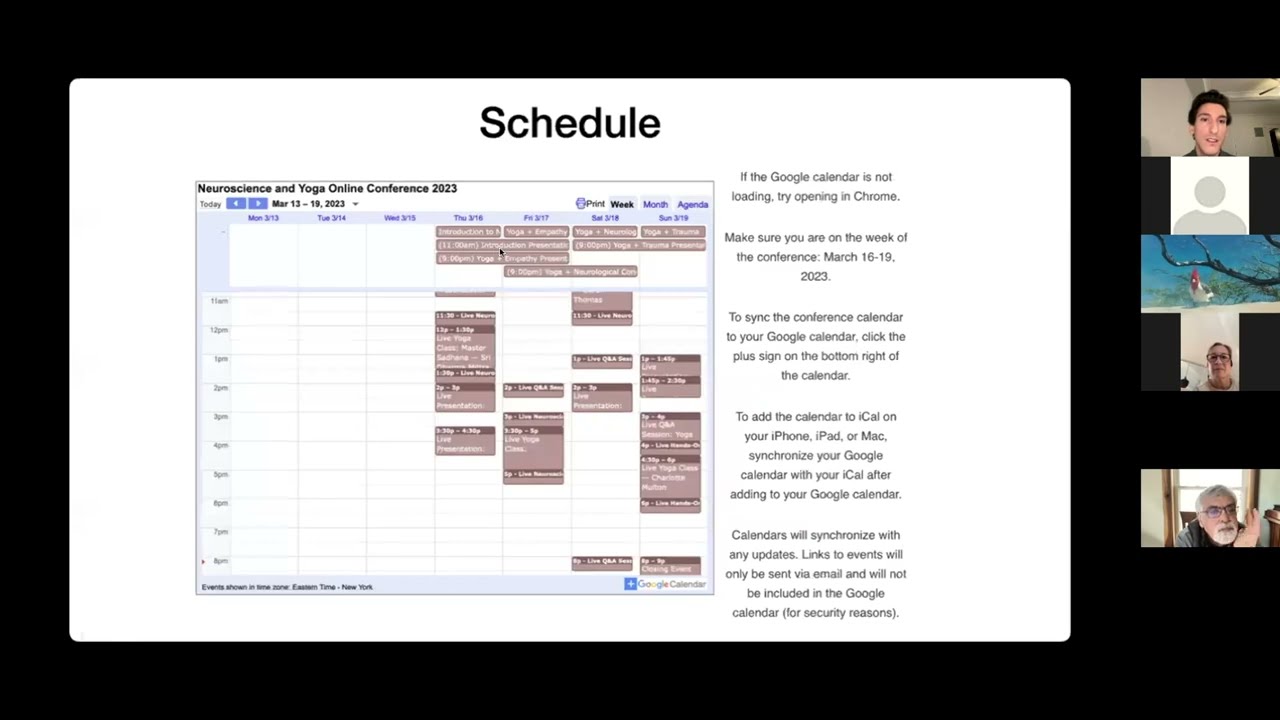
A neurology resident and yoga student walks through the 2023 Neuroscience and Yoga Online Conference: four days of neuroscience talks, live yoga classes, and experiments across Foundations, Empathy, Neurological Conditions, and Trauma. Three registration tiers offer different access to recordings, live sessions, workbooks, and CE credits.
Chapters
All right, let's get started. Hello, everyone. It is so heartwarming to see all of you here. I can't even tell you how much joy it brings to me to know that there are people interested in neuroscience and yoga. I really think that this is the kind of stuff that can change people's lives and change the world. So Thank you all for being here. This is the Neuroscience and Yoga Online Conference kickoff party. We're going to go over the story behind the conference, how the conference works, how to access events, what to expect every day, some frequently asked questions, and where to go if you have further questions. And as I'm going through the material, please write down your questions, save them for the end, And we can, you know, we— I'll stay on as long as we need to, to make sure everyone's questions are answered. And just to start, if everyone doesn't mind, you've already actually been doing this, which is great. But please put in the chat your name, where you're from, and what you're hoping to get out of the conference, why you joined, basically. And while you're doing that, I will start by introducing myself. It's been really fun for me to hear everyone's stories. It's my favorite part is getting to meet everyone and hearing everyone's experience. It's so fascinating how different everyone's experiences with neuroscience and yoga. And it's only fair that I introduce myself, even though I find it awkward every single time. Okay, so I will introduce myself through some photos. So the first thing I'd like to share about myself is that I'm a yoga student. I've been practicing yoga for about 15, 14 or 15 years. This is me with my teacher, Sri Dharma Mitra, here in New York City. And I'm about, I don't know, 18 years old in this photo. And Dharma's been my teacher pretty much since the early days that I was practicing yoga. And I am still a yoga student. So this is Dharma And me in February of 2020. This was when I was on vacation in my first year of residency, and I was just so happy to be able to go back to class every single day. And this was right before COVID obviously, February 2020. And yeah, I'm actually on vacation from my normal job right now, so I can fully devote myself to this conference. And That is me as a yoga student. So I've already mentioned this, but another side of me is that I'm a resident physician. So science is really, really important to me. I see science save lives every day. And so I'm a resident in neurology, which means that I specialize— I'm a medical doctor who specializes in disorders of the nervous system like stroke and epilepsy and multiple sclerosis and Parkinson's. And of course, that's one of the topics this year, which I've been waiting for for a very long time. And the last thing about me is I'm really passionate about neuroscience outreach. And so this is a photo from, I think, 2019. This is when our events used to be in person, the neuroscience and yoga events. And this was at the end of an event. We had a plastinated brain. So someone had actually donated their brain after they passed away, and it was preserved, and we were able to bring it to sessions to go over neuroanatomy. So I share all of this so you think of me as approachable and human. I'm here and I'm available to help. I want everyone to have a great experience during the conference. And yeah, and I'll just show you some photos from past events. These were all our in-person and one virtual event in the past, and we've been doing this since 2014. So just so many, so many, um, you know, awesome events, and I love every single one of them. So that's me. Um, you're gonna meet so many amazing contributors to this conference, and the speakers and yoga teachers, they're all outstanding. I look up to every single one of them. There's going to be an introduction to each of them before their session, so you'll get to know them then. And I just show you all their pictures here, and I have to highlight that, you know, if you don't want to take my word for it how special and amazing they are, you can just look at their— the speakers page. You'll see all of their amazing accomplishments. They've been featured in, you know, the most important scientific journals like JAMA and Neurology and the Journal of Neuroscience. And they've also been featured in major news outlets like Time and Scientific American and NPR and TED and the New York Times. And yeah, so we are really lucky with the speakers and yoga teachers that we have this year. I also want to shout out all of the people who contribute to the conference. So there's a lot of work going on on the back end. And these are some of the people who are contributing. I try to keep this list up to date. And so we have the people who are helping to create the experiments, Jocelyn, Elisa, and Ekaterina, the people who are moderating the Facebook group, Kristen, Charlotte, and Natalie. Rookie might help with that too. We also have the people who have been working on advertising and communication, which is by far the hardest part of this, getting the word out. So you can see a lot of people, Vidanchi, Soha, Natalie, Maggie, Jenna Lee, Joyce, and Chris. And then new this year, we have translations going on. So Amy and Charlotte have been working to get French translations to everyone, and I have trans— not that I know Spanish, but I used a translator app to get the presentations into Spanish. And so both Spanish and French will be available for all of the presentations. Charlotte is also running a WhatsApp group for live translations, and in the first email that's going to go out at 11 AM, you will be able to join that WhatsApp group if you are a Frenchie. Okay, so all of this history, all of these people come together into the 2023 Neuroscience and Yoga Online Conference. So the conference has 4 days this year, and each has a different topic. Every year we do different topics since there's so much to cover, right? I don't know if we'll ever run out of topics. And then the first day is the day that we're in right now. This is the introductory day, and it's all about what foundations do we need to lay in order to get the most out of the conference. So this presentation is all about how the conference works, and then the Other presentations today will be about introduction to neuroscience, introduction to yoga, the basics of scientific research, and how to find and read scientific abstracts, and things like that. So really awesome material to lay the foundations today. The second day of the conference will be all about yoga and empathy. The third day will be all about yoga and neurological conditions. Like I said, I'm really excited for this day. We have amazing speakers on stroke, and neuropathy and Parkinson's. And then I'll also be doing a presentation where together we'll all be able to look up whatever we're interested in. And the last day, I know one of the most requested topics is yoga and trauma, and we have a lot of people contributing to that day. So it's going to be amazing. I'm really glad it's the last day and kind of, you know, we'll, we'll all be primed for it. So every day of the conference will have several main components. There will be neuroscience presentations, yoga classes, experiments, and question and answer sessions. And I want to go over— before going over the schedule, I want to go over the different passes just to prevent any confusion. And I'm bringing, bringing this up early so that you can, as you go through this presentation, think about which pass is right for you. And sign up for that soon. And I'll tell you why it's important to sign up for these things soon. So there are 3 options for registration. The first is the presentation access pass all the way on the left here. So attendees with this pass will have access to all of the presentations by the expert physicians and researchers. for 24 hours. And we really want this knowledge to be accessible to everyone. So this pass is donation-based, and the 24 hours means that everyone in every time zone should be able to tune in at some point during their day. This pass also includes access to our Facebook group, which I'll talk about shortly, and the option to donate will come at the end. So if you've, you know, been looking for that. Thank you so much for thinking about donating. I really appreciate it. The link for that will come in emails coming up. Okay, there's one point of confusion here that I'm gonna mention several times throughout this presentation, which is that there are live presentations. But these are still presentations, so they are included in the presentation access pass. So like this one, Live presentations are included in the Presentation Access Pass. Okay, the next— and again, any questions, please put them in the chat and I will catch up in a little bit. The next is the Live Access Pass. So that is in the middle here. And this adds access to all of the live events during the conference. So there will be yoga classes with amazing teachers. Including today, Sridhar Mamitra and Eddie Stern. Tomorrow we have Whitney Wilkerson and Jenna Lee Hoffman. On Sat— I'm really testing my knowledge of the schedule right now. On Saturday we have Sarah Thomas and Tiffany Cruikshank, and on Sunday we have Lauren Duke and Charlotte Moulton. So That is our lineup of amazing yoga teachers. In addition to the yoga classes, the Live Access Pass includes experiments before and after the yoga classes. And we regularly hear feedback that this is one of the coolest parts of the conference, which is that you can see how science works, how science is conducted, and then also see the effects on yourself. And we'll have a presentation Usually a month or 2 after the conference, going over the results from these experiments. And also there will be question and answer sessions that will be live with the researchers. And finally, in-person events in New York City, which I'll talk more about in a little bit, and we can as a group decide what those will look like. Okay, again, questions, please put them in the chat. Okay. Finally, we have the Lifetime Access Pass, and this one is really meant for people who are kind of considering this like a mini teacher training or really trying to soak up the knowledge in a very deep way. And so this includes everything the conference has to offer. So it has all the presentations, the yoga classes, the question and answer sessions, the in-person events, the experiments, everything. But you also get their recordings, so you have ongoing access to them. It's called lifetime because it should be, you know, for your lifetime. I did get a funny email that was like, if I, if I die and then, then resuscitated, does that still count as one lifetime? Or is it— but yeah, it's whenever your email expires. It's linked to your email. And then the other thing to note is There were some questions about whether the lifetime access pass applies to future conferences. It does not. So it is a lifetime access pass to the material of this conference. Okay, the lifetime access pass also includes some really amazing extra things. So there are workbooks, which are, I, I think, one of the— I— it blows me away that we have these workbooks. So basically, the workbooks are the presentations with certain parts missing. And so as you're going through the presentations, you fill in those details and it's turning passive listening into active learning. And then afterwards, let's say in a year, you want to quickly refer back to some of the things you learned. You now have the workbook, which is sort of like a mini textbook of everything you learned during the conference. So it's a really cool learning resource. We also have quizzes, which are there, you know, I think being quizzed is the best way to learn. And it's actually supported by education research that the recall of information, trying to recall it, is how you tell your brain this is important, make sure it sticks. So the quizzes, you can take them as many times as you want, and they will have feedback to make sure that you're retaining the main points of the conference. And then lastly, the lifetime access pass. Also includes Yoga Alliance continuing education credit for 25 hours. And I just learned we will also be able to offer IAYT, which is the International Association of Yoga Therapists, continuing education credit as well. Okay. So as I was saying before, you can switch passes at any point during the conference, but I really want people to think about it now. Um, ask your questions now because let's say you have a Presentation Access Pass and upgrade to the Live Access Pass on Saturday, you will have missed the yoga class and the experiments and the other live events on Thursday and Friday. And we cannot back offer those. Once they expire, they expire. And, uh, I still think that the live events Saturday and Sunday are very valuable, so I won't stop anyone from upgrading on Saturday. But I just want to point out the benefit of, you know, making a decision earlier. Okay. Thank you for listening to me go on and on about that. So we're gonna go over the schedule now. So the schedule will be linked in every single email. There is a schedule page which you can always find. On the website, and there are a few ways to look at the schedule. So I'm going to start with this Google Calendar. So this is the first part of the scheduling page, and there are a few tabs on the Google Calendar: Week, Month, and Agenda. Right now I'm showing the Agenda view. So, uh, the reason I really like the Google Calendar is it will show events in your time zone. If it's not doing it on the website, if it's still showing it in Eastern time and you're somewhere else, you can just hit plus and it will add it to your Google Calendar and show in your time zone how the schedule works out. And, um, there are a few things I want to highlight about the Google Calendar that can be a little bit confusing. So on the top there are these events called presentations are available. And those tell you when a set of presentations are available for that 24-hour period. Usually it might even be a little longer than 24 hours. And the— for some reason Google Calendar puts these at the top. So even though the yoga and empathy presentations become available at 9 PM, it's above the 2 PM, 3 PM, 3:30 PM, and 5 PM events. So that can be a little bit confusing, but it's because it spans 2 days. So it's going from 9 PM on Thursday to 9 PM on Friday, and then at 9 PM on Friday, the yoga and neurological conditions presentations become available. And so any event that spans 2 days on Google Calendar is present at the top. So just train yourself to look at it that way, and it's not as confusing. Okay, and just to be clear, like we said before, anything that says live presentation is available to presentation access pass holders. Anything else that says live is not available to presentation access pass holders. And I think that is everything there is to know with this view. There are some instructions on the right, so if you forget from this presentation, these instructions on the right are meant to help guide you through the Google Calendar. All right, that is it for the Google Calendar. One more thing that might come up is about the links. So the links every day will be sent via email. All communication for the conference will occur via email. So one thing that I notice is that only about 60% of people open the emails for the conference, and that's gonna really be a problem. So it's, it's critical to check emails in order to make sure you're getting the links and all the events and any updates. Okay, the other view for the Google Calendar is by week. So if you click week, you'll see a view that's kind of really intuitive of how the events are laid out. And I actually like this view because here you can see that the presentations are available, uh, events are spanning 2 days, which is really what it is. And another thing to note here If you sync the Google Calendar with your calendar, any changes that are made will sync with your calendar as well. I'm not anticipating any changes. You know, we really finalized the schedule at this point, but you never know. So I just want to plug that benefit of syncing with the Google Calendar. A couple of other things. So there are question and answer sessions for those with the Live Access Pass and the Lifetime Access Pass. And it didn't always work to have all of the researchers in one question and answer session. Ideally, we would have one question and answer session at the end of the day. But because the researchers come from all over the world, what happened is the time zones just didn't work out. And so some days we have 2 question and answer sessions. So on Saturday, We have one at 3 PM. Nope, sorry. Ah, on Saturday we have one at 1 PM and one at 8 PM. And so for the 1 PM, that's with Dr. Arlene Schmid. So I recommend that you watch her presentations first on Saturday. And then the one at 8 PM is with Dr. Jojo Kwok. So I recommend you watch her presentations afterwards. The same thing applies to Sunday. So On Sunday we have one early in the morning. It's not showing here, but I think it's 9 AM. I'd have to look. It's 8 or 9 AM. So those are with Shirley Telles and Kristen Anderson. I recommend watching those presentations first, and then the question and answer session later in the day is 3 to 4 PM, and that's the time by which you should have caught everyone else's presentations. Okay, this is another way to look at the schedule on the same page, and this one is not organized chronologically. So the Google Calendar is organized chronologically. This one is organized by event type, so don't scroll through it thinking that it's in time order. So you'll see that the first thing is up here there are tabs, and if you click the tabs, it pages through the different days. So if you click yoga and empathy, if you click yoga and neurologic conditions, if you click yoga and trauma, and the this view also includes more detailed descriptions of the presentations and the other events, so you know which ones you can prioritize and which ones you you know really want to focus on. Okay, so if it's under presentations, it's available to everyone. There are also going to be ones that say, uh, yoga class and experiment. Those are available to Live Access Pass and Lifetime Access Pass holders. And that's why I said this view is organized by event type. And then same thing, question and answer sessions. Okay, um, there is a huge amount of volume in this conference, and I— the reason I said you might want to prioritize is Because, you know, everyone has a busy life. It's designed to that you, you know, can fit this in because it's 24 hours. And so the presentations are about 30 minutes each. If there are 3 to 5 per day, it's about 2 to 3 hours per day of presentations. And you can, you know, put them on on the go. But it's okay if you miss some. Okay, so just do your best. The volume of content can be overwhelming. And so yeah, it's okay to skip some presentations in favor of the ones that interest you. If you can attend the live events live though, that's very much appreciated. Okay, so now we're gonna go to what a presentation page looks like. So when you get the email with the presentations for a day, you open it and you come to a page like this. And they'll have this format where it says the presentation title, who's presenting, and then how long it's available for, and the presentation itself. There will also be a short bio for the researcher. If you click their picture, it will take you to the speaker page where you can learn more about them. And then there's also a question form. And I really, really encourage you to use the question form. You can use it even while the presentation is still running because it's on the same page. So you just type your name, your email address, who the question is for, which topic it is, and then what your question is. And that will help us stay really organized so that we can get questions to the right people at the right time. And the lifetime access passholders should also use these presentation pages during the conference because these are where the question forms live. Uh, the question form is also linked in your emails every day. So you can access it that way. But again, I really want to encourage how important questions are during this conference. Okay, next, the live sessions. So there are 4 types of live sessions during the conference. These are the ones that are available to live and lifetime access pass holders. So there are yoga classes, question and answer sessions, experiments, and new this year, discussion groups. So the yoga classes we talked about a little bit. We have amazing yoga teachers: Sri Dharmamitra, Eddie Stern, Whitney Wilkerson, Jenna Lee Hoffman, Sarah Thomas, Tiffany Crookshank, Charlotte Moulton, and Lauren Duke. And there will be the experiments before and after the yoga classes. And for the first time ever during our conference, you can do them asynchronously. So if you're catching the recording of a yoga class The link will be there for you to do the yoga, the experiments, and the question and answer sessions. So these, I really encourage you to again submit your questions and attend them live. The conversations during these are insanely good, like having multiple researchers feeding off each other and going back and forth is super enlightening. I regularly go back to these, like these are my favorite recordings from the conference. Okay, and then new this year, the discussion groups. So this will occur at the end of every day. It'll be the last session of every day, and it'll be our chance to break out into groups and summarize what we learned during the day. You'll also have the chance to meet all of your peers from around the world and potentially form new friendships and collaborations. And this is just a happy picture of people in a Zoom meeting. All right, and now we'll get into the Lifetime Access Portal. So this is available for Lifetime Access Pass holders, and this is where all of the recordings and special bonus offers will be included. So if you find the header of— on every single page, this is how you'll get to the Lifetime Access Portal. And just to be clear, this is gonna be very confusing, and I'm gonna change this today. But right now the header is at the bottom of the registration page, and the reason for this is that people were not— they were getting distracted with the menu bar and looking at other things and not signing up. So right now the only things available on the registration page are registration, unless you scroll all the way to the bottom, and then you'll see this. At some point today I'm going to move this to the top, but on all of the pages you'll see this bar. You click the 3 bars here and it'll open up the menu and you'll see a list of options. So again, we talked about the speaker page, the schedule page, there's a page to upgrade your pass. There's also a page not listed here for bingo, which I'm going to talk about, but you'll also see lifetime access login. And if you click lifetime access login, you'll be taken to a page like this. If you ever want to just type the page into your URL, it's very easy. It's members.neuroyoganyc.com. Once you log in, and of course, if you have trouble logging in, you forgot your password. But once you log in, you'll see a page like this. This is the topics from all of our conferences going back to 2021. The ones for this year are the Introduction Neuroscience and Yoga 2023, Yoga and Trauma, Yoga and Empathy, and Yoga and Neurological Conditions. And some of the boxes will be grayed out for you. That's just because you haven't joined that prior conference. If you're interested in prior conferences, we can set you up with that. But don't worry if some of them are grayed out. It— for pretty much— I, I don't want to say it's definitely the case for everyone that everything is working, but I do a lot of checks, and I've been spot checking as people signed up. And the system is correctly assigning everyone to the 2023 lifetime access topics. Okay, there's also this Dharma Yoga Classes topic that has recordings of yoga classes that I've taught. That's really for my co-residents. A lot of my co-residents will take the yoga classes afterwards. You guys are welcome to join as well. But yeah, don't worry about that one either. Okay, so now once you click into a topic, like let's say you're on this page, you click into a topic, you're gonna see a page like this. So it'll show you the presentation and then all of the other components of that topic, and one of them is gonna be the workbook at the top. And if you look, the introductory day workbook is already uploaded, and so is yoga and empathy, and neurological conditions and trauma will be uploaded soon. And so You can access everything that you need from the Lifetime Access Portal by clicking through these components of a topic. Okay. And also, just to note, we are still adding things, so we'll be adding things every day. The presentations are not here yet, and that's really to encourage you to go to the links you're gonna get in your email if you have a Lifetime Access Pass. Submit your questions through those pages, and then once those pages expire, I'll put them here. Okay, other things to note. So if you go back to the topic page in the Lifetime Access Portal and scroll down, you'll see a Resources tab and this button, Manage Your Receipts Account and Billing Info. Let's say that you need to get your receipt and, uh, you know, have a copy of your receipt. You can do it right there. Receipts were always emailed to you at the time that you signed up, so you can check your email too. But if you need another one, you can do it there. The other thing you can do is, let's say you want to change your receipt from your personal name to your business name so that you can use it as a deduction on your taxes. You can click that button and change the name on your receipt. Okay, um, there's also this new Etsy button which I'll tell you about. We have a conference shop for souvenirs. Okay, now we can talk about the workbooks. So I already mentioned how cool they are. This is just an image of one of them, so you can see that there's the components of a presentation but with certain parts missing, and you fill it in as you go. And just to reiterate, so this really turns passive listening into active learning and then serves as a mini textbook after the conference. There are 2 ways to get the workbook. So the first is by upgrading to the Lifetime Access Pass, of course. The second is by sharing the conference. And so I want to go over sharing now. So in every email, you're gonna see either something like this or something that just says share the conference with your friends to earn rewards. And if you click on the link that looks like this and contains your email address, it's gonna open up a very cool page that I'm gonna show you in a second. And we have different prizes. So for one referral, if you refer one person to the conference, we appreciate that so much because, you know, advertising is impossible. It's so hard. And getting the word out is something we can't thank you enough for. So we're just starting by offering these rewards. The first one is a deep relaxation audio. And this is a great practice for like before bed if you have insomnia or if you just want to relax during the day. And I actually made this deep relaxation audio in, I think it was April or May of 2020, peak COVID in New York City, just absolute mayhem and craziness. And between busy shifts, I made it for my co-residents so that they could relax between shifts too. The reward for sharing and getting 2 people to come to the conference is a Dharma yoga class that I taught. 5 referrals is a bonus presentation about empathy, mental health, and cognition. 10 referrals is the workbooks, as we were saying before. And 20 referrals— I don't know if anyone will want this, but I had to come up with something else— and so we can have a one-on-one session and talk about whatever you want. And again, these are all to say thank you so much for sharing the conference. We really, really depend on word of mouth to help reach more people. So if you click this link with your email address in it, it'll open up a page like this, and this is the sharing widget. So there are instructions here, and it just goes over the different tabs. So there's a Share tab, a Rewards tab, and an Activity tab. If you click the share tab, you will see something like this that has your unique referral link. This is the link that you send to people to sign up. So you copy this link, send it to them, and if they sign up through that link, you get credit, and that credit counts towards the rewards. You can also use any of these social links. So if you click Facebook, it'll open up a post with the link automatically in it. Same thing with Twitter, LinkedIn, WhatsApp, Telegram, and Skype. Okay, if you click the Rewards tab, you'll see the different rewards that are available with a description, and then you'll see your progress towards it. So let's say you have one referral, this bar will be half full. You can also go to the Activity tab and see how many people visited the website through your link and how many people have signed up through your link. Okay, so this is how we're going to bring the best people into the conference, right? The people who are interested in the conference most likely have friends who are interested in the conference, and all of us get to interact in the Facebook group. The Facebook group is really about interpersonal connection. You know, this is an online conference. We don't have the same kind of hallway interactions and running into each other between events. That makes an in-person conference so special and, uh, social. So the Facebook group is filling in for that, and already lots of people are introducing themselves, and I think it's wonderful. I'm going to try to catch up today and say hello to everyone. And every day during the conference, there will be discussion topics posted, and in the comments, we can all get to know each other and discuss what we're learning. And I really think the best way to use it is to talk about how are we going to apply this knowledge. What are we going to change in the way that we practice yoga, in the way that we teach yoga, and in the way that we advocate for yoga? And another thing about the Facebook group is, um, some people might say, I don't have a Facebook account, I don't like Facebook, I don't want to do it. I'm actually the same. I don't have a personal Facebook, I don't use Facebook, I'm not super into it. I made an account just for this. So I encourage you to consider that, you know. I don't put anything personal on there. I have zero friends. I, you know, I literally am just a member of this group and participate in the group. So if you're up for that, there will be other ways, like I said, like the live discussion groups, if you want to get the social aspect other ways. And lastly, in the Facebook group, in order to make sure everyone has a good experience, and also to make sure you have a good experience, I, I'm gonna ask everyone to avoid posting tech questions in the Facebook group. The reason for this is that I'm not as— I, I can't keep my eye on the Facebook group as much. Like, I'll check it a few times a day. So tech questions should come to me via email. You can reply to the emails that you get from me or submit a support request. I'll get those too. And I am— okay, I'm not bragging, but like, I get back to people often within 5 minutes, but definitely within an hour or 2, as long as I'm not sleeping. So that is by far the best way to get tech questions addressed. Okay. Next, how else can we make sure everyone is social and having fun during the conference? So this is new this year. This is bingo. It sounds really cheesy, but it's a way to kind of help everyone know what kinds of things should I be doing to have fun. And again, you're going to be entered into raffles for prizes during these, you know, when you submit bingo. So these are the different things you can do for bingo. So, you know, even just attending this event, signing up for the conference, joining the Facebook group, introducing yourself in the Facebook group. and sharing your biggest takeaway from a presentation in the Facebook group, that's already one row. That's already one bingo. Okay? And this will be linked to in every email. There's gonna be a website that you go to and it looks like this. There are instructions about how bingo works, and there's a button here where to upload once you win bingo. There are also the listed prizes. I might be able to add to this as we keep, you know, hearing back from people and getting more prizes. But we're going to be giving away things from the conference shop, so crewneck sweatshirt, a t-shirt, a mug. We'll also have virtual yoga classes offered with Jenna Lee, Dr. Arlene Schmid's book Yoga Therapy, which is a really great resource for physical and occupational therapists. We'll also have Dr. Arlene Schmid's book Integrative Rehabilitation Practices. Free registration to Dr. Luberto's course at Harvard called How to Start and Restart a Meditation Practice, which will start in May. We'll have a free ticket to the Virtual Conscious Well-Being Series with Deepak Chopra and Eddie Stern. Some people already got this. And then presentations from prior conferences will also be available as raffle prizes. So how do you get your bingo card? You actually just click download your bingo card here. And when you do that, you're gonna be taken to this really cool bingo card. And I just wanna show you what it looks like. So let me just share my screen with this. So this is the bingo card. Again, there are instructions on here. So if you don't remember this presentation, you can just read what's up here. And let's say you don't wanna print it. Like, I don't have a printer. I don't wanna deal with crossing things out. Me neither. All you have to do is on a phone, tablet, or computer, tap a box and it will X out. And you can do that for all of them. And if you tap it again, it un-Xs. Okay, the links in here also work. So if you want to join the Facebook group really quickly, you just click the link. Okay. So also on the page about bingo, there is square descriptions. And so if you click on B-I-N-G or O, it'll tell you exactly what you have to do for that square to be marked if you're not sure. We also have some FAQs here, and one of them— I'll actually go through all of them. So can I win multiple prizes? The answer is yes. The more you submit bingo, the more prizes you can win. You can also tell us, I don't want to win this prize in the form that you submit the bingo with. So if you say, I don't want to win this prize, we'll make sure that if you win, you get another prize. Do I have to upgrade my pass in order to win? So in other words, can you win with a Presentation Access Pass? You can win up to 3 prizes with a Presentation Access Pass, which is amazing. Yes, you can win more prizes if you upgrade. So some of the squares require attending some of the live events and also using the workbooks. But you can still win with a presentation access pass. Another one is, will we be checking what you submit? And to the best of my ability, yes. So please do not cheat. And we already talked about what if you don't have a printer. All right, so that is another component of the conference. Next, we're moving on to— we're almost at the end. I'm so sorry, this has been a whirlwind of updates. So next is the live in-person events in New York City. And this is really special and new this year. We can really kind of make this how we want it to be, especially on Saturday and Sunday. And I, I think we should talk more about what this can look like. So this could be that we have a screen up and all watch the presentations together. This could mean that we just have a meet and greet separate from all of the events of the day. We could also host live events there, you know, whatever. And it really depends on what— how many people are in New York City and how many people would come. So I am going to ask, you know, maybe at the end of this we can talk about that, and I'll also send an email about it as well. The next thing is the conference shop, which I mentioned. So if you'd like souvenirs, You can just click on any of the Etsy buttons. I'm actually wearing my Neuroscience and Yoga Online Conference socks, which I love. They're very cozy. And all of the brain logos that are super cute are on the souvenirs. And my brother-in-law Chris actually made the brain logo. All right, last few things. What if you have questions? Well, there's a support page that will be linked in every email as well. And as I get questions— excuse me— I will be updating the FAQs on this page. And so already there are questions that are on there that are not on this picture that I took. And when you click on them, they'll expand and explain it. And if it doesn't make sense, or if it doesn't answer your question, below will be a support request. And you can just submit a support request. And like I said, I'll get back to you really quickly. You can also reply to emails and I'll get back to you really quickly. Please, this is— I don't know, I don't think anyone here is gonna do this. Sometimes people are really mean to me. Please be nice to me. I promise I'm doing my best. You know, if a link isn't working, it's not because I'm trying to scam you or I'm trying to like hinder your learning. It's because something went wrong technically. So just let me know and I will fix it. So I really appreciate everyone's kindness, and I will do the same and be kind. Okay. So that is everything I have to orient everyone again. I'm so happy you're here. I'm really, really thankful for this community, and I now open it up to questions. And while questions are rolling in, and while I'm looking at the questions, I just have to give a huge, huge thank you to a few people. The— oh, Eddie's here. Wow, I was just gonna thank you, Eddie. So Eddie Stern is someone who has really supported this conference and encouraged me. So the first time I was thinking about doing this conference, you know, I was very nervous. I was like, no one's gonna come, no one's gonna care. And Eddie really pushed me through those doubts. So thank you so much, Eddie. You are amazing. And I also want to thank Sarah Margot, who— I'm not sure if she's here, but she has been so supportive and so encouraging and reviews everything since the beginning of this conference also.










