Neuroscience and Yoga Online Conference Intro Party (cleaned up)
In this kickoff session, Jonathan (a neurology resident and longtime yoga practitioner) welcomes attendees to the Neuroscience and Yoga Online Conference and walks them through every aspect of the event. He shares his personal background—early yoga training with Sridharma Mitra, his medical residency, and past in‑person neuroscience‑yoga gatherings—to illustrate the conference’s origins. The conference is organized around three thematic days (Yoga & Cognition, Yoga & Mental Health, Yoga & Chronic Pain) each featuring 3‑5 research presentations, a live yoga class, pre‑ and post‑class experiments, and a Q&A session. Four ticket tiers are explained: a donation‑based Presentation Access Pass (24‑hour presentation viewing and Facebook group), a Live Access Pass (adds live yoga classes, experiments, and Q&As), and a Lifetime Access Pass (ongoing portal access, workbooks, quizzes, and Yoga Alliance CE credit). Detailed schedule logistics are provided, including timing of presentations, live sessions, and how recordings are handled. The live sessions use secure Zoom links sent shortly before each event; the experiments use a free app (Weltery) to capture physiological data. A lifetime‑access portal lets pass holders track progress, view recordings, and access supplemental materials. Community interaction is fostered through a moderated Facebook group, while technical and general FAQs are hosted on the conference website. Finally, the process for obtaining Yoga Alliance continuing‑education credit is outlined. The presenter ends by thanking organizers, encouraging questions, and expressing excitement for the upcoming days.
Chapters
Okay, good. All right.
So I guess I will get started. So I'll introduce myself in a moment. But I just want to start by saying that I am deeply, deeply overjoyed that there are so many people interested in this. It really excites me that people care about neuroscience. And it excites me that people care about yoga. And that people care about both together is overjoy. So I just want to say welcome to all of you to the Neuroscience and Yoga Online Conference kickoff party. So we're going to go over a few different things. We're going to go over the story behind the conference, how the conference works, so each day what you should expect, how you can access the events, and then what, you know, like basically FAQs, like frequently asked questions, and where to go if you have further questions. As we're going through this, I encourage you to write down your questions. You can put them in the chat, or if you'd like, you could write them down separately and then put them in the chat later. And I will look at the chat at the end of this. I'm not going to take questions during because I suspect I may answer a good number of questions as we go. So I'm going to start just by introducing myself so you know who I am. So, and I think it's important you know who I am because I'm approachable and I'm human and you can reach out to me. So I just want you to feel comfortable reaching out to me. So I also think it's important for you to know who I am because I've heard so many stories about you guys and who you are and where you're from. So it's a fair exchange.
So Jonathan.
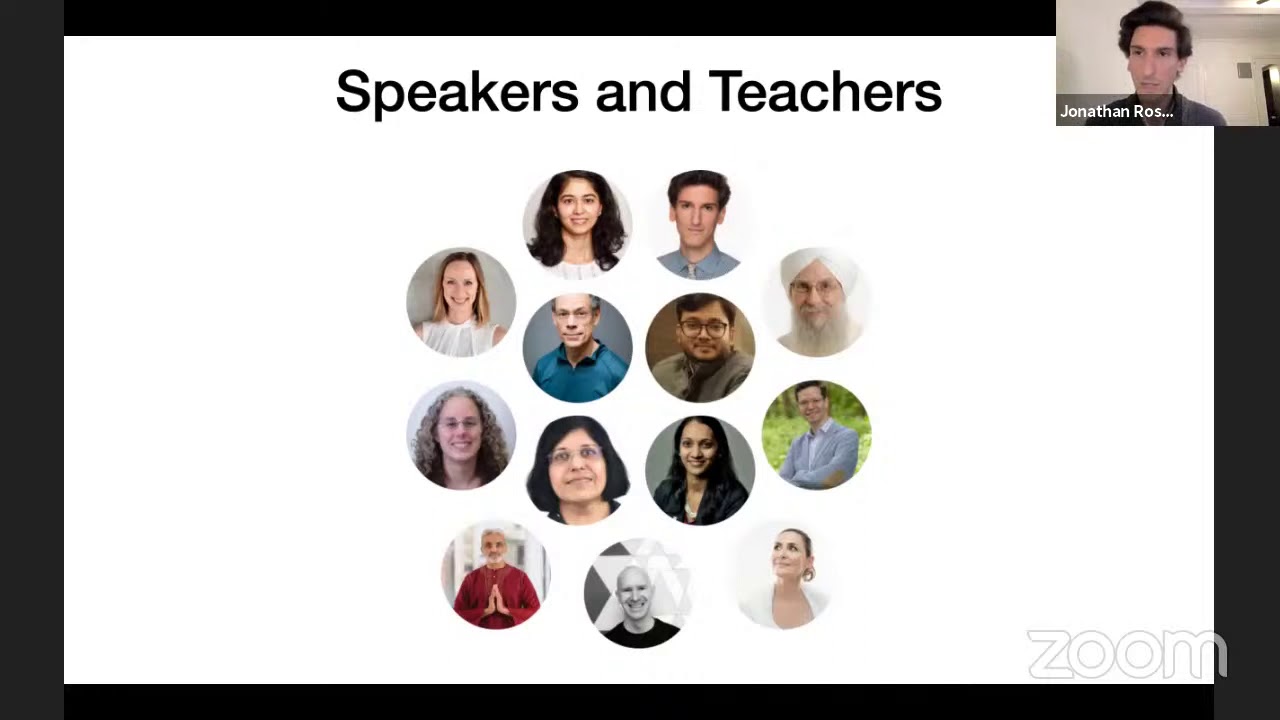
I'm a yoga student first and foremost. I started practicing yoga when I was a teenager, and I actually have a picture from back then. This is me and Sridharma Mitra, my yoga teacher. And I think I'm 18 years old in this photo with him. And so yoga has been a big part of my life for a very long time. I always return to the practices of yoga. I think that What yoga has really taught me is all is within and you can really connect with that at any time. Just a picture of more recently. This is February 2020, right before COVID took over the world. This was at Dharma Center. I was on vacation having the time of my life taking yoga every day. This is another side of me. I'm a physician in training, so I'm a resident physician in New York City, and I am a neurologist, so I study disorders of the brain and the nervous system. So these include things like strokes, seizures, multiple sclerosis, Parkinson's disease, neuropathies, and this is what I spend most of my time doing. I'm actually on vacation this week, and I made my vacation all about this conference. And this is one of my close friends in residency, Dr. Urban. We are— we go, you know, back to the beginning of residency, and we've been together for a while as friends. And then this is kind of a picture of where the two merge. So this is at a past neuroscience and yoga event where, when they were in person, we used to be able to bring these plastinated donated brains from patients. So patients while they were alive signed up to offer their brains for educational purposes, and we used to borrow them from our institutions and bring them to teach neuroanatomy at these events. So this is just a picture of that, some of my favorite memories of my life so far. So this is a little bit about me. I hope it helps you feel comfortable approaching me and, and asking questions and connecting. So the background of this conference is really in merging these 2 interests of neuroscience and yoga for me, and I imagine, you know, for everyone here too. So for me personally, I started doing a lot of neuroscience about 10 years ago, and When I was an undergraduate student, it was very important in our department that everyone participate in neuroscience outreach, meaning that people engage with non-scientists and talk about what science is and what it isn't. And we had so many events doing this during Brain Awareness Week, which is an international celebration of neuroscience, and it's actually starting at the end of the conference. I encourage you to check it out. So the whole background is during my undergraduate, I started making events combining neuroscience and yoga. These are some of the pictures of events in the past. I actually ran out of space, so here are some more pictures. And the conference is really a continuation of that. So the conference is the online way of doing it, and it also means that we can now connect with even more people, including the researchers themselves who do the studies, which previously we weren't able to do. So that leads me into talking about the people in this conference. So you're going to meet all of the speakers. You'll be able to— obviously you'll hear introductions about them and their presentations, but you'll also be able to ask them questions and hopefully get a lot out of the experience. And I think They're all amazing. I look up to all of them, and that is not an exaggeration. I honestly think they are fantastic scientists and have done amazing work in the field of neuroscience and yoga. You don't have to take my word for it though. They've been featured in many, you know, powerful news organizations including Time, Scientific American, NPR, TED, the New York Times. And they've also been published in very reputable journals including the Annals of Internal Medicine and Neurology. You'll hear more about all of them and then of course the yoga teachers as well. You'll get to meet them. If you'd like to learn more about them, there's a speaker page on the website and you can read their bios and then they all have links that you can go to learn even more. There are many people who help with making everything happen, and you'll meet them too. So there are people who are helping with making the experiments happen. There are people who are basically making the whole Facebook group happen because I don't know how to use Facebook. And there are people who are making sure the Zoom meetings are going well, and there are people who are helping with reaching out to people and communicating with people. So You'll encounter a lot of these amazing people, and I hope that you say hello and introduce yourself and take it as an opportunity to connect. Everyone here is interested in neuroscience and yoga, so we all share that. So on to a little bit more about the conference. So the conference has 3 separate topics. each corresponding to a different day. So the first day will be yoga and cognition, including attention and memory. So how does yoga affect cognition, attention, and memory? The second day will be yoga and mental health, including anxiety, depression, and trauma. And the third day will be yoga and chronic pain, including migraines, back pain, And so these 3 topics are going to be focused on different days, and then each day will have the same components, which we're going to go into a little bit more. But I will say the components are a presentation, multiple presentations, 3 to 5 presentations per day, yoga classes, so one yoga class per day, experiments before and after the yoga class. And then question and answer sessions with the presenters. So those are the main components, and we're going to go over in detail what each of them is and what to expect. So in order to talk more about the components, I just want to talk about the different passes, because which pass you sign up for determines which components you're going to participate in. So we really wanted this conference to be available to everyone. We wanted to make it as accessible as possible. And so the first option is a donation-based option where we're not asking for anything in return. We're offering the presentations for people's learning, and it's available for 24 hours. We also have a Facebook group, which again we'll talk more about, that allows for more engagement and discussion on these presentations. So those are what's included in the Presentation Access Pass. The Live Access Pass adds to this by including the live sessions. And so these are the yoga classes, the experiments, and the question and answer sessions. The Lifetime Access Pass is the next step, which is really designed for yoga teachers and people who want to go really deep into the material. And so instead of 24-hour access to the presentations, It offers lifetime ongoing access to the presentations in a secure portal, which we'll also look at. And it will include all of the live events as well, but not all of them will be recorded in the portal, and we'll talk about which ones will and will not. And then we're working on some transcriptions and workbooks and quizzes just to kind of enhance the learning aspect of this. And with all of that, it comes with Yoga Alliance continuing education credit. Let me just make sure I didn't miss anything on my list. Ah, yes, one thing I want to mention about the lifetime access portal is that it is not complete yet. So for those of you who have logged in, material will continue to be added to it as the conference goes on and as, as we complete things on the back end. So as we get the presentations, we go through them, we make the transcriptions, and then we make workbooks, and we're going to keep adding things. Um, and that— all right, that's everything. Um, so between the passes, you can actually switch at any point in the conference, but I would highly recommend whatever you're thinking about, please ask your questions today in this or email me separately, because I want to make sure everyone has the right pass for them before we launch into all the material. Because, um, basically, if you, if you purchase a live access pass on Saturday You will miss Friday. And you know, of course, you're still getting Saturday and Sunday, which is amazing. But I don't want anyone to miss out when you know we could have talked about it now. So now that we've talked about the passes, we can talk about the schedule. The schedule is on the website, so you can go to the main website neuroyoganyc.com. And there's a schedule section, and then you can just tab through the different days. You also will have this beautiful PDF that Emily made of the schedule in every single email you get from us. So it'll have what's going on each day. So this is just what today's looked like. This is where we are right now. We're at the Neuroscience and Yoga Online Conference kickoff party or intro party. I've been inconsistent with naming. And you can see, so it says below, available to all tiers. So this just— so when you're going through the schedule, you can look at it and know which ones am I participating in. So these are what the other 3 days look like. You may have seen this on your— in your emails already. And it looks like a lot. It's a lot of text. But if you break it down, it all follows the exact same pattern that we talked about, which is presentations, yoga classes with, with experiments around them, and then question and answer sessions. And one thing that I really want to point out that is super important is that the presentations for 24 hours start 24 hours before the question and answer session. So that means it gives you the full day to go through the presentations and submit your questions so that we have them all together and people are prepared for the question and answer session. So we'll just go through one day as an example. If we look at Friday, tomorrow, you can see that all of the presentations, the top 3, say available at 5 PM Eastern Standard Time March 11th, which is approximately 2 hours from right now. So all of the presentations for tomorrow will go live today so that people all over the world can watch them and prepare for the question and answer session. And the presentations say available to all tiers because these are, you know, the presentations are available to Presentation Access Pass, Live Access Pass, and Lifetime Access Pass. There is one thing that can get confusing, and it is that 4 of the presentations will be given live, and this should be really fun for everyone. So we're going to have live presentations as well. Those live presentations are still presentations, so just think of them like presentations. They will be live at some point, but then they will be available for 24 hours, and they will be available to all tiers. So that is the— that those are all the presentations for the day. And then if we move down, we see at 2:30 PM there is an experiment. 3 PM, a yoga class. 4 PM, more experiments, right? So the yoga class is going to be between 3 and 4, and then the experiments are around it. Someone sent an email, I think it might have been Mark, that the end time should be on here. And that's true. Good point. I will say that generally the experiments will be 30 minutes. The yoga classes will be an hour or an hour and a half. I mean, it's— it might vary a little bit. And then the yoga classes on Saturday are much longer. They're 2 and a half hours. And then the question and answer sessions will be about an hour. I also don't want to hold anyone, you know, if there's a ton of engagement and people have a lot of questions and the presenters are comfortable staying a little bit later, it will also run a little bit later. And then the Q&A session is at the end of the day, you can see on Friday. And it says which passes are able to attend that, so live and lifetime access for the live events, the experiments, the class, the yoga class, and the question and answer session. So that's how the schedule works. One place to be super careful, so there's one live presentation on Friday, there are 3, the other 3 are on Saturday. And so from 6 PM to 8 PM, there will be 3 live presentations which will be available for 24 hours, but the question and answer session is at 9 PM. I'm sorry that the schedule worked out this way, but this was kind of the time constraints we were dealing with, with everyone's schedule and time zones. So if you're able to, I would really encourage you to try to stay the entire 6 to 8 PM, take a break from 8 to 9, and then come to the question and answer session at 9. Okay, and one last thing to be aware of, the presentations on Saturday— on Sunday, I mean, I apologize. So 24 hours before the question and answer session, right? The question and answer session on Sunday, Yoga and Pain, is at 11:00 AM. So that means that the presentations are available at 11 AM on Saturday, which is tough, right? Saturday is already a busy day. So now you would have to watch all the presentations before that. So the presentations are about 30 minutes each. And so hopefully you can watch them on Sunday, but before 11 AM. Should take 2 and a half hours. If you're not able to, We extended how long they're available until 3 PM, so 4 extra hours so that you're able to watch those. Because I know that that's really tight scheduling, and again, it's— it was balancing a lot of people's schedules. So that's an overview of the schedule and the most frequent questions people have about it. And huge shout out to Karen. who you'll meet in the Facebook group, she actually realized the 11 AM issue and pointed it out and fixed it. So, okay, so now I want to go over each of the individual components. I want to talk about the presentations, the yoga classes, the experiments, and the question and answer session. So this is what a presentation page will look like, and you'll basically see a title, a countdown timer that tells you this is how much longer this presentation will be available. The presentation itself, which will be a video, you can pause, you can rewind, you can watch it 3 times, 4 times, as many times as you want in the 24-hour period. And you'll also see a summary of the researcher's bio, as well as a really important reminder that all of this is education and not medical advice, right? We don't give medical advice over the internet randomly, right? It's all— You, you need an evaluation if you want medical advice. So this is educational, we're presenting research. And then below that is the very important question form. So the question form links to a spreadsheet. And so when you're, when you're watching the presentation, this is the best place to submit your questions. When you submit them here, they go to a spreadsheet that we will pull up during the question and answer sessions and be able to sort. And then go through them. So I highly encourage you to use the question forms embedded on the presentation pages. Let me just make sure I did not miss anything. Okay, that is everything. So now we'll talk about the live session. So again, the live session includes the yoga classes, the question and answer sessions, and the experiments. It does not include the live presentations, right? Those are presentations. So for these, the links will come to your email 10 to 15 minutes before every event. And I think someone was asking why that is. So it's a kind of a security issue, having the same link. I've had Zoom bombings, I'll just flat out say that, and we just want to make sure everyone has a good experience here and we want to make sure that that doesn't happen. So this is a security measure. And so the live events, the yoga classes on Friday will be Eddie Stern. Saturday will be Sridharma Mitra, and Sunday will be Catherine McCusker. The time— so Eddie's in the afternoon on Friday, Dharma's in the morning on Saturday, and Catherine McCusker's in the evening on Sunday. And that is at every time, like every, you know, morning, evening, afternoon. gives people the opportunity in different places to participate. It is set to New York time because that's where the conference is based, but we want, you know, there should be at least one or two you're able to join wherever you are. The question— I'll start with the experiments because that's around the yoga classes. The experiments are extremely cool. It's probably my favorite part of this conference, where we will be essentially replicating some of the science experiments talked about in the presentations, but on ourselves. Not just me, but everyone. So you will have the opportunity to do this too if you join the experiments, where we'll basically have apps that you use to kind of record different physiologic measurements. We'll have computer games where you're kind of answering questions and we're testing your memory and attention function. And we'll have kind of questionnaires that people fill out too. And all of this will just be demonstrating, first of all, how science works, and then second of all, how it affects you and your own neurophysiology. It's really fun. I love it. The only thing to note is that you will not get the results right at the end. It takes us a little bit of time to To collect all the data, organize it, clean it up, and analyze it. So that will come, if not the next day, you know, maybe a couple of days after the conference ends, we'll be able to send all that out. Okay, and then the question and answer session. So as I said, we'll be pulling from that form. It will have, you know, everyone who's watching the presentations has the opportunity to submit questions to the question and answer sessions. We'll, we'll go through them, we'll kind of group them, put similar questions together, and we'll, we'll kind of have a very comprehensive question list for the researchers. We will also have the opportunity for people to either type into the chat in the Zoom meeting or open their mic and ask live if, if that's what they want to do. And this will kind of be a nice way for people to interact with the researchers. So those are all the live sessions. So now I want to go over the lifetime access portal. Oh, one thing I should mention. So the presentations— so the presentation access pass and the live access pass access the presentations through here. The live sessions are how the live access pass and Lifetime Access Pass access the live sessions. And the live sessions are unfortunately only live. The only one that really can be recorded is the question and answer session. And the reason for that is the yoga classes are proprietary, they belong to the yoga teachers. And then the experiments are I mean, basically it's just going to be us helping people set up the experiments and do them, and then the presentations about the experiments we will share. And then the question and answer sessions will be recorded, but as of right now they are not available for 24 hours. If, if enough people email me and say that they really want that, I will try to make it happen. It just takes some work on the tech backend side of it. Um, so that's who will be accessing this, and then the lifetime access portal is where the people who get a lifetime access pass can go in and access everything. So the way to go is the 3 bars in the top right are the menu, and when you click that, it opens up this, and at the bottom you see lifetime access login. When you click that, you get taken to this course page. Do not click Take This Course. I think some people may have been doing that, and then it asks you to buy the course, but you already bought it. So you click Login. When you click Login, you go to a login page, your login was emailed to you. And then once you log in, you see your profile. And if you scroll down, you'll see all of the content contained in the conference. And it's organized by day or topic. And when you click on one of the, uh, one of the lessons, let's say you're interested in yoga and memory, it'll open up the presentation for yoga and memory. And you can even keep track of which ones you've done and which ones you haven't done. So you can mark them complete, you can, um, advance, and obviously you can watch it as many times as you want. And then on the left, you have access to all of the other ones if you want to like click through and navigate everything. We will continue, as I said before, we will continue to add things to this portal. So as the presentations happen, as the question and answer sessions happen, and we're still working on some of the transcripts and workbooks and other fun stuff and quizzes to put in here. Okay, now the Facebook group. So one of my favorite things about the in-person events was that we met a lot of people and everyone got— I felt like I made a lot of friends at these events. And we don't have the same kind of interpersonal connection over the internet. It's hard. So this Facebook group is an attempt at improving that. And so it's really a community where we can discuss what we're learning in the presentations, and then also get to know each other. So these are just 3 of the introductory posts. These are the 3 people who are moderating the Facebook group, so Kristen, Karen, and me. And it's really, I think, going to be a great experience. And we're going to offer prizes for people who participate. I'm all about bribing people to participate if we need to. So yeah, I really encourage you to join, or at least, at the very least, check it out and see what you think. One thing to note about the Facebook group. So this is for community building. It's for people to talk to each other and learn about neuroscience. It's really not for the technical side of the conference. So if you're having issues like logging in or something's not working, go through the support page on the website because that's going to go directly to my email. And I set up the whole backend of the website so I can help you fix that. So the tech stuff, I really think, should go through the website because it's going to go to the right person to help you. Whereas if you, if you do things in the Facebook group, I, you know, I might fall behind. I'm less fast. So let's say you have questions. What do you do now? And not questions during the Zoom meeting. You can definitely ask them during the Zoom meeting, but There— this is a small team of people, and, you know, we all have full-time jobs outside of this, so we are trying to streamline everything so that people's questions are answered efficiently and, you know, decrease our email numbers. So the website has 2 separate sections for frequently asked questions. This one is on the main page, so if you scroll down on the main page, these— this set of FAQs really answers what are the different passes, what is this conference, how can I join if I'm on a tight budget, what if I'm internationally, how do I get into things, like just like those kinds of questions. So I really encourage you to check out the frequently asked questions when you have a question, because anytime we're getting questions, I've been trying to put them into these, um, so that— because I assume if one person has the question, other people do too. So, um, everything will be here. If it's not in this one, there's a button below it, Other Questions. Check out our technical support page. And this— these are the questions that are kind of more technical. So, I placed my order, um, but I didn't get my email, or I, um, ordered twice, or I missed one of the live events. What can I do now? The videos aren't working. Basically a lot of the, the tech questions. So these are all answered here as well, and I encourage you to check them out. If you still have a question after you've gone through the FAQs, absolutely reach out to us. Just below this on the website, there is a form that you fill out to ask questions. And it goes right to my email. So that is my overview of the conference and how things work. I hope it is helpful for people. I think a lot of people have worked really, really hard to make this happen. And, you know, I know there are going to be some glitches and issues that come up, but we're here to work through it and make sure everyone has a good experience. Learning neuroscience and yoga. So just don't hesitate to, you know, let us know and let us help. I also just want to say a big thank you to Eddie Stern, who is one of the yoga teachers. He actually was— he encouraged me so much early on when I was kind of thinking about doing this. He, he was a huge source of support. So I just want to a big thank you to him. And I also have to say that it is very auspicious that this conference starts on Shivaratri, which is a major holiday, and ends during Brain Awareness Week. It's kind of— we're kind of going between yoga and neuroscience. So, um, that's the end of my presentation. Thank you all so much for listening. I open it up to chats. I'm going to look at the chat box right now. I lost my mouse. Thank you, everyone. Ah, great question, Mark. So in every email, I'm going to pull them up right now and see if I can show you. All right, I'm sharing my whole screen, guys. Don't judge anything on my screen.
Okay.
So this is the email and the— at the bottom of every one, what I need you to do right now, this is me being like, pay attention. There is a place, place the events you don't want to miss in your calendar right now. And if you click this, it will open up the PDF of the document I showed you. So that's where you can access it from every email. Mahashivaratri. All right. So it looks like there are no other questions. I'm happy to stick around for a few minutes. I'm also happy to just chat. Um, I'm going to let everyone unmute themselves. I trust you guys now. I always am a little worried, but okay.
Hey Jonathan, it's Mary.
Hi Mary.
Hi, um, just for planning purposes, I think you said Saturday morning's class is going to be about 2 hours.
Yeah, 2 and a half.
2 and a half.
Yeah.
Okay, awesome.
It's not all postures, so it's a Maha Shakti, which is an all-levels posture class, and then there is a yoga nidra afterwards, so a deep relaxation.
Okay, I think on the schedule it has the experiment starting at noon, but that'll more likely be like 12:30-ish.
Um, ooh, let me check. I hope that's not a typo.
It might have just gotten cut off. It—
I think it got cut off. Um, we will fix that. We will fix that and send it out. Sorry about that.
Yeah, no biggie.
Thank you for pointing it out.
Yep.
So it'll be about, um, 12:45 when the experiments start. And the, uh, experiments are basically— you'll have 15 minutes between the yoga class ending and the experiment starting.
Okay, cool.
Just so you can go to the bathroom and whatever you need. How will you apply 10 hours for teachers to the Yoga Alliance? Great question. So The Yoga Alliance part of it, the continuing education credit, will be through the lifetime access pass. And it's once you complete the portal and do all of the sessions, then we report, you know, basically put it through to the Yoga Alliance. The word report sounded weird to me, sorry. And Emily, who is here may want to talk about that more.
Here, also my phone might die, so if I cut out suddenly, it's not to be rude. So I have put this conference on my personal Yoga Alliance profile. To get credit, you have to be at least Tier 2 to participate in the Q&A sessions, and we just need proof that you've taken part in the conference. Which is just us like taking attendance, kind of like in school. I will submit your email that you used to register for the conference, and then you will receive an email from Yoga Alliance confirming that you did take part in the conference, and I'll send you a little certificate too so you can show people that you took part in this. Questions about that, you're welcome to talk to me.
Thank you so much, Emily. Trying to unspotlight myself, but I can't find it. What does Eddie's class look like tomorrow? All levels? Great question. So Eddie was— he's been working on a new class that is Very much all levels, and it includes a lot of pranayama. Actually, I think about 20 minutes of the class is pranayama. So he he's definitely designed it to be all levels. All of the classes should be all levels, and if not, you modify. Don't you know? Don't go crazy. Yes, so someone is asking, are you planning to continue more classes in the future? And the answer is yes. I don't know if it'll be this conference every year, but hopefully it will. I think this conference is amazing. I'm really excited to see all of the presentations and the experiments and the yoga classes, and I You know, in the past we've done kind of smaller events, and we may continue to do those too in between, but definitely more to come. All right, so I'll do about 3 more minutes. It looks like questions are tapering, but please feel free in the next few minutes to ask away. Yes. Oh, great question. Thank you. So someone is asking about this app that we're asking people to get. So, um, for the live and lifetime access pass holders who are going to participate in the experiments, we're asking you to get this app. At the bottom of every email you'll see it. And essentially what the app does is allow us to record certain physiologic variables. Basically, it allows us to just use the back of a camera and your finger, and you put the camera to your finger and we can Measure a lot of things. And so the app is free. It does ask that you make an account. I actually made an account through Apple. I didn't even have to make it. Apple, like, I don't know, I look at the email and it's like a fake email that Apple sent them. So it's pretty cool. And you just make an account and we'll show you everything you need to do from there. You just— I just want to have it downloaded so we don't have to wait for people to download it. That was the reason I put it in the email. Every other experiment will be on the computer, so you'll just need to open up your computer, click a link, and then do what it says. It will involve keyboards and mice, so I'm going to ask that you do not use a phone or a tablet. Try to use your computer for the experiments. If you can't, obviously it's okay, but that's ideal. Did I miss any questions? If I missed your question, please repost it. Yes, I can show you the logo. Hold on one second. So I could do this a really bootleg way and just hold up my phone, but I'm going to show you their website. So it's, uh, Weltery, and they have a really nice website. And if you want to download their stuff, you can just click on Apple or Android if you have one of those. I think those are the only 2 it works with. Correct. So the next time we'll be together is 9 AM Eastern Standard Time tomorrow, uh, and that is about 17 hours from now. Um, you will get a link and we will, uh, start with Dr. Khalsa's presentations. All right. Thank you everyone for the amazing questions. I hope they were helpful. I'm Going to reiterate how overjoyed I am, and I'm really looking forward to the next few days. So thank you guys so much for being a part of it.
All right.
Take care, everyone. We will be in touch. You'll get an email soon with the links to the presentations for the next 24 hours.










