Why is it important to scientifically study yoga?
Neurologist Jonathan Rosenthal argues that scientific study of yoga is essential for establishing credibility, ensuring safety, and combating misinformation. Over 8,000 studies now examine yoga's effects on migraine, cancer symptoms, eating disorders, and back pain. He teaches how to locate and evaluate research using the PICO framework and reliable databases like PubMed.
Chapters
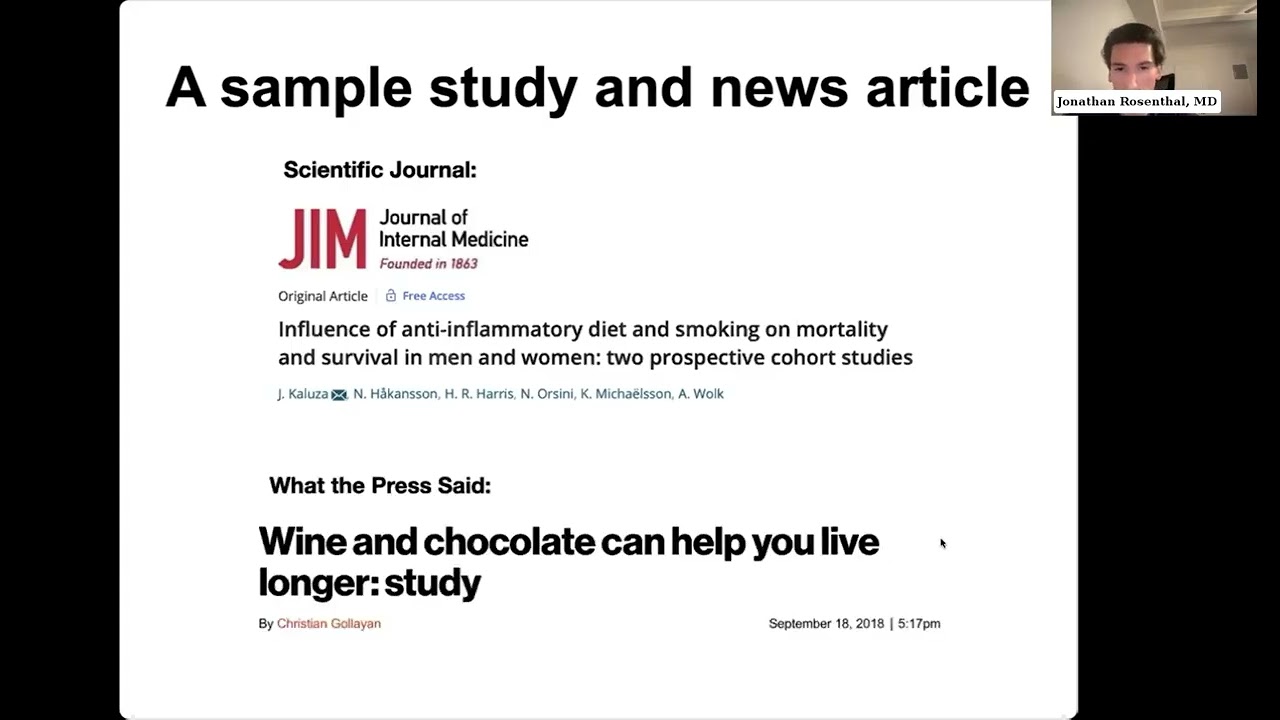
So thank you everyone so much. I am very excited to be here and thank you everyone in attendance for your attention. I'm going to be presenting about neuroscience and yoga and really science in general. And I just have to say, I really love hearing from everyone. I love hearing everyone's stories and learning about you. So yeah, definitely everyone, if you do reach out to me and when people are talking going forward, please continue introducing yourselves. But it's only fair if I return my, if I introduce myself in return. So I'll tell you about me through some photos. So I'm Jonathan. I am a yoga student in New York City, and this is a picture of me and my guru in 2013, then again in 2020. So I'm a student of Sridharamamitra here in New York City. I'm also a physician, and so science is really, really important to me. I see science save lives every day. And I'm a neurologist, which means that I'm a medical doctor that specializes in taking care of patients with diseases like stroke and epilepsy and multiple sclerosis and Parkinson's and so many more. And I'm also really passionate about neuroscience outreach, which means sharing neuroscience with everyone. And this is a photo from one of our events back in, I think, 2019, and we were going over neuroanatomy with a brain that someone had actually donated after they passed away. And I share all of this so you think of me as approachable and human, and I really want to share neuroscience and yoga with everyone in attendance. So thank you again for having me. An overview of what I'll go over. I'll very quickly go over what is yoga. I don't think I need to with this audience. I'll also go over what is science. And I think the most important thing I'll talk about is why do I think it's important to study yoga scientifically? I'll go over a sample study. And equip you with probably what I think is the most empowering skill in this area, which is how to find and read a scientific abstract. And then I'll summarize with some practical takeaways. Is everyone ready? Mm-hmm. Okay. So quick introduction to yoga. I think everyone here, when you picture yoga, you have a very specific picture of what yoga is. But I just have to point out that if you Google yoga, This is a very recent Google image search of yoga. What you find is fit young people in tight pants. And I think we all know that that's not necessarily what yoga is. All of us here, I think, think of yoga as an ancient practice that was initially designed to bring first health and then mental sharpness and ultimately a settled mind so that the practitioner could identify with their true selves, their higher selves. And quickly, I think everyone here knows this as well. Yoga consists, classical yoga consists of 8 components, all again designed to bring a settled mind. And why it's important to bring this up now is if we're going to talk about yoga in scientific research, it's not always the case that all components of yoga are included. Typically in the scientific literature, yoga includes postures, breathing, meditation, and relaxation. And this is changing to some extent. More studies are including all parts of yoga, but for now, the bulk of the literature includes these 4. And when yoga is studied, I also think it's important to note that it's been found to be very safe with minimal risk of harm. There are some really horrible case reports of people getting really injured with yoga, but those seem very rare. And when yoga is studied in large trials by well-credentialed teachers, I very rarely see any serious adverse outcomes. Most of the adverse outcomes are just minor temporary joint pain and soreness. Okay, so that is my overview of yoga and how yoga is studied scientifically a little bit. So now I just want to talk about what is science. And I think everyone here, you know, we all know that science is kind of the language of modern society. To the point now that people even talk about science with almost a religious or dogmatic tone, right? Which is actually pretty anti-science. But really science is all about how do you know what you know? How do you know what you know? So for example, if I show you some data like this, which is ice cream sales and shark attacks over the months of the year, you might look at this and make a conclusion like, wow. Sharks must really like ice cream because when there's more ice cream sales, there's more shark attacks, right? And do you know that that's true based on these data? Absolutely not, right? That's not, that's not the most reasonable conclusion, even though it's one possible conclusion. And probably the most likely conclusion is that these 2 go together because when it's summer, more people eat ice cream and more people go in the water where the sharks are. And so science is really about considering all the possibilities and then testing them one by one. And of course, this example, which is kind of humorous, is really obvious. Um, but you'll notice that there are subtler examples in our lives all the time where we tend to draw conclusions with insufficient evidence like that and take shortcuts in reasoning and data collection. And so science is a systematic way To avoid those shortcuts and reliably answer questions. And of course, in this process, no single study is perfect, but taken together, the scientific literature really advances collective knowledge over time. So science is a systematic way of building knowledge about the natural world, and it works by building a model of how something works, kind of like, I think it works this way. And it's really important to note, one of my professors said this, and I, I think it's brilliant. All models are wrong, but some are useful. So no matter what, there's always a way to prove some part of a model wrong, but for a lot of things, it might be very useful. And then when you're testing that model, you make that model have a prediction, which is called the hypothesis, and then you test it using an experiment. And whenever this is done, it should be valid, meaning we're measuring what we actually think we're measuring. It should be replicable. So if someone else did the exact same study, they should get the same results. And it should be ethically conducted. And this is really the core of what science is. It is just a process using these methods to build knowledge about the natural world. Okay. And now a slide that I'm really passionate about. Why is science important for yoga? You know, a lot of people send me hate mail. Because they say that studying yoga scientifically takes away from some of the mysticism of yoga. And I really don't think that this has to be the case. I think that yoga and science are really viewing the same thing, which is the world, from different perspectives. So the way I see this is yoga is trying to get at pure consciousness, which in yoga language, for those who are familiar with it, is like Purusha. And science is really trying to understand the cause and effect in the world of matter, which is Prakriti. And so really they're kind of looking at 2 different sides of the world. And it's so important to study yoga scientifically because as we said before, science is the language of modern society. And so sharing scientifically proven benefits encourages participation from individuals in yoga. And also helps institutions like healthcare organizations, schools, government organizations to really buy into and promote yoga. The other thing, and I really feel strongly about this because obviously I work with patients, I think we owe it to patients to know the risks and benefits of yoga before we recommend it to them. I don't think it's fair to tell people who are suffering with a disease like multiple sclerosis or cancer or anything like that to say you should do yoga without knowing for sure that it's going to help them. And I don't know if you guys have noticed this, but I, I feel like I go out into the yoga world and I hear a lot of false claims and misinformation about yoga. And this really damages the credibility of the yoga community. And I think having scientific research can actually help address this because then we can talk about things that are actually verified. And longer term, I think yoga may actually help. We could improve on yoga protocols so that it can be applied more and more effectively to certain populations. And lastly, also by the same methods, reduce the risks of yoga, which are already quite small. So this is why I think it's really important to study yoga scientifically. And this is happening. This is a picture of the number of studies published per year. On yoga. And just last year in 2023, there were 859 scientific studies published on yoga. And so the total now is over 8,000, right? So you, you hear that number and you're like, oh wow, there's actually a lot published. And so this is really encouraging and it's, it's exponential. It's more and more every year. And it's a really exciting time for yoga, I think. And just to give some evidence or like examples of how important this is, because of some really well-designed studies that have been conducted, yoga is now in the guidelines for medical practitioners for several diseases. Meaning that when people are reviewing, okay, how should I help patients with this disease? Yoga is on the list. And those diseases are migraine, where it has a level B of evidence. Which is very good. Cancer, where it is recommended for helping with pain, mood, sleep, quality of life, also for eating disorders, and lastly for back pain. And so the scientific research has really changed how yoga is recommended and available for people because of all of these studies published. But besides, you know, despite all of this research happening, There is something weird that happens that you guys might encounter, which is when media outlets get ahold of the research. They tend to do this thing where they assume that everyone can't handle science, and so they kind of change how they present information. And in some cases they totally change the meaning of the study. So this is just an example. This was a study that was done not on yoga, but I think it's just a really good example. So the influence of anti-inflammatory diet and smoking on mortality and survival in men and women. Okay? So you can tell from the title of this study, it's about diet and smoking and how that affects how long people live. Well, when the media got ahold of this, the press said wine and chocolate can help you live longer. Study. Yes. Right? So it's very important to realize where you're consuming information because it can definitely get distorted. And so Very quickly, I just wanna give you what I think is the most empowering thing in the world, which is the ability to find and read a scientific abstract. And there are a few key concepts I want to go over. The first is levels of evidence. So this is really getting at how do I know what I know? So for example, let's say I, you went to the doctor and you were told you have high blood pressure, and then you were talking to Someone and they told you, well, I heard that if you take garlic pills, it will help your high blood pressure. Now, do you know that to be true based on that person telling you that? Of course not, right? That level of evidence is very low. It's not even on this chart actually. It's below the bottom. That's called anecdotal evidence where you just kind of hear it from someone. It's like a story. And then above that is where A lot of, let, let's say there's a doctor who's heard a lot of people using garlic and found that it helped them. That would be expert opinion. So higher than anecdotal evidence, but still quite low on the pyramid. I'm gonna leave out these 3 and focus on the top here. The highest level of evidence and the terms that we should be looking for in studies are randomized controlled trials, systematic reviews, and meta-analyses. With meta-analyses being the best. These are the levels of evidence that are the most convincing that you can have the most trust in, and that then can influence guidelines and change practice. So whenever you're looking for studies, these are like the main terms to look out for. And the other thing to look out for is this acronym we call PICO, P-I-C-O, population intervention comparison outcome. And so it's how many people are in the study? You know, what's the population? Obviously, if a study's done on 100 people, it's better than a study done on 10 people. Also, how did they recruit people? Is it only people who are healthy or did they include people who have certain diseases? If you're trying to apply yoga to someone who has a disease, you probably wanna study it in people with the same disease. And then you wanna know that the study, the people in the study are diverse enough that the study Applies to all people. You also wanna know, what are they calling yoga? What are they including in yoga? Which postures did they do? Did they do breathing? Did they do meditation? Did they include ethical rules? Did they include personal observances? And then you also wanna know, was it randomized? Meaning that people were assigned to one group or another group randomly, and the other group is usually a control group. And control groups are really important because if you're comparing yoga to doing nothing, yoga's probably better, but We wanna know also, is yoga better than aerobic exercise? Is it better than cognitive behavioral therapy? Is it better than meditation by itself? And by the way, in many of the studies, the answer to those questions is yes. And so that's really what the comparison is all about. And then we also wanna know what were their outcomes? What did they measure? Is that an accurate way to measure outcomes? And then do their data support their conclusion? So I think this is probably the most picturable slide in this presentation. If you wanna take a picture, I recommend just taking out your phone quickly, snapping this. It's a very helpful way to go through and look at studies when you're trying to read them. So I'll wait about 10 seconds. All right. And then let's say you wanna find scientific abstracts. Where can you go to do that? Well, there are 2 extremely reliable places. One is Google Scholar. Which is great because it searches the web to find free versions of it for you. And then the other one is pubmed.gov, which is a United States National Library of Medicine, but it pulls from databases all over the world. And these 2 are kind of like the main repositories of scientific knowledge. Okay, so that is everything I wanted to really, uh, go over and just to summarize. Studying yoga scientifically is important for understanding the risks and benefits of yoga, for making yoga credible in modern society and ensuring it is safe and effective, especially if people are going to pursue it for health reasons. You can read the primary sources of information by finding abstracts on PubMed and Google Scholar. The level of evidence matters, with meta-analysis being better than randomized controlled trials being better than everything else. You can begin to evaluate an abstract based on the PICO model, which was population intervention control and outcome with more people, active controls. Active control means compare yoga to something, not just nothing. And randomization being better. And then detailed descriptions of interventions are better. And of course, beware of clickbait and misinformation, which is everywhere on yoga. So I hope Uh, these points are really helpful as you continue on your yoga journey, as we all are. And if you'd like to learn more, I host an annual conference on neuroscience and yoga. We've covered so many topics over the years, including mental health and pain and child development and ADHD and brain aging and addiction and empathy and trauma and so much more. And you can go to the website. The conference is free. Every year. We also have a YouTube video with more details about how to, uh, find and read scientific abstract if you just search for neuroscience and yoga. And I don't know if we're doing questions, but I'm always available if anyone has any questions, and I will leave it there. Thank you again.










