How to Underwrite Any Multifamily Deal in 3 Minutes (Free Formula Inside)
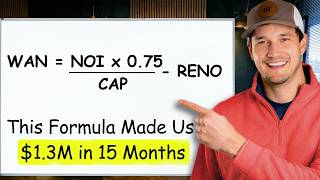
Jonathan Cronin shows how to underwrite a multifamily deal in under two minutes using five inputs: market rents, unit mix, expense ratio, renovation costs, and cap rate. He walks through the five-step formula live on an 88-unit property, arriving at a $4.5 million offer that later negotiated to $4 million.
Chapters
In this video, I am going to show you how to underwrite any deal in under three minutes using nothing more than a napkin. And this is exactly how I just analyzed a deal that ended up netting us over $1.3 million in equity within 15 months. Alright. And this is the first step that our investors in our private community use as well, to see if their deal is worth their time or not. Okay. My name is Jonathan Cronin. Together with my partners we have a real estate portfolio of over 550 million. And I'm going to walk you through and give you my initial assessment of the deal that we just took down and what I call my napkin analysis in three minutes. And then we're going to show you how we go into a deep assessment to make sure we are ready to sign a contract. All right, you ready? Let's go. All right, so first off, what is needed? There are five key metrics I've outlined here that are needed before we can go into the calculation and before we can go into the three minute example. We're going to put it on a timer in just a second. But number one, what need to write down is market rents. We need to know what are people actually paying in the market for similar units in that exact area? What are people paying? Not what is the owner charging or what is the owner collecting currently, it's what can people pay for similar units? Okay, so what is the market rents? What's our opportunity for growth? Typically we're buying properties that have opportunity to increase the rents based on fixing up the property, adding value. Okay, number two, you need the unit mix. That's pretty self explanatory. How many units? How many units of each type of unit? So one bedroom, one bath, two bedrooms, one bath, three bedrooms, two baths, whatever that is. 32 units, three, two, 12 units. Two, two, whatever that is, write that down. Number three, expenses. So if you don't want to dive into expenses right away, Right, we're doing a napkin. We're just, we're at a dinner party, we're talking to someone and they're just sharing exactly, you know, about deal. So we can do some quick estimate and we'll say just 50%. Now be more conservative. If you're looking at properties that are value add 1970s, 19, 2000. Somewhere around there you may want to underwrite for 55%, but we're just going to say 50% as a general rule. All right. So expenses could be, you know, your maintenance, property management, your taxes, insurance, all this kind of stuff, expenses. So you're you're going to back out 50% of your expenses from your income. Okay, number four is your renovation costs. This is a not a hard rule here on the napkin. We're just doing an initial assessment. I would just estimate based on what you know about the property based off what the seller, the broker is telling you. Go to Google Maps and just drive the property, see what you think it would take. Typically for us, we're doing light to moderate value add. We're not doing any heavy guts or things that are under 50% occupied. We're not doing full unit renovations in terms of, you know, from ground up or, you know, any guts. Right. So we typically just say light to moderate value add. If you don't think there's a whole lot that needs to be done, just estimate 3 to 5k per unit. Okay, so just a quick rental cost. Give an estimate. All right, number five. And lastly is your market cap rate. So look, market cap rate can confuse people, but essentially it's the number that your unit could sell for based off of once you get it stabilized. Right. Once you get it up to market rate. So your cap rate is typically, you know, your noi divided by the state, the value of the property that gives you your cap rate. Right, but in this situation, we want to know if your property was fully renovated, what could it sell for? So the noi, once it's renovated, divided by a certain number can give you what you could sell it for. So the higher the cap rate, it's typically a lower, less competitive market. Right. It's not as desirable of a market, the lower the cap rate, higher competition, really nice areas. Okay, so the best way to find your market cap rate is simply a commercial mortgage broker or a commercial appraiser. That's going to be your truest source. Obviously you can go to ChatGPT and get a quick idea, but just make sure you're putting in the market cap rate, not the current cap rate, but the market cap rate for past sold investments in that area that are at a similar condition to where you're going to get your property. So the specific type of property value add multifamily, you know, class B, class C, whatever that is. Okay. In that specific area. All right, so that's the what's needed. That's what you need initially. And we're going to move on to five step calculation before we get an example. You got to know how to calculate what's needed. Okay, so first you take your unit mix times your market rents. Again, that is not your current rents, that is market rents. All right? Then you multiply it by 12 months and that gives you your yearly gross potential rents, all right, Your gpr. Now again, this is what you the max you can make from the property. We're not going into a deep assessment right now. We're just trying to figure out is this deal worth your time and then we can move on afterwards to go into a deeper assessment. Once we've got the napkin, it passes the napkin. Okay? So at that point, once you go deeper, you can factor in, you know, vacancy, loss, to lease, all these different things. But right now it is just your gross potential rent. If the property was 100% occupied. Okay, number two, you're going to take your gross potential rent and you're going to multiply it by 50% or you're just going to take out the expenses. Okay? So if it's 55% expense ratio, you're obviously multiplying it by 45% and then that is going to give you your net operating income, right? So your income minus your expense expenses gives you your noi. Okay, so for this case, we take our gross potential rents times 50% equals your net operating income. All right? Now next we take our noi, all right? Because that noi is what tells us the value of our property. That's a very important number. So we're going to take the noi and divide it by your market cap rate. Again, there's several different cap rates out there. The broker is going to say your in place cap rates. If I were to buy the property right now, what would it return on my investment a year from now? What is that cap rate? That's not the cap rate we're talking about or the cap rate that we want to get it to, whatever that is. This is about the market cap rate. What's the lowest we can sell this property for once it's stabilized? Okay, so noi divided by your market cap rate gives you your stabilized value. And single family, you may hear it about after repair value, after you fix up the property, what's it worth? Okay, so, so now we have our stabilized value, we go to step four. Stabilized value times 0.78. Now what is that? 0.78. That gives you your total cost basis. The reason we put this here is because obviously you're not buying it for what it's worth in the future, right? You got to have margin now to be able to make sense of the purchase, right? And make sense of the effort you're going to be putting in. So everyone's number may be different. Some of our investors that we help, you know, may put a 75%, some may put 80%. You know, years ago we were doing more like 70%. You know, the reality is you got to be competitive in the market, but you got to make sense of your time. And this again, this number will, will go deeper in. If it passes our initial assessment, we'll figure out what is the cash flow coming to you every month. We'll figure out all that kind of stuff to see is it worth your time. But for right now, if it's a light to moderate value add, there's no heavy guts, there's no flat full property renovations, there's no under 50% occupied or really even under 70% occupied. As long as it's above 70%, I would attribute 78% to 80% discount on your stabilized value. Okay. That gives you your total cost basis. Number five is your total cost basis minus your renovation cost. Okay. Gives you your maximum allowable offer. This is what you're actually going to offer the seller. All right, so your total cost basis is what you're actually the full funding that you need for the property and what you would be getting the debt and the investors in on. But then your maximum allow offer is what you can actually offer the seller. Okay. All right, so now we're going to get into the three minute example. Okay. Before you start running the clock, I want to give you the data behind this. Now big thing is the more you know your market, the faster you can go through the napkin and you can decipher the good deals from the bad deals. And the reason I emphasize that so much is because you've got to learn how to decipher through good deals versus bad deals. Because the worst thing you can do is waste your time on bad deals. No matter if you're a smaller investor or you're a larger investor. That's one thing we do really well is finding really good deals going off market direct to seller, being in an auction of one. Right. But that's only possible if we can create a lot of lead flow and decipher very quickly what are the good deals versus bad deals. So as I give you the data, understand this is from market knowledge, this from doing some research. But at the end of the day, the more you know your market, the more we can do it. So market rents 825 per month. Okay. Unit mix is 88 units, expenses 50%. We went with the general rule of thumb here at 50%, we don't have the financials to go through. We're just getting a general rule of thumb here at 50% renovation cost $264,000. We just attributed $3,000 per unit to 88 units. Okay, market cap rate 6.75. Again, you can go to chat gbt. You can just have market knowledge, right, or go to a commercial mortgage broker. Commercial appraiser. Now here we are, we've got the information. Get your calculator out, see if you can beat me. We've got the numbers. Let's start the clock. 3, 2. All right, so market. 825 times 88 times 12 months. Let's go to the number. 871. 200. All right, 871. 200 is our gross potential rents. That's our total income. Now we're going to times it by 0.5. All right, so that's 435. 435,600. Now we've got our NOI, our net operating income. Now we divide that by the cap rate divided by 0675. It gives us 6 million. This is our stabilized value. 6 million 453. 333. All right, hope you're following. That's your NOI divided by your cap rate is your stabilized value. Stabilized value times 0.75. We went with 75% discount to give us our total cost basis of 4.84 million. Now that's our total cost. That's what we want to be all in for. We backed out our discount. Now we got to get our maximum allowable offer. I feel like I'm a auctioneer at this point. TCB minus rental cost. Uh oh, did I do that wrong? Oh, I did. Where's my. I think I clicked a button. Oh, there we are. Okay, now TCB minus your rental cost of 264. 4576000. All right, time. We got our maximum allowable offer of 4.5 million. I did it in 1 minute and 50 seconds. All right, let's go. If you got that number, let us know in the chat. Put in what you got. If you have a problem with these numbers, put it in there. I can hear somebody saying now. Oh, that doesn't equal that. Do the numbers, let me know what you got. What was your time? Let's go. Alright, so we got our number. $4.576 million. Now what's the next step? All right, so your maximum allowable offer is $4.5 million. We actually ended up buying this property for $4 million. Okay. After going through the next steps, we were able to get it down to 4 million plus. We know how to generate off market deals. All right, we'll talk more about that in a little bit, but we know how to negotiate. All right. Now if the seller is asking 6 million for this property, what do you do? First off, I'd walk away or I'd let the seller broker know where you're at, where the underwriting came in and say, thanks for sending this, just not the right one at this time. A lot of times they may come back to you after the next buyer falls through, which is actually what happened with this property. Now, if the seller is asking for $5 million on this property and you just came back with 4.5, you need to go deeper. That's within a nice range to actually be worth your time. Look at realistic market rents. Go further in verifying those. Look at the expenses on the Property in the T12, the trailing 12 months. How much work actually needs to be done on this property for you to get it stabilized. You may can go to an 80% discount instead of 75 if it's not much that needs to be done. Right? All right, that's the napkin analysis. You just underwrote a four million dollar property in less than three minutes. All right. Now after looking further into the deal, we ended up underwriting at about a 55% expense ratio. Realistically, guys, on a C property, to be conservative, you're normally around 55%. We also had a strong relationship with the broker who was able to get us at a low price. Right. And was able to bring credibility. Key was this was a pocket listing, it was off market. All right, You've got to learn how to go off market. A lot of times credibility wins even at a lower price because brokers and sellers don't want to risk locking something up and then it falls through. So if you are new in the game, partner up. Okay? Get in a community that can give you the backing. All right, if you want to learn more about REI accelerator community, go in the description, grab the link and let us know in the comments what other videos you want us to make on finding and closing commercial real estate. All right, see you soon.
More from Jonathan




NEVER Buy an Apartment Building Without Checking These 5 Things (I'm a Real Estate Attorney)





