I bought a 90-Unit Apartment worth $13m... Here's EXACTLY how much it will make me from day one
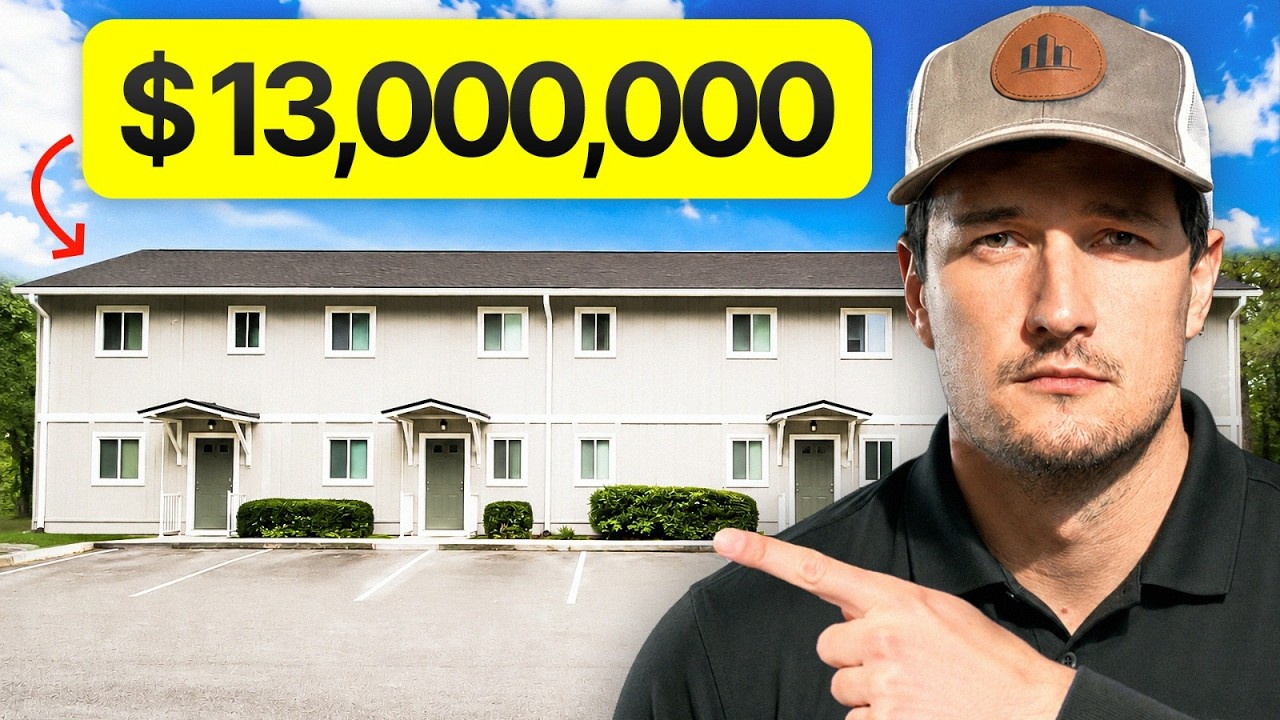
Jonathan Cronin bought a 90-unit Atlanta apartment complex for $7.2 million, a $6.6 million discount from the seller's $13.8 million investment. Day one: $6,000 monthly cash flow after debt service, plus a $170,000 acquisition fee. He projects 18 percent IRR, potentially 46 percent if sold quickly, through rent growth and expense cuts.
Chapters
All right, guys. So we just closed this 90-unit apartment complex, Canopy West, Atlanta, Georgia. $7.2 million, all in cost around $8.5 million. We're so excited. We just raised about $2.75 million for the down payment from capital partners. And so in this video, this is the first time that we have walked or been to the property at all since closing. We just closed this past week. We're going to take you on the journey, walk you through exactly how we found the deal, how we funded the deal, how We bought it for $6.6 million less than the seller had in it. So we got a $6.6 million discount on this property. We're going to walk you through how we did that and we're going to walk you through how much cash flow. What are we walking into? How much is this going to make us day 1, day 12 months, you know, whatever? And how do we make money on this deal with capital partners involved? Let's get into it. So how do we find this deal? This is a 90-unit apartment complex, and it's important to note we bought this at $6.6 million discount. There's only one way to find these types of deals, and it's not LoopNet, CREXi. Most of these newer investors, they get into this game, they go all out like, I'm going to buy apartments or I'm going to get into real estate. All the deals go to die on LoopNet, CREXi. The bigger the brochure, the worse the deal. All right. The only reason I'm going to LoopNet and CREXi is because the brokers that are represented, they more than likely have pocket listings. Okay. Pocket listings are the greatest way to get into this game. Now, If you are not also going direct to seller, you're missing out on what will eventually become probably half of your profits or half of your portfolio is direct to seller. Because what are the brokers doing? Right. The brokers are going direct to seller. You think the broker's going to another broker? No, the broker is going direct to seller. They're going off market. So if you're not going off market, this deal was found because we were able to connect with a broker and build a relationship to the point. And we had these scripts and all kind of stuff that I'd be happy to help you with if you need that. But if you understand the game, understand how to build credibility, because right now in the market it is a buyer's market. However, it is not just sellers looking for any buyer out there, right? In fact, because of the buyer's market being from— it's stimulated by loan maturity walls coming up, right? In fact, Blackstone, there's all kind of big companies out there that are Starting these huge billions, multibillion-dollar funds just to buy distressed assets from the bank, just to buy distressed debt, right? Debt that's, that's coming due. So it shows you there's a massive maturity wall that's happening. And that's the exact story with this deal. Okay. We found this deal because the seller was— bought the deal in '22, planned to refinance a few years later. They got a 3-year loan, right? Now what happened between 22 and now? Interest rates skyrocketed. Now they can't pay back the debt based on the value. So the bank's only going to lend so much based on the value of the property and based on what they can actually pay, what the NOI is going to actually support. Right. And with the high interest rates, it makes it less that they can actually loan because the DSCR has to be 1.25x the NOI. The NOI is your profit on the property. How much profit are we making? It has to be 1.25 times the debt service that you're actually going to be giving. So, that's what happened here. The seller was forced to sell because they could not refinance and the loan was coming due and the property was not going to cash flow or was not going to be able to support that debt. Now, going back to the fact that it's a buyer's market, it's really not a buyer's market, it's a credibility market because they're in a situation where they are forced to close Or they're forced to sell the property, but they can't— they still cannot afford to get into contract and it not closing. They have to move quickly. And so they are, they are getting brokers to go find a buyer that's credible. Other buyers were offering the seller $9 to $10 million and we offered $7.2 million. And because we understood how to build credibility, how to get them to trust us, how to build the confidence to close, we beat the other buyers out. So what does that mean? We bought this deal because of pocket listing. Now, that plays into the reality of how we got it for a $6.6 million loss. Point number 2 is how do you find deals at a discount? Well, first off, it's about negotiation. Second off, $6.6 million discount on this property. We bought it with cash flow day 1. So that's a big rule that you have to understand is always buy these properties cash flow day 1. How do we fund the deal? How do we get the capital in the deal? First off, if you are going to raise capital, we raised about $2.75 million on this deal. We did it in a relatively short amount of time. And the reality of this deal is it's going to make about an 18% IRR, probably a lot more if we're going to sell very quickly, which it looks like we could. But people first off are attracted to at least an 18%. It depends on who you're going after. If you're going after, you know, high net worth individuals, accredited investors, they are typically looking for north of 15 to 18% IRR or annualized rate of return, right? If they put in $100,000, you give them $180,000 back after the hold period, you're typically paying just say 8% of that upfront, right? The first few years or maybe by the time you refinance, or sometimes these deals are structured where you pay all of the 18% at the end once you sell or refinance. Typically, if you're going to raise capital like this, you first need a brand. Okay? You need to figure out what kind of properties am I going after, which I'm going to recommend you go after light to moderate value-add apartments, deals that you can increase the value, increase the rents, decrease the expenses, Right? And you structure, okay, what is my exact brand? Who am I going after? You can even get so granular in this thing, you could basically create a niche. Okay, if you're a dentist, doctor, or you're a chiropractor, whatever that is, if you're a construction worker, you own a construction business, you can create a brand around that to niche down, right? And what we say is you niche down to blow up, right? Because you've probably heard the saying, the riches are in the niches. Right? It's about the people who feel like they're being called out. You're on social media, you're sharing with people what you do. If they feel like you're talking directly to them, guess what? They're going to pay attention more. If you're just saying in general, hey, we help investors, we help investors get returns, you're talking to a broad audience, no one feels called out and no one feels like you're talking to them, they're not going to pay attention. You sound like everybody else, right? So first off, you need a brand. You need to figure out who am I in the market, who am I targeting, know exactly what you're getting into, what types deals you're going to buy. And so from there, we can— you can run ads, you can set up webinars. The most successful people I know— in fact, we just had a guy named Kevin, he set up webinars, okay? As soon as he got under contract, he's starting to set up webinars every week. And just from his first webinar, he raised about $250,000 just on one webinar on the spot, right? And so from there, he started to nurture those investors. And from that one webinar, Raised over $2.25 million, and all he needed was about $1.5 million. That's the opportunity. If you can figure out how to create your brand, your positioning in the market, and then you can get with other people, right? And here's the last thing. If you want to be able to raise that kind of money, you've got to get in a network with people that are actually doing these types of deals, that are wanting to either one, place their money and get their money working for them. Maybe they got it in a 401, IRA, they got it in the stock market. Maybe they are in single family and are tired of the single family route and want to scale into multifamily. They've got a high-paying W-2 job right now and they're looking to offset their taxes. That was a massive thing for our— for this deal right here is people offsetting their taxes and helping and this being a big tax benefit because what this deal is going to do is get bonus appreciation. So year 1, we're going to be able to write off probably 20 to 30% of the deal, right? It's probably a $7.2 million deal. We'll probably get $2 million or more after we do a cost seg study to be able to write off on taxes. And that's another positioning too. You got to get in the room with either one, people who are ready to fund deals like this, or number 2, people who are willing to actually help you raise capital. I always say commercial real estate is a team sport. Alright, if you're not in the team game, you need to get out the game. But $6.6 million, the seller was all in at $13.8 million on this deal. The seller had paid And put into this property, renovated the whole thing, got the property nice, renovated all the units. I mean, they just did the works on this deal. But because they were in a tight situation, we were able to come in, buy it at a discount with it fully renovated or mostly renovated. Okay, so that only comes if you have the ability to negotiate, you have the ability to step in, bring credibility. And insurance to close. So, what's our strategy on this deal? We are targeting a forced appreciation strategy, okay? So, we already made money day 1. Walking into this deal, we already are making money. People, like I said before, people offered $9 and $10 million for this property. We paid $7.2 million. So, we already have a buyer pool because people wanted to offer $9 and $10 million. This property actually started performing better even the last month. So there's currently on this property a 13% rent growth month over month. Plus, the seller had done all these renovations right before they had to sell. So we're already experiencing every single month the expenses are getting better with cost savings from the sewer pipeline, all kinds of different things that actually are taking place on this property. So we're already experiencing numbers that make this property worth probably $10, $11 million. So in other words, Based on our loan structure, we've got to wait 6 months before we can actually sell it, right? 6 months of marketing and then a year actually sell the property, right? If we sell it in a year at $110K a door, we bought it for $80K, that means our investors are going to get 46% IRR, right? 46%. You're not seeing that on any other deal, right? You're not seeing that in this market. That's unheard of. If you're looking at all the ads that say 50%, 30% IRR, all that kind of stuff, it's just a lie. Right. We advertise 18% because we're conservative and we actually know what we're doing. But then we come in and we always want to overdeliver, underpromise, overdeliver. That's what's key about this game. You want to be able to keep investors. You want to set expectations to get them in, but you want to rise above those expectations to make sure you keep them in. All right. You want to make sure you overdeliver so that you are retaining these investors. They want to be on here. They want to refer people to you. They want to increase their— they want to be a part of the next deal. They want to constantly stay with you for life. If you take care of these investors, you learn how to raise capital, you take care of these investors, they're going to be with you forever. And that's, that's worth its weight in gold. So we are essentially coming in here and immediately getting a $2 million equity check in a sense, right? We are walking into almost $2 million in equity just by purchasing this property. Not only that, other way we make money. How do we make money? We make money at the buy. So typically you have your general partner and your limited partner, your limited limited partner are the ones that write a check, go home and sit down and wait for the check to hit the mailbox. They don't do anything. They're the passive investor. They own about 60% of the property. They put the money in, they get around an 18% IRR. You know, just say within 3 to 4 or 5 years, we're going to probably try and reduce that if we can to just say 12 to 24 months. The general partner are the ones who are operating the deal, finding the deal like us. They're getting the loan, they're getting the down payment. They're getting the actual value-add plan together. They're doing the due diligence. They're operating the property. Earlier today, we met the property management company that is taking over this property. So, we're actually in there in the beginning every day and then eventually we'll go down to just say once a week and then eventually, you know, every other week we're checking in just making sure we're looking at the numbers. Occupancy's high, rents are good, delinquency's low. You know, we're looking at those specific numbers. But we do all the work. Now, Because of that, we typically pay ourselves what's called an acquisition fee. And I would recommend if you're going to buy apartments, you pay yourself an acquisition fee. So at closing, you get just say between 2% and 5% acquisition fee. On this deal, we're all in about $8.5 million, 2%. So about $170K we paid ourselves. Now that fee is either if you're a solo investor, that's your payment. And we typically recommend cash flow just being the cherry on top, right? Cash flow of the property in the first year, 2 years, you're just rolling that in to make it faster to get to the stabilization, to the refinance. You want to constantly reinvest until that property is at the refinance. It's stabilized, which again, stabilized just simply means it's over 90% occupied for at least 90 days and it's at market rent. So you want to do whatever you can to attack the value-add plan with the cash flow. So you're not taking cash flow out. You just take that $170K. For us, if you have— and if you have a team, we pay part of that $170K, we pay to our acquisitions director. To our team, maybe some marketing costs, whatever else, right? We use that acquisition fee to pay the initial bills and then we continue down the value-add plan and we get it to stabilize. So what's going to happen if you do the math on this specific deal? What is the actual cash we're making as we come in? First off, $170K acquisition fee is what you pay yourself at the closing table. Second off, we immediately have about $130,000 Every single month hitting the bank account. All right. This property is about 98% occupied. The rents are between $1,450 to $1,500 per month for 90 units. So that's around $130K per month. Right now, our expense ratio— this is the value-add opportunity right here. Right. It's currently about a 60% expense ratio, meaning, you know, after maintenance, after repairs, after all the utility, everything that we have for expenses on the property, trash, the office, the insurance, property management, you know, all these different things, right? 60% expense ratio. We're going to bring that down to 55%. But currently that's about 60%. So that means our NOI actually is about $52,000 per month. So currently today we're walking into an NOI, a net operating income, income minus expenses of $52,000 Per month. Okay. Now you got to take out your debt. So what is our debt on this property right now? We took out debt. It was around $5.5 million, somewhere around there. $29,000 per month is what the debt service is per month. Investors are going to get around $15,000 to $18,000 per month. So that puts us— just say cash flow is around $6,000 per month. Again, cherry on top. We're not looking at the cash flow We want to make sure it is cash flowing. We're not buying negative cash flowing, so it's not actually losing money. We just care about the value add. The real reason people get into this is because if I improve this property to another million dollars, just say $20,000 a month in the NOI, if I just add even $20,000 per month, let's do the math. 20 times 12 months divided by 0.065. That's adding $3.69 million in value just by adding $20,000 per month. So that could either be from rent increases or that could be from expense decreases. But what is the real reason people get into opportunities like this? If I take this expense ratio from 60% to 55%, if I take it down even just 5%, let's do the math. $130,000 in income times 0.05. So 5%, that's $6,500 Per month, just in decreasing expenses a little bit, times 12 months, that's $78,000 divided by a 6.5 cap rate. That means I just increased the property value $1.2 million just by decreasing 5%, taking 5% off the expenses. That's why people get into these properties. Now, if I decrease that to 55%, I can then either refinance, pay out my investors, so now I'm paying less, or I can sell the property and I'm able to, you know, obviously take that check and move that into the next deal. But then if you do that math at 55%, we're no longer cash flowing $6,000, we're cash flowing over $10,000, and we've got tax benefits, we've got over a couple million to $2-3 million in net worth and in value. That we've added. We've got all kinds of different— and then the acquisition fee. And you can do that again and again and again. It took us about 3 to 4 months to close this deal, and we can do that 5, 10 times a year and all of it compounds, right? So I hope this helps. If this made sense for you or if you have any questions, drop in the comments below. If you are looking for a network of people who will help you get into multifamily apartments, if you are looking for capital partners, if you're looking for systems to be able to attract capital partners, Repeatedly, we are building a fund right now of $100 million per year that we're raising just through ads and organic marketing, right? And we're going to be talking about exactly how to do that in the coming months. If you want to learn how to do that, if you want to get in the room with people who are scaling to thousands and thousands of units, some, some of these guys that are in our group have tens of thousands of units. If you want to get in the room with people and be able to buy deals like this, description below, I'll set up a link for you to be able to book a call with our team and we would love to connect with you. We are a faith-based group, and, uh, so if that resonates with you, we'd love to connect. But, uh, anyway, I hope this was helpful. God bless. See you soon.
More from Jonathan




NEVER Buy an Apartment Building Without Checking These 5 Things (I'm a Real Estate Attorney)





