I Own an 88-Unit Apartment Complex: Here's What It Makes Me Every Month
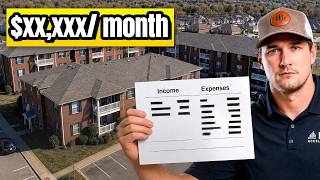
Real-estate syndicator Jonathan Cronin bought an 88-unit apartment complex for $4 million with $3.38 million in bank debt and $1.2 million from investors. The property generates $847k in annual income against $506k in expenses, and a planned $160 rent increase per unit creates $3 million in forced appreciation. Investors get an 8% preferred return plus 25% of profits, totaling a 174% cash-on-cash return over three years.
Chapters
So today I am going to break down exactly how much cash we bring in from this 88-unit apartment complex and how we bought it using capital partners to fund the deal. My name is Jonathan Cronin. Together with my partners, we have over $550 million in assets under management, and we've been able to help over 1,000 investors buy deals just like this and scale their real estate portfolio. Now, you would've asked me 7 years ago if I were to be able to buy something like this, I would think you're crazy, right? I dreamed of being able to get into deals just like this, this 88-unit. But today I am going to break down line by line income expenses. I'm going to show you exactly what it looks like for investors, what it looks like for us, and how we structure this deal to take it down using capital partners. What kind of returns can you expect from a deal like this? Let's go. So we're going to break this deal down. First off, it's an 88-unit. So let's talk about the purchase of the property. 88-unit. LIHTC property. Low Income Housing Tax Credit property. How did we find this deal? First off, before we get into all the numbers and break this thing down, we found it through a broker relationship. All right. Now, this is very critical. If you are a new investor starting out in the market, you've got to start building broker relationships. We talk about going direct to seller all the time. We've got several videos on here where we talk about how to get direct to seller. That's one avenue. But brokers have what we call pocket listings, deals that when they first come to the broker, you know, you want to be the first one that they go to. Okay. And so that's what happened here. We had a relationship with a broker that had not advertised this deal publicly. We reached out to him, he started sharing this deal with us. And so that was how we got this deal. All right. Now, again, we— you got to get off LoopNet, off CREXi, off, you know, the public advertising platforms, because once they hit the market, guys, it's, it's game over, right? It's deals that have already been passed on by probably thousands of investors. We always say the bigger the brochure, the worse the deal. All right. So let's get into it. So 88 units, we found this through a broker relationship off market, and it's a value-add opportunity. In other words, we have the ability to force appreciate this property. We have the ability to increase the NOI, increase the value of the property. And that is what's essential. We're not depending on market appreciation, right? If you were doing that when we bought this deal in 2023, you would have been in a lot of trouble, right? Because we all know the interest rates went up. Fed just got together and said, oh, inflation's going crazy. And what was it, June '22? Yeah. Said inflation's going crazy. And so they increased the interest rates, 6 caps go to 8 caps, right? And it's just wild. But let's break down. So this property was purchased for $4 million. $4 million. We bought it for $4 million. Total funding after improvement costs, after closing costs, after all of these things, total funding was $4.58 million. $4.58 million is what we got to bring to the table. This is the total funding we needed. So the debt, on this, what we got from a bank, was about $3,380,000 was the debt. All right. So let's just— I'm gonna do a breakdown of the high-level numbers, $3.38 million. And then I'll break down the exact income, the expenses, everything, the debt, all that kind of stuff. But what happens now is we have $3.38 million in debt. All right. We had to raise $1.2 million. Mm-hmm. So we raised $1.2 million from accredited investors. Raise $1.2 million plus $3.38 million. That should be $4.58 million. So we're going to— for this raise, we're going to take investors, we're going to give them 8%. So $1.2 million, 8% preferred returns. 8% pref, meaning if they put in that $1.2 million, they get 8% on that every single year in preferred returns starting year 1 for us, right? A lot of investors don't want to do that. They don't want to give out preferred returns year 1. They want to wait till the, the refinance or, you know, 2 years, 3 years from now, whenever they sell. We now have this property under contract about to sell for $7 million under contract. $7 million. So first off, I want to show you that means we're creating $3 million in forced appreciation over 3 years. So 3 years, $3 million. And this is first point I want to make, guys. When it comes to cash flow, everybody's like, what's the cash flow? How much am I putting in my pocket every month? When you're buying value-add apartments like this, the reason people flock to these types of deals, the cash flow is the cherry on top. All right, so you gotta think, I just created $3 million equity creation, equity creation, $3 million. Not too bad of a payday, right? Million dollars a year for owning this property. The other thing that we got as a credit, as the general partners, right? The operators in the deal. Once we close this deal at the closing table, we pay ourselves what's called an acquisition fee. Alright, the acquisition fee is about 2 to 5%, depends on how big the deal is. For this deal, just say 3%. That means we paid ourselves acquisition fee, $137,000. We paid ourselves. And this is the beauty of a lot of these big syndicators. They make money off of the acquisition fee because this is our fee for finding the deal, doing all the work, legwork there. Mm-hmm. Getting the deal structured, getting the deal under contract, raising the capital. And now we're going to go on and do the value-add plan, which is what I'm going to talk about here in just a second. Value-add. How did we get this property from $4 million purchase price to $7 million valuation and under contract for $7 million? How do we do that? We increase the income. But that acquisition fee— and some syndicators charge an asset management fee. They charge all kinds of different fees. We just charge this. And basically you can go in, just say it took us 3, 4 months to buy this property because typically the contract period is about that, you know, 2 to 3 months. Sometimes we get an extension. I can do this deal 3, 4, 5, 6 times in a year and you just multiply that number by 5, 6 times. All right. So that's the first way you do it. You don't want to necessarily depend on cash flow day one. Cash flow day one is important in the purchase that we know the property is healthy, it's cash flowing. We don't want to buy properties necessarily at negative cash flow unless we've got strong experience in remodeling. We've got a strong risk appetite, right? You're going to have a longer lag time. You're putting more risk on the property because it's negatively cash flowing. Not to say there's not great deals that are negatively cash flowing, but this deal, we are cash flowing day one. But what we do is we roll that in. Mm-hmm. To the, to the improvements of the property. Right. So the first 1, 2, 3 years, we're just trying to do everything we can to increase the value of the property. So we take the cash flow, we roll it in because we've taken the acquisition fee. We could do it again on as many properties as we want. But then we're in a race to get this property to that $7 million, create $3 million in in added value and added equity. So our— so if you want to play that out for our investors from a high level, when we create that $3 million, we now— when we sell this property, when we close, we are going to pay off this $1.2 million. And then if you add it up, and then we're going to pay them the equity after we pay that $1.2 million. So the investors own 25% of the deal. So that's the profit split. The GPs, the active operators, 75%. The LPs, we gave them 25% ownership of the deal or their profit split. Okay, now you say, "Man, that's pretty low for them," right? So many people, you know, there's also the exact opposite model. It depends on the deal, depends on how good it is, the market, it depends on a lot of things. But for this specific deal, 25% had them walking away with a really nice return. So this is exactly how it plays out. So what we're going to do is 8% on their $1.2 million. How much is that? 8% times $0.08. That's $96,000 in preferred returns. So returns for the LP. 96,000. Year 3 equals $96,000 times 3. So when they walk away, they will have had $288,000 in preferred returns. All right. Now, what does their 25% ownership get them? First off, we're going to pay back this $1.2 million, and then they're going to get 25% of the rest, right? So just say total funding was $4.58 million. You do your $7 million minus your $4.58 million. What is that? That's $2.42 million. So $2.42 million is after we've, we've paid off the total funding, is the total equity needed. We pay back our investors their $1.2 million and then we have $2.4 million left over. All right, so $2.4 million times 1.25, they're going to get $605,000. So that equals $605,000. See, my handwriting's not that great. $605,000 is what they now own. And at the sale, they're going to get this back. So we're going to add $605,000 plus your $1.2 million. So plus $1.2 million, plus your $288,000. Divide that by their original equity that they put in, which is $1.2 million. That's 1.74%. Right? So 174% is what they got back. Right? So 74% divided by 3 years gives us a total annualized return Of 24.67%. Where are you going to find those kind of deals, right? Investors would kill for a deal like this, especially in today's market, right? We bought this in '23 and now our investors are going to realize a 24% annualized return on their money. All right, so this is what it's all about. Now, how do we increase the value? How did we create that for our investors? How do we create $3 million? Okay, understand this: forced appreciation is the play if you, if you really want to go fast, right? And again, this is just one deal. We could be doing 10 of these deals all in just a year, 2 years, right? So all of this multiplies at that level. Value add. So what we need to do is we need to increase expenses— or increase income, and we need to decrease expenses. This particular deal was a steal. All right. So it was already over 90% occupied. So we didn't really have to do a whole lot to attract more tenants. However, We are realizing this property, and the reason we bought it was because it was $160 below market rent, meaning right down the street there's another property fixed up a little nicer. It is charging $160 more per month per unit. Right. So we increase $160 if we can fix up the property, really take care of the tenants, put better systems in place. The property— old property management company was not paying attention. The old owner, they were running it like a nonprofit. In fact, I think that was actually what it was. What we did was we just gave some love to the property, right? We adjusted a little bit in improvement costs. You see, we raised $580K or we bought the deal $580K for total funding, which, you know, that's only $580,000 that we needed to put into improvements. And then you subtract the actual closing costs, all that kind of stuff. So it didn't need a whole lot of renovations on the units and everything. It just needed better property property management operations. So that's what we did. We came in, we increased the income $160 per month per unit. We came in, we decreased expenses. We saved probably $3,000 a month on management fees. We'd, uh, there was all kinds of different things that we did, uh, vendor renegotiations, $1,500 a month in savings on that. So we did a lot there, but just say we take $160 straight to the bottom line. All right, this deal was just, say, at a 6.5 cap when we bought it. I think, uh, now it's about a 6% cap rate. So you got $160 per unit, which is 88 units. So $160 times 88 times 12 months in a year, that's $168,960 divided by 0.06. That's $2.8 million in increased value just from doing that one thing alone, much less decreasing expenses. So that's the value-add plan. And that is how we were able to generate 24.67% for our investors and increase $3 million on the purchase. Now understand, in today's market, people don't know how to get into deals like this because they are depending on market appreciation, right? They're thinking, okay, markets are going to increase. Interest rates— here's one if you hadn't heard before— interest rates are going to stay the same. Right. And so we have all these people going under because they are dependent on the interest rates, all kinds of different things, and they're not able to make it work for a refinance, for a sale. They're— the banks are taking back properties left and right right now. And we're buying deals at a loss from the seller. Right. So in fact, we just purchased a 90-unit apartment complex or it's about to close. 90 units in Atlanta, Georgia, for $6 million under what the original owner had it in, in place. Right. So he had $6 million more in the property than we're buying it for. He bought it for about $10 million. I'm creating a video on that. It should be coming out soon. $10 million. He put in another $4 million. We're buying it for about $7.2 million. So that's the opportunity, but no one knows how to operate and increase the value and make sure to depend on this more than they're depending on the market. So let's break down what are the income and expenses for this property. Let's talk about what is it actually cash flow? What does this property actually make? Make? Let's talk about it. All right. So income. Just last month, I got the T12 right here. I'm gonna go ahead and show it to you. T12, the income on the property was technically about $900,000 over the past year. So about $75,000 per month. Last month, $75,000 or— $75,000. March 2026, $75,000. And then gross collected income after, you know, your loss to lease vacancy, after, you know, the fees that you're charging, all these different things were probably actually at $847,000. So income, gross income, $847,000. Okay. Expenses. Expenses. Let's break this down. I'm not just going to breeze over this, but expenses were about $300,000 and— or $506,000. $506,000. What does that include? So first off, we have property management. So first off, our property management cost Property management was about $5,400 average per month. Then we have— so property management fees, you've got fixed fees, you've got a percent of the income. So it averaged out over this particular property for 500 $5,400. Marketing costs. So getting the— this is a very minimal expense, or at least it should be on a property like this. Marketing cost is just simply the cost for listing the property on Apartments.com, things like that. It was $545 a month. So not a big line item right there. Shouldn't be a big line item. Maintenance. Okay, so maintenance last month.— was a little bit higher, about $2,900, about $3,000. Pest control, carpet cleaning, landscaping, cleaning fees, you know, your turns, all this kind of stuff, fire and safety. Okay, it typically averages around $1,900 per month. So this is yearly, by the way. This is monthly. So maintenance— Maintenance. Is $1,900 per month. Okay, now we're moving on. We have property taxes. Okay. Property taxes. Obviously, these are property taxes are seasonal, but just say we look at it per month and you're looking at probably around $3,700 or just say $37,000 per year. So what is that per month? That's $3,000 taxes. $3K. All right. Now we have your utilities. So obviously you need to look into being able to charge back some of these utilities, but including tenant reimbursement, all this kind of stuff, we're paying about $78,000 a year. This is one of the big ticket items I see right now In fact, this 90-unit deal has a massive opportunity for decreasing utilities. But for this 88-unit property, the utilities are around $6,500 per month. All right. Now we have repairs. So repairs are one you got to keep an eye on. But repairs monthly, this includes, you know, your plumbing, HVAC, general repairs, rental turns, electrical, wind, electrical, windows, etc., etc. So $400— $4,400 per month is repairs. All right. So this is our total expenses. So $506,000, our gross income and collections. So technically, this is not gross income. This is gross collected income. $847,000. Expenses is $506,000. Now, how do we get to the bottom line? We have our debt. So how much do we pay for debt? $24,000 per month. So about $288,000. Forgive my scribbling. Hope that doesn't offend too many people. Per year. $288,000 per year is our debt. And then what are we going to pay our investors? So investors, like I said, once they exit this property now, we pay preferred returns. You know, year 1, which a lot of investors don't do that. You don't have to do that. In fact, you know, I think it's pretty normal to actually pay investors your preferred returns and you catch them up. Now, I mean, you're not just— you're not just not paying them the preferred returns year 1, year 2, year 3. If you don't pay those preferred returns, you pay them at the refinance or the sale of the property. In this case, we're selling the property. Now, if you're wondering why would we sell versus refinance, it just comes down to if somebody makes you a really good offer, you know, I forget who said it, but if somebody makes me a stupid offer, I'm going to be stupid as well. Right. So we're going to— We're going to take the offer at $7 million. But we definitely would love to hold on to the property for a while., but it just makes sense and we want to do what's, what's best for our investors first and foremost. So investors, they're 8% preferred returns. 8% pref means $96K per year. So we have our NOI and we have $280K in debt and $96K per year. Now, obviously you got to factor in again, we're not focused on cash flow so much as we are the ability to increase. So if you're not paying this, you're going to be— you're going to be having this as far as cash flow every year. But if you are paying this, you have more at the refinance or the sale, right? So more of that $3 million. Remember that $3 million net to GP. But you're the GP. If you found the deal, if you're operating the deal, whether you have 1 partner, 2 partners, 3 partners, this is net to the GPs. Okay, how much is it? So earlier we said $7 million minus your $4.58 million. You're paying back your investors, you're paying back your debt. Then we have $2.42 million and then we're going to times that by 75%. So the investors are walking away with $1.8 million. Again, using Capital Partners to fund the deal. This is what we are gaining over a 3-year period. Okay. Now, the other things we haven't talked about is going to be your tax advantages, your bonus depreciation, all the things that we were able to achieve on this property that could have been around, I believe, after cost segregation, we were probably around $1, $1.5 million that we were able to use in tax benefits. All right, so again, you add that up, you add up all the other opportunities, the acquisition fee, which I had on here earlier, the $130,000, you have the opportunity to create value and get paid well for it. You can change investors' lives and you can change the property, the community, you have the opportunity to make a lot of money, but really more than that, make a bigger impact. So This, I hope this makes sense for you. This is why we do what we do, because first off, we want to take care of our investors and we want to be able to do this again and again and again. Now, if you've been following our videos, you need to go check them out because I just broke down what is happening in today's market because it's the same type of buyer that bought a property in 2023 is also experiencing some major issues right now. There's, there's some that bought wrong, that bought with the idea that interest rates would stay the same. Right. And they didn't have enough room to be able to increase the value and actually make sense of a refinance or even a sell. So right now there's massive opportunities out there. And as long as you know how to build your brand, attract really good deals for, you know, from brokers, you know, your pocket listings and go direct to seller. If you can create strong funnels around acquiring deals, there are some opportunities. All right. We just bought a 90-unit deal, $6 million under what the seller has in it. So I hope that helps. And if you like that video, make sure to drop in the comments that this was helpful for you. If you want to know more about the tax benefits, I know that's one thing I touched on and wasn't able to go deep on. But if you want to hear more about the tax benefits, bonus appreciation, cost segregation, all that kind of stuff. Drop in the comments that you'd like to know more about the tax strategies around what, what this actually does for you as an investor, for your limited partners that are actually putting capital in the deal. Drop in the comments and we'll look at those comments and we'll make a video based on those. Okay. All right, guys. God bless. Hope this helped. Have a wonderful day.
More from Jonathan




NEVER Buy an Apartment Building Without Checking These 5 Things (I'm a Real Estate Attorney)





