Quit Your 9–5 With Real Estate? Here’s How Many Units You Need
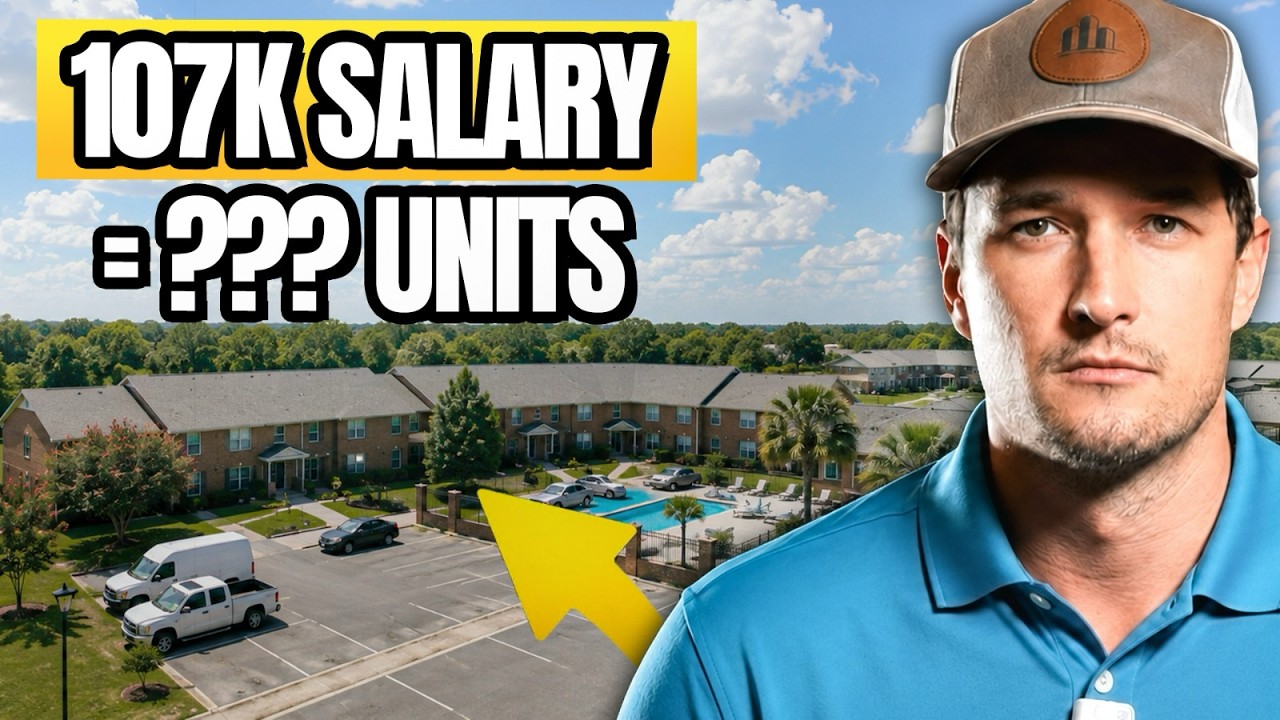
Jonathan Cronin compares two paths to replacing a $107k salary through real estate. You'd need about 20 single-family rentals and $750k in capital, or one 45-unit apartment building with $500k raised. The multifamily deal generates $254k annual cash flow after refinance and $1.4M in equity gains over two years.
Chapters
So the average American today needs about $107,000 to comfortably live. Now, depending on where you live, you know, it could be higher or lower, but that is about $8,900 per month if you break it down that you need to be able to comfortably live in America. Most people understand real estate is the best and safest investment you can make, but how many units do you actually need to be able to replace that kind of salary? If you're somebody who wants to quit your job, replace your income, You want to be able to make a bigger impact with your life, with your time, energy, and money. I want to break down for you in this video exactly how many doors you need, what strategy you should be taking to truly be able to do that, and in less than a year. For context, my company has about $550 million in assets under management, and that's spread out across a lot of different assets, but primarily multifamily. Now, we also have experience in restaurants. We have experience in self-storage or mobile home parks. We have experience in Airbnbs, assisted living facilities, all kinds of different assets. So we're going to give you the exact path you should take. In fact, I'll give you 2 or 3 potential pathways and let you decide. And then at the end, we'll tell you what we think you should do. There's a single-family home that we bought. The story is the owner, the previous owner had passed away and his heirs were just trying to get rid of it quickly. And so we bought this deal for $90,000. We put $15,000 into it and rent it for about $1,400 a month. The math— let me just break down the math for you. That's $90,000 purchase price, $15,000 we put into it. All right. So the down payment plus the renovation costs was about $37,500. Okay. The gross income, $1,400 times 12 months. Again, assuming full occupancy year round, that's $16,800. The expense ratio would probably be around 40%. Insurance, taxes, repairs and maintenance. You're looking at net income of about $10,000 per year. After the expenses. Now, if you put a mortgage on this thing, the mortgage is about $4,700 per year. So after your mortgage, you're around $5,200 a year. So that's just about $430 per month from one single-family home. So you do the math. How many of these do you need to be able to replace $107,000 a year? All right. Assuming everything goes right, right. I don't have to replace the HVAC system. I don't have to replace the hot water heater, you know, the roof. I don't have to. You know, do all these different things that you need to factor in, you know, which, which by the way, you will have to replace the roof, you will have to replace the HVAC. It's just a matter of when. So all that needs to be factored into the expenses so that you can understand what it's actually going to make you over a period of time. But just suppose everything goes right. To make $107,000, you need 20 of these single-family homes to actually achieve that. That's 20 different deals. That's 20 different locations. That's 20 different closings. That's 20 different times that you're finding a good deal. How long would it take you to actually be able to find a deal like this? And if you total all of that up, the money you're putting in, just say we do 20 identical deals, you know, $15,000 or $37,500 down payment including the renovation costs, that's about $750,000 that you're going to have to put down to be able to achieve that income amount. And if you want to do it inside of a year, if you want to be able to achieve that number inside of 1 year, it's going to take a lot of time. Right. You're going to have 2 deals. If you break that down, you'll probably have 2 deals per month that you're buying And you're renovating. So you're going to have to manage renovations for 2 deals every single month. So if you have a full-time job, probably not likely, right? You're going to have to manage those people because guess what? You're probably going to get ripped off if you don't, right? And then all of a sudden $15,000 turns into $30,000 per house. And now we're over $1 million in a down payment plus renovation costs. So that's the single-family route, right? If you were to buy a rental, it'd take 20 different deals like this. Our company has hundreds of units, hundreds of deals, and we have hundreds of single-family. We learned the hard way. So what's the next asset? What's the next pathway that may make more sense? Let's talk about it. Now, here is where smart investors are putting their time, energy, and effort, which you only have so much of. What if instead of doing 20 single-family homes or 20 units separately, you could do one deal, 40 units, right? This deal right here is a 45-unit apartment deal that we bought recently, and it was $2.4 million. We put $500,000 We raised the capital. All you need to figure out is how do I now go from funding it myself to raising the capital from investors? So let's break down the numbers. All right. So this deal gross income is about $620,000 per year. The net after expenses is $387,000. The mortgage is around $133,000. We also just paid off our investors. So that $500,000, we paid it off after the refinance. So after we bought it, we improved the property, which I'll talk about in a second. We refinanced into cheaper debt. I'll get to that as well. But But now, after debts paid, after investors paid, our cash flow that we're actually putting in our pocket is $254,000 per year. All right. $21,600 per month. Now, here's the thing. The trick is, and what we did for this property is when we first bought it, we didn't take any of the cash out. So we put all of the cash back in to try and speed up the timeframe to getting it refinanced and getting our investors paid back. With that being said, how do you actually make money year 1? If you're somebody who— I can't wait 2 years to be able to get that kind of money. First thing before I get into that. Where's the real money made in deals like this? It's not necessarily cash flow. Cash flow is great, but the real money, the reason people buy deals like this, is because we bought this deal for $2.4 million. We came in immediately and created value. So we got with the tenants, asked them what they wanted, what they needed to be able to improve the property. What did they feel like they needed? What would be helpful for them? And we added value to the community. Okay? And then we came in after making some improvements, not really that much, minor improvements to the property, and just making sure that the property management company was doing a good job. We came in and we increased the rents to market rate. So they already knew that rents were below market rate. And in fact, we have people here that have been here for 15 years or more, and they love this property. They love us. They love taking care of things. They'll pick up trash. Like, they just— they're awesome tenants. And they have obviously been a part of that rent increase, and they know that it's worth it, right? So we came in, increased the rents. And what's beautiful about multifamily— this is what you need to hear. Single-family, the value of the property is based on the comparables in the area. So what did another single-family home sell for? These properties, the value is based off the NOI. So if I decrease expenses and increase income, the net operating income becomes higher, and then it's based on the market cap rate in the area that, that values the property. I have plenty of videos on cap rate, how to value apartments. We were able to take this property from a $2.4 million purchase price, and in 2 years it was around $3.8 million. All right, $3.8 million. So 2 years, we created 1.5 times $1.4 million in equity from one deal. That is why people get into it. Not only that, they get into it because of the tax benefits. Okay, bonus depreciation. We're able to use a cost seg study and get massive tax benefits that roll into years as long as we really need it. And so that said, how do we actually get paid year one? So if you're brand new, if you have no money or you have very little money, I would focus on what's called an acquisition It is what the smart syndicators are focused on. It is, it is one of the best ways to initially get money out, get cash in the bank, and make sense of the process, right? Because we want to roll all the cash flow down the line to the refinance and to be able to get this property stabilized, over 90% occupied, and actually in a place where we can pay off investors, get agency debt, Fannie Mae, Freddie Mac, that kind of debt's cheaper money longer term. And so we go from bridge debt To then refinance and get cheaper debt on it. And so that increases our margins, our cash flow, and it allows us to pay back our investors. But the acquisition fee is what you need to be focused on. If you're a newer investor, you need cash now. This one deal, we would typically do about a 3% acquisition fee at the closing table. So as the general partner— general partner is the sponsor, the limited partner are the people putting the money in. They're the passive investors. All they do is write a check. And go sit and wait for the income, right? Wait for the returns. All right. You as the active operator, as the one that is actually doing the work, that is actually in the trenches, that are— you found the deal, you structured the deal, you got the capital, you are now implementing the value-add plan. You take an acquisition fee. So 3% to 5%, sometimes 2%, depending on how big of a deal it is. And so that 3% on $2.4 million, what is that? That's $72,000. that you would pay yourself at the closing table. So $72,000 on one deal. And again, here's the downside. The downside, I mean, you got one deal, it's 45 units, you got over 20 different deals, right? You can, you can do one deal that's 45 units and you just need to raise the capital, less money out of your own pocket. The downside of this is the fact that it may take you a little bit longer to learn the game. So there's more paperwork involved. You're doing a syndication, right? There's more— you don't have a brand, so you're going to have to really hunt for these types of deals, right? You're going to have to learn systems and processes. processes to be able to find off-market deals like this. These deals aren't just laying out in the streets, right? You got to put in the work. But whereas compared to single-family, it may take you a month to find a deal like we just talked about, $90,000, $1,400 per month rents, right? It may take you a month of solid effort. And this may take you 3 months, right? But 3 months to find one deal that does 10 times or more or 50 times the actual return of a single-family home. So it may take you more time. You're going to have to figure out systems to bring capital in, but it is the safest. It is the best possible asset for you to own. I mean, $21,000. So in summary, 2 years, $1.4 million plus your tax benefits plus your $72,000. So you take that $72,000 and you go do it again, right? Say it takes you 6 months to close that first deal. Most of our mastermind members, that's about what it takes, about 6 months to close their first deal. Some have done it sooner, some have— we have one guy, Steven, he closed a 51-unit deal within 4 months. But just say it takes you a couple months to learn, a couple months to really find that deal, and then 3, 4 months to actually close, because these properties take a little longer in the contract period. Just say it's 30-day due diligence, 30 days to close, so 60 to— sometimes there's an extension, so it could be even 90 days. To actually close one of these things, one of these apartment deals. But in summary, $1.4 million in equity growth in 2 years. Not too bad, right? But in, in the initial 6 months, $72,000. And now you have a brand, you have a presence, you have a system that is bringing you more deals. You have credibility in the market because you've done a deal. You have the investor attraction system down because you just raised capital. Now you have a bunch of people sitting on the sidelines saying, hey, Maybe not this deal, but next deal. And then you do 2 or 3 of these things in 1 year. So if you compare the differences in the single-family route versus this, now I'm not having to go chase, go travel around all over the city to go look at 20 different single-family homes and make sure they're, you know, I'm checking in on the property or whatever it is. I have 1 property with 45 units. All right. 1 property, 1 roof, or actually about 8 roofs here. I mean, either way, it's all in 1 place, right? And if I have a vacancy here, guess what? I'm still paying the mortgage. I still have all my other tenants paying the bills. They're still paying me, right? If I have a single-family home, you're either vacant or you're occupied, right? It's either you have somebody in there. If you lose somebody, you have no income. You're not paying the bills. You could wipe out so much of your cash flow, right? So it's way more efficient. It's way better upside opportunity, and that's the big deal, guys. The NOI drives the value. That's what you got to get— understand. That's why you need to be in multifamily deals, guys. So You know, way better tax benefits, way safer. Investors want to be a part of these deals. So if you're optimizing, if you're a new investor and you're optimizing for leveraging your time, energy, and effort, and especially money, right, you have to figure out how to raise capital, how to bring other partners on, right? Because now I'm able to do 45 units without spending any of my own money. However, you also have to understand what's in it for the investor. So if you can figure that out, because these investors right here made about 30% annualized return within 2 years. 30% annualized return in 2 years, right? That's, that's so, so we're also blessing investors. We're also helping investors. If you can figure out how to make it a win-win for your investors and you, it's gonna change the game, right? You're gonna be able to level up. Fix and flips, Airbnb, small deals, single-family rentals, all these different things. Wait, I just talked to one of our mastermind members today. He went from 0 to 54 units in 6 months. Never done a deal like this before, never raised capital before, and on his first raise raised $2.4 million, which was actually $700,000 more than he even needed, right? He overraised his deal, which is important. And now he's able to scale infinitely. He's over 200 units after another 6 months, right? So that is the power of leveling up your knowledge, right? Leveling up— if there's one thing that keeps people back, and it's not money, it's not time, it's not experience, it's knowledge, right? It's confidence, really. And competence equals confidence, right? So how do you get competence? You get in the room with people that are doing deals like this. So if you want to learn more about how you can participate and how you get in deals like this and be able to level up your real estate portfolio, stop wasting time in the trap of single-family, stop wasting time in all these other active investment opportunities— if you want to learn how to do that, you can only get in the room with people that are thinking bigger than you for so long before you start thinking bigger, right? You can only get in the room with people that are doing big deals from nothing, from where you are at, before you're like, man, there's no difference between me and him. That's exactly what happened with me with my partner Larry. My partner Larry donated a house to our ministry, and I was able to get in the room with him, seeing him take down these big deals while I'm chasing these small deals, right? And I'm like, man, there's no difference between me and him. He's just thinking bigger. He's, he's at a bigger level. They say there's a big saying, You, you work with dollars, you make dollars, right? You work with thousands, you make thousands. You work with millions, you make millions, right? So you can't play small and expect big returns or expect to go faster than most people, right? So if you want to learn how to do it, I'd love to, uh, connect with you. Book a call with our team. I'll drop a link in the description. We'd love to map out a plan for you and get you the exact strategy that we would recommend if we were in your shoes. We also have a big 4-day apartment launch challenge, right? So if you want to get in the room In the next few weeks, I believe August 24th through the 27th, we are going to be at a ministry headquarters. One of the ones that I was leading and helping grow 5-10 years ago, and we're going to be there and we're going to be partnering together for 4 days, all day, every day. We're partnering up in the room. We're finding deals. I'm calling brokers and sellers on your behalf. We're talking through the underwriting, how to assess deals like this. How much can you pay when you find a deal like this? And then we're actually raising capital in the room. If you want to be a part of that, I'd love to see you there. Book a call with our team and let them walk you through that, and they can even get you registered for that. And then yeah, we have so many different things coming up. We're also doing a capital raising masterclass. We'd love to just shoot you that. It's completely free. So if you want to be a part of that, let us know. If you want to raise capital, if you want to learn how to attract investors in today's market, we'd love to connect with you. So all right guys, God bless. I hope this was helpful.
More from Jonathan




NEVER Buy an Apartment Building Without Checking These 5 Things (I'm a Real Estate Attorney)





