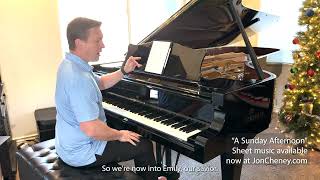
In this solo piano walkthrough, the creator introduces the medley "Come Follow Me" / "In Humility Our Savior" from his piano book and the ten‑year‑old album A Sunday Afternoon. He demonstrates the piece while offering practical performance and compositional advice aimed at intermediate to intermediate‑advanced pianists. The discussion covers how to structure the piece for listeners—starting simply, adding complexity, and using dynamic contrast (loud/soft, fast/slow) to heighten emotional impact. He highlights a syncopated section that requires precise left‑hand execution, explains the importance of contrast and phrasing, and encourages listeners to reference the recorded album for reference. The overall tone is instructional and encouraging, emphasizing that the piece is accessible yet offers room for expressive nuance.
Chapters
Okay, this song is called "Come Follow Me." It's from my new piano book, "A Sunday Afternoon," from an album that's 10 years old. The first song I did in here is called "Come Follow Me" slash "In Humility Our Savior." It's just a medley of these two songs. Very simple. A lot of these songs are intermediate to maybe a couple intermediate-advanced pieces, like, you know, moments in there. It's not terribly difficult. It's not really difficult. Most people should be able to sit down and work through it. This will be great. So I'm going to not just play through it, I'm going to talk through it and, you know, talk about things that maybe— maybe ways you can play it to make it prettier. So you can also listen to the album. A Sunday Afternoon is available on all streaming platforms, so you can hear how I play it there as well. So, um, I really like establishing a song before I get crazy into it. I I think it's easier for the listener if you're performing this in like Sacramento or something, or even just playing it at home, right? People start listening and say, oh, okay, I know the song, right? You don't have to get right into it and just start going crazy. I like to develop it so it starts simple, it's a little bit harder, and then we go to the next section. Again, none of this is really, really hard. It's just a little bit more complex and a few more frills here and there. Okay, that part's really fun. So we're now into In Humility Our Savior, a couple verses in, and we're almost done. Couple pages left and then we're done here. But this part has a fun just kind of syncopation part. It sounds pretty easy as I play it for you, but it takes just a second to get it right. Really focus on getting that left hand right. So something I do here that I do a lot when I'm trying— again, when I'm writing these songs, I really am trying to help maximize the impact, the emotional impact of the song. And so switching out of fast to slow, loud to soft, and back and forth, those switches, if you do them right, are very powerful and it hits people really hard. And so I back off, you know, we did this kind of syncopated part. Kind of fun. And then really simple. And then some high. So now we're going to move back to growing a little bit to get kind of a, a amount last verse. So, um, you heard how the impact of that, that this, those big deep notes and kind of the louder— it's still reverent, right? But just more powerful. It's more powerful because of the contrast. All right, so if you're a composer or whatever, you're working on this, on, on writing music, that contrast is so powerful in really pulling emotion out of your audience. So, um, all right, that's it. That's it for that one. On to the next song.