Grandpa Cheney's Medley - Walkthrough from A Sunday Afternoon Album
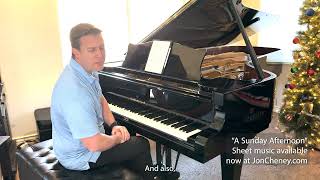
Pianist Jon Cheney walks through his piece "Grandpa Cheney's Medley," a funeral tribute that weaves together three hymns with a recurring riff. He breaks down the structure, hand positions, pedal timing, and how to convey reverence and comfort when playing it.
Chapters
Okay, the next song in A Sunday Afternoon in the New Piano Book is called Grandpa Cheney's Medley. This is my dad's dad, and I wrote this for his funeral and played it at his funeral. It is, it's a mix of really 4 songs, but I say 3 songs on here: Oh My Father, Love at Home, and God Be With You Till We Meet Again. And these were, you know, songs that he liked, and obviously honoring a father Love at Home, Family, and then God Be with You Till We Meet Again. So it's a fairly obvious way to mix the songs, to mix for losing a father, for my aunts and uncles and my dad. But this song, I probably wrote it a few years before I published this album, and this is absolutely the hardest song in the book. It's a 1, 2, 3, 4, 5, 6 7-page song, and that has "High on the Mountaintop" at the end. Grandpuccini loved that song, and he would sing it. There's kind of an inside joke there that we'll keep inside, but, um, but I quoted it at the end, and you'll see that. So, um, bottom line is this song is— it's really fun. I, I like to build songs around some sort of riff, right? In this one, it's That continues throughout the whole song, and it's a really good way if you're writing music, you're coming up with like a hymn arrangement or something you want to do for sacrament meeting or a special performance, or maybe you want to record your own music, that's great. If you create just something that just works in between, it starts as an intro, it's a segue, you can change keys with it, It's kind of a fun way to compose music. So anyway, I won't talk too much about that. I'm going to play through this. I guarantee you I'm going to stop a couple times. I may even stop and redo something a time or two if I don't play it as well as I like, because there are a couple spots that you need to kind of get right. I'm going to talk through it. One of them is right here in the beginning in "Oh My Father." It has kind of a move you got to go for it, and it's hard to hit right. But here we go. Okay, so that's "Oh My Father." It's the beginning of a song, and so I don't want to get big. I don't want to get too— I could do that at the end of the song. Maybe. But at the beginning of the song, when you're still introing it, you got to be quiet. But you still— I really like playing fast and quiet. I think it's fun. And so this one has a few, a few just kind of arpeggios and patterns on the bottom hand that aren't too bad. The thing that's tough on this one is this, um, right here. If you're practicing this song and trying to get ready for performance, I guarantee that's the spot that's going to trip you up. But it's a great, great practice. All I'm doing here is a C and an E, and then I go do the same thing, and then a C and a G. It's just taking, taking the spread out kind of triads without the middle note and just going down. Those are— that's a great exercise to do just as a pianist, the triads. And then you can take out the triad, the middle, the middle note, try the third. I was going to say the tritone. It's not tritone. This is a tritone. We're not using those here. But, and then, and then the next one, same thing with the, with the G chord. The reason why it's a little bit difficult is because your hand actually has to change shape just a little bit as you go down that. It's a 6th and then a 5th and then a 6th and then a 6th. So you go back and forth between that 5th and 6th, and you got to do it just at the right time. And then same thing here, we start at a 6th, go to a 6th, go to a 5th, and back to a 6th, right? So Good luck practicing that one. So it's easy to get bored in a song when you're listening. Even playing, um, if it does the same thing over and over again. Some really easy arrangements do that, right? They're just— that's fine, pure beginner. As you start to get better, move into intermediate, and then start to get into advanced, you're going to switch things up a little bit more. You don't want to switch them up too much, otherwise you're just going to lose the listener. But I kind of do that here on the left hand. The pattern is different on every single, like, one It's kind of an interesting pattern, and then the left hand treats that pattern differently every time, and it's syncopated on the top along with that. So this is just kind of It might sound relatively simple, but it might take you a time or two to get it right, and that's okay. And also, nobody will know if you're playing it or performing it if you don't get it exactly right, I will know, you will know, but it won't matter. So I do this every time I play Love at Home. Whenever I hit that, no matter what arrangement I'm playing it in, if I'm just playing in church or playing it whenever I always add the 10th below it, which is the A and the B with— anyway, I do that here. You can find that pattern in all of my songs that have this, and I have a few medleys that have this song in it anyway. No, let's play that better. Okay, so I love this song. This, you know, I talked about these, these kind of riffs and things that tie things together. So I played at the beginning, I played it in between on My Father and Love at Home, and now I'm doing this fun just kind of break section. We'll call it a bridge, kind of a bridge that's bridging two things together, right? And I just like it. Enjoy it. And then there's one part here, there's actually a melody in there kind of for one moment, and it's written, it's kind of, you know, you can see some little marks on it that show to emphasize these notes, uh, 1, 2, 3, 4, 5, 6, 7, about 8 measures in. So anyway, I'll play this. Okay, I'm going to come back to that. You've just done this nice big section, right? Remember I talked about earlier how repetition gets a little bit boring? And so I, I don't think people will be bored during this section, but as soon as they've heard it, right, if I went on for another, you know, 16 or 32 bars, you know, playing similar things right there because it was kind of fun to get in the groove of this thing, I'd lose the listener for sure. But I— now I'm going to hold that all the way out and clear, clear the pedal right as I hit that. And we're back to— we're into a new song, right? God Be With You Till We Meet Again. At a funeral, God Be With You Till We Meet Again, that's the, that's the gut punch song that's going Everyone's gonna be crying as they try to sing through this song because they're thinking about their loved one that they're not gonna see for a while. And that's tough. That's tough to deal with. And so think about them as you play this song. You might even cry while you play it. I'm almost crying right now just talking about it. But if you do it right, don't take away from that moment just because you happen to have the spotlight at the moment. That moment is this moment is about them. And that's part of what this part of the song is for. It lets them just think about that by just doing a single note. Everyone's just thinking, God be with you till we meet again. Stay out of their way. That's why these are open chords. Let them think about it, then jump into the big section and really hit it. So you've gone big for a second. Now back away again. Then finish your song. By the way, this will be comforting to them. They've heard this already 2 or 3 times, and now they're coming back to it, and they're like, oh, this ties it all together. Oh, I just feel good. And it brings it all together. Very pretty, very appropriate for a farewell. They're going on— your parents are going on a mission or going off somewhere. Um, obviously at a funeral, this is very powerful. I hope to hear many stories in the comments or others about people that you care about, or maybe if you get the opportunity to play this, please share your story about what people think and how you made them feel. When you're playing the piano, your goal, or at least my goal usually, is to touch somebody out there in the audience and help them feel something, help them feel something that they don't normally feel out there in the world. So, so that's that, Gran Puccini's Medley. I hope you enjoy it. Let me know if you have any questions in the comments.










