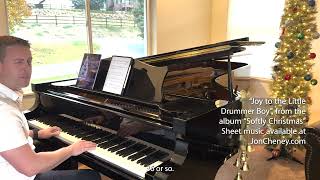
In this video Jon Cheney walks through his original piano arrangement titled “Joy to the Little Drummer Boy,” which fuses the melodies of “Joy to the World,” “A Little Drummer Boy,” and snippets of other Christmas hymns. He begins by situating the piece within his Softly Christmas album and explains the overall mood—soft, grounded sections that swell into larger, more dramatic passages. Cheney then details the structural layout: starting in the key of C, moving up an octave, inserting quoted motifs from “Joy to the World,” “O Come, All Ye Faithful,” and “Hark! The Herald Angels Sing,” and using a brief F♯ modulation before shifting to G and its relative minor E minor to facilitate a smooth return to C. He highlights specific performance challenges—filler notes, trills, a two‑octave C run, a big jump back to the tonic, and precise timing on beats—offering practical tips for mastering them. Throughout, he stresses dynamic contrast (big, resonant sections followed by quiet, reverent passages) and encourages pianists to make interpretive choices that enhance audience impact, especially in a church setting where the piece is less commonly performed. The walkthrough ends with a reminder that the arrangement is meant to be both technically engaging and emotionally moving.
Chapters
Hey, this song is called "Joy to the Little Drummer Boy," part of the Softly Christmas album. I have it on digital, which is how I like to play, and then of course if you want a, you know, traditional piano book, you can do that too. This song— so Softly Christmas is made up of a bunch of soft songs, soft Christmas songs, and this one is no different in the beginning at least. We do get a spot where we get to be a little bit bigger in here but it's still, it's big and then it comes right back down, right? And it's just supposed to keep you kind of grounded and really good. I like, I love the song Joy to the Little Drummer Boy and the lyrics, and we can talk about those another time. But, but you know, this is about giving a gift. I don't have anything else to give except my little drum. So I'm going to play this for you. So let me talk you through this and show you, just, I'll talk through some of the things and what I was thinking about as I wrote it. And how you can play it. Okay, so this one has a lot of filler notes in it. Going to make sure you pull out that, and all this other stuff just kind of fades into the background. Okay. Okay, so we've basically played through the first kind of main, uh, verse, and we're still nice and calm. Now we're going to move up to, um, the next octave up. We're going to play that. We're going to start embellishing it a little bit and kind of foreshadowing what's about to 'Come,' where we jump over to 'Joy to the World' here in a second. So we're going to start quoting a couple things, and actually we're quoting a couple things. We're going to quote 'Joy to the World,' we're going to quote 'O Come, All Ye Faithful,' and some different things. So you'll hear that as I play it. This is where it gets really fun in this song. So here we go. Okay, so you heard the Joy to the World, did that twice. Now we're going to switch over. So what I do here is I, is I kind of suspend you on this G chord that almost feels like I stay there too long, and then it resolves, and it feels good when it resolves. But we switch over to a whole other song, right? Sorry, my bad, my bad, right? The Herald Angels Sing, we quote another song there. Oh my gosh, I keep messing up here. I'm sorry, um, I'm looking at this F sharp and I'm talking through it and it's messing me up. I'm, I'm adding an F sharp. The song is in the key of C, but we throw in an F sharp right there and kind of modulate up to this other, um, anyway, we add, we switch over to the key of G, right? So, um, But then we jump right back into an E minor, which is the relative minor to G, but also happens to have the same— it's easier to get back to a C from there. So anyway, here we go. So that part, that whole section sounds really, really nice when you play it together, and I messed it up a little bit by hitting the couple wrong notes and by talking through it. And so I'm going to go back, I'm going to play that section, and then I'm going to drive right into the big section, which is just— right, we're going to have a big run. This is where you get to kind of open it up a little bit. All right, but I'm going to play through that whole section together so you can hear what it's like. So here's the second verse. Okay, so we're going to talk through that section a little bit. Um, you can be as big as you want. Um, It's really not that hard once you practice it. It's a C run, C to C, 2 octaves. You hit a C right at the top. I do this a lot in my music, um, some triplets in there and stuff. It's really fun. Practice get it right. Make sure you hit that, um, that, um, rest there. Pretty easy. So you're supposed to get a good trill. That's about what I want it to be. Maybe 6 or so. And then you— but you have— this is really hard to get right on time because you do a big jump. That's actually not that hard. It's just Then you're going to get right back to that C, all on time. Um, if you get to this D late and you're trying to get back to that, so you're going to, you're going to struggle getting there, right? You got to make sure you hit that D on beat 4, right? 1, 2, 3, 4. I even missed that time. 1, 2, 3, 4, right on 4. Okay, then we bring it back to the softly Christmas feel. We go really quiet after we've gone really big, right? Fade down. So I want to talk about this. Some people struggle with playing really slow parts like this because like, it's boring. And then what they'll do is they'll, they'll say, oh, I'm just going to fill this in, right? So I'm coming down So they'll just kind of start making that, and that's fine. You can do whatever you want. Music is a choice. But the point here is to provide major contrast. You're really big, and all of a sudden you're just going I promise you that when you play this for an audience, they will feel that difference if you give them room to breathe. Part of it is you just put a lot of notes. It's busy, and people want to just be like, "I just want to hear some notes." Just give them the melody. Let them fill in the rest. Right, okay, so then, then we bring it back up a little bit. I can't stress enough how important it is to be able to hit these notes softly, also moving fast, right? This song does really, really well in a good church setting. The Drummer Boy is not one that's sung a lot in church, right? It is sometimes, right? I've heard it before, but it's less played. And this kind of turns it into a way that makes it very reverent, very moving, and you'll really enjoy this So that one's called "Joy to the Little Drummer Boy," combining "Joy to the World" and "A Little Drummer Boy." Hope you enjoyed that.